
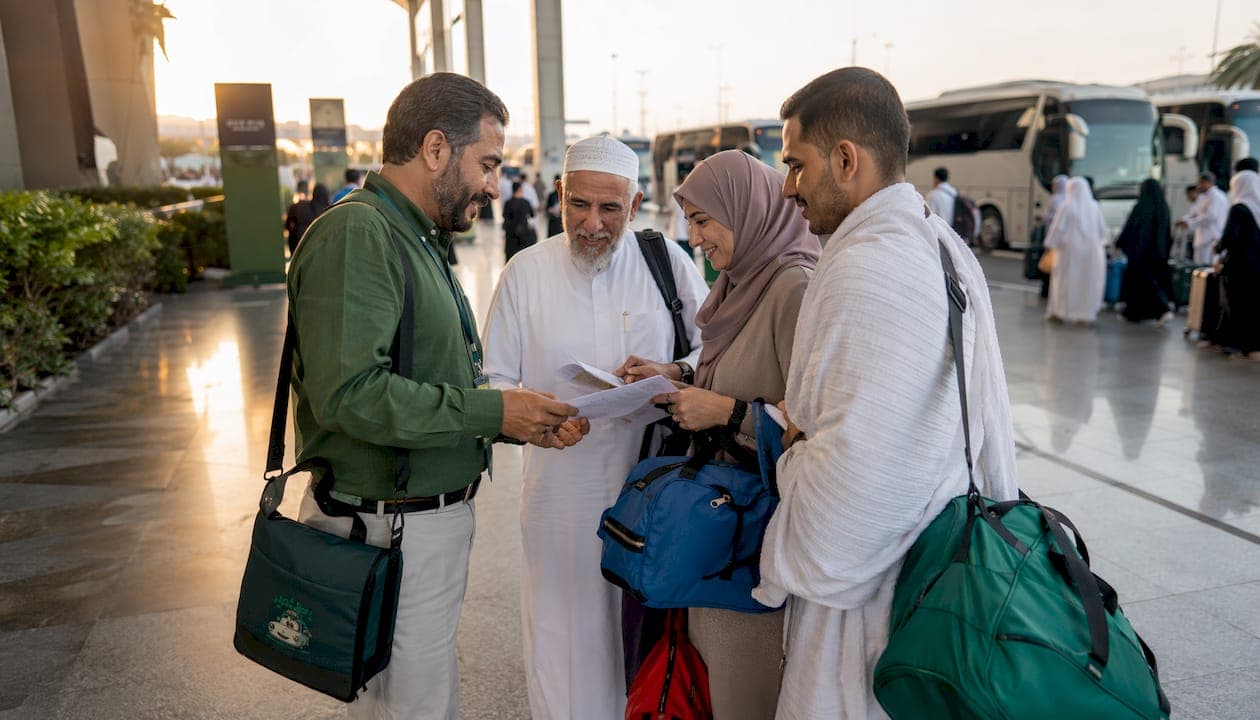
A seamless guest liaison owns every step of a pilgrim's transfer, from the moment a booking is confirmed to the final drop-off, with three outcomes that matter most: punctuality, cultural sensitivity, and real-time certainty. Before departure, pilgrims should receive a driver photo and vehicle details. Response time to any inquiry should be under 5 minutes to ensure prompt service.
- Driver photo and vehicle plate sent before every trip
- Initial response under 5 minutes for all inquiries
- Real-time tracking link active from pickup to destination
Table of Contents
- What does a seamless guest liaison actually do at each stage?
- Why this role matters more for pilgrimage than any other travel
- What technology and response standards should you expect in 2026?
- Pre-booking checklist: what to confirm before you pay
- How to evaluate a provider's guest liaison service
- How Saudisayyah implements guest liaison for pilgrims
- What timing should pilgrims expect for transfers and punctuality?
- Key Takeaways
- Why liaison quality defines the pilgrimage experience
- Saudisayyah: premium pilgrimage transfers with full liaison support
- Useful sources
What does a seamless guest liaison actually do at each stage?
The role covers five distinct stages, each with specific tasks.
Booking stage. Confirm group size, luggage volume, and ritual timing requirements. Verify pickup locations and note any visa or entry conditions that affect routing.
Pre-trip. Send a pre-trip message with the driver's photo, vehicle plate number, pickup point, and a live tracking link. Confirm any special religious requests, including prayer stops and timing windows. Proactive pre-arrival messaging that includes booking-specific details prevents pilgrims from having to ask for routine information.
Meet and greet. Assigned staff at the airport or station assist with luggage, escort pilgrims to the vehicle, and provide a culturally appropriate greeting. Language support is available for non-Arabic speakers.
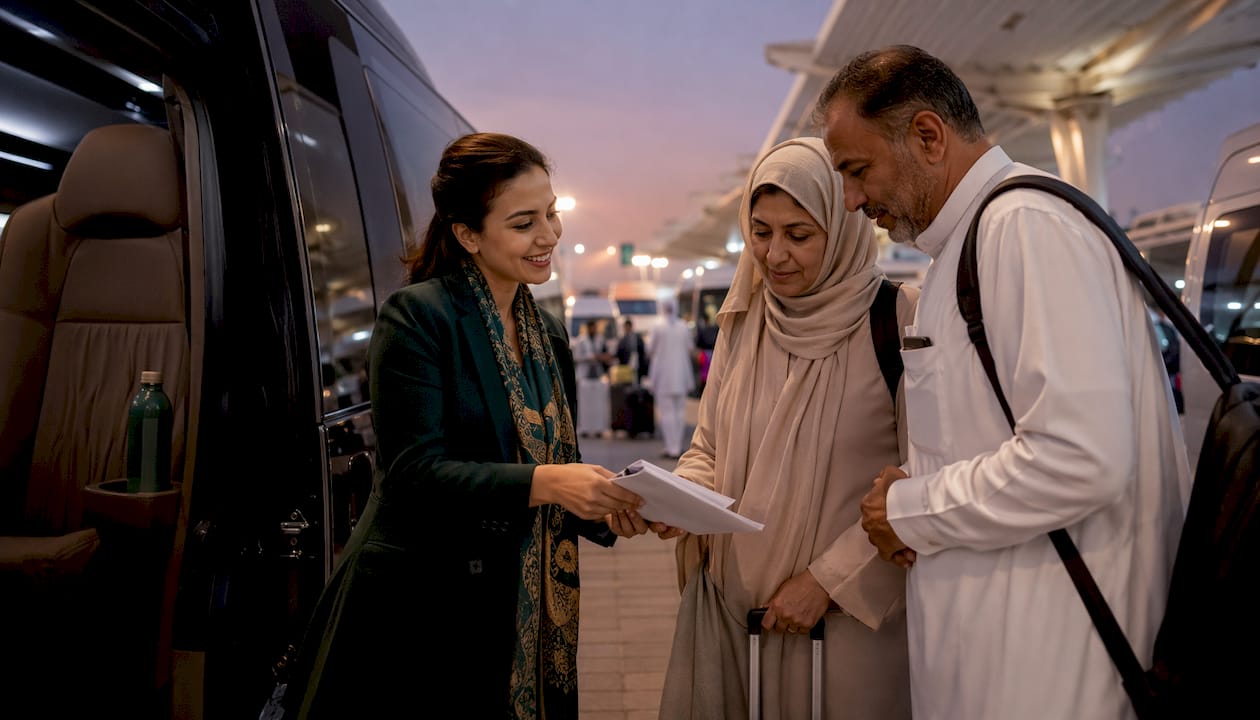
In-trip monitoring. Real-time tracking runs throughout the transfer. ETA updates go out proactively. If crowding near holy sites or a ritual timing conflict arises, alternate routing is activated and the pilgrim is notified. An escalation path for delays is documented and staffed.
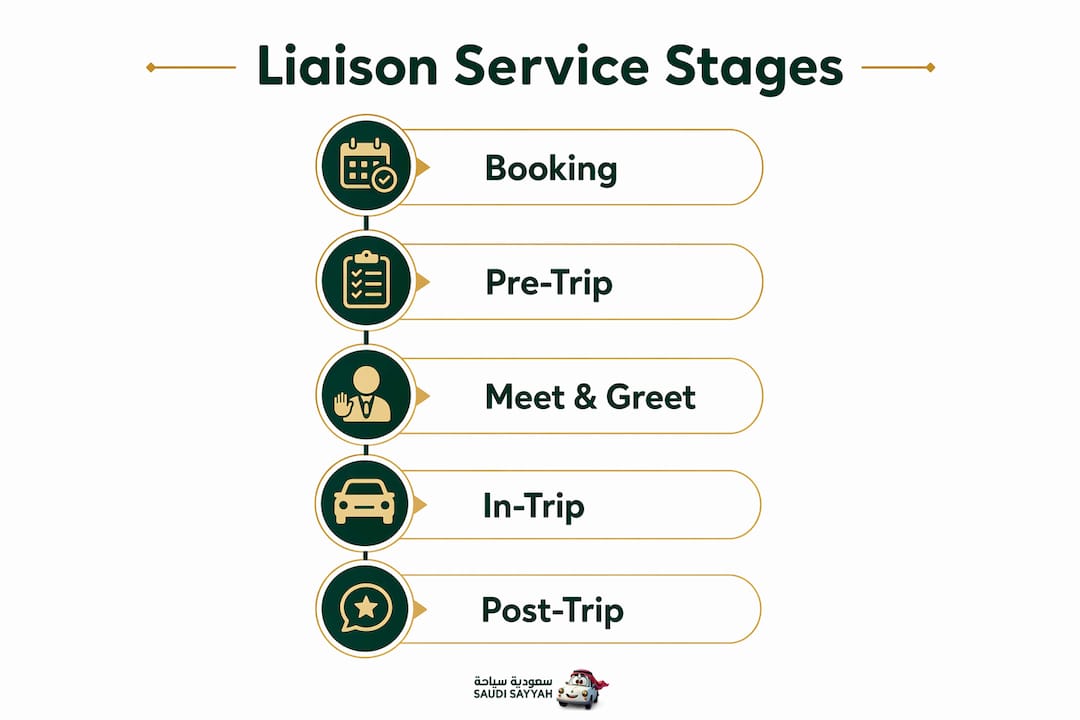
Post-trip. A feedback request goes out within 24 hours. Any incident is resolved and recorded. Notes from the trip are stored for repeat bookings, so returning pilgrims receive personalized travel assistance without repeating their preferences.
Pro Tip: Ask your provider whether post-trip notes carry over to future bookings. A provider that remembers your prayer-stop preferences from a previous Umrah trip is operating at a different level than one that starts fresh every time.
Why this role matters more for pilgrimage than any other travel
Guest liaison is a strategic function that differentiates providers by anticipating needs before pilgrims ask. For religious travel, the stakes are higher than a missed connection. A delayed transfer can mean a missed Tawaf window or a separated group at the Haram.
Proactive liaison work reduces that risk directly. When a flight lands late, a liaison who already has the updated arrival time can reassign a driver and reroute before the pilgrim reaches baggage claim. For first-time visitors and older travelers, that kind of anticipation removes the cognitive load of logistics entirely, freeing attention for the spiritual purpose of the trip.
A pilgrim who is not worried about whether the car will arrive is a pilgrim who can focus on prayer. That is the practical outcome of effective guest relationship management: fewer logistics decisions, more presence.
The role of hospitality in pilgrimage extends beyond comfort. It directly affects whether a pilgrim completes rituals on schedule. Liaison quality and ritual completion are linked.
What technology and response standards should you expect in 2026?
Initial response under 5 minutes is the 2026 industry standard for competitive transportation services. Automation handles routine queries; human agents handle exceptions.
The technology stack behind that standard has three components.
| Component | Function | What to confirm |
|---|---|---|
| Geolocation + real-time tracking | Live vehicle position visible to pilgrim | Tracking link sent before pickup |
| Integrated booking system | Triggers automated messages from booking data | No manual reminders; automation-driven |
| Dynamic personalized messaging | Driver photo, plate number, name in every message | Personalization confirmed at booking |
Automation in travel works best when the booking platform, messaging system, and fleet telematics are connected. When those systems are integrated, automated triggers fire from actual booking data rather than manual reminders, which eliminates the most common source of errors: a staff member forgetting to send a pre-trip message.
24/7 multilingual support and documented escalation protocols are non-optional for pilgrimage transfers. Pickup-window policy and typical transfer durations should be stated in writing before booking. For pilgrimage services, messaging priority is reliability and timing, not upgrade offers.
Pre-booking checklist: what to confirm before you pay
| Item | Sample question | Acceptable answer |
|---|---|---|
| Driver photo | "Will I receive a photo before pickup?" | Yes, sent automatically |
| Vehicle model and plate | "Which vehicle and plate number?" | Specific model and plate confirmed |
| 24/7 support contact | "Who do I call at 2 AM if there's a problem?" | Dedicated number, not a general inbox |
| Real-time tracking link | "Will I have a live tracking link?" | Yes, active from dispatch |
| Pickup window | "How early will the driver arrive?" | Stated window |
| Cancellation and refund terms | "What is the refund policy if my flight changes?" | Written policy, specific timeframe |
| Prayer-stop accommodations | "Can we stop for Salah during the transfer?" | Confirmed, with timing flexibility |
| Luggage policy | "Is there a limit on bags or weight?" | Specific limit or "no restriction" |
- Ask for the driver photo policy in writing before paying a deposit.
- Confirm the 24/7 support number is staffed, not a voicemail.
- Verify the tracking link is live, not a static map.
- Get the cancellation terms in writing, including the refund window for flight delays.
- Confirm prayer-stop flexibility if your transfer exceeds 90 minutes.
For group pilgrimage travel, add a question about escalation protocols when the group is split across multiple vehicles.
How to evaluate a provider's guest liaison service
| Criterion | Score 1 (weak) | Score 3 (acceptable) | Score 5 (strong) |
|---|---|---|---|
| Responsiveness | Hours to reply | — | Under 5 minutes, automated + human |
| Tracking technology | No tracking | Basic GPS share | Live link with ETA updates |
| Driver professionalism | No pre-trip info | Name only | Photo, plate, and contact number |
| Fleet condition | Age unknown | Stated model year | Latest model, documented features |
| 24/7 support | Business hours only | Extended hours | Round-the-clock, multilingual |
| Pricing clarity | Fees unclear | Base price stated | Full breakdown, cancellation terms written |
Red flags to avoid:
- No driver photo sent before pickup
- No tracking link provided
- Pickup policy described as "approximately" with no stated window
- Support available only during business hours
- Fees listed as "subject to change" without a written quote
Solo pilgrims can weight responsiveness and driver professionalism most heavily. Group bookings need stronger scores on escalation protocols and fleet capacity. Optimizing group transport for pilgrimages requires a provider who can coordinate multiple vehicles under a single liaison contact.
How Saudisayyah implements guest liaison for pilgrims
Saudisayyah's platform matches every trust signal pilgrims should require:
- Automated international-standard booking system that triggers pre-trip messages from booking data, not manual staff reminders
- Geolocation-enabled platform that sends driver photo, vehicle details, and a live tracking link before every pickup
- Modern fleet of latest-model vehicles with advanced safety features, documented on the fleet page
- 24/7 multilingual support with documented escalation protocols for delays and emergencies
- Airport meet-and-greet with luggage assistance and escort to the vehicle
- Timed transfers for rituals, with prayer-stop accommodations built into the booking process
- Proactive communication that eliminates surprises for first-time visitors to the holy lands
The guest experience standards that drive Saudisayyah's approach treat liaison work as a continuous function, not a one-time check-in. Driver photos and vehicle details go out automatically. Tracking is live. Support is available at any hour.
What timing should pilgrims expect for transfers and punctuality?
Booking lead time of at least 48 hours is standard for airport transfers in Saudi Arabia. For Hajj season, booking well in advance is strongly recommended given demand at Jeddah's King Abdulaziz International Airport and Madinah's Prince Mohammed bin Abdulaziz Airport.
Pickup windows for airport arrivals should include arrival before the confirmed arrival time so the driver can be waiting at the arrivals hall. For hotel-to-site transfers, drivers arrive at the stated pickup time, not a window. Multi-city pilgrim trips require tighter scheduling, with transfer durations between Makkah and Madinah running approximately 4–5 hours by road.
Typical transfer durations: airport to Makkah hotels runs 45–60 minutes from Jeddah under normal traffic. Transfers during peak Hajj periods may take longer due to road controls near the Haram. A provider with real-time routing capability adjusts for those conditions without waiting for the pilgrim to ask.
Key Takeaways
A seamless guest liaison reduces pilgrimage risk by owning every logistics decision from booking to drop-off, so pilgrims focus on worship rather than coordination.
| Point | Details |
|---|---|
| Response time standard | Providers should reply to inquiries in under 5 minutes; automation handles routine queries, humans handle exceptions. |
| Pre-trip confirmation | Insist on a driver photo, vehicle plate, and live tracking link before every pickup, sent automatically. |
| Checklist before booking | Confirm 24/7 support, written cancellation terms, and prayer-stop flexibility in writing before paying. |
| Timing expectations | Book airport transfers at least 48 hours ahead; 7–14 days during Hajj season to secure availability. |
| Saudisayyah | Provides automated pre-trip driver details, live tracking, modern fleet, and 24/7 multilingual support for Umrah and Hajj transfers. |
Why liaison quality defines the pilgrimage experience
The gap between a good transport provider and a genuine guest liaison is not vehicle quality. It is whether the provider anticipates problems before the pilgrim encounters them. Most transport failures during pilgrimage, including missed pickups, wrong terminals, and delayed reroutes, happen because no one owned the communication between booking and arrival. A liaison closes that gap by design.
The conventional wisdom is that technology solves this. It does not, on its own. Automation must enhance human engagement, not replace it. A driver photo sent automatically is useful. A human agent who calls when a flight lands two hours late is what converts a stressful arrival into a calm one. Pilgrims, especially first-time visitors, need both.
Saudisayyah: premium pilgrimage transfers with full liaison support
Pilgrims who want confirmed driver details, live tracking, and 24/7 support before they land in Saudi Arabia can book directly through Saudisayyah's services page. The booking system is fully automated and internationally compliant, so confirmation and pre-trip details go out without manual follow-up.
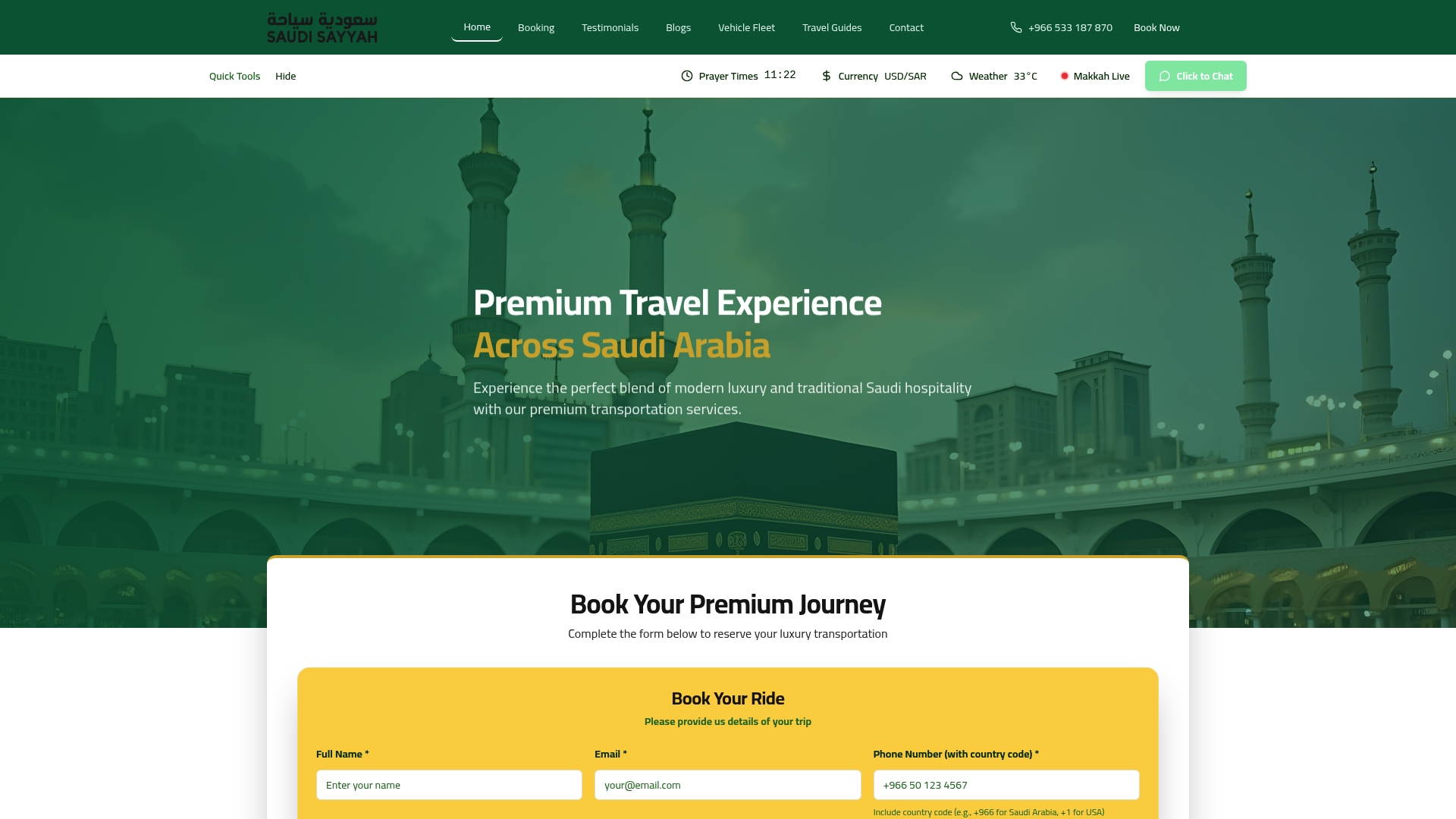
Available services include airport pickups with meet-and-greet, point-to-point transfers between Makkah and Madinah, guided Ziarah tours to religious and historical sites, and hourly vehicle hire for flexible itineraries. All bookings include driver photo, vehicle details, and a real-time tracking link. Support is available around the clock, in multiple languages. To confirm vehicle availability and driver details for your travel dates, visit saudisayyah.com/services.
Useful sources
The sources below cover guest communication standards, guest relations best practices, and messaging technology guidance used throughout this article. Brand-specific claims about Saudisayyah come directly from the provider.
- 7 High-Impact Guest Communication Strategies — Covers 2026 response-time standards and dynamic personalization in guest messaging.
- Guest Relations Guide: Build Loyalty & Enhance Hotel Revenue — Defines proactive liaison work and the markers of genuine vs. scripted guest engagement.
- Hotel Guest Messaging: Tips, Strategies and Tools — Explains systems integration and the distinction between reactive contact centers and proactive liaison functions.
- Guest Messaging: A Practical Guide for Hotels and Short-Term Rentals — Details automated trigger messaging tied to booking data and its role in reducing manual errors.
- 8 Hotel Guest Communication Tips Every Hotelier Should Know — Covers direct messaging channels and escalation path standards.