

TL;DR:
- Automation in travel encompasses AI, biometrics, and mobile tools that improve efficiency and safety. It reduces costs, shortens planning time, and enhances duty-of-care through human-in-the-loop systems and modular API integration. For travelers and managers, leveraging automation involves setting up personal workflows, starting with expense automation, and maintaining transparency to build trust and maximize benefits.
The role of automation in travel is widely misunderstood. Most people assume it means robots replacing airline staff or chatbots making human agents obsolete. The reality is more practical and, frankly, more useful. Automation today covers everything from AI-powered booking engines and biometric boarding to real-time flight delay alerts and smartphone location triggers that cut your roaming bill. This guide breaks down how these technologies actually work, what the data says about their impact, and how both travelers and industry professionals can get more out of them.
Table of Contents
- Key takeaways
- The role of automation in travel today
- Documented benefits: efficiency, safety, and satisfaction
- The nuances: what automation cannot do alone
- Practical applications for travelers and professionals
- What I have learned watching automation actually get deployed
- How Saudisayyah puts automation to work for pilgrims
- FAQ
Key takeaways
| Point | Details |
|---|---|
| Automation spans many technologies | AI, APIs, biometrics, and mobile tools each solve different travel problems. |
| Cost and time savings are documented | AI platforms cut total travel program costs by a median 23% and planning time by up to 90%. |
| Human oversight remains necessary | Effective systems use human-in-the-loop design, not full replacement of agents. |
| Modular adoption reduces risk | API-first middleware lets organizations automate incrementally without replacing full systems. |
| Pilgrimage travel benefits directly | Platforms like Saudisayyah apply automation to booking, tracking, and real-time communication for Hajj and Umrah travelers. |
The role of automation in travel today
Automation in travel is not a single technology. It is a category of tools that handle specific, repeatable tasks faster and more accurately than manual processes allow. Understanding what each tool does makes it much easier to evaluate where automation actually helps.
Here are the core technologies currently in active use across the travel industry:
- AI booking and itinerary engines. These systems analyze pricing history, seat availability, and traveler preferences to recommend or automatically book the best option. Dynamic pricing tools update fares in near real-time based on demand signals, which benefits both airlines and cost-conscious corporate travel managers.
- Chatbots and conversational AI. Customer-facing chatbots handle routine queries around the clock: visa requirements, baggage policies, check-in deadlines. AI-driven agents automate over 90% of routine travel interactions while maintaining 95% customer satisfaction.
- Robotic process automation (RPA). RPA handles back-office workflows such as invoice reconciliation, expense report generation, and compliance checks. These are not glamorous tasks, but manual processing of them wastes enormous amounts of time.
- APIs for real-time data. Application programming interfaces connect airline systems, airports, and travel management platforms. SITA's Advance Flight Delay Notification API, for example, sends encrypted automated alerts to airports when inbound delays exceed 15 minutes, allowing ground teams to adjust gates, staff, and connections before the plane lands.
- Biometric systems. Face recognition and fingerprint scanning now replace manual passport checks at many international airports. These systems speed up boarding, reduce queue lengths, and improve identity verification accuracy compared to human document inspection.
- Smartphone automation. Travelers with iOS Shortcuts or Android Routines can configure location-based triggers that reduce roaming costs, switch automatically to Wi-Fi calling, and pre-download offline maps when connected to home Wi-Fi before departure.
Each of these operates in a different layer of the travel experience. Some are invisible to travelers. Others put direct control in your hands.
Documented benefits: efficiency, safety, and satisfaction
The impact of automation on travel is no longer theoretical. Multiple large-scale studies and program audits have produced specific numbers worth knowing.
Cost and time performance
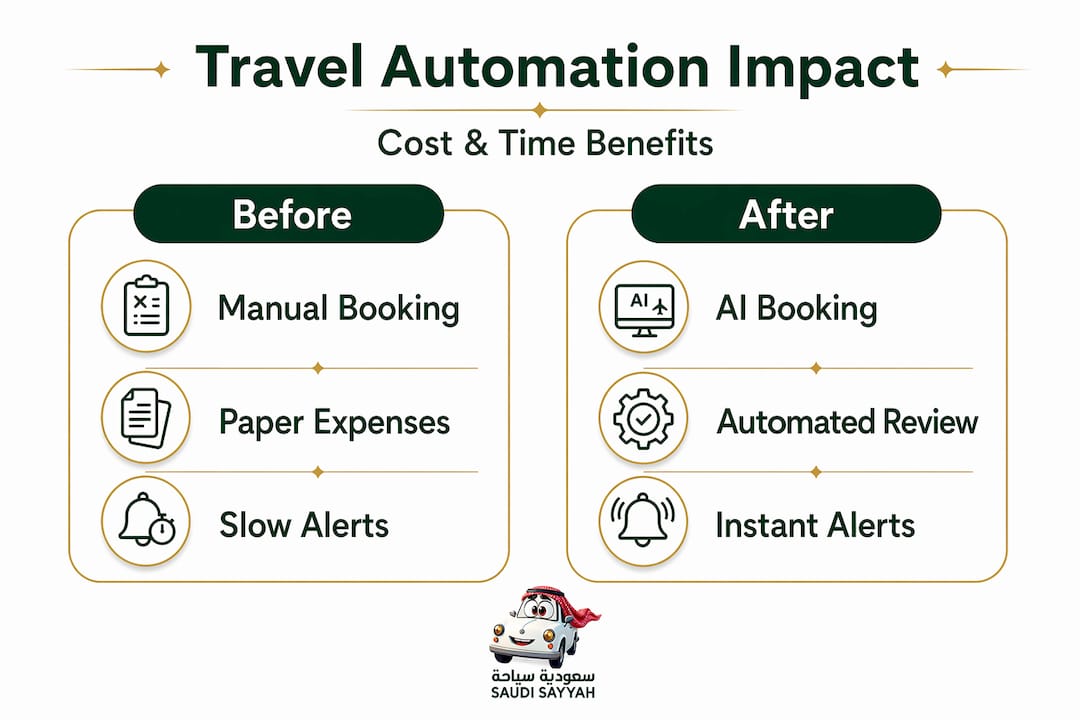
Enterprises using AI-powered travel management achieve a 23% reduction in total travel program costs at the median, with employee planning time dropping by as much as 90%. That 90% figure sounds extreme until you consider how much time corporate travelers spend cross-referencing fares, checking policy compliance, and filling out expense reports manually.
Duty of care and compliance
The safety dimension of automation is particularly significant. AI platforms have been shown to improve policy compliance from 62% to 89% while cutting expense processing time by 72%. Duty-of-care response times, meaning how quickly a travel manager can locate and assist a traveler in distress, dropped from 45 minutes to under 3 minutes in documented program data. For a traveler stranded in an unfamiliar city, that difference matters enormously.
Disruption management at scale
The financial cost of flight delays across Europe reached €16.1 billion over a decade. Automated early alert systems attack this problem at the source by giving airports actionable data before disruption cascades through connecting flights. This is a concrete example of how automation changes travel at the infrastructure level, not just at the booking interface.
| Metric | Before automation | After automation |
|---|---|---|
| Policy compliance rate | 62% | 89% |
| Expense processing time | Baseline | 72% reduction |
| Duty-of-care response | 45 minutes | Under 3 minutes |
| Planning time per employee | Baseline | Up to 90% reduction |
| Expense violation detection | Manual baseline | 3 to 5x more violations found |
AI platforms also identify 3 to 5 times more expense violations than manual review processes, recovering 15 to 25% of platform costs through flagged fraudulent claims alone. The ROI case for automation is not soft. It is built on hard operational numbers.

The nuances: what automation cannot do alone
The most common mistake organizations make is treating automation as a binary switch. You either automate everything or you do not. In practice, the strongest implementations work differently.
Human-in-the-loop AI design is the standard approach among mature travel technology deployments. Routine, high-volume tasks go to automated systems. Complex disruptions, emotional situations, and nuanced itinerary requests go to human agents. This is not a compromise. It is the architecture that produces the best outcomes for both efficiency and customer trust.
The integration question is equally important. Many organizations assume that adopting automation means replacing their entire technology stack, which creates legitimate hesitation. The more practical approach uses modular API-first middleware that connects to existing Global Distribution Systems (GDS), Property Management Systems (PMS), and CRM platforms without requiring a full replacement. Incremental automation through API integration preserves existing investments while adding new capabilities one layer at a time.
Traveler trust is the third variable that gets overlooked. Passengers are more willing to accept automated check-in, AI recommendations, and chatbot support when they understand what the system is doing and know a human is available if needed. Transparency and hybrid models are not optional features. They are what separates automation that builds loyalty from automation that frustrates users.
Pro Tip: When evaluating any travel automation tool, ask the vendor specifically how exception handling works. If a human agent cannot take over from the automated system within 60 seconds when needed, the design is incomplete.
Here are the most common adoption challenges organizations report:
- Legacy system incompatibility with modern API-based tools
- Traveler resistance when automation replaces familiar human touchpoints
- Data privacy concerns with biometric and location-based systems
- Insufficient training for staff who now work alongside AI rather than independently
Practical applications for travelers and professionals
Whether you travel for personal reasons or manage travel programs for an organization, there are specific actions you can take right now to get more from automation.
- Set up smartphone automation before every trip. Configure location triggers on your phone to disable mobile data automatically when you land abroad, switch to a local eSIM profile, and enable Wi-Fi calling. This takes about 10 minutes once and saves a noticeable amount on every international trip.
- Use AI trip planning tools for research, not just booking. AI-powered travel assistants can compare multi-city routing options in seconds, flag visa requirements, and identify policy-compliant hotel options. Use them to generate options, then apply your own judgment to the final decision.
- For travel managers, start with expense automation. Expense processing is the highest-friction, lowest-value manual task in most corporate travel programs. Automating it first produces fast ROI and builds internal confidence in broader automation initiatives.
- Monitor exception reports, not just dashboards. Automated systems flag outliers. The value is in reviewing those flags regularly. An AI that detects policy violations is only useful if a human reviews and acts on the results.
- For pilgrimage travel, use platforms with real-time tracking built in. Travelers visiting the holy lands for the first time face unfamiliar routes, high crowd volumes, and language barriers. Automated pilgrimage logistics that include driver tracking, pre-trip vehicle information, and automated communication reduce uncertainty significantly.
- Deploy chatbots for after-hours support first. If you are deploying automation at an organizational level, chatbot coverage during off-hours is the lowest-risk, highest-impact starting point. Last-minute booking responsiveness is where automated systems outperform human-only operations most clearly.
The future of automation in travel points toward what researchers call "augmented expertise." AI handles the data-heavy, repetitive tasks. Human agents focus on emotional intelligence, complex problem-solving, and personalized service. That split is already the operating model at the most effective travel companies in 2026.
What I have learned watching automation actually get deployed
I have watched enough travel automation projects succeed and fail to have a clear view on what separates the two. The failures almost always share one trait: the organization treats automation as a cost-cutting tool rather than a service-quality tool. They deploy a chatbot to reduce headcount, not to give travelers better answers at 2 a.m. Users notice that difference immediately.
What most people miss is that the technical complexity of automation is not the hard part. The hard part is change management: getting travel managers to trust exception reports, getting travelers to trust AI recommendations, and getting executives to accept that hybrid human-AI models are not a sign that the technology is incomplete. They are a sign that the technology is mature.
I have also seen organizations underestimate how much maintenance automated systems require. An AI trained on 2023 fare data and policy rules will degrade in accuracy by 2025 without retraining. The initial deployment is the beginning, not the finish line.
My honest take: if you are a traveler, the benefits of travel automation are already surrounding you, and using them actively rather than passively gives you a measurable edge. If you are a professional, the ROI data is clear enough to justify investment. Start modular, measure everything, and keep humans in the loop for anything that involves a frustrated or distressed traveler.
— Fa
How Saudisayyah puts automation to work for pilgrims
For travelers making Umrah or Hajj, often for the first time, the stakes of unreliable transport are especially high. Saudisayyah was built specifically for this context.
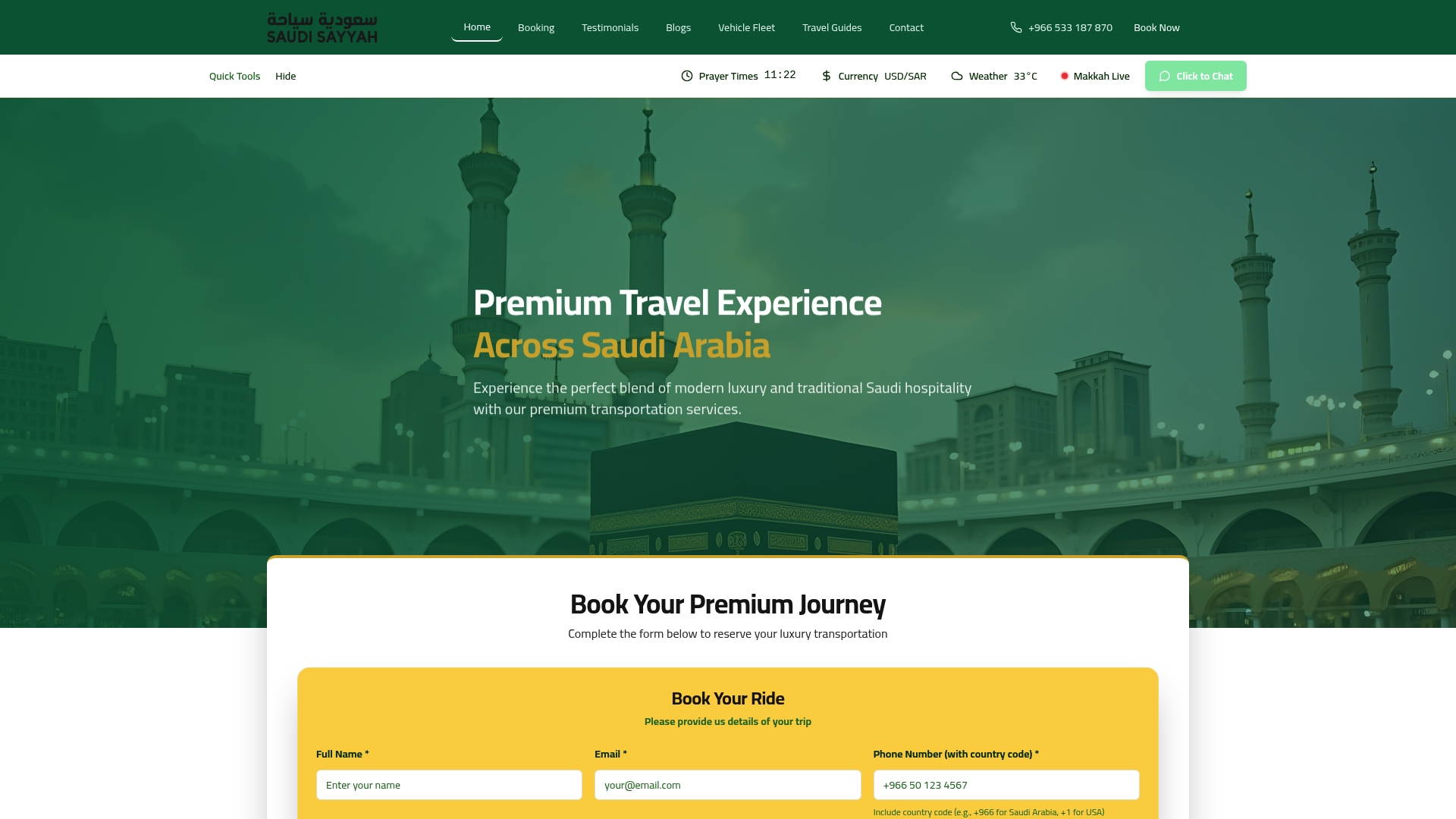
The platform runs a fully automated, internationally-compliant booking management system that handles reservations, assigns professional drivers, and sends real-time vehicle details and driver photos before every trip. Geolocation tracking means you always know exactly where your car is. The system maintains continuous communication throughout your trip, so there are no gaps in information at unfamiliar intersections or crowded terminals.
Saudisayyah's premium vehicle fleet uses the latest model year vehicles, and pilgrim satisfaction rates reflect what happens when technology and attentive service operate together. Explore transport services for your pilgrimage and see how automated travel actually feels when it is designed around the traveler.
FAQ
What is travel automation?
Travel automation refers to the use of AI, APIs, robotic process automation, biometrics, and mobile tools to handle repetitive or data-intensive travel tasks without manual intervention. Examples include automated flight alerts, AI booking engines, and chatbot customer support.
Does automation replace human travel agents?
No. The most effective model is human-in-the-loop design, where AI handles routine tasks and humans manage complex or emotional situations. AI augments human agents rather than replacing them.
What are the main benefits of travel automation?
Documented benefits include up to 90% reduction in planning time, 23% lower program costs, duty-of-care response times under 3 minutes, and 95% customer satisfaction scores when AI handles routine service interactions.
How do travelers personally benefit from automation?
Travelers can use smartphone automation to cut roaming costs, receive early flight delay alerts through API-based apps, and get 24/7 chatbot support for routine queries. Platforms with real-time tracking provide additional peace of mind, particularly in unfamiliar destinations.
What is the biggest challenge in implementing travel automation?
Integration with legacy systems is the most cited technical barrier. The practical solution is API-first middleware that connects to existing GDS, PMS, and CRM platforms incrementally, reducing risk while adding automation capabilities over time.