
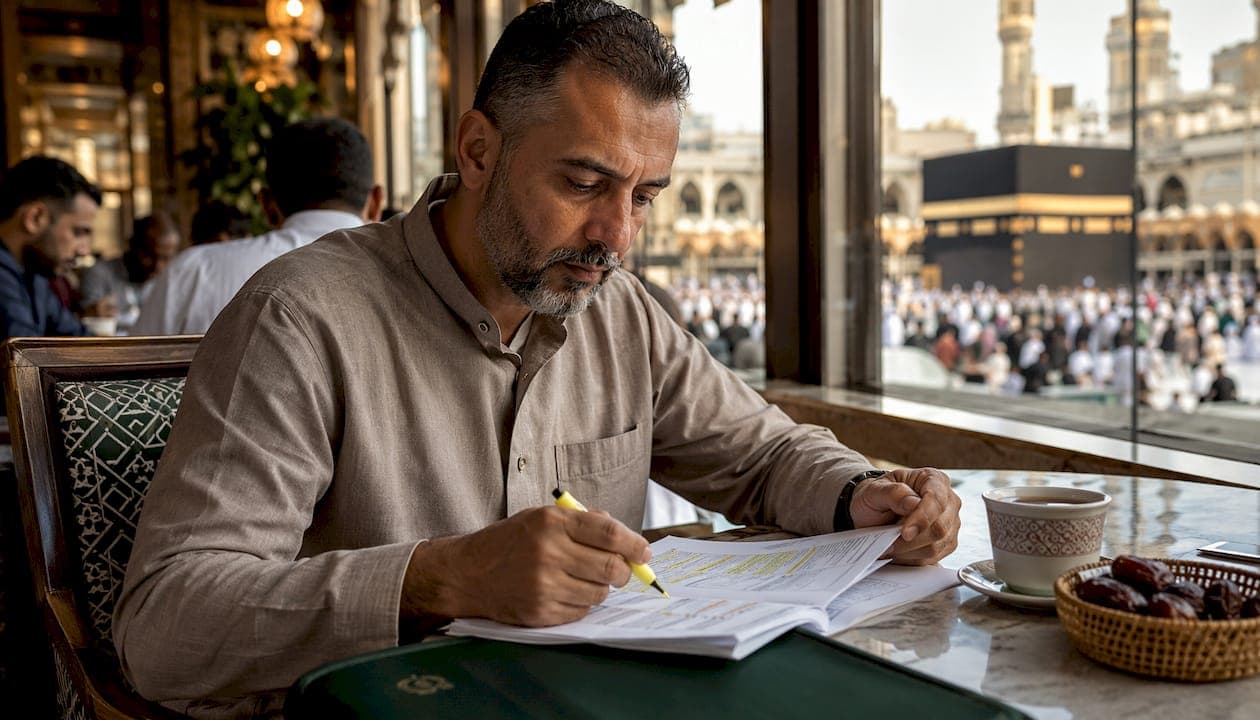
TL;DR:
- Scheduling pilgrimages effectively involves building each day with 1-2 fixed activities, clustering sites geographically, and including buffers to prevent delays. A professional transport provider is essential for executing the plan through real-time tracking and automation, ensuring timely transfers and minimal missed appointments. Proper planning enhances the sacred experience by minimizing transit time and accommodating prayer and congestion delays.
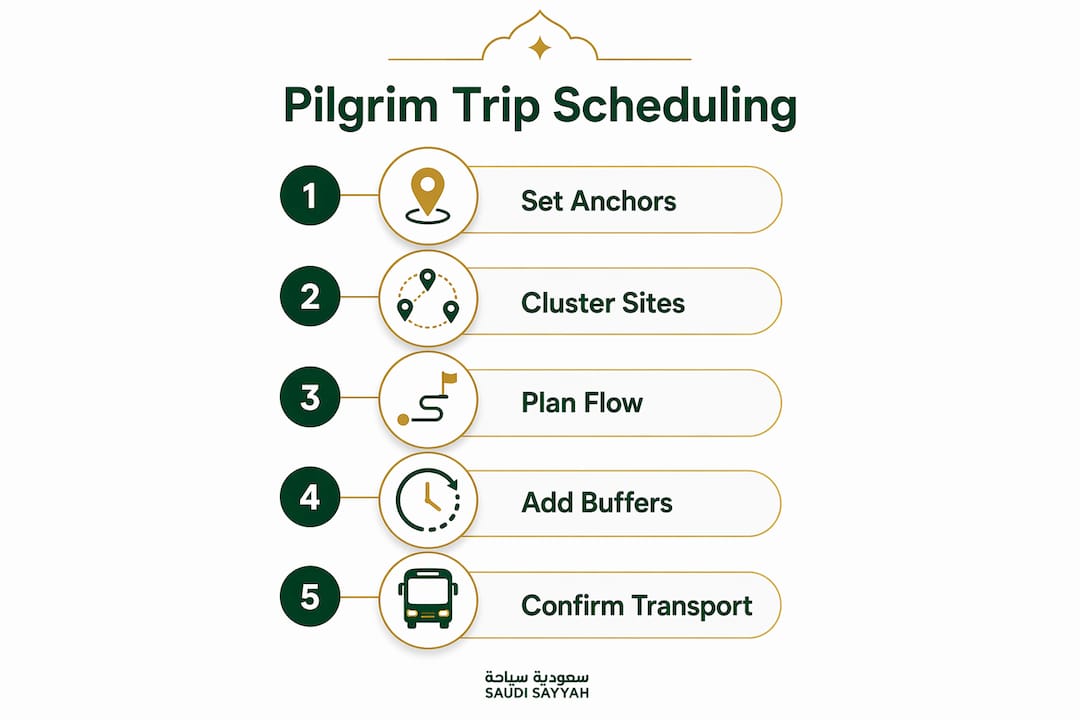
The most effective way to optimize trip scheduling for a pilgrimage to Saudi Arabia: build each day around 1–2 fixed-time anchor activities, cluster nearby holy sites into geographic zones, and add 30–60 minute buffers between every block. Then hand the confirmed plan to a professional transport provider for execution.
This approach delivers fewer missed transfers, less time in transit, and more time at sacred sites. The steps are:
- Identify anchors (guided Ziarah tours, airport transfers, prayer windows)
- Cluster sites by neighborhood or district
- Sequence days in one direction to avoid backtracking
- Add 30–60 minute buffers between all blocks
- Confirm flight numbers, driver contact, vehicle details, and real-time tracking with your provider before departure
Scheduling accuracy improves significantly when dynamic tools replace static lists — research indicates scheduling accuracy can rise significantly when planners use real-time, constraint-aware systems rather than fixed itineraries.
Table of Contents
- How to optimize trip scheduling: anchors, clustering, and buffers
- How to build a day-by-day pilgrim itinerary
- What to confirm before booking transport and guided tours
- What a technology-forward provider delivers to enforce the schedule
- Questions to ask before committing to any provider
- Common scheduling mistakes pilgrims make
- Key Takeaways
- What actually makes a pilgrim schedule hold together
- Saudisayyah puts the schedule into practice
- Sources and further reading
How to optimize trip scheduling: anchors, clustering, and buffers
A well-organized pilgrimage itinerary is not about scheduling every minute. It is about building a structure that prevents wasted time. The full framework has four components.
Anchors. An anchor is any fixed-time commitment: a guided Ziarah tour, an airport pickup, a group prayer window. Limit each day to 1–2 anchors — everything else becomes a flexible time block. More than two anchors per day creates a fragile chain where one delay collapses the rest.
Geographic clustering. Group holy sites and points of interest by neighborhood or district, then assign each cluster to a single day. Clustering by zone can cut daily commute time by 30–50% compared to non-clustered itineraries. Around Makkah and Madinah, this means grouping Ziarah stops along a single corridor rather than crossing the city twice.
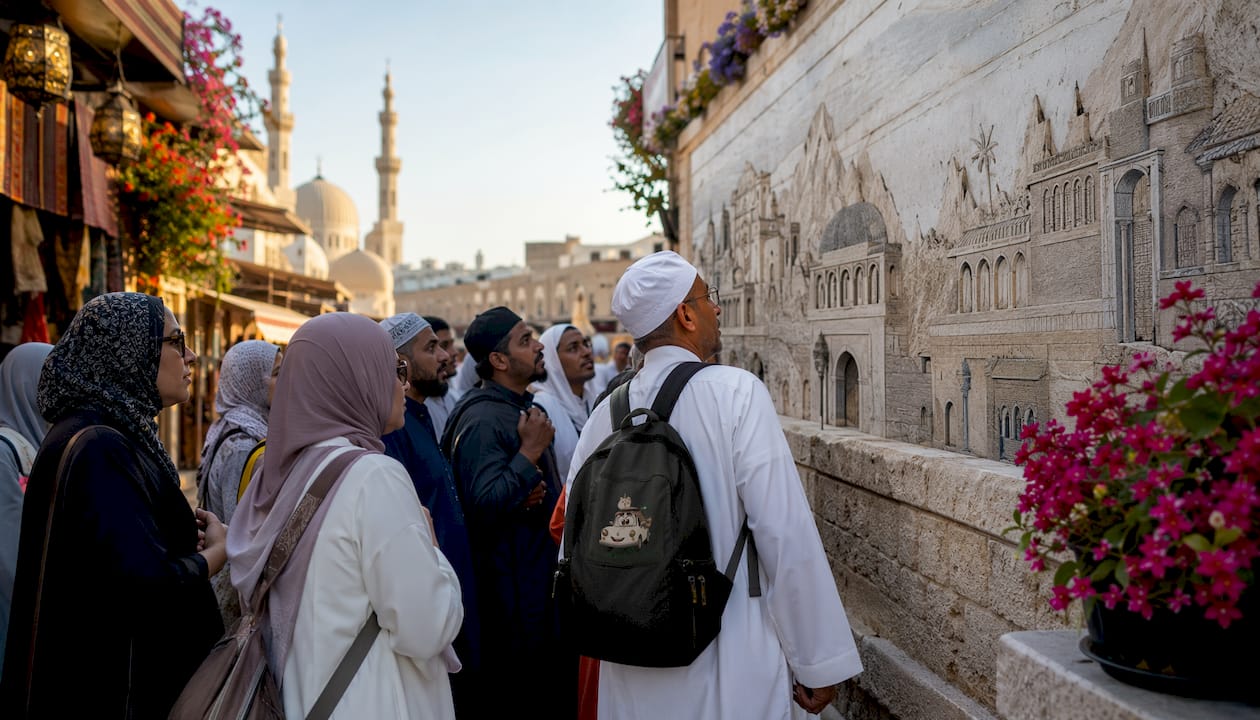
One-direction flow. Sequence your days A→B→C. Avoid looping or backtracking — redundant transit wastes time and multiplies the risk of delays compounding.
Buffers. Add 30–60 minutes between every scheduled block. For pilgrims, this buffer is not optional: congestion near holy sites, prayer time transitions, and group pacing all consume time that a tight schedule has no room for.
| Scheduling Element | Recommended Standard | Source |
|---|---|---|
| Anchor activities per day | 1–2 maximum | Vacation Planner Blog |
| Buffer between activities | 30–60 minutes | Vacation Planner Blog |
| Transit time reduction (clustering) | 30–50% | VoyagerNest |
| Pre-planned vs. open time | around three-fifths of the schedule planned and the remainder open | Elite Travel Group |
Pro Tip: Schedule anchor activities to start after major prayer times when possible. A Ziarah tour that begins immediately after Dhuhr prayer avoids the conflict of a group splitting attention between the tour and the call to prayer.
For more on journey scheduling workflows, the Saudisayyah blog covers the full operational framework.
How to build a day-by-day pilgrim itinerary
Start with confirmed fixed points: flight arrival and departure times, first-night hotel, and any pre-booked tours. Mark arrival and departure days as half-days. Begin planning 4–6 weeks before departure for international trips; longer for peak Umrah seasons.
Use 2–3 hour time blocks rather than minute-by-minute scheduling. A block labeled "Morning: Masjid al-Haram visit + nearby Ziarah stops" is more resilient than a timetable that collapses if one site runs long.
Step-by-step build process:
- Lock in flights and first-night accommodation near holy sites
- Mark arrival and departure as half-days in the plan
- List all desired sites and group them by geographic zone
- Assign each zone cluster to a day, sequencing in one direction
- Place 1–2 anchors per day with confirmed booking times
- Fill remaining blocks with flexible activities (2–3 hour windows)
- Add a buffer of sufficient time between every block
- Identify a backup option for each anchor in case of delay
Sample: Single-city Umrah day
- Morning anchor: Guided Ziarah tour (pre-booked, fixed time)
- Buffer: 45 minutes
- Mid-morning: Clustered nearby historical sites (flexible block)
- Afternoon: Rest and Asr prayer (unscheduled)
- Evening: Open
Sample: Multi-city transfer day
- Morning anchor: Airport transfer (confirmed pickup window)
- Buffer: 60 minutes at airport
- Afternoon: One light activity near arrival hotel (flexible)
- Evening: Rest
For multi-city pilgrim trip logistics, Saudisayyah's operational guide covers intercity transfer timing in detail.
Day checklist fields to track for each day:
- Date and city/zone
- Anchor activity and confirmed booking time
- Estimated transit time (use real-time mapping, not straight-line estimates)
- Buffer allocation
- Backup option
- Booking status
- Driver name and contact number
What to confirm before booking transport and guided tours
Book in sequence: flights first, then first-night accommodation near sacred sites, then high-demand guided Ziarah tours and airport transfers. Leaving transport for last is the most common cause of schedule collapse.
Pre-booking transport anchors for Umrah is particularly important because rituals have specific, non-negotiable time windows. Ride-share availability near holy sites during peak periods is unreliable.
- Flight numbers (arrival and departure) for every leg
- First-night hotel address and check-in window
- Guided Ziarah tour confirmation numbers and start times
- Airport transfer booking reference and pickup window
- Driver name, photo, and direct phone number
- Vehicle make, model, and plate number
- Real-time tracking link or app access
- Cancellation and delay policy in writing
- Emergency contact number for the provider
Build pickup windows with extra margin during busy periods around holy sites. A 60-minute buffer before a flight departure is the minimum; 90 minutes is safer during Umrah peak season.
The Umrah pilgrimage logistics guide on the Saudisayyah blog covers transfer timing and regional routing in full.
What a technology-forward provider delivers to enforce the schedule
A professional provider does not just drive. The right service operationalizes the entire framework. These are the features to demand:
- Automated, internationally compliant booking management — confirmations, reminders, and schedule updates without manual follow-up
- Real-time driver geolocation — visible to the pilgrim before and during every trip
- Driver photo and vehicle details sent before pickup — no uncertainty about who is arriving or in what vehicle
- Constant customer communication — proactive updates on timing, traffic, and any adjustments
- Backup vehicle planning for congestion or mechanical issues on multi-leg transfers
Saudisayyah's platform delivers all of these. The booking system is fully automated and built to international compliance standards. Before every trip, pilgrims receive the driver's photo, vehicle details, and a live tracking link. The platform maintains communication throughout, so there are no surprises at pickup.
Example workflow: A pilgrim books an airport transfer and a guided Ziarah tour through Saudisayyah. The system sends a booking confirmation with the driver's name, photo, and vehicle details 24 hours before pickup. On the day, live tracking activates when the driver departs. If the flight is delayed, the pilgrim updates the flight number and the system reassigns the pickup window automatically. Post-trip, a confirmation closes the booking record.
For groups, the group transport coordination guide covers vehicle allocation and multi-leg handoffs. The same automation principles that drive efficiency in large-scale logistics apply directly to how Saudisayyah manages its booking and dispatch operations.
Questions to ask before committing to any provider
Ask these before paying:
- Are drivers experienced specifically with pilgrim routes in Makkah and Madinah?
- Is real-time GPS tracking available and shared with the passenger?
- What is the exact vehicle model and passenger capacity?
- What happens if a flight is delayed? Is there a live reassignment process?
- What are the cancellation and emergency procedures?
Get these in writing:
- Exact pickup and dropoff locations with confirmed buffer windows
- Driver's direct phone number
- Contingency plan for missed flights or extended delays
- Insurance and licensing documentation
Red flags that should stop the booking:
- Vague pickup instructions with no specific location or window
- No driver identity or vehicle information provided before the trip
- Provider refuses to confirm flight numbers or link them to the booking
- No written cancellation or delay policy
- Missing insurance or licensing details on request
Use the group pilgrimage travel checklist to cross-reference these questions against your full group's requirements before finalizing.
Common scheduling mistakes pilgrims make
Overloading the day. More than two anchor activities creates a chain where one delay breaks everything. Drop to 1–2 anchors and convert the rest to optional flexible blocks.
Backtracking across a city. Scheduling sites in a non-geographic order wastes transit time and compounds delays. Re-cluster by neighborhood and apply one-direction sequencing.
Zero buffers. A schedule with no gaps between activities fails at the first delay. Add 30–60 minutes between every block, and build in arrival and prayer time before anchors.
Trusting straight-line transit estimates. Maps show distance, not reality. Walking to a vehicle, waiting, traffic near holy sites — all of this adds time. Check historical traffic patterns and add extra margin around peak prayer hours.
Not supplying flight numbers to the provider. If the provider does not have the flight number, they cannot adjust for delays. Supply flight numbers at booking and confirm the provider has a live reassignment process.
Key Takeaways
A pilgrim schedule works when anchors are fixed, sites are clustered by zone, buffers are built in, and a provider with real-time tracking executes the plan.
| Point | Details |
|---|---|
| Anchor limit | Cap each day at 1–2 fixed-time activities; make everything else a flexible block. |
| Geographic clustering | Grouping sites by zone can reduce daily transit time by 30–50%. |
| Buffer rule | Add 30–60 minutes between every scheduled block, especially near holy sites. |
| Booking sequence | Secure flights first, then accommodation near sacred sites, then tours and transfers. |
| Saudisayyah | Provides automated booking, real-time driver tracking, and pre-trip driver and vehicle details for every pilgrim transfer. |
What actually makes a pilgrim schedule hold together
Schedules look clean on paper. On the ground, they meet traffic, prayer times, group pacing, and the unexpected. The providers who enforce schedules reliably are the ones who build operational margin into every leg — not just the anchors.
Buffers are not wasted time. They are the mechanism that keeps the rest of the day intact. A 45-minute buffer before a Ziarah tour is what allows a group to arrive, settle, and be present rather than rushed. The parts of the day that should stay flexible are the ones between anchors: the walk between sites, the rest period, the unscheduled time near the Haram. Those moments are where the pilgrimage actually happens.
The practical constraint most pilgrims underestimate is congestion near holy sites during peak prayer times. Any provider worth booking has a protocol for this — proactive rerouting, adjusted pickup windows, and a direct line to the driver. If a provider cannot describe that protocol clearly before the booking is confirmed, that is the answer.
Saudisayyah puts the schedule into practice
Pilgrims who build a solid itinerary still need a provider that can execute it without gaps. Saudisayyah connects the plan to the ground.
Every booking through Saudisayyah includes an automated confirmation, the driver's photo and vehicle details before pickup, and live GPS tracking throughout the trip. The fleet uses latest-model vehicles. Drivers have years of experience on pilgrim routes in Makkah and Madinah. The booking system is fully automated and built to international compliance standards, so confirmations, updates, and reassignments happen without manual follow-up.
When a flight is delayed, the system adjusts. When traffic builds near a holy site, the driver reroutes. The pilgrim receives updates throughout. No surprises.
View available services and book a transfer or guided Ziarah tour — have your flight numbers, hotel address, and preferred pickup window ready when you start.
Sources and further reading
- How to Organize a Trip Itinerary: Templates, Tips, and Tools — anchor limits, buffer rules, time-blocking, and planning lead times
- How to Make an Itinerary for a Trip That Actually Works — geographic clustering and transit reduction data
- How to Create a Trip Plan That Won't Fall Apart — one-direction flow and backtracking prevention
- Step by Step Trip Itinerary: Your Complete Planning Guide — booking sequence, 60% planning rule, and Umrah pre-booking guidance
- How to Optimize Trip Planning for Stress-Free Travel — scheduling accuracy data for dynamic vs. static planning tools
- Saudisayyah Blog: Pilgrimage Trip Planning Guide — comprehensive operational detail for sacred travel planning
- Saudisayyah Blog: Workflow for Holy Site Visits — step-by-step workflow for visiting holy sites in Saudi Arabia