

TL;DR:
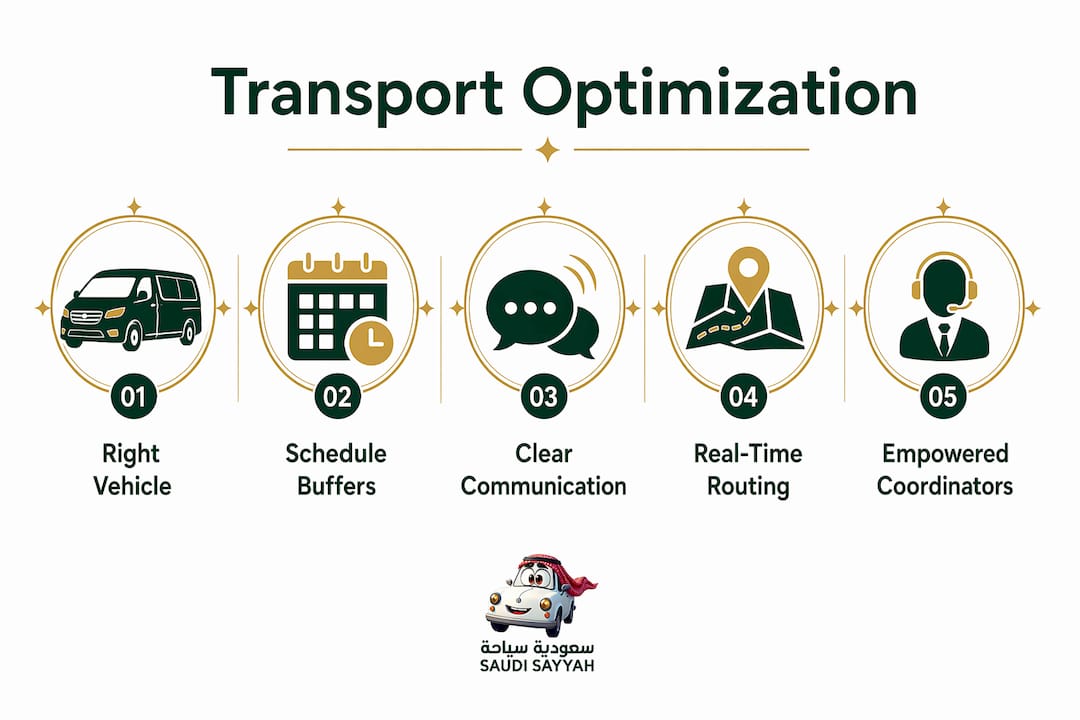
- Effective pilgrimage group transport depends on proper vehicle sizing, realistic schedule buffers, and clear ground coordination. Implementing these strategies, such as empowering a dedicated bus captain and pre-mapping routes, significantly enhances punctuality and passenger experience. Using real-time tracking and advance planning transforms complex logistics into reliable, smooth operations.
Group transport optimization is the process of matching vehicle capacity, scheduling, communication, and routing to the exact demands of a large traveling party. For pilgrimage organizers managing Umrah or Hajj groups, getting this wrong means missed prayer windows, stranded passengers, and a damaged experience that no apology can fix. The good news: most failures trace back to three fixable gaps. Wrong vehicle sizing, unrealistic schedules, and fragmented communication cause the majority of delays. Fix those three, and you have a reliable operation. This article covers how to optimize group transport from the ground up, with practical strategies built for religious pilgrimage logistics.
How to optimize group transport: start with the right vehicle size
Vehicle sizing is the single decision that shapes every other part of your operation. Get it wrong, and no amount of scheduling or communication fixes the downstream problems.
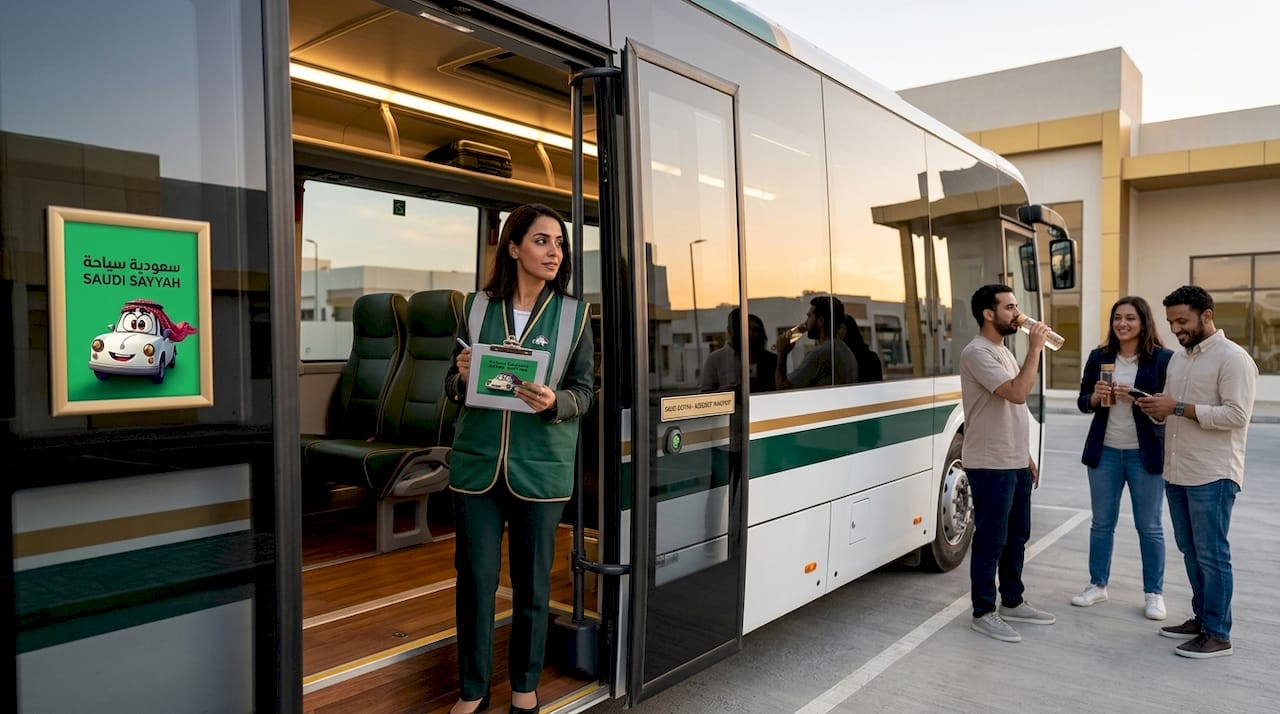
The standard practice is to lock in your exact headcount first, then add a small buffer for late additions or last-minute changes. A group of 38 confirmed travelers does not fill a 40-seat coach. It fills a 40-seat coach with no room for luggage, no space for accessibility needs, and no margin for the two guests who always show up with an extra bag. Upsizing for luggage space is not a luxury. It is a scheduling tool. A vehicle that cannot fit all bags forces multiple loading cycles, which adds 10 to 20 minutes to every departure.
Comparing vehicle options by group size
| Group size | Recommended vehicle | Key consideration |
|---|---|---|
| 1 to 6 passengers | Sedan or SUV | Luggage space per passenger is tight; consider a second vehicle for bags |
| 7 to 14 passengers | Minivan or minibus | Confirm luggage hold capacity before booking |
| 15 to 35 passengers | Standard coach | Upsize by 10 to 15 seats for comfort and baggage |
| 36 to 50 passengers | Full-size coach | Verify undercarriage storage volume against group luggage count |
| 50 or more passengers | Multi-vehicle dispatch | Fleet redundancy is standard practice at this size |
For groups above 50 passengers, multi-vehicle dispatch is not optional. It is the only reliable approach. A single mechanical issue or traffic delay strands your entire group. Splitting into two or more vehicles means one problem affects half the party at most, and the operation continues.
Crowding raises dwell times at stops by up to 14%, and congested aisles increase alighting times by up to 68%. Those numbers translate directly into schedule slippage. A vehicle packed to its seat maximum boards and unloads slowly. A vehicle sized with a 10 to 15 seat buffer moves people on and off in a fraction of the time.
Pro Tip: Count your luggage pieces before you count your passengers. One pilgrim traveling for 10 days often carries two large bags. Multiply that across 40 travelers and you have 80 pieces of luggage to account for before you select a single vehicle.
Why schedule buffers are non-negotiable for group travel
Realistic timing is the backbone of group transport efficiency. Most schedule failures happen because planners model departure times as if boarding is instant. It never is.
Industry operators recommend building 15 to 20 minute buffers into each trip leg to cover boarding, bag stowage, and settling time for groups of approximately 40 passengers. That buffer is not padding. It is the time your group actually needs. Cutting it out to make a schedule look tighter does not make the operation faster. It makes every leg run late.
Pilgrimage itineraries add a layer of complexity that standard event transport does not face. Prayer windows are fixed. Access gates at the Masjid al-Haram and Masjid an-Nabawi open and close on schedules that do not accommodate late buses. Your transport timing must match the religious itinerary, not just the venue clock.
Here is how to build a schedule that holds:
- Start from fixed constraints. Identify every prayer time, gate opening, and mandatory arrival window first. These are non-negotiable anchors.
- Work backward from each anchor. Add your realistic travel time, then add the 15 to 20 minute boarding buffer on top.
- Account for accessibility. Travelers with mobility needs require more boarding time. Scheduling with accessibility factors produces accurate timetables. Ignoring them produces optimistic ones that fail on the day.
- Build in a contingency window. One 30-minute buffer somewhere in the daily schedule absorbs minor delays without cascading into the evening.
- Communicate the real departure time. Tell passengers to be at the vehicle 10 minutes before your buffered departure. This is your insurance against the last-minute scramble.
Pro Tip: Never share the exact buffered departure time with passengers. Share a time 10 minutes earlier. The buffer protects your schedule. The earlier call time protects your buffer.
How to manage group transportation through clear communication
The biggest day-of improvements come from process design, not vehicle selection. Clear instructions, staggered pickups, and a designated coordinator consistently outperform last-minute fixes regardless of how good the vehicles are. This is the insight most planners learn the hard way.
The single most effective structural change you can make is assigning a transportation coordinator, often called a "bus captain," with the authority to make real-time decisions. This person is not a messenger. They have the power to delay a departure, redirect a vehicle, or split a group without escalating to a committee. Indecision at the point of departure costs more time than almost any other factor.
Here is a communication setup that works for groups of 20 to 200 travelers:
- Assign one bus captain per vehicle. Each captain has direct contact with the lead coordinator and the driver. No passenger communicates directly with the driver about logistics.
- Use a single communication channel. WhatsApp groups, dedicated apps, or trip management platforms all work. The channel matters less than the discipline of using only one. Split communication creates conflicting instructions.
- Conduct a pre-departure briefing. Before the first trip leg, brief all passengers on pickup points, departure times, and what to do if they miss a vehicle. Written instructions distributed in advance reduce questions at the vehicle door.
- Use staggered departures for large groups. If your group exceeds 100 travelers, stagger vehicle departures by 10 to 15 minutes. This prevents a single traffic event from affecting every vehicle simultaneously.
- Confirm vendor status the night before. Call or message every driver and confirm vehicle readiness, pickup location, and departure time. Centralized trip records with approval checkpoints make this systematic rather than ad hoc.
A well-structured Umrah travel workflow documents every one of these steps in advance, so the coordinator is executing a plan rather than improvising under pressure.
What role does real-time routing play in group transport efficiency?
Static route plans fail when reality changes. Traffic, road closures near holy sites, and unexpected crowd surges at access gates are predictable unpredictabilities. The question is whether your operation can respond or whether it stalls.
Digital platforms and real-time visibility allow coordinators to monitor vehicle positions and traffic conditions simultaneously, enabling proactive route adjustments before a delay compounds. Companies like Volvo and ASM Group have built entire logistics frameworks around this principle. For pilgrimage transport, the same logic applies at a smaller scale.
Routing constraints specific to pilgrimage transport
| Constraint type | Planning implication | Adaptive response |
|---|---|---|
| Prayer window timing | Routes must deliver groups before Adhan | Build 20-minute arrival buffer before each prayer |
| Gate access restrictions | Certain entry points close during peak hours | Pre-map two alternative entry routes per destination |
| Crowd surge zones | Tawaf and Sa'i areas create pedestrian overflow | Coordinate drop-off points 300 to 500 meters from peak zones |
| Multi-group dispatch | Vehicles depart at different times | Assign each vehicle a unique route to avoid convoy bunching |
Giving drivers clear route restrictions plus a single on-site decision-maker prevents costly last-minute detours. When a driver has two pre-approved alternative routes and one person authorized to choose between them, the decision takes 30 seconds. Without that structure, the same decision takes 10 minutes of phone calls.
For examples of efficient travel in practice, the pattern is consistent: groups that pre-map alternatives and empower a ground coordinator arrive on schedule far more often than groups that rely on driver judgment alone.
Key takeaways
Optimizing group transport requires correct vehicle sizing, realistic schedule buffers, a single empowered coordinator, and pre-mapped route alternatives before the first departure.
| Point | Details |
|---|---|
| Size vehicles above headcount | Upsize by 10 to 15 seats to accommodate luggage and reduce boarding time. |
| Build 15 to 20 minute buffers | Add boarding and stowage time to every trip leg, not just travel time. |
| Assign one bus captain per vehicle | A single decision-maker on the ground prevents delays from escalating. |
| Use one communication channel | Centralized updates eliminate conflicting instructions across a large group. |
| Pre-map alternative routes | Two approved alternatives per destination allow 30-second decisions when conditions change. |
What I have learned from planning pilgrimage transport
The planners who struggle most are the ones who treat group transport as a vehicle booking problem. It is not. It is a coordination problem that happens to involve vehicles.
I have seen well-funded operations fall apart because no one was empowered to make a call when the lead bus hit a road closure 20 minutes from the Haram. The group waited 40 minutes while three people on a phone chain debated the alternative. The vehicles were fine. The process was not.
The concept of "capacity discipline" is underused in pilgrimage planning. Filling a coach to its maximum seat count feels efficient. It is not. Crowding-aware transport planning trades a small amount of travel time to reduce boarding delays and passenger discomfort. That trade is almost always worth it. A group that boards in 4 minutes instead of 12 minutes recovers 8 minutes per leg. Over a 10-day pilgrimage with four daily trips, that is more than 5 hours of schedule recovery.
Technology has genuinely changed what is possible here. Real-time tracking, pre-trip driver verification, and automated booking confirmations have removed entire categories of uncertainty that used to consume coordinator attention. The planners who use these tools well spend their energy on the decisions that require human judgment. The ones who do not spend their energy chasing information that a platform could surface in seconds.
The uncomfortable truth is that most group transport problems are solved before departure day. The reliable transport operations I have observed share one trait: they are boring on the day. Everything was decided in advance.
— Fa
How Saudisayyah supports group pilgrimage transport
Saudisayyah is built specifically for the logistics demands of Umrah and Hajj group travel. The fleet options cover groups from small family parties to large organized delegations, with vehicles sized to carry both passengers and their luggage without compromise. Every booking runs through a fully automated, internationally-compliant management system that confirms driver details, vehicle specifications, and real-time tracking before each trip departs.
Professional drivers with extensive pilgrimage route experience handle the on-ground execution. The geolocation platform sends coordinators driver photos and live vehicle positions, so the bus captain always knows exactly where each vehicle is. For group organizers who need reliable, scalable transport services in Saudi Arabia, Saudisayyah removes the coordination uncertainty that derails even well-planned pilgrimages.
FAQ
What is the best vehicle size for a group of 40 pilgrims?
A full-size coach with 50 to 55 seats is the recommended choice for 40 passengers. The extra capacity accommodates luggage and reduces boarding time significantly.
How many minutes of buffer should I add per trip leg?
Operators recommend 15 to 20 minutes per leg for groups of approximately 40 travelers, covering boarding, bag stowage, and minor delays.
Why use multiple vehicles for groups over 50 passengers?
Multi-vehicle dispatch protects against a single mechanical failure or traffic delay stranding the entire group. Fleet redundancy at this scale is standard practice in professional group transport operations.
What does a bus captain do in group transport?
A bus captain is the designated on-site coordinator with authority to make real-time decisions about departures, route changes, and passenger management without escalating to a remote planner.
How does real-time tracking improve group transport logistics?
Real-time tracking lets coordinators monitor vehicle positions and traffic simultaneously, enabling proactive route adjustments before delays compound across the full group itinerary.