

TL;DR:
- Journey scheduling automates complex, multi-step workflows across transportation and business operations, managing timing, branching, and state tracking. It enhances efficiency and reliability by coordinating actions like vehicle dispatch and customer communications, while providing detailed audit logs. Effective journey scheduling relies on structured data, clear state transitions, and regular performance review.
Journey scheduling is the structured process of organizing and automating sequences of timed steps across transportation routes, logistics operations, or business workflows. It combines triggers, timing controls, conditional branching, and recurrence rules to coordinate multi-step activities reliably. Unlike simple task automation, journey scheduling manages state across many steps, handles exceptions, and maintains an audit trail of every action taken.
Core elements of journey scheduling:
- Triggers: Events, dates, or API calls that start a workflow or route assignment
- Timing controls: Delays, scheduled windows, and recurrence intervals (daily, weekly, monthly, yearly)
- Conditional branching: Logic that routes users or vehicles down different paths based on data or behavior
- State management: Tracking progress across nodes so the system knows where each participant stands
- Auditability: Step-by-step logs that allow review and debugging of individual runs
Journey scheduling differs from basic automation in one key way. Basic automation fires a single action. Journey scheduling manages a directed workflow graph of nodes with timing, branching conditions, and state tracking, which supports detailed diagnostics when something goes wrong.
How journey scheduling works in transportation and logistics
Transportation is where journey scheduling has the longest history. Coordinating vehicle routes, passenger itineraries, and service reliability across a public transit network requires precise timing at every step.
Key applications in this context:
- Route coordination: Scheduling vehicle movements on fixed public transit timetables, accounting for departure and arrival constraints
- Optimization criteria: Systems prioritize fastest routes, fewest transfers, shortest distance, or lowest cost depending on the passenger's preference
- Multi-modal integration: Schedules span buses, trains, rapid transit, cycling connections, and ferries within a single itinerary
- Passenger vs. vehicle scheduling: Trip planning for passengers is distinct from the operational scheduling of vehicles. European standards such as Transmodel formalize this separation to prevent system design errors
- Real-time communication: Platforms that integrate geolocation tracking, driver details, and live updates improve service reliability and reduce uncertainty for travelers
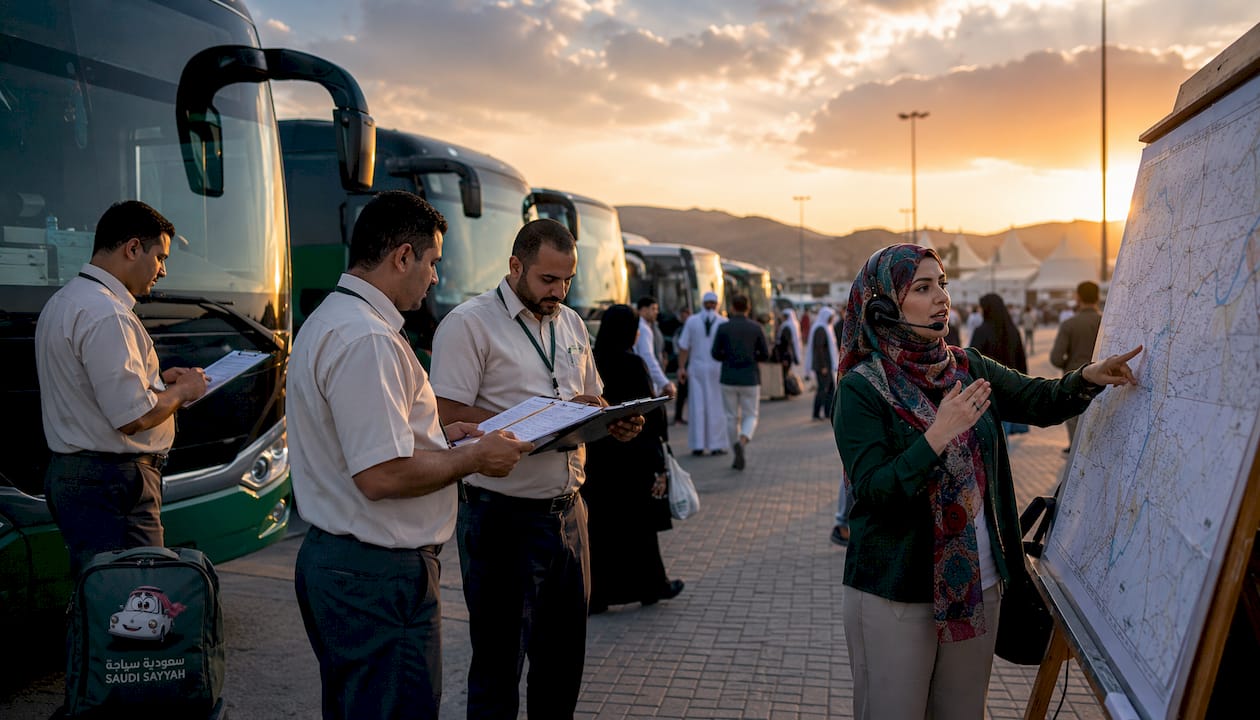
Pilgrimage transport is a practical example of journey scheduling applied at scale. Saudisayyah's platform sends driver photos, vehicle details, and real-time tracking before every trip, coordinating pilgrimage group transport across complex multi-stop itineraries. For first-time visitors to the holy lands, that level of coordination removes guesswork entirely. Group airport pickup operations follow similar logic, where coordinating group arrivals requires sequenced vehicle dispatch, timing buffers, and real-time status updates.
How journey scheduling applies to business processes and customer experience
In business platforms, journey scheduling automates multi-step communication and workflow sequences triggered by user behavior, dates, or system events. The Courier platform defines a journey as a directed graph of nodes that executes when triggered, with built-in delays, branching, enrichment, and delivery across every channel.
What this looks like in practice:
- Trigger types: Segment membership, API events, or scheduled dates enroll contacts into a workflow automatically
- Delays and timing: Execution pauses for a set duration or until a specific time before the next node fires
- Branching paths: Conditional logic routes users down different sequences based on their data or actions
- Frequency limits: Rate controls prevent notification fatigue by capping how often a user receives messages
- Audit trails: Every run is inspectable step by step, so teams can diagnose exactly what happened for a specific user
- Data contracts: Typed schemas define the variables a journey expects, enabling autofill across all nodes and consistent personalization throughout execution
Common use cases include employee onboarding flows, recurring manager check-ins, and multi-step marketing campaigns. Oracle's HR platform, for example, supports recurring journey scheduling with daily, weekly, monthly, and yearly repeat options, each configurable with run limits and end dates.
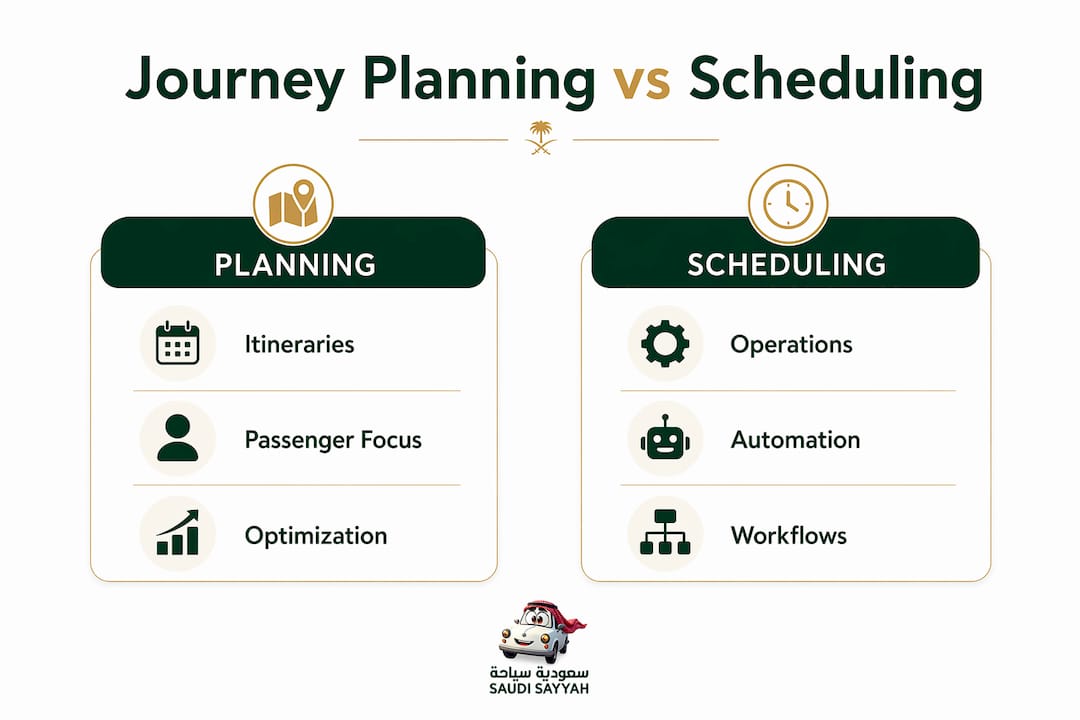
What separates journey planning from journey scheduling
The two terms are often used interchangeably, but they describe different functions. Confusing them leads to system design errors and unreliable service delivery.
| Dimension | Journey planning | Journey scheduling |
|---|---|---|
| Focus | Itinerary optimization for passengers | Execution timing and recurrence of workflows or routes |
| Nature | Static, optimized for convenience | Dynamic, operational |
| Transportation context | Public transit timetables for riders | Vehicle operations and dispatch |
| Business context | Mapping desired communication touchpoints | Automating when and how those touchpoints fire |
| Output | A recommended route or itinerary | A running workflow with state and audit logs |
The U.S. Department of Transportation recognizes that separating passenger-facing planning from operational scheduling is critical to infrastructure reliability. A journey planner answers "how should I get there?" Journey scheduling answers "when does each step execute, and what happens if it fails?"
Benefits, challenges, and best practices of journey scheduling
Benefits
- Efficiency: Automated timing removes manual coordination across steps
- Cost reduction: Fewer missed handoffs and retries lower operational overhead
- Consistency: Every participant moves through the same sequence with the same logic applied
- Auditability: Logs make it possible to trace failures and improve workflows over time
- Personalization at scale: Data contracts enable variable-driven communication without manual customization
Challenges
- Workflow complexity: Designing branching logic across many nodes requires careful planning upfront
- Population changes: In recurring schedules, new participants added mid-cycle need the system to handle retries and reconciliation. Oracle's platform addresses this with a runs-per-period setting that catches new hires or added participants who missed an earlier cycle
- Rigidity vs. flexibility: Over-scheduling creates brittle workflows that break when real conditions deviate from the plan
Best practices
- Define data contracts first. A typed schema that specifies every variable the journey needs prevents broken personalization mid-execution.
- Book in sequence. For travel scheduling, core commitments first means flights before accommodation, accommodation before activities. This reduces last-minute price spikes and logistical conflicts.
- Build in unscheduled buffers. Experts recommend at least one unscheduled half-day per week in travel itineraries to absorb delays and allow flexibility.
- Treat workflows as state machines. Each node should have a defined state, a clear transition condition, and a fallback for failure.
- Monitor and iterate. Step-through audit logs are only useful if teams review them regularly and adjust logic based on what they find.
Pro Tip: Build your planning timeline around anchors, not a minute-by-minute schedule. Lock in the non-negotiables first, then leave the surrounding time loosely held so the workflow can adapt to real conditions.
Real-world examples of journey scheduling in action
Pilgrimage transport coordination. Saudisayyah applies journey scheduling across the full arc of a pilgrim's trip, from multi-city itinerary management to real-time driver dispatch. The platform's geolocation layer sends vehicle details and tracking links before each leg, so travelers always know what comes next.
Employee onboarding workflows. An HR team using Oracle's Journeys app schedules a recurring monthly check-in for all direct reports. The system assigns the journey automatically on the configured date, handles any new hires added to the group mid-cycle, and logs completion for each participant.
Corporate transportation dispatch. Fleet operators coordinating corporate transportation use scheduling platforms to sequence vehicle assignments, set pickup windows, and trigger driver notifications at defined intervals before each pickup.
Marketing onboarding sequences. A SaaS company triggers a seven-step onboarding journey when a user signs up. Each step fires on a delay, branches based on whether the user completed the previous action, and caps at one message per day to avoid overload.
How journey scheduling affects cost efficiency and resource use
Poorly timed workflows waste resources. A vehicle dispatched too early idles. A notification sent at the wrong moment gets ignored, requiring a retry. Journey scheduling reduces both by aligning execution with actual demand and real-time conditions.
In transportation, optimized dispatch reduces idle time and fuel consumption. In business workflows, frequency limits and branching logic cut the volume of unnecessary messages, which lowers delivery costs and improves engagement rates. The data-driven approach to scheduling, using typed schemas and structured triggers, also reduces the manual effort required to maintain workflows as conditions change.
Key metrics for evaluating journey scheduling effectiveness
Tracking the right numbers shows whether a scheduling system is working or needs adjustment.
- On-time execution rate: Percentage of workflow steps that fire within the intended window
- Retry rate: How often the system needs to re-attempt a failed step, which signals fragile logic or data issues
- Completion rate: Percentage of participants who reach the end of a multi-step workflow
- Drop-off points: Which nodes see the most exits, indicating where logic or timing needs revision
- Audit log review frequency: How often teams inspect step-through logs, a proxy for operational discipline
- Cost per completed run: Total operational cost divided by successful workflow completions
How journey scheduling connects to other operational systems
Journey scheduling rarely runs in isolation. Its value multiplies when connected to the systems that supply data and consume outputs.
- CRM and HR platforms: Provide the user data and segment membership that trigger journeys and populate variables
- Real-time tracking systems: Feed location and status data into transportation scheduling to adjust dispatch timing dynamically
- Notification delivery channels: Email, SMS, push, and in-app messaging systems receive the output of each scheduled node
- Analytics platforms: Consume completion and drop-off data to surface performance trends
- ERP and booking systems: In travel and logistics, scheduling connects to inventory, pricing, and reservation systems to confirm availability before committing a step
Key Takeaways
Journey scheduling coordinates timed, conditional, multi-step workflows across transportation and business contexts, and its effectiveness depends on clear data contracts, defined state transitions, and ongoing audit review.
| Point | Details |
|---|---|
| Core definition | Journey scheduling automates multi-step workflows using triggers, timing, branching, and state management. |
| Planning vs. scheduling | Journey planning optimizes itineraries for passengers; scheduling manages execution timing and recurrence. |
| Recurring schedule handling | Systems like Oracle Journeys use runs-per-period settings to reconcile new participants added mid-cycle. |
| Best practice: sequence first | Book flights before accommodation, define data contracts before building workflow nodes. |
| Key metric to watch | Retry rate and drop-off points reveal where scheduling logic or timing needs adjustment. |
Saudisayyah applies journey scheduling across every leg of a pilgrim's trip, from automated dispatch to real-time tracking and direct driver communication. Explore pilgrimage transport services or review the premium fleet available for Umrah and Hajj travel.