

Digital guest education is the structured delivery of property, policy, and local information across pre-arrival, on-site, and post-stay digital touchpoints. Three quick checks for any property today:
- Can guests access Wi-Fi credentials without calling the front desk?
- Are check-in instructions available via a link or QR code before arrival?
- Do guests have emergency contacts in a format they can reach without internet?
Hosts who implement detailed digital guidebooks commonly report a 30–50% reduction in routine guest inquiries about Wi-Fi passwords, appliance instructions, and local recommendations. HospitalityNet frames guest education as a loyalty tool, not a support function. Saudisayyah applies the same principle to pilgrim transport: driver photos, vehicle details, and real-time tracking arrive before every trip, so guests never need to ask.
Key Takeaways
Digital guest education works when it delivers the right information at the right moment, staff actively promote it, and engagement data drives continuous improvement.
Table of Contents
- Why does digital guest education matter for operations?
- What content should every guest resource include?
- How should you sequence guest education across the stay?
- Which platforms deliver digital guest education effectively?
- How do you write guest education content that actually gets read?
- How do you get staff to actually use and promote digital resources?
- What KPIs tell you if guest education is working?
- Ready-to-use templates for pre-arrival, arrival, and checkout
- Why digital guest education deserves operational priority now
- Sources
Why does digital guest education matter for operations?
Digital guest education reduces friction at every touchpoint and generates engagement signals that operations teams can act on. That combination makes it one of the highest-return investments a property manager can make.
The operational benefits are direct. Fewer routine inquiries free staff for higher-value interactions. Guests who understand how to use appliances, access amenities, and follow house rules generate fewer complaints. HospitalityNet notes that guest education builds connection and loyalty by sharing property story, local culture, and positive messages across multiple channels.
Revenue follows naturally. A guest who reads a pre-arrival message about an on-site spa or a guided tour is more likely to book it. Upsell links embedded in a digital guidebook convert better than a printed flyer left on a counter.
Safety and compliance clarity also improve. Guests who receive emergency contacts, evacuation routes, and house rules digitally before arrival are less likely to violate policies through ignorance. That protects the property and the guest.
What content should every guest resource include?
A digital guest book centralizes check-in instructions, Wi-Fi credentials, appliance guides, house rules, and local recommendations into a web-based resource accessible from any device without an app or login. That no-login requirement is the baseline standard.
Every guest-facing digital resource should cover:
- Access: Door codes, key pickup location, parking instructions, elevator access
- Wi-Fi and connectivity: Network name, password, and troubleshooting steps
- Safety: Emergency contacts, fire exits, nearest hospital, property manager phone number
- Appliances: Step-by-step instructions for washing machine cycles, thermostat settings, TV casting, and coffee machine operation
- House rules: Quiet hours, trash and recycling procedures, smoking policy, pet rules
- Checkout: Departure time, key return, what to leave on or off
- Amenities: Pool hours, gym access, dining options, spa booking links
- Local recommendations: Transport options, nearby attractions, trusted restaurants
The detail level matters more than most managers expect. A guest who cannot figure out the washing machine cycle will call. A guest who finds a one-sentence instruction with a photo will not. For complex appliances, a 20–30 second video clip outperforms a paragraph of text every time.
How should you sequence guest education across the stay?
The right content at the wrong moment is ignored. Map each piece of information to the moment a guest actually needs it.
Pre-arrival (confirmation through 24 hours before): Send logistics, excitement, and access information. The booking confirmation should include a link to the digital guidebook. A second message 24–72 hours before arrival should highlight check-in instructions, parking, and any time-sensitive details. A day-of message confirms the access code and emergency contact. Digital touchpoints including emails, booking portals, and QR codes provide engagement data that helps teams identify friction before it becomes a complaint.
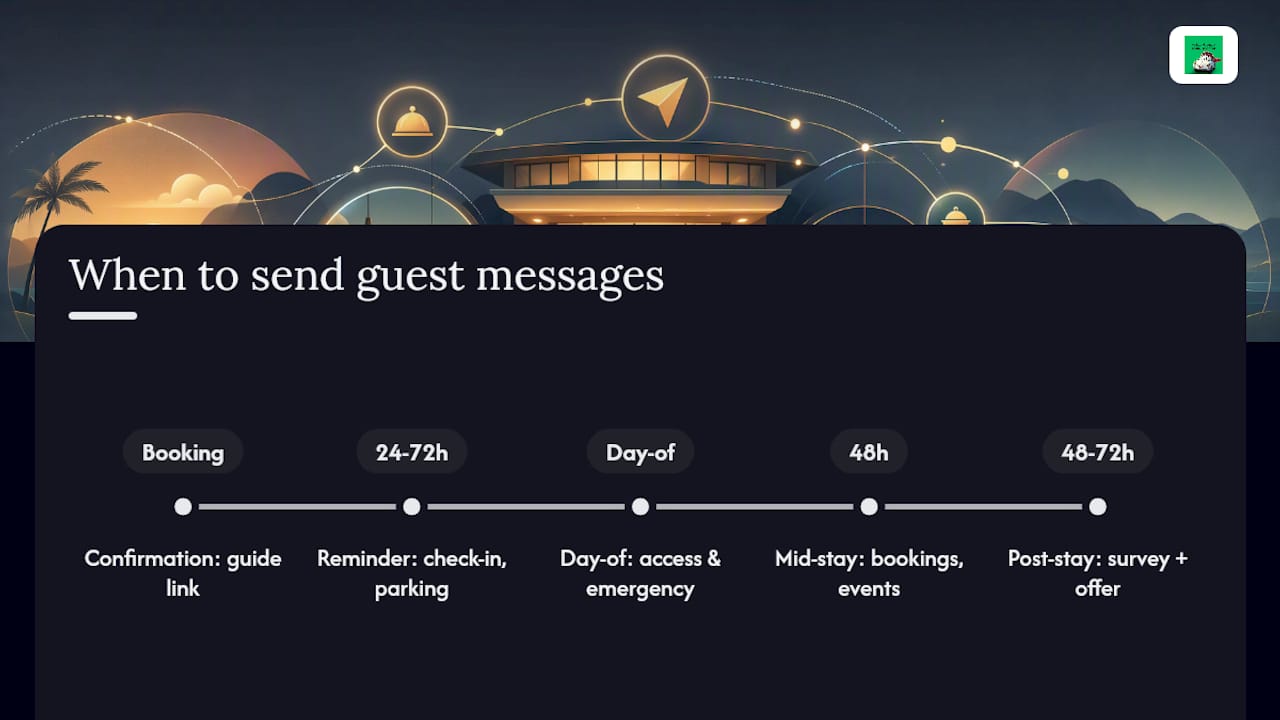
On-site (arrival through mid-stay): QR codes at the door, in the room, and near appliances give guests instant access to the relevant section of the guidebook. A mid-stay message at the 48-hour mark can prompt amenity bookings or share a local event happening that week. Keep these short. One link, one action.
Post-stay (48–72 hours after checkout): A survey link and a return offer. The survey captures NPS and specific feedback. The offer converts satisfied guests into repeat bookings. Contactless flows and QR-based access have become a baseline expectation in modern travel, not a differentiator.
Which platforms deliver digital guest education effectively?
Pick the simplest platform that removes friction for guests and connects to your existing operations. Complexity in the back end is fine. Complexity for the guest is not.
Platform types, from lightest to most integrated:
- Web-based guidebook (URL + QR): A single link or QR code opens a mobile-optimized page. No app, no login. Suitable for short-stay units and small portfolios. Tools in this category include Hostaway's guidebook feature and Chekin's digital guest book.
- Messaging platforms: SMS, WhatsApp, or email automation sends timed messages with links. Works alongside any guidebook. Adds scheduling and personalization without replacing the core resource.
- In-room tablets or smart TVs: Higher cost, higher engagement for resort or hotel contexts. Best for long-stay guests who need ongoing access to amenity schedules and local content.
- Full guest experience platforms: Digital guest platforms that centralize services let staff focus on hospitality while automation handles routine tasks and upsell opportunities. These integrate with property management systems (PMS), booking engines, and payment tools.
Selection criteria to apply before choosing:
- No-login access: Guests should reach the guidebook from a link or QR scan with zero friction
- Analytics: Track QR scans, link clicks, and page views to see what guests actually read
- PMS integration: Automate pre-arrival message delivery based on booking data
- Multilingual support: Essential for international guest segments
- Cost and scale: A 3-unit host needs a different solution than a 300-room hotel
A digital concierge layer on top of a basic guidebook adds upsell and personalization capabilities without requiring a full platform rebuild.
How do you write guest education content that actually gets read?
Short, scannable, action-first copy performs best. One-sentence instruction plus one supporting detail. That is the unit of effective guest education content.
Do:
- Use active voice: "Press the blue button to start the washing machine."
- Write step-by-step micro-instructions for any appliance with more than two steps.
- Add a photo or screenshot for anything involving a panel, remote, or keypad.
- Provide a language toggle for your top two or three guest segments. Travel personalization research confirms that language-matched content increases engagement across international audiences.
- Offer a downloadable PDF or printable checklist for guests who prefer offline access.
Don't:
- Use property jargon ("the HVAC unit in the utility corridor").
- Write paragraphs where a numbered list would work.
- Design content that requires an app download to access.
- Assume guests know local conventions (trash separation rules, recycling symbols, tipping norms).
Accessibility is not optional. Font size should be readable on a phone without zooming. Color contrast must meet basic readability standards. Alt text on images helps guests using screen readers and also loads faster on slow connections.
Pro Tip: Record a 20–30 second screen-capture or walkthrough video for any task that generates repeat questions. Research on virtual guest interactions shows short recorded sessions increase engagement and acceptance of online content compared to text-only instructions.
Keep content dynamic. Update it when local transport changes, when a facility closes for maintenance, or when a new amenity opens. A guest who follows outdated instructions and finds the pool closed will not leave a five-star review.
How do you get staff to actually use and promote digital resources?
A digital resource succeeds only when staff adopt and actively promote it. Technology adoption is a people problem as much as a platform problem. Effective digital guest education requires parallel staff training so teams can promote platforms to guests and handle exceptions.
Role assignments to define before launch:
- Content owner: One person responsible for updating the guidebook and reviewing analytics weekly during the first month.
- Pre-arrival coordinator: Sends or schedules the pre-arrival message sequence. Often automated, but someone must own the exception queue.
- Front desk or host: Promotes the guidebook during check-in and handles accessibility requests (guests who need a printed version or a different language).
Staff rollout, step by step:
- Run a train-the-trainer session covering the platform, the content, and the message sequence.
- Give front desk staff a one-page cheat sheet with the guidebook URL, QR code, and the three most common guest questions it answers.
- Script a check-in line: "Your guidebook link is in your confirmation email. It has the Wi-Fi password, appliance instructions, and my direct number."
- Set a two-week review date. Pull QR scan and click data. Identify which sections guests skip and which they return to.
- Feed findings back into a 30-minute staff debrief. Update content based on what the data shows.
Customer service in hospitality depends on staff confidence. A team that understands the digital tools and can explain them clearly to guests will see faster adoption and fewer escalations.
What KPIs tell you if guest education is working?
Measure engagement, operational impact, and guest sentiment. Raw content delivery tells you nothing. Behavior-based signals tell you what guests actually use.
The feedback loop matters as much as the metrics. Pull analytics weekly in the first month. Flag sections with low engagement and rewrite or reformat them. Flag sections that generate follow-up questions and add more detail. Digital customer feedback from post-stay surveys adds qualitative context that click data alone cannot provide.
Schedule a content review every 90 days. Assign the analytics pull to the content owner. Feed insights into the next staff debrief. That cycle, repeated consistently, is what separates a guidebook that gets read from one that gets ignored.
Ready-to-use templates for pre-arrival, arrival, and checkout
Three short templates a manager can adapt and send today.
Template 1: Pre-arrival message (send 24–72 hours before check-in)
Hi [Guest Name], your stay at [Property Name] starts [Date]. Your check-in time is [Time]. Access code: [Code]. Full instructions, Wi-Fi, and local tips: [Guidebook Link]. Questions? Reply here or call [Phone Number].
Template 2: Day-of arrival SMS or WhatsApp
You're almost here. Door code: [Code]. Wi-Fi: [Network] / [Password]. Parking: [Location]. Guidebook: [Link]. Safe travels.
Template 3: Post-stay message (send 48–72 hours after checkout)
Thank you for staying at [Property Name]. We'd love your feedback: [Survey Link]. Book your next stay and receive [Offer]: [Booking Link].
Implementation checklist to launch in one week:
- Assign a content owner and a pre-arrival coordinator.
- Select a platform (start with a web-based guidebook if budget is limited).
- Build or import content using the checklist in the "What content" section above.
- Localize into the top two languages for your guest segment.
- Test the full flow with a staff member acting as a guest.
- Print QR code cards for each unit or room.
- Embed the guidebook link in your booking confirmation template.
- Set a two-week analytics review date before launch.
For transport and transfer contexts, the same logic applies. Saudisayyah sends driver photos, vehicle details, and a tracking link before every trip, giving passengers the equivalent of a pre-arrival guidebook for their journey. The hotel check-in workflow and the pre-trip communication sequence share the same goal: eliminate uncertainty before the guest arrives.
Why digital guest education deserves operational priority now
Property teams that treat digital guest education as a marketing add-on consistently underperform those that treat it as an operational capability. The difference shows up in staff workload, NPS scores, and repeat booking rates.

HospitalityNet's commentary on guest education as a loyalty tool is not new. What has changed is the tooling. Web-based guidebooks, QR codes, and automated messaging have made it possible for a single-unit host to deliver the same pre-arrival information quality as a 200-room hotel. The barrier is no longer technology. It is internal adoption.
Staff training is where most implementations stall. A guidebook that staff do not mention during check-in gets ignored. A QR code that no one explains gets photographed and forgotten. The eLearning Industry's research on digital training is direct: training improves staff efficiency and guest outcomes together. You cannot separate the two.
The role of technology in pilgrimage contexts illustrates the stakes clearly. First-time visitors to unfamiliar destinations need more information, not less. Saudisayyah's approach of maintaining constant communication before and during every trip reflects the same principle that applies to any property: eliminate surprises, and guests focus on the experience rather than the logistics.
Sources
Implementers looking to go deeper on any section of this guide will find these resources directly relevant:
- What is Digital Guidebook? | Hostaway | Short-Term, Airbnb & Vacation Rental Management Software
- Digital Guest Book: How They Improve the Guest Experience - Chekin
- Educating Your Guests About Their Property While Communicating Positive Messages
- Use of guest speakers in higher education (systematic review) - PMC