

TL;DR:
- Ground transportation costs significantly impact the total Umrah trip budget, often rivaling flight expenses.
- Pre-booking transfers and choosing budget-friendly options can reduce costs and ease travel stress.
- Building flexibility and including buffers helps ensure a smooth experience for first-time pilgrims.
Planning transport for your first Umrah trip is one of the most confusing parts of the whole process. There are flights, airport transfers, intercity travel, and daily local trips, all with very different prices and booking methods. Many first-time pilgrims from the USA, UK, or EU underestimate total transport costs or get caught off guard by fees nobody warned them about. This guide covers every transport step in order, with real price benchmarks, honest comparisons, and practical tips built specifically for Western first-timers heading to the holy cities in 2026.
Table of Contents
- What you need before you travel: Transport planning essentials
- Step 1: International flights and arrival transfers — what to expect and what it costs
- Step 2: Intercity travel between Makkah and Madinah — fastest, cheapest, or most comfortable?
- Step 3: Local transport in Makkah and Madinah — buses, taxis, and private hire breakdown
- Final budgeting tips and common mistakes to avoid
- What we wish every first-time Umrah pilgrim knew about transport costs
- How Saudi Sayyah helps you travel smarter for Umrah
- Frequently asked questions
Key Takeaways
| Point | Details |
|---|---|
| Flights are the biggest cost | Expect international flights to be 40–50% of your transport budget, so book early and compare open-jaw tickets. |
| Compare all transfer options | Haramain Train, SAPTCO bus, and private cars each suit different needs and group sizes for intercity travel. |
| Watch for hidden expenses | Factor in station taxi fees, tolls, and booking service costs to avoid surprises during your trip. |
| Save with smart timing | Traveling off-peak and booking several months ahead can reduce total transport costs by up to 40%. |
| Packages add support, not savings | Umrah packages simplify logistics but usually come with a 15–20% higher price tag than DIY travel. |
What you need before you travel: Transport planning essentials
Before booking anything, you need a clear picture of how transport costs break down across your whole trip. Most people focus only on flights, but ground transport adds up fast.
Economy round-trip flights from the USA, UK, or EU typically cost $800 to $1,500, making up 40 to 50% of your total trip budget. That means the other half goes to everything else: airport transfers, intercity travel, and daily local trips. Knowing this split helps you plan without running short.
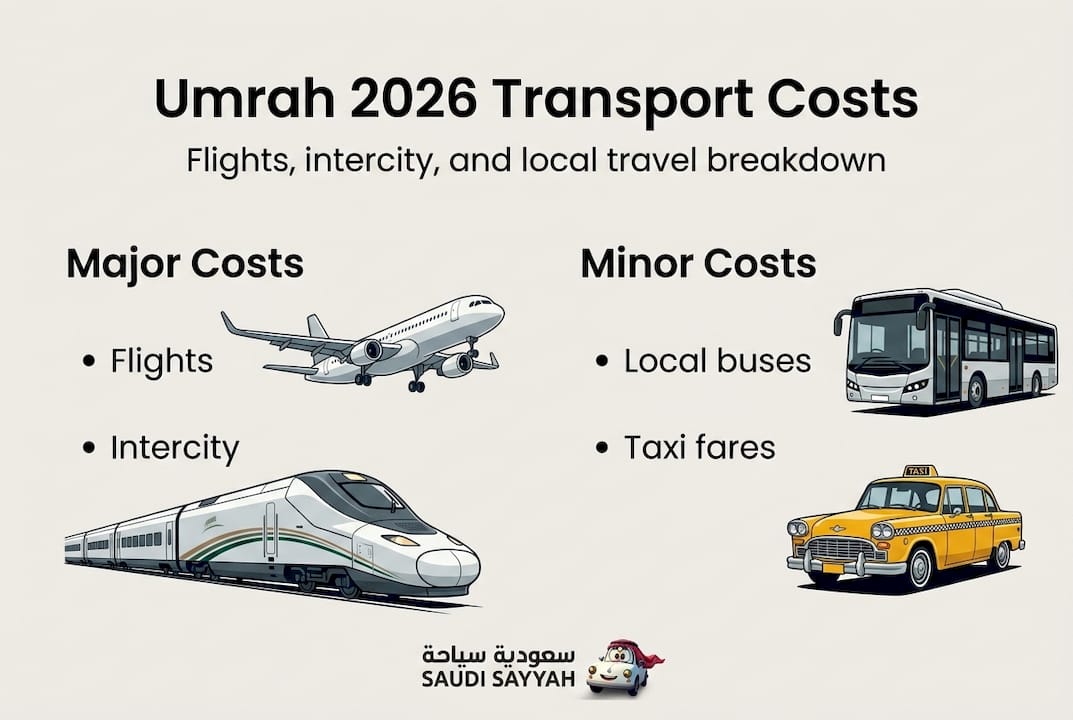
Here is a quick overview of the main transport budget categories:
| Transport category | Estimated cost (USD) | Share of transport budget |
|---|---|---|
| International flights | $800 to $1,500 | 40 to 50% |
| Airport transfers | $30 to $100 | 5 to 10% |
| Intercity (Makkah/Madinah) | $50 to $150 | 10 to 15% |
| Local daily transport | $50 to $200 | 10 to 20% |
Key preparations to make before departure:
- Book flights 3 to 6 months early. Mid-week departures often cost less.
- Consider an open-jaw ticket. Arrive in Jeddah (JED), depart from Madinah (MED), or the reverse. This removes one costly intercity leg.
- Pre-book your airport transfers for Umrah rather than arranging them at the airport, where prices are unpredictable.
- Download key apps: Haramain Train, SAPTCO, and a map app with offline capability.
- Carry Saudi Riyals (SAR) in cash for small taxis and buses that do not accept cards.
Pro Tip: Review the first-time Umrah travel tips checklist before finalizing your itinerary. Small oversights at this stage, like missing a transfer booking, can cost more to fix on the ground.
Step 1: International flights and arrival transfers — what to expect and what it costs
With pre-travel prep in mind, here is where your first major costs land: flights and the ride from the airport to your hotel.
Round-trip economy fares from Western countries run $800 to $1,500. Business class easily doubles that. Booking mid-week, 3 to 6 months ahead, and using fare alert tools can shave $100 to $300 off the total. Open-jaw tickets, where you fly into one city and out of another, typically cost the same or slightly less than a standard round-trip and save you a full intercity travel leg.
Once you land, here are your main transfer options from Jeddah or Madinah Airport:
| Transfer option | Price range | Travel time | Best for |
|---|---|---|---|
| Private car (pre-booked) | SAR150 to SAR300 | 45 to 90 min | Families, first-timers |
| SAPTCO airport bus | SAR20 to SAR40 | 60 to 120 min | Budget solo travelers |
| Haramain Train (from JED airport) | SAR40 to SAR80 | 30 to 40 min | Solo, light luggage |
| Airport taxi (unmetered) | SAR200 to SAR400 | 45 to 90 min | Last resort only |
Steps for a smooth airport arrival:
- Confirm your transfer booking 24 hours before landing.
- Save your driver's contact in your phone before the flight.
- Exchange some currency at the airport (enough for one small taxi if needed).
- Follow airport transfers logistics guidance and look for your driver in the arrivals hall, not outside.
- Avoid unmarked taxis outside the terminal. They charge 2 to 3 times the standard rate.
Pro Tip: Pre-booking through a reputable service is worth it. Review choosing the best Umrah transport options before you land so you are not making decisions at midnight after a 12-hour flight.
Step 2: Intercity travel between Makkah and Madinah — fastest, cheapest, or most comfortable?
Once you are settled, the next major cost is traveling between Makkah and Madinah. The distance is roughly 430 km and you have three main options.
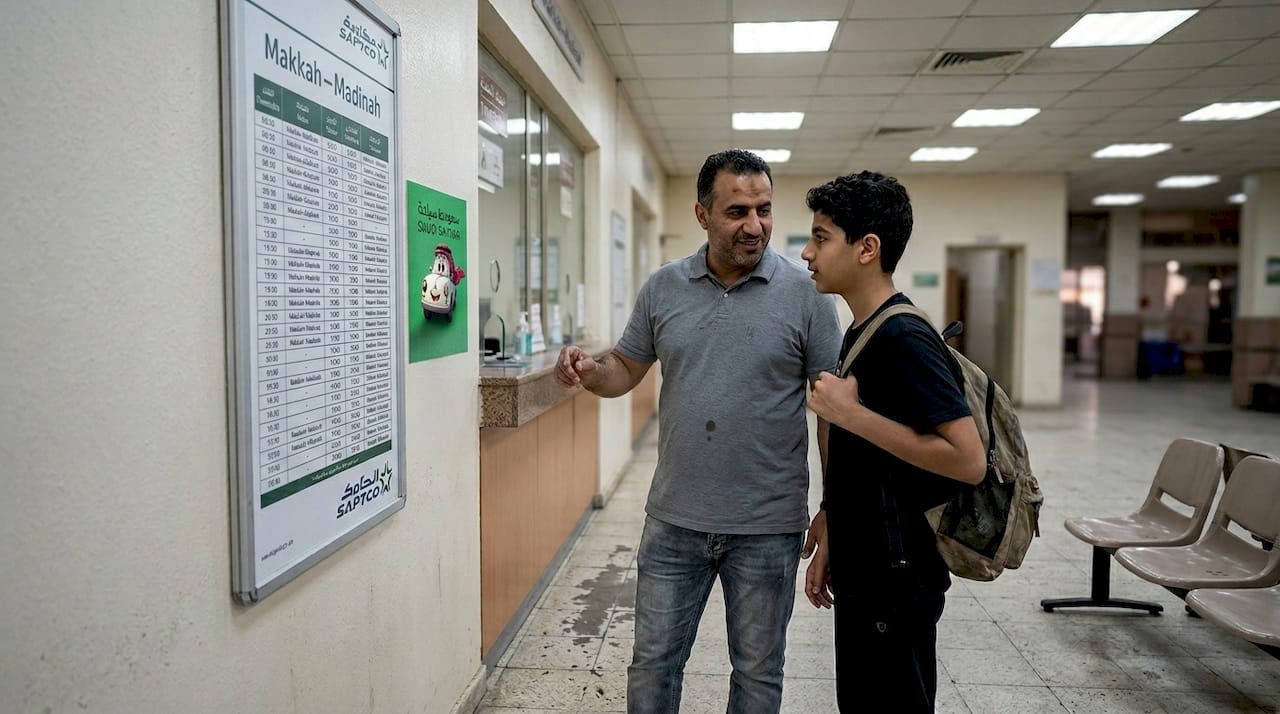
The Haramain High-Speed Train covers Makkah to Madinah in about 2 hours. Economy tickets run SAR150 to SAR230. Business class costs SAR250 to SAR360. The train is fast and comfortable, but stations are not in the city center, so you need a taxi each way at SAR40 to SAR50. For a solo traveler, this is manageable. For a family of four, those taxi costs add up quickly.
SAPTCO buses are the cheapest option at SAR69 per person for Makkah to Madinah, but the journey takes 3 to 7 hours depending on stops and traffic. Buses can be crowded, luggage space is limited, and they drop passengers at a station, not at your hotel. That adds another taxi fare.
| Option | Price per person | Journey time | Hidden extra cost |
|---|---|---|---|
| Haramain Train (economy) | SAR150 to SAR230 | ~2 hours | SAR40 to SAR50 taxi each way |
| SAPTCO Bus | SAR69 | 3 to 7 hours | SAR30 to SAR50 taxi each way |
| Private car (fixed rate) | SAR400 to SAR700 total | 4 to 5 hours | None, door to door |
For families, the benefits of private transport are clear: one fixed price, door-to-door service, no station taxis, and flexible departure times. For elderly pilgrims, the comfort and accessibility of a private vehicle can make a real difference. For group travelers, splitting a private car across 4 to 6 passengers brings the per-person cost below the train price.
Pro Tip: Always factor in the station taxi cost when comparing train versus private car. What looks like a SAR100 saving on the train can disappear quickly once you add two taxi fares at each end.
Step 3: Local transport in Makkah and Madinah — buses, taxis, and private hire breakdown
After main intercity travel, the daily costs of getting around the holy cities are easy to underestimate. These small trips to the Haram, markets, and your hotel add up over a 10 to 14 day stay.
SAPTCO intracity bus routes are available in both cities at very low fares, typically SAR5 to SAR15 per ride. They are reliable on main corridors but crowded during peak prayer times. Routes do not cover all areas, so a combination with taxis is often necessary.
Local taxis (metered or app-based) typically charge SAR20 to SAR60 for short city trips. During peak times (Friday prayers, Eid windows), fares spike significantly. Ride-hailing apps like Careem are available and generally more transparent on pricing than street taxis.
Key points for local transport:
- Use ride-hailing apps where possible for transparent pricing.
- Avoid street taxis during peak prayer times. Surge pricing is common and unregulated.
- Budget SAR50 to SAR100 per day for local transport if you take 3 to 5 short trips.
- For accessible transport bookings, request vehicles with extra space or wheelchair access in advance.
- Keep small cash for buses and older taxi drivers who do not use apps.
"Local transport costs are the most underestimated part of any Umrah budget. A 10-day trip with 4 daily rides can easily add SAR500 to SAR1,000 to your total."
Pro Tip: Review safety tips for Umrah pilgrims before your trip. Knowing which areas to avoid late at night and which platforms are trusted saves both money and stress.
Final budgeting tips and common mistakes to avoid
With all transport modes explained, here is how to put the full budget together without surprises.
The single biggest lever on total cost is timing. Off-peak travel in January and February is 20 to 40% cheaper across flights and ground transport. If your schedule allows, this alone can save hundreds of dollars.
A full transport budget summary for a solo traveler:
- Flights: $800 to $1,500 (book 3 to 6 months early)
- Arrival transfer: SAR150 to SAR300 (pre-booked private or train)
- Intercity (one way): SAR150 to SAR700 depending on mode and group size
- Local daily transport: SAR50 to SAR100 per day
- Emergency buffer: 15% of total transport budget
Total estimated range: $1,000 to $2,000 USD depending on season, group size, and comfort level.
Common mistakes first-timers make:
- Forgetting station taxi costs at both ends of the train journey (SAR40 to SAR50 each way).
- Skipping the emergency buffer and running short mid-trip.
- Not checking Umrah transport decision options early enough to compare prices.
- Assuming packages are always more expensive. For novices, packages that include support often cost only 15 to 20% more than DIY but remove significant logistical stress.
Pro Tip: If flying into Madinah is cheaper from your departure city, do that first. It removes one expensive intercity leg and is often significantly cheaper from European and UK airports.
What we wish every first-time Umrah pilgrim knew about transport costs
The numbers in this guide are useful. But the real challenge for most first-time Western pilgrims is not the price. It is the unexpected: the fatigue after a 12-hour flight, language barriers at a busy station, traffic that triples your travel time, or a family member who needs more help than planned.
These are the moments where saving SAR80 on a bus ticket stops being a win. Paying a little more for a pre-arranged private vehicle, with a confirmed driver and fixed price, removes an entire category of stress. That is worth something real, especially on a trip this meaningful.
Based on reliable Umrah transport insights gathered over years of helping Western pilgrims, the travelers who report the smoothest experiences are not always the ones who spent the least. They are the ones who built in flexibility, kept a buffer, and chose certainty over savings at the critical touchpoints like arrival transfers and intercity moves.
A 10% premium on key legs of the journey often pays for itself in time, energy, and peace of mind.
How Saudi Sayyah helps you travel smarter for Umrah
Every transport step in this guide has one thing in common: it goes smoother with confirmed bookings, clear pricing, and a reliable local contact.
Saudi Sayyah covers airport transfers, intercity rides, and daily local hire through one platform built for pilgrims. The Umrah car hire service supports English-speaking travelers with fixed rates, no hidden fees, and real-time driver tracking sent before every trip. The Umrah vehicle fleet uses latest-model vehicles with professional, experienced drivers. Before you arrive, check Makkah live updates for current conditions. No guesswork. No surprises. Just reliable transport so you can focus on your pilgrimage.
Frequently asked questions
How much should I budget for total transport during Umrah if coming from the USA, UK, or EU?
Economy round-trips cost $800 to $1,500, making up 40 to 50% of total trip costs. Plan for $1,000 to $2,000 total transport across flights, intercity travel, and local rides, adjusted for group size and season.
Is it cheaper to use the Haramain High-Speed Train, SAPTCO bus, or a private car between Makkah and Madinah?
SAPTCO buses are the cheapest per person, the Haramain Train is fastest but adds station taxi costs, and private cars offer the best value for groups of 4 or more traveling door to door.
What are hidden or easily missed transport costs for Umrah pilgrims?
Station taxis at both ends of train journeys cost SAR40 to SAR50 each way. Other missed costs include peak pricing surges, app booking fees, and local cash-only bus fares.
Are Umrah packages better for transport than booking everything myself?
Packages typically cost 15 to 20% more than DIY bookings but include support, pre-arranged transport, and far less logistical stress, making them a solid choice for first-time travelers.
When is the best time to book transport to save money during Umrah?
Book 3 to 6 months in advance and target off-peak months like January and February, when prices across flights and ground transport are 20 to 40% lower than peak season.