
TL;DR:
- Western advisories highlight regional threats, but Makkah and Madinah remain generally safe.
- Proper planning includes vaccination, documentation, reliable transport, and situational awareness.
- Staying informed and prepared minimizes risks, ensuring a safe and smooth Umrah pilgrimage.
Traveling to Saudi Arabia for Umrah is a deeply personal milestone. For first-time pilgrims from Western countries, it also comes with real questions about safety. Western governments currently issue Level 2 and Level 3 caution advisories for Saudi Arabia, citing regional missile and drone threats. That can feel alarming. But the reality on the ground in Makkah and Madinah is far more manageable than headlines suggest. This guide walks through current advisories, health requirements, transport options, and on-the-ground safety steps so you can focus on your pilgrimage with confidence.
Table of Contents
- Understanding current travel advisories and safety alerts
- Preparing for safe travel: health, documents, and permits
- Choosing safe and reliable transport in Saudi Arabia
- On-the-ground safety: situational awareness and troubleshooting
- Our take: Why context and preparation matter more than headlines
- Enhance your Umrah journey with trusted transport
- Frequently asked questions
Key Takeaways
| Point | Details |
|---|---|
| Monitor both advisories | Checking both Western and Saudi safety alerts ensures you’re prepared for risks and local actions. |
| Get required vaccines early | Timely meningitis vaccination is critical—schedule at least two weeks before traveling for Umrah. |
| Use trusted transport options | Uber, Careem, Haramain train, and staying near the Haram help minimize exposure to hazards. |
| Prepare documents and permits | Make sure you have your Nusuk permit, visa, and emergency contact details before your journey. |
| Practice situational awareness | Stay alert to official safety updates, crowds, and weather for a smoother and safer pilgrimage. |
Understanding current travel advisories and safety alerts
Not all advisories say the same thing. The US, UK, Australia, and Canada each publish their own risk assessments for Saudi Arabia, and they differ in tone and scope.
| Country | Advisory level | Primary concern |
|---|---|---|
| United States | Level 2: Exercise increased caution | Missile/drone threats, terrorism |
| United Kingdom | High degree of caution | Regional conflict, border areas |
| Australia | Exercise a high degree of caution | Terrorism, civil unrest |
| Canada | Exercise a high degree of caution | Regional instability |
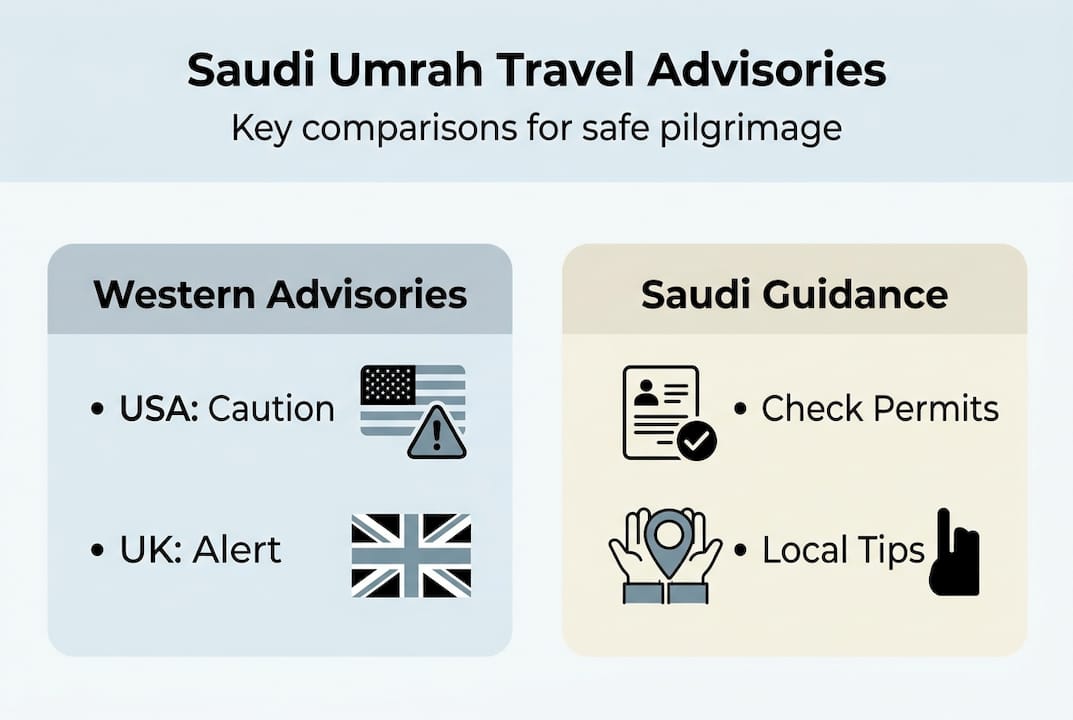
All four governments flag regional conflict as the main concern. None advise against visiting Makkah or Madinah specifically. The US Travel Advisory notes that threats are concentrated near Yemen-facing border regions, not in the holy cities.
Saudi official sources take a different angle. Saudi guidance for pilgrims focuses primarily on crowd management, heat safety, and health protocols rather than terrorism. That contrast matters. It means you are dealing with two parallel risk frameworks, and both are worth reading.
"The U.S. Embassy has ordered the departure of non-emergency U.S. government employees from Saudi Arabia due to threats of missile and drone attacks." — US Embassy Riyadh, March 2026
How do you act on this? Start with a simple risk assessment:
- Check your home country advisory before booking and again one week before departure
- Avoid border regions near Yemen, including Jizan and Najran provinces
- Stay in the Haram corridor (Makkah and Madinah) where security is dense and incidents are rare
- Register with your embassy so you receive real-time alerts by email or SMS
- Bookmark official sources on your phone for quick access while traveling
Planning your airport transfers for Umrah in advance also reduces exposure to unfamiliar situations on arrival, when disorientation is highest.
Advisories are not reasons to cancel. They are tools for informed decision-making. Read them carefully, note the specific geographic warnings, and plan your itinerary around the low-risk zones where millions of pilgrims travel safely every year.
Preparing for safe travel: health, documents, and permits
Once you have assessed the advisory landscape, the next step is getting your paperwork and health preparations in order. This is where many first-time pilgrims underestimate the lead time required.

Health requirements
The meningitis vaccine is mandatory for all Umrah pilgrims. This is not optional. UK health data recorded 5 confirmed MenW meningitis cases in returning Umrah pilgrims in early 2025, underscoring why Saudi Arabia enforces this requirement strictly at entry.
Pro Tip: Book your meningitis vaccine at least two weeks before departure. The vaccine needs time to build immunity, and some clinics require an appointment several days in advance.
Beyond meningitis, consider these additional health steps:
- Get a seasonal flu vaccine, especially if traveling during peak season
- Consult your doctor about COVID-19 booster status
- Pack oral rehydration salts and a basic first aid kit
- Carry a supply of any prescription medication with a doctor's letter in English and Arabic
Documents and permits
| Document | Details |
|---|---|
| Passport | Valid for at least 6 months beyond travel dates |
| Umrah visa | Obtained through licensed travel agent or Nusuk app |
| Nusuk permit | Required for entry to Masjid al-Haram and prayers |
| Vaccination certificate | Meningitis proof required at Saudi border |
| Emergency contacts | Written copy separate from your phone |
The Nusuk app is the official Saudi platform for managing Umrah permits and booking prayer slots. Download it before you leave home. Detailed visa and vaccine requirements for US citizens are worth reviewing early in your planning process.
Keep digital and physical copies of every document. Store one set in your hotel safe and carry another on your person.
Choosing safe and reliable transport in Saudi Arabia
Transport is one of the most practical safety decisions you will make during Umrah. Getting it right reduces heat exposure, crowding risk, and the chance of getting lost in an unfamiliar city.
Recommended transport options for pilgrims include:
- Uber and Careem: Both operate widely in Jeddah, Makkah, and Madinah. Fares are metered, drivers are rated, and you can track your route in real time
- Haramain High Speed Railway: Connects Jeddah, Makkah, and Madinah quickly and affordably. Ideal for inter-city travel between the two holy cities
- Official Haram shuttle buses: Free or low-cost buses run between key pilgrimage sites. Reliable but can be crowded during peak times
- Pre-booked private transfers: Best option for airport arrivals, elderly pilgrims, or groups needing flexibility
Staying close to Masjid al-Haram is one of the most effective safety decisions you can make. Shorter walking distances mean less heat exposure, less time in crowds, and faster access to facilities if something goes wrong.
Pro Tip: Arrive at the Haram at least 45 minutes before prayer time. Crowd density spikes in the final 15 minutes before each prayer, and navigating that surge is harder and riskier.
For pilgrims with mobility needs, accessible transport for Umrah is available through specialist providers. For older travelers, dedicated transport for elderly pilgrims covers specific vehicle and routing considerations. Traveling with a group? Coordinated group travel tips help keep everyone together and on schedule.
Always carry water. Temperatures in Makkah regularly exceed 40°C (104°F) during summer months. Dehydration sets in faster than most people expect, especially during physical rituals like Tawaf.
On-the-ground safety: situational awareness and troubleshooting
Preparation before departure only goes so far. Once you are in Saudi Arabia, staying safe requires active awareness and a clear plan for when things do not go as expected.
Step-by-step alert monitoring
- Save your home country's embassy contact number before landing
- Purchase a local SIM card at the airport for data access and local calls
- Check your government's travel advisory app or website every 48 hours
- Monitor Saudi Civil Defense social media accounts for local alerts
- Share your daily itinerary with a trusted contact back home
The US Travel Advisory issued shelter-in-place guidance for embassy staff during missile and drone incidents in 2025. That protocol applies to civilians too. If an alert is issued, stay indoors, move away from windows, and wait for the all-clear from official sources.
"If you decide to travel to Saudi Arabia, have a contingency plan for emergency situations." — US Embassy Riyadh
Common troubleshooting scenarios
- Lost passport: Contact your embassy immediately. Most Western embassies in Riyadh offer emergency travel documents within 24 to 48 hours
- Medical emergency: Saudi Arabia has high-quality hospitals near the Haram. Save the number for Al-Noor Specialist Hospital in Makkah before you arrive
- Separated from your group: Designate a fixed meeting point near a landmark before entering crowded areas
- Transport breakdown: Use Uber or Careem as backup. Keep the app installed and your account funded
- Unexpected curfew or area closure: Follow instructions from Saudi police and contact your accommodation for guidance
For best group transport options that keep everyone coordinated, pre-booking is always more reliable than arranging on the day. Detailed planning guidance for first-time visitors to the holy cities covers many of these scenarios in depth.
Stay connected, stay hydrated, and stay aware. Those three habits resolve the majority of on-the-ground problems pilgrims encounter.
Our take: Why context and preparation matter more than headlines
Headlines about missile threats and travel advisories can make Saudi Arabia sound dangerous across the board. That framing is misleading. The risks are real but geographically specific. Makkah and Madinah are not the Yemen border. Millions of pilgrims complete Umrah safely every year, including hundreds of thousands from Western countries.
What actually separates a smooth pilgrimage from a stressful one is not luck. It is preparation. Pilgrims who book vetted transport, get vaccinated on time, register with their embassy, and monitor both Western and Saudi advisories consistently have fewer problems. The ones who skip those steps are the ones who end up in difficult situations.
The key insight: treat Western and Saudi advisories as complementary, not competing. Western advisories flag geopolitical threats. Saudi sources flag crowd and health risks. You need both to have a full picture.
Using reliable transport is one of the most practical ways to reduce daily risk. Vetted drivers, real-time tracking, and pre-confirmed bookings remove a significant layer of uncertainty from each day.
Enhance your Umrah journey with trusted transport
Safety during Umrah is built on layers: the right documents, the right vaccines, the right information, and the right transport. Saudi Sayyah handles the transport layer so you can focus on everything else.
Through a fully automated booking system, Saudi Sayyah provides real-time driver tracking, verified vehicle details, and professional drivers with years of experience serving pilgrims. Every booking is confirmed in advance, with no surprises on arrival. Browse available car hire services or explore the premium Umrah transport fleet to find the right option for your group size and schedule. Reliable transport is not a luxury during Umrah. It is a safety decision.
Frequently asked questions
What are the main travel risks for Umrah pilgrims in Saudi Arabia?
Regional missile and drone threats near border areas, heat exhaustion, crowd-related incidents, and meningitis exposure are the primary risks for Umrah pilgrims. These risks are manageable with the right preparation and awareness.
Which apps are essential for safe travel and Umrah entry?
Nusuk is required for Umrah permits and prayer slot bookings; Uber and Careem are the most reliable ride-hailing options for getting around Makkah and Madinah safely.
What vaccines are mandatory for Umrah, and when should I get them?
The meningitis vaccine is mandatory for all Umrah pilgrims and should be taken at least two weeks before departure. UKHSA data confirms that cases in returning pilgrims make this a genuine health priority, not just a formality.
How can I stay updated on safety alerts while in Saudi Arabia?
Monitor both your home country's travel advisory updates and Saudi official sources for real-time information. Register with your embassy before departure so alerts reach you directly.