
TL;DR:
- Travel accessibility involves designing services so pilgrims with diverse mobility, sensory, or cognitive needs can participate fully throughout their journey.
- The success of an accessible trip depends on careful planning of every stage, including booking, transit, accommodation, and site access, by addressing the weakest links in the accessibility chain.
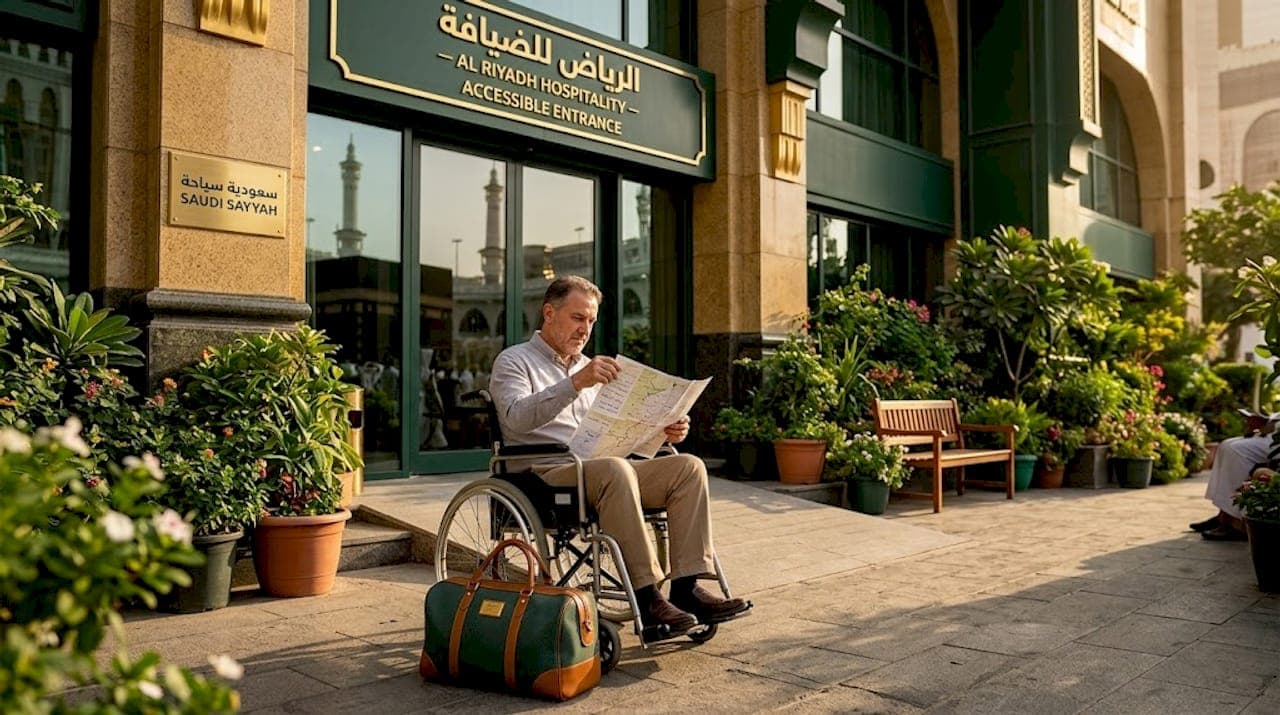
What is travel accessibility? Most people picture a ramp at the entrance of a building. The reality is far broader. Travel accessibility means designing services so that people can participate fully regardless of mobility, vision, hearing, or cognitive needs. For first-time Umrah pilgrims, this matters at every stage: from the moment you book your flight to the minute you stand inside Masjid al-Haram. Overlook any single link in that chain, and the entire journey becomes harder than it needs to be.
Table of Contents
- Understanding travel accessibility: core concepts and why it matters
- Travel accessibility standards and challenges for international pilgrims
- Accessibility features and practical realities of Umrah travel in Saudi Arabia
- Planning and preparing for an accessible Umrah journey: practical steps and expert tips
- The overlooked truths about travel accessibility for Umrah pilgrims
- Make your accessible Umrah journey smooth with Saudi Sayyah
- Frequently asked questions
Key Takeaways
| Point | Details |
|---|---|
| Accessibility is holistic | Travel accessibility covers all phases of a trip, from booking through transportation to visiting sites, ensuring participation with dignity. |
| Standards vary internationally | Accessibility rules differ by country, so pilgrims must research Saudi Arabia’s specific regulations and service offerings. |
| Verify accessibility details | Don’t rely only on booking site labels; confirm room sizes, transport accessibility, and services directly with providers. |
| Plan for the entire journey | Manage stamina, transport transfers, and crowd navigation to minimize barriers beyond holy site infrastructure. |
| Communicate needs early | Providing accurate information about mobility aids and requirements well before travel helps ensure smooth, dignified experiences. |
Understanding travel accessibility: core concepts and why it matters
Accessibility in travel is not a special accommodation. It is a baseline standard. Inclusive tourism enables travelers to experience destinations with dignity and independence through universally designed products and services. That word "dignity" is doing a lot of work in that definition. It shifts the focus from "can you technically get through the door" to "can you move through this experience without depending on strangers or feeling like an afterthought."
The social model of disability is worth knowing here. It argues that disability is not a personal condition to be managed. It is a mismatch between a person's needs and the environment around them. A wheelchair user is not disabled by their chair. They are disabled by stairs. This framing matters because it puts the responsibility on service providers, transport companies, hotels, and tour operators to adapt, not on the traveler to cope.
Travel accessibility touches every stage of a trip:
- Booking. Can you communicate your needs clearly and confirm they have been acknowledged?
- Transit. Does the airport, airline, and ground transport accommodate you without barriers?
- Accommodation. Does the room actually match what "accessible" means to you specifically?
- Site access. Can you participate in the rituals themselves at the pace your body allows?
One of the most useful frameworks is the accessibility chain. A trip is only as accessible as its weakest link. You can have the best wheelchair-accessible hotel in Makkah, but if the shuttle from the airport has two steps and no ramp, the whole system breaks down. Understanding this helps Umrah pilgrimage logistics planning from the start, not as an afterthought.
"Inclusive tourism enables travelers to experience destinations with dignity and independence through universally designed tourism products and services." — Inclusive Tourism
Travel accessibility standards and challenges for international pilgrims
International travel adds complexity. Accessibility rules vary by country, by airline, and sometimes by airport terminal. What is legally required in one country may be entirely voluntary in another. Pilgrims traveling from the United States, United Kingdom, or Australia will find that Saudi Arabia has its own regulatory environment, and assuming your home country's standards apply is a common and costly mistake.
Airline policies deserve specific attention:
- Mobility aids. Airlines and airports must collaborate to transport wheelchairs safely, but policies on battery-powered chairs differ. Lithium-ion batteries have specific size and watt-hour restrictions.
- Pre-boarding. Most airlines offer pre-boarding for passengers with disabilities, but you must request it. It is not automatic.
- Hidden disabilities. Conditions like chronic fatigue, heart conditions, or severe arthritis are not always visible. Many pilgrims have these conditions and do not think to flag them with their airline.
- Service animals. Cultural and religious norms in Saudi Arabia differ from Western countries regarding animals in public spaces. Verify this directly with your airline and the Saudi authorities before assuming your service animal can accompany you throughout.
Contacting your airline at least 48 to 72 hours before departure is the minimum. For battery-powered wheelchairs or scooters, submit documentation as early as possible to avoid the aircraft being declared unable to carry your equipment.
Pro Tip: Ask your airline for a written confirmation of every accessibility arrangement you make. A verbal agreement over the phone is not enough protection if something changes at check-in.
For more detailed guidance on accessible transport for Umrah pilgrims, the specifics of what to request and when are covered thoroughly.
Accessibility features and practical realities of Umrah travel in Saudi Arabia
Saudi Arabia has made significant investments in holy site accessibility. Masjid al-Haram offers dedicated wheelchair Tawaf lanes, marked paths for Sa'i, free wheelchair services at entry points, elevators throughout the complex, and electric wheelchair and cart rentals for pilgrims with mobility needs. These are genuine, usable features, not just symbolic ones.
Electric wheelchair rentals typically cost between SAR 100 and SAR 300 per day depending on the type and rental duration. Manual wheelchairs are available free of charge from mosque staff at designated entry gates.
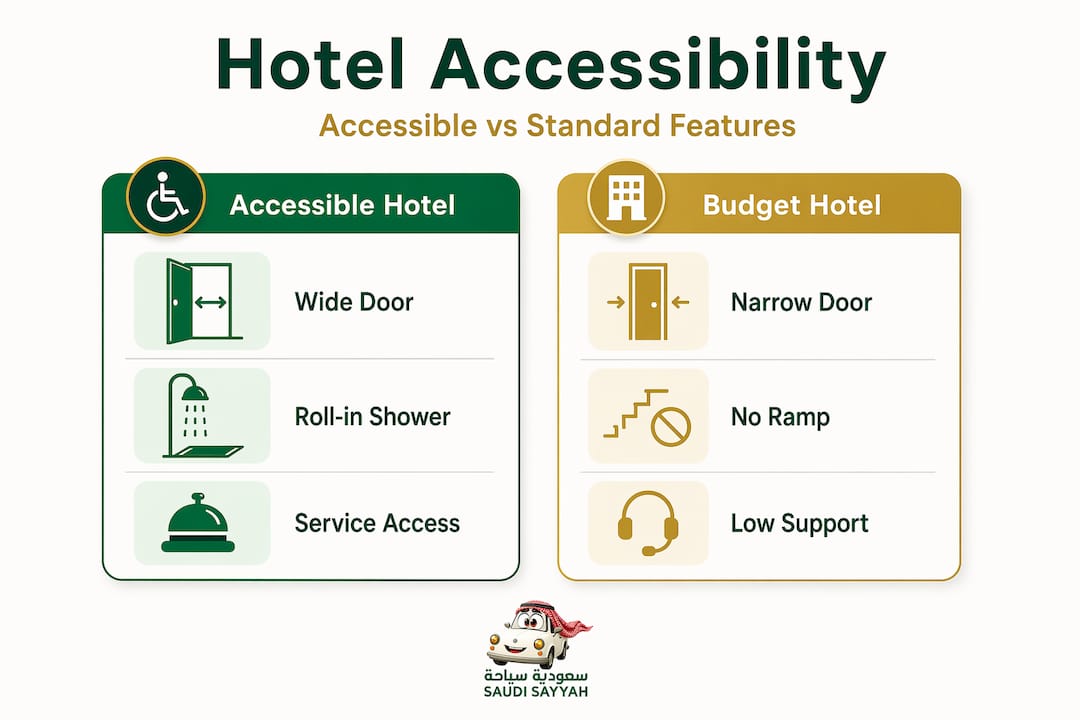
Here is how accessible and non-accessible hotel options near the Haram compare:
| Feature | Accessible hotel (4 to 5 star) | Standard or budget hotel |
|---|---|---|
| Doorway width | 90 cm or wider | Often 70 to 75 cm |
| Bathroom setup | Roll-in shower, grab bars | Standard tub or shower only |
| Elevator access | Yes, to all floors | Sometimes absent or unreliable |
| Proximity to Haram | Often within 500 meters | May require shuttle |
| Staff disability training | Usually present | Inconsistent |
The hotel choice directly affects stamina. A pilgrim staying 200 meters from the Haram gate expends far less energy than one staying 1.5 kilometers away and relying on shuttle buses with steps.
The most friction points occur outside the mosque itself. Hotel transfers, shuttle services, and navigating crowds between sites are where plans often fall apart. Verifying transport and accommodation details directly, and not relying on booking labels alone, is not optional. It is necessary.
Here are key checklist items for this stage:
- Confirm wheelchair ramp access at your hotel entrance
- Verify elevator availability and minimum door width
- Ask your transport provider specifically whether the vehicle has a ramp or lift
- Identify the closest accessible gate to the Haram from your hotel
Pro Tip: Book accessible transport for Umrah and family transport planning through providers who specialize in pilgrimage routes. They understand both the physical layout and the religious timing demands.
Planning and preparing for an accessible Umrah journey: practical steps and expert tips
Accessible travel requires more research, more calls, and more backup plans than standard travel. This is not discouraging. It is just accurate. Building your plan around that reality means fewer surprises.
Here is a practical planning sequence:
- Assess your specific needs. List every requirement: room features, doorway dimensions, bathroom type, elevator access, and walking distance tolerances. Be precise, not general.
- Contact your airline. Notify them of mobility aids, medical equipment, and any assistance needed during the flight. Submit battery documentation for powered wheelchairs immediately.
- Verify hotel accessibility in detail. Call the hotel directly. Ask about door widths, shower type, grab bars, and the distance from your room to the elevator. Do not rely on website descriptions alone.
- Arrange ground transport in advance. Confirm vehicle type, ramp or lift availability, and driver familiarity with accessible boarding at least 48 hours before each transfer.
- Pack medical and mobility essentials. Bring chargers, spare batteries, medications in original packaging with prescriptions, and any documentation for medical devices.
- Build rest into your itinerary. Rituals like Tawaf and Sa'i involve significant physical effort. Plan recovery time between sessions, especially for the first two days.
- Save local contact numbers. Have direct contact details for your hotel's accessibility coordinator, your transport provider, and the nearest medical facility.
Pro Tip: Review pre-arranged Umrah transport tips and guidance on maximizing transport comfort before confirming any bookings. These resources address specific scenarios that catch first-timers off guard.
Clear, proactive communication with every service provider is the single most effective thing you can do. Write down what you need. Confirm it in writing. Follow up 24 hours before each leg of travel.

The overlooked truths about travel accessibility for Umrah pilgrims
Most accessibility guides focus on what facilities exist. Far fewer address why the system still regularly fails pilgrims who did everything right.
The first uncomfortable truth: "accessible" is a label, not a guarantee. A hotel that marks its rooms as accessible may be measuring by local standards that bear no resemblance to what a pilgrim using a power wheelchair actually needs. Verifying details beyond booking labels is essential because accessibility often fails at service boundaries, like transferring between transport and holy sites, where no single provider owns the problem.
The second truth: transport demands equal or more attention than mosque access. Masjid al-Haram has invested heavily in internal accessibility features. The roads, vehicles, and crowds outside have not kept pace to the same degree. Daily transfers, wait times, and crowd navigation are the biggest challenges for pilgrims with limited stamina, not the mosque itself. A pilgrim who plans only for the mosque and not for the three transfers a day between hotel, bus stop, and gate will be exhausted by day two.
The third truth: energy is a resource that needs to be rationed. First-time pilgrims often try to complete rituals at the fastest possible pace out of excitement or religious urgency. For pilgrims with mobility issues or chronic conditions, this approach backfires. Sustainable pacing, shorter sessions, and rest built into the schedule produce a better overall experience and allow pilgrims to complete all required rituals without health setbacks.
The fourth truth: coordination gaps between providers are the biggest structural problem. Your airline may handle your wheelchair perfectly. The airport transfer may be flawless. But if the hotel van that picks you up has no ramp, the whole chain broke. The responsibility to identify and fill these gaps currently falls on the traveler. That is the reality of accessible tourism today, and it is why detailed planning is non-negotiable.
For deeper accessible transport insights, understanding how providers in Saudi Arabia specifically operate will help set realistic expectations before departure.
Make your accessible Umrah journey smooth with Saudi Sayyah
Planning an accessible Umrah trip involves a lot of moving parts. Transport is one of the most controllable elements when you book the right provider. Saudi Sayyah offers vehicle options suited to pilgrims with mobility requirements, with drivers experienced in pilgrimage routes and accessibility needs. All bookings include real-time driver tracking, vehicle details, and direct contact before every trip, so there are no surprises at any transfer point.
Saudi Sayyah's car hire services for Umrah pilgrims cover key routes between airports, hotels near the Haram, and pilgrimage sites. The premium accessible vehicle fleet includes late-model vehicles with features that support comfortable boarding and travel. Combine the planning framework in this guide with pre-booked, verified transport, and the logistics side of your journey is handled. That leaves the focus where it belongs: on the spiritual purpose of the trip.
Frequently asked questions
What does travel accessibility mean for Umrah pilgrims?
It means designing services and environments so pilgrims with mobility, sensory, or cognitive needs can participate fully throughout their entire journey, not just inside holy sites.
How can I ensure my mobility aids are handled properly when flying to Saudi Arabia?
Provide detailed information about your mobility aids to your airline well before your flight. For battery-powered chairs, IATA guidelines support safe transport, but airlines need advance documentation to plan properly.
Are all hotels near the Haram equally accessible?
No. Newer upscale hotels typically meet international standards, while budget accommodations often lack ramps, suitable elevators, or roll-in showers. Always verify specific features directly with the hotel before booking.
What are common challenges beyond mosque accessibility during Umrah?
Transport between accommodations and holy sites, stamina management for repetitive rituals, and navigating dense crowds are the most common friction points, all of which require advance planning and reliable transport arrangements.