
TL;DR:
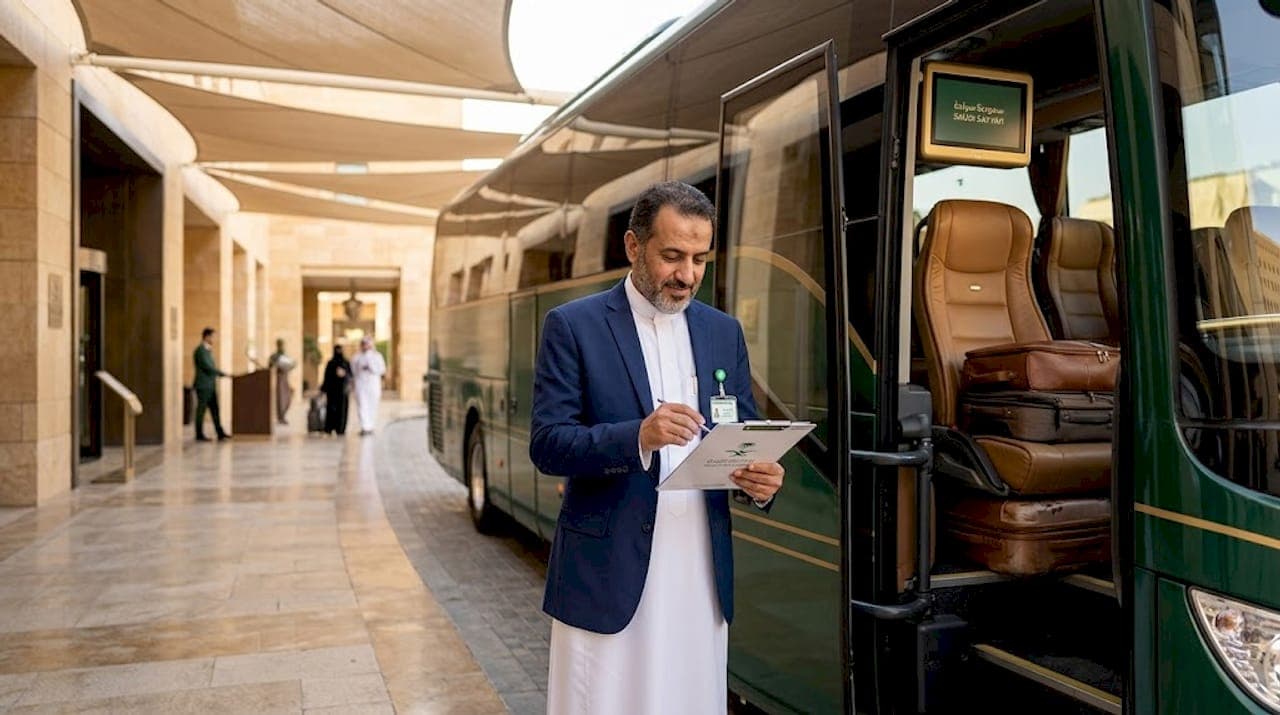
- Choosing licensed transport during Umrah is essential to avoid risks such as fines, vehicle confiscation, and missed rituals. Licensed services provide safety, legal checkpoint access, emergency coordination, and schedule reliability, ensuring a smoother pilgrimage. Verifying operator licenses and booking early with trusted providers like Saudi Sayyah guarantees a secure, compliant, and stress-free journey.
Not all transport options during Umrah are created equal. Many first-time pilgrims arrive in Saudi Arabia assuming that any available vehicle or ride will do the job. That assumption carries serious risk. The wrong choice can mean denied access at checkpoints, hefty government fines, delays during critical ritual windows, or worse, no support during a medical crisis. This guide covers what makes transport secure and compliant for Umrah, why the stakes are higher than most pilgrims realize, and how to choose and book the right service before you land.
Table of Contents
- Understanding the risks of informal and unlicensed transport
- How Saudi Arabia ensures safety: Licensed transport advantages
- Public vs. private transport: Finding the right fit for your Umrah journey
- How to verify and book secure, compliant transport for Umrah
- The overlooked link: Secure transport is more than just a ride
- Connect with trusted Umrah transport experts
- Frequently asked questions
Key Takeaways
| Point | Details |
|---|---|
| Legal compliance is crucial | Using licensed transport is required by Saudi law and prevents fines or disruptions during your pilgrimage. |
| Licensed services enhance safety | Government-approved vehicles feature checks, support, and reliable access to all sites. |
| Different needs, different options | Compare public and private services to choose the best fit for your group’s comfort and schedule. |
| Medical responsiveness matters | Secure transport helps ensure quick, coordinated medical assistance for pilgrims if needed. |
| Prepare and verify ahead | Confirm all licenses and documentation before travel to ensure a smooth, worry-free journey. |
Understanding the risks of informal and unlicensed transport
To understand why secure transport matters, it's important to look at the real risks faced by those who choose informal or unlicensed options.
Pilgrims from Western countries often assume that ride-hailing apps or informal drivers offering cheap fares near hotels are acceptable alternatives to official services. They are not. Saudi Arabia enforces strict transport regulations during Umrah and Hajj seasons, and the consequences of non-compliance fall on both the driver and the passenger.
Licensed transport services are required for legal access to holy sites, checkpoints, and during Hajj/Umrah seasons, with fines reaching up to 100,000 SAR and vehicle confiscation for violations.
That's not a minor inconvenience. Being stopped at a checkpoint in an unlicensed vehicle could mean missing Tawaf, Sai, or other time-sensitive rituals entirely. There's no appeal process in the moment. There's no refund on your spiritual schedule.
The health dimension is equally serious. Proper transport aids in faster response for the roughly 23% of pilgrims who face medical issues during their journey. Unlicensed vehicles have no coordination with emergency services, no trained protocols, and often no air conditioning adequate for Saudi heat. A delay of even 20 to 30 minutes in a heat emergency can be life-threatening.
Key risks of unlicensed or informal transport during Umrah:
- Fines up to 100,000 SAR imposed on operators and potentially passengers
- Vehicle confiscation leaving you stranded mid-journey
- Checkpoint denial blocking access to the Haram and surrounding holy sites
- No emergency coordination in case of medical or accident incidents
- Unpredictable routing that may violate seasonal road restrictions
Understanding the importance of reliable transport before departure is not just practical planning. It's risk management. The pilgrimage is a demanding physical experience, often undertaken across multiple days with significant walking, heat exposure, and crowd density. Transport that fails at any point in that chain creates cascading problems.
First-time pilgrims also frequently underestimate how different Saudi road rules and access zones are compared to Western cities. Certain roads and entry points near Masjid al-Haram are entirely restricted to licensed vehicles during peak seasons. An informal driver, however confident, simply cannot get you where you need to go legally. Working with professional drivers for Umrah who understand these access rules is the only reliable path forward. Learning about compliant Umrah transport options in advance removes guesswork entirely.
How Saudi Arabia ensures safety: Licensed transport advantages
While informal transport poses real dangers, Saudi Arabia has invested heavily in licensed transport solutions to address these issues head-on.
The Saudi government's transport infrastructure during pilgrimage seasons is substantial. Saudi government deploys over 25,000 buses and 9,000 taxis with rigorous safety checks, maintains 7,400 kilometers of roadway, and runs 24/7 accident response units to support official pilgrim shuttles. This is not a casual operation. It is a logistical system built specifically to keep millions of pilgrims moving safely.
Licensed operators plug into this system. They receive route updates, checkpoint clearances, and coordination with traffic management authorities. Unlicensed operators get none of that. They're operating outside the system entirely, which is exactly why they represent such a significant risk.
Practical advantages of licensed transport for Umrah pilgrims:
- Legal checkpoint access: Licensed vehicles carry verified permits allowing entry to restricted zones near holy sites
- Vehicle safety standards: Regular inspections ensure mechanical reliability, functioning air conditioning, and seatbelt compliance
- Driver vetting: Licensed operators employ drivers who have passed background checks and route training
- Medical coordination: Drivers are aware of emergency contact protocols and nearest medical stations
- Documentation trail: Booking records protect you in disputes and provide proof of compliance if questioned
- Schedule reliability: Official and licensed services adhere to published routes and times, reducing the chance of missed rituals
Pro Tip: Always ask for the operator's transport license number before confirming a booking. Cross-check it with the Saudi Ministry of Hajj and Umrah's published operator registry if you have access. This single step eliminates most fraudulent or non-compliant providers.
| Safety feature | Licensed transport | Unlicensed transport |
|---|---|---|
| Checkpoint access | Guaranteed | Not guaranteed |
| Vehicle inspection | Required by law | None |
| Driver background check | Required | None |
| Emergency coordination | Built in | None |
| Legal documentation | Full | None |
| Insurance coverage | Mandatory | Rare |
Reviewing Saudi Arabia safety protocols and understanding booking accessible Umrah transport early gives pilgrims a clear advantage in planning a smooth, worry-free trip.
Public vs. private transport: Finding the right fit for your Umrah journey
Now that you know what makes licensed transport safe, let's consider which type fits different needs for Umrah pilgrims.
Both public and private licensed transport options exist in Saudi Arabia. Neither is universally better. The right choice depends on group size, budget, mobility needs, and how much flexibility matters to the individual pilgrim.
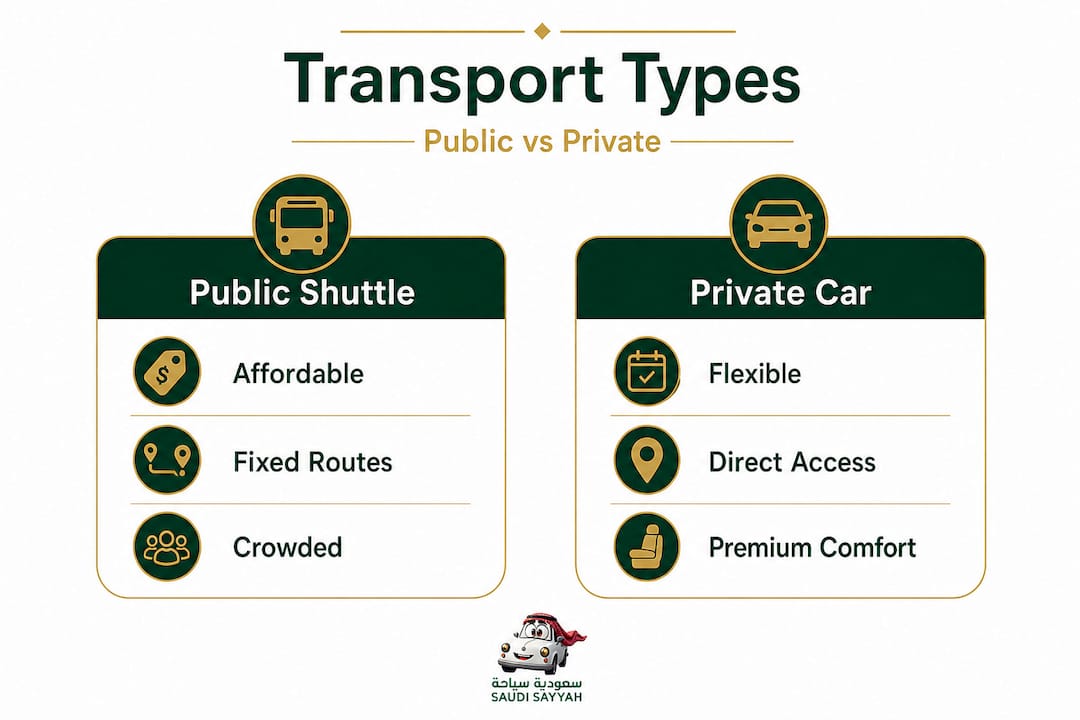
Public or official shuttle services run on fixed routes between hotels, the Haram, and other key sites. They are affordable, frequently scheduled, and well-regulated. For solo pilgrims or small groups on a tighter budget, they work well in normal conditions. The challenge is volume. During peak Umrah seasons, these shuttles fill quickly. Schedules are fixed, meaning if you miss a bus, you wait.
Private licensed transport offers a different experience. You book a vehicle for your group, set the pickup time, and travel without sharing space with strangers. For families traveling with young children, elderly parents, or anyone with mobility limitations, this is usually the smarter option. Private does not mean unregulated. Reputable private Umrah transport options are fully licensed, insured, and compliant with all seasonal restrictions.
| Feature | Public/official shuttles | Private licensed transport |
|---|---|---|
| Cost | Lower | Higher |
| Flexibility | Fixed schedule | Flexible timing |
| Comfort | Shared, can be crowded | Private, spacious |
| Accessibility | Limited | Tailored options available |
| Group suitability | Solo or small groups | Families, large groups, elderly |
| Booking lead time | Short | Recommended 2 to 4 weeks ahead |
| Legal compliance | Always | Verify before booking |
For pilgrims traveling with elderly relatives, the private route is almost always worth the additional cost. Crowds on public shuttles can be overwhelming for those with limited mobility or health conditions. Dedicated elderly-friendly Umrah transport services exist specifically for this segment and include features like low entry steps, extra space, and drivers trained in passenger assistance.
Key considerations when choosing between public and private:
- Group size: Groups of four or more often find private transport cost-competitive when the fare is split
- Ritual timing: If specific prayer times or ritual windows matter to your schedule, private transport offers the control you need
- Medical needs: Anyone managing a chronic condition or recent illness should prioritize private transport with direct emergency access
- Language: Private licensed drivers from specialist Umrah operators are more likely to have English-speaking staff
Pro Tip: Book private transport at least two to four weeks before your Umrah dates during peak seasons such as Ramadan. Availability drops sharply as departure dates approach, and early booking typically locks in better rates.
How to verify and book secure, compliant transport for Umrah
With your transport type chosen, here's how you can confidently select, verify, and book safe, legal transit for your Umrah.
Many pilgrims handle this step incorrectly. They search online, find a service that looks legitimate, and book based on price alone. A professional-looking website does not mean the operator is licensed. Verification requires a few specific steps that most first-timers skip entirely.
Step-by-step: Verifying and booking compliant transport
- Request the license number: Ask the transport provider for their official Saudi Ministry of Hajj and Umrah transport license. A legitimate company will provide it without hesitation.
- Check registration validity: Confirm the license is current and covers the Umrah season you're traveling in. Some operators hold licenses that lapse or are restricted to Hajj only.
- Confirm vehicle details in writing: Get the vehicle type, model year, and plate number in your booking confirmation. This matches what should arrive for your trip.
- Review cancellation and delay policies: Understand what happens if a vehicle does not arrive or there is a delay at checkpoints.
- Ask about driver communication: Find out if the driver speaks English or if translation support is available.
- Pay through traceable methods: Use credit cards or recognized payment platforms. Avoid cash-only operators, as they leave no documentation trail.
Documentation you should expect from a compliant provider:
- Written booking confirmation with vehicle details
- Driver name and contact number provided ahead of pickup
- Operator license number on all documentation
- Receipts or invoices in English or Arabic with a company letterhead
Licensed services are emphasized specifically to prevent delays, fines, and health risks that come from poor transport choices. The paperwork trail that licensed operators provide also serves as your legal protection if anything goes wrong.
What most first-time pilgrims miss: verifying that the transport covers the full journey, not just the hotel-to-Haram leg. Transportation between Makkah and Madinah, airport pickups, and Ziyarah site visits all require separately licensed services in many cases. Confirm coverage for every leg of your journey before paying. Reading pre-arranged Umrah transport tips before finalizing bookings helps identify gaps most travelers don't notice. Staying informed on Umrah travel regulations also prevents surprises at the border or at checkpoints.
Pro Tip: Booking transport through your Umrah travel agency adds one layer of verification, since reputable agencies only partner with licensed operators. However, always double-check independently. Agencies occasionally use subcontractors who do not meet the same standards.
The overlooked link: Secure transport is more than just a ride
There's a tendency, especially among first-time pilgrims, to treat transportation as an afterthought. Flights get booked months in advance. Hotels are researched carefully. Visas are tracked obsessively. Transport gets handled "once we land." That order of priorities is backwards.

Secure, licensed transport is not a logistical detail. It is the connective tissue of the entire Umrah experience. Every ritual depends on getting to the right place at the right time. Delays at checkpoints don't just waste hours; they can eliminate the opportunity to complete specific acts of worship that cannot be rescheduled. The spiritual stakes are real.
There's also something less discussed: the mental load of managing uncertain transport while trying to maintain spiritual focus. Pilgrims who arrive without pre-confirmed transport spend cognitive energy solving logistics in one of the most crowded, high-pressure environments they will ever experience. That energy could be spent in prayer and reflection. Transport that is booked, confirmed, tracked, and professional removes that burden entirely.
The concept of "luxury" in this context doesn't mean an expensive vehicle. It means a journey free from doubt. Knowing that a licensed, verified driver is picking you up, that the vehicle details are confirmed, and that a real-time tracking link is active before your trip starts is the kind of peace of mind that money genuinely buys in this context. Exploring reliable Umrah transport insights reinforces why this planning step deserves the same attention as flights and accommodation.
The uncomfortable truth is that many transport incidents during pilgrimage seasons are entirely preventable. They happen because someone chose based on price, convenience, or a local recommendation without verifying credentials. The regulatory infrastructure exists in Saudi Arabia. Pilgrims simply need to engage with it correctly.
Connect with trusted Umrah transport experts
Secure transport. Verified drivers. Real-time tracking. These aren't extras for pilgrims traveling from Western countries. They are baseline requirements for a journey this important.
Saudi Sayyah provides secure car hire services built specifically for Umrah pilgrims, with fully licensed operators, internationally-compliant booking systems, and driver details sent to your phone before every pickup. The Umrah fleet overview shows the latest-model vehicles available across different group sizes and accessibility needs. For live conditions and route updates near the holy sites, Makkah real-time transport info keeps pilgrims informed on the ground. Every booking comes with written confirmation, driver photos, vehicle details, and active tracking. No guessing. No surprises.
Frequently asked questions
What happens if I use unlicensed transportation during Umrah?
Using unlicensed transport can result in fines up to 100,000 SAR and the vehicle may be confiscated, potentially stranding you mid-journey and causing you to miss time-sensitive rituals.
How can I check if a transport service is properly licensed in Saudi Arabia?
Ask the operator to provide their official registration number from the Saudi Ministry of Hajj and Umrah, and confirm in writing that their services are permitted for pilgrims during the specific Umrah season you are traveling in.
Are there accessible transport options for elderly or disabled pilgrims?
Yes. Licensed providers offer vehicles with low entry steps, additional space, and drivers trained in passenger assistance, specifically designed to meet the mobility needs of elderly or disabled pilgrims.
What should I do in case of a medical emergency during transport?
Licensed transport operators are coordinated with local emergency response systems, and your driver can help reach medical care faster, which is critical given that 23% of pilgrims experience some form of medical issue during their journey.