

TL;DR:
- User-centric travel in Umrah uses AI and technology to personalize planning, reduce effort, and improve spiritual focus. Modern tools such as AI itineraries, AR navigation, crowd detection, and integrated booking streamline complex logistics for Western pilgrims. Emphasizing empathetic design, these solutions minimize stress and enable pilgrims to fully engage with their spiritual journey.
Most Western pilgrims assume planning Umrah means weeks of manual coordination: chasing visa approvals, comparing hotel distances to the Haram, and stitching together transport with no single system connecting it all. That assumption is outdated. The role of user-centric travel has shifted from a nice idea to a working reality, powered by AI tools and technology platforms that put your specific needs at the center of every decision. This guide explains what that shift means, how it works in practice, and how you can apply it before your next pilgrimage.
Table of Contents
- Understanding user-centric travel in the Umrah context
- How technology is reshaping Umrah travel for Western pilgrims
- Comparing traditional and user-centric travel planning for Umrah
- Applying user-centric travel to enhance your Umrah journey
- Why user-centric travel is the future of meaningful Umrah pilgrimages
- Explore user-centric Umrah travel solutions with Saudi Sayyah
- Frequently asked questions
Key Takeaways
| Point | Details |
|---|---|
| Simplifies Umrah planning | User-centric travel uses AI to streamline complex pilgrimage arrangements saving you significant time. |
| Enhances navigation safety | Technology like AR and real-time crowd detection helps you move confidently through sacred sites. |
| Supports diverse needs | Personalized itineraries adapt to family groups, first-timers, and budget constraints. |
| Boosts spiritual focus | By reducing logistical stress, user-centric travel lets you concentrate on the spiritual aspects of Umrah. |
| Provides practical tools | Apps offer offline maps, prayer reminders, and privacy-focused digital journals for a smoother pilgrimage. |
Understanding user-centric travel in the Umrah context
User-centric travel means that every planning decision, every system, and every service is designed around the individual pilgrim's needs, not around what is convenient for the provider. For Western Umrah pilgrims, this distinction matters more than it might seem.
Consider the typical Western pilgrim profile. You may be traveling for the first time, navigating a different language, managing a fixed budget, and coordinating a journey across multiple countries. The Umrah pilgrimage logistics chain involves flights, visas, accommodation within walking distance of the Masjid al-Haram, ground transport, crowd management, and time-sensitive rituals. Traditional planning treats each of those as a separate task. User-centric design connects them.
What user-centric travel looks like in practice:
- Personalized itinerary generation that accounts for your departure city, budget range, physical capacity, and travel group size
- Real-time updates that adapt when flights are delayed or permit windows shift
- Navigation tools that communicate in English and account for cultural context
- Support channels available in your time zone
- A single platform that holds your bookings, documents, and guidance in one place
The technology driving this is agentic AI, which refers to AI systems that can take multi-step actions independently, not just answer a single question. Agentic AI frameworks generate itineraries with 80 to 90% completeness and dynamically integrate travel, accommodations, and permits for Western pilgrims, reducing the manual effort that used to consume days of planning. That completeness score matters because it reflects how few gaps remain for the pilgrim to fill in themselves.
User-centric design also fosters spiritual focus. When logistics are handled, your attention can remain where it belongs: on the purpose of the journey itself.
How technology is reshaping Umrah travel for Western pilgrims
The tools now available to Western pilgrims were not realistic five years ago. Today they are practical, affordable, and accessible on a standard smartphone.
Key tools in the current landscape:
- AI itinerary planners that consolidate flights, hotels, Nusuk permits, and ground transport into a single workflow, often completed in under five minutes
- Augmented reality (AR) navigation that overlays route guidance onto a live camera view of the holy sites, helping pilgrims who have never walked these paths before
- Real-time crowd detection that flags congestion near the Kaaba or the Sa'i path, allowing you to time your arrival or take an alternate route
- Family tracking tools that let group members share locations during the tawaf, where crowds can separate people quickly
- Offline maps that function without a data connection, critical in areas with network strain
The UmHajGo app cuts navigation errors by 50%, offers AI itinerary planning, AR navigation, real-time crowd detection, and supports budgets from $1,500 to $5,000 for 7 to 14 day pilgrimages. That error reduction figure is significant. A navigation mistake in the Haram complex is not just inconvenient; it can mean missing a ritual window or becoming separated from your group.
Pro Tip: Prioritize apps that offer multi-language support and an offline mode. Data coverage inside the holy sites varies, and you should not rely on a live connection for ritual guidance.
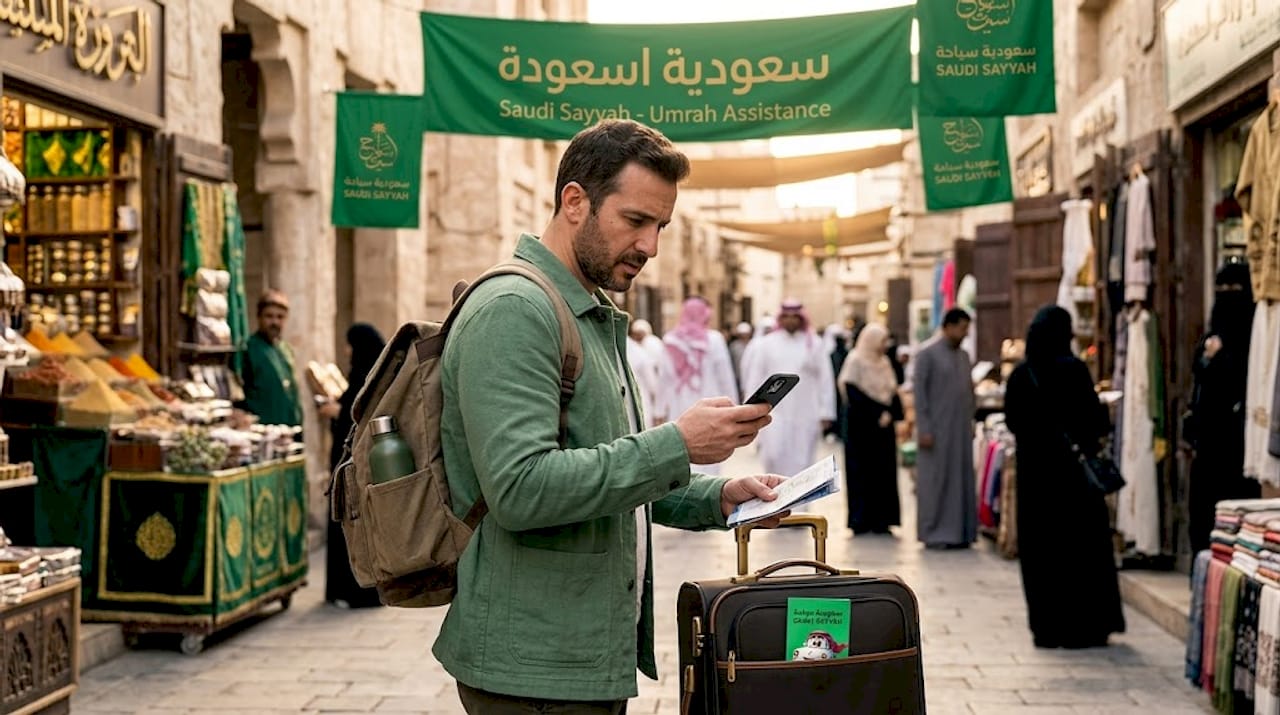
Typical Umrah package components and tech support at each stage:
| Stage | Traditional approach | Technology-assisted approach |
|---|---|---|
| Pre-trip planning | Manual research, multiple booking sites | AI generates full itinerary in minutes |
| Navigation on-site | Paper maps, asking locals | AR overlay with real-time crowd data |
| Group coordination | Phone calls, fixed meeting points | Live location sharing within app |
| Permit management | Separate portal, easy to miss deadlines | Integrated permit reminders and filing |
| Transport booking | Separate vendor calls | Pre-arranged, tracked transport confirmed via app |
Both pre-arranged Umrah transport and efficient transport solutions are now bookable inside the same digital environment as your hotel and flights, removing one of the most fragmented parts of the old planning process.
Comparing traditional and user-centric travel planning for Umrah
Understanding the tech tools is one thing. Seeing the direct comparison makes the value concrete.
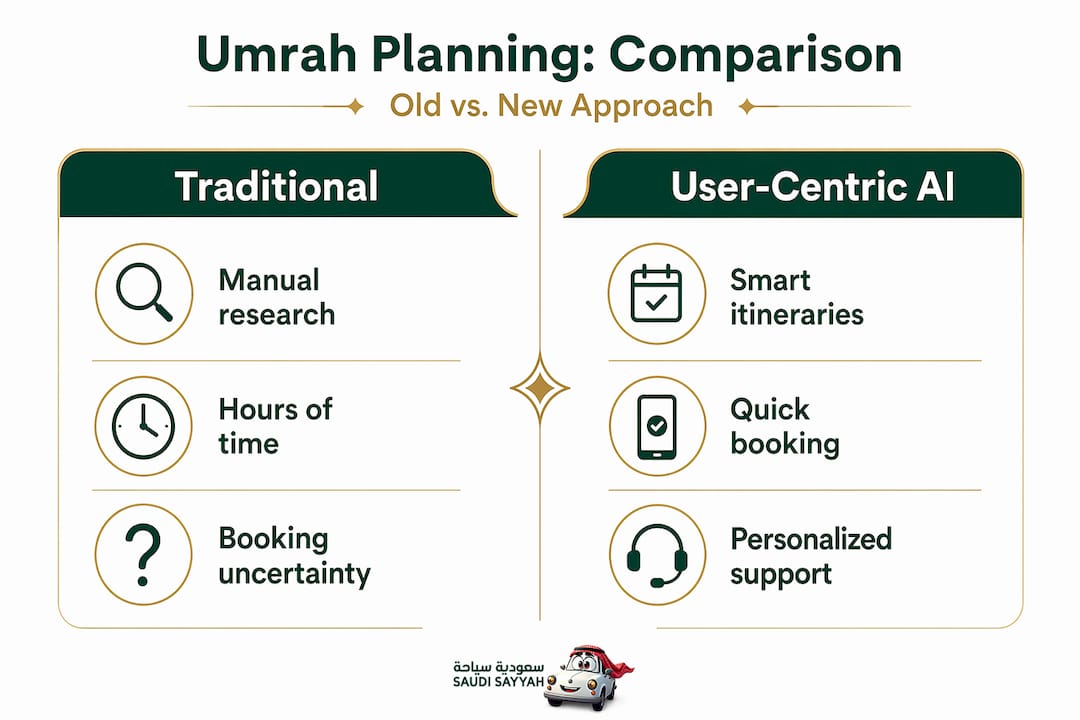
| Factor | Traditional planning | User-centric AI planning |
|---|---|---|
| Time to complete itinerary | 10 to 20+ hours | Under 5 minutes |
| Error rate | High (fragmented systems) | Low (integrated data) |
| Adaptability to changes | Manual rebooking required | Automatic adjustment suggestions |
| Language support | Limited | Multi-language, English-first options |
| Contextual fit to pilgrim profile | Generic packages | Personalized to budget, group, and needs |
| Stress level reported | High | Significantly reduced |
AI-generated itineraries show 85% contextually relevant results when evaluated against diverse pilgrim profiles, a meaningful improvement over the generic packages that traditional planning produces.
That said, a balanced view is important. Not every pilgrim is ready to hand full control to an algorithm.
When traditional planning still makes sense:
- Experienced repeat pilgrims who have established routes and trusted local contacts
- Those with limited smartphone access or data literacy
- Situations where a specific scholar's guidance dictates very particular ritual timing
When user-centric AI planning is the stronger choice:
- First-time Western pilgrims managing complex multi-leg journeys
- Families or groups with varied physical needs, such as elderly parents or young children
- Pilgrims on tight budgets who need to compare many options quickly
- Anyone traveling during peak season when crowds and logistics are at their most complex
A hybrid approach works well for many pilgrims. Use AI to generate and confirm the framework. Then review each booking yourself before finalizing. The goal of automated travel for Umrah is not to remove your judgment; it is to remove the hours of mechanical work so your judgment can focus where it matters.
Pro Tip: After your AI tool generates an itinerary, cross-check the hotel distance to Masjid al-Haram manually. Distance calculations in apps sometimes use road distance rather than walking path, and those differ significantly near the Haram.
Applying user-centric travel to enhance your Umrah journey
Having compared approaches, here are practical steps you can take before, during, and after your pilgrimage to apply user-centric travel effectively.
Before you travel:
- Select your core planning app based on English language support, offline capability, and whether it integrates Nusuk permit filing. Apps like UmHajGo and Umrah Journey provide AI-driven planning, ritual guidance, offline maps, and prayer tracking tailored for Western pilgrims.
- Set your budget range clearly before you begin searching. Most Western pilgrims fit within the $1,500 to $5,000 range for a 7 to 14 day trip including flights, accommodation, and ground transport.
- Download offline maps for Makkah and Madinah while still on home Wi-Fi. Do not wait until you land.
- Enable prayer time notifications within your chosen app and sync them to your itinerary so ritual timing appears alongside transport times.
- Confirm your transport pre-booking, including driver details and vehicle information. Reliable transport for Umrah pilgrims is one of the most cited sources of stress when left unconfirmed. If you are traveling with elderly family members, review transport options for elderly pilgrims separately, as vehicle access and driver assistance needs differ.
During the pilgrimage:
- Use crowd detection actively, not just when you feel the crowd building. Check the app 20 to 30 minutes before each major ritual to time your approach.
- Set family check-in intervals if traveling as a group. Fifteen-minute location check-ins inside the Haram are a practical standard.
- Keep your phone below 40% data use for navigation tasks and rely on downloaded content for ritual guidance.
After your journey:
- Submit feedback through your app or service provider. The importance of traveler feedback in improving these systems is real. Your experience data helps the next pilgrim.
- Note what did not work and share it specifically. General ratings help less than specific route feedback or timing errors.
Pro Tip: Choose apps that store your ritual progress and personal data locally on your device, not only on a remote server. For a journey this personal, local storage gives you both privacy and reliability if connectivity drops.
Selecting the best pilgrimage transport option before you land is one of the highest-return preparations you can make. Transport failures cause more mid-pilgrimage disruption than almost any other single factor.
Why user-centric travel is the future of meaningful Umrah pilgrimages
Here is an observation worth sitting with. Most travel technology is built for efficiency. Fewer clicks, faster booking, lower friction. That is useful, but it misses something important for Umrah specifically.
The pilgrims who benefit most from user-centric travel are not the ones who get to Makkah faster. They are the ones who arrive less anxious, more prepared, and with enough mental space to actually engage with the spiritual weight of what they are doing. That is a different design goal than efficiency.
Traveler-centric design empowers pilgrims by creating programs they want to use, not have to use, boosting compliance and spiritual focus through empathetic technology. That distinction between "want to use" and "have to use" is where most Umrah tech currently fails. Too many apps feel like filing systems. The ones that succeed feel like a knowledgeable companion.
Empathetic design matters here in a specific way. Many Western pilgrims carry anxiety about performing rituals correctly, about language barriers, about navigating a city they have never visited. Technology that acknowledges those concerns, that explains rather than just directs, builds trust. And trust is what allows a pilgrim to shift attention from logistics to meaning.
This is not a case where more automation is always better. The best user-centric solutions for Umrah understand when to step back. They confirm your transport is on the way and then go quiet. They remind you of prayer time and then get out of the way. The goal is not engagement with the app. The goal is engagement with the journey.
Pro Tip: When evaluating any Umrah travel platform, ask one simple question: does this tool explain the why behind each ritual prompt, or only the what? Platforms that include context, not just instructions, are designed with the pilgrim's actual experience in mind.
Explore user-centric Umrah travel solutions with Saudi Sayyah
To make your user-centric travel a reality, consider how Saudi Sayyah's transport services can support the digital planning you have built.
Saudi Sayyah's transport services are built around the same principles this article covers: reduce uncertainty, provide information before you need it, and let you focus on your pilgrimage. Through the geolocation-enabled platform, you receive driver photos, vehicle details, and real-time tracking before each trip. Browse the full range of car hire services for Umrah to find the option that matches your group size and schedule. Review the premium vehicles available for Umrah transport to confirm comfort and access for every member of your group. For live conditions on arrival day, Makkah live transport updates keep your ground coordination current. No surprises. Just transport that works.
Frequently asked questions
What does user-centric travel mean for Umrah pilgrims?
User-centric travel tailors planning and services around each pilgrim's needs, using technology to simplify bookings, navigation, and support for a personalized Umrah experience. AI-based travel planning generates personalized, complete itineraries that simplify complex Umrah coordination.
How can AI improve my Umrah itinerary planning?
AI tools quickly create detailed, context-aware itineraries by integrating flights, accommodations, and permits, reducing planning time from hours to minutes. Agentic AI generates itineraries in under 5 minutes with high completeness for Western pilgrims.
Are there apps that help guide me during the Umrah pilgrimage?
Yes, apps like UmHajGo and Umrah Journey offer real-time navigation, prayer reminders, ritual guidance, and offline maps tailored for Western pilgrims. The UmHajGo app provides AR navigation, crowd detection, and ritual guidance to improve pilgrim confidence and safety.
How does user-centric travel support budget management for Umrah?
User-centric travel platforms help you select packages and services that fit your budget while optimizing itinerary value and convenience. Technology supports budgets from $1,500 to $5,000 for 7 to 14 day pilgrimages including flights and accommodation.
Can user-centric travel help with navigating crowds during Umrah?
Yes, apps with real-time crowd detection reduce navigation errors significantly, helping you avoid congested areas and travel more safely. UmHajGo's crowd detection cuts navigation errors by 50%, giving pilgrims better control over timing and routing inside the holy sites.