
TL;DR:
- Efficient Umrah transport focuses on reliability, safety, and smart layering of transport modes. Proper planning, pre-booking, and adaptability are key to smooth journeys. Technology like AI crowd management enhances real-time adjustments, reducing delays.
Efficient Transport Explained: Smart Solutions for Umrah Pilgrims
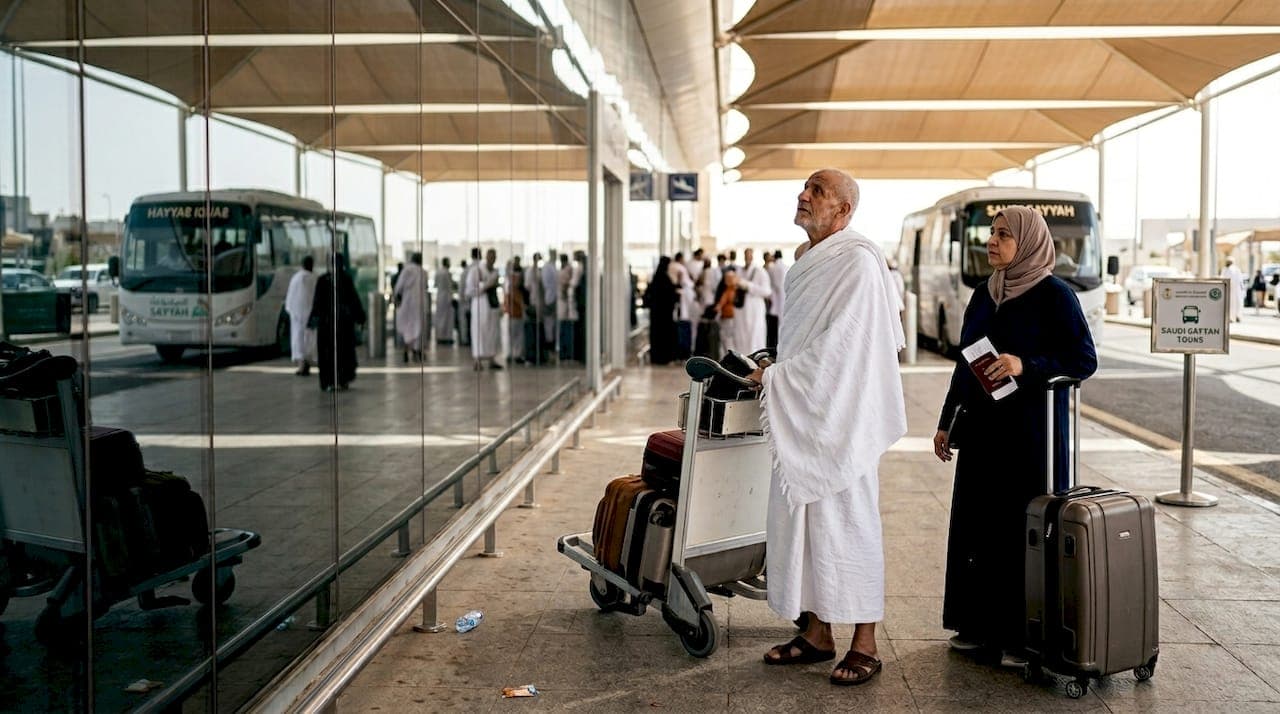
Many first-time Umrah pilgrims assume efficient transport simply means finding the fastest car or the cheapest ride. That assumption leads to missed connections, long waits at crowded hubs, and real frustration during a sacred journey. True efficiency in the pilgrimage context covers reliability, safety, group coordination, and smart layering of different transport modes working together. This guide breaks down what efficient transport actually means for Umrah, how modern systems support it, and what practical steps you can take to apply these strategies from the moment you land.
Table of Contents
- What is efficient transport for Umrah?
- Building blocks: How efficient transport works during Umrah
- Common barriers to efficient transport and how to overcome them
- Efficient transport in action: Step-by-step for every leg of your Umrah
- Why efficient transport means thinking differently as a first-time Umrah pilgrim
- Let Saudi Sayyah make your Umrah journey truly efficient
- Frequently asked questions
Key Takeaways
| Point | Details |
|---|---|
| Layered transport systems | Efficient Umrah transport means using shuttles, metro, taxis, and walking together to match journey needs. |
| Plan every journey stage | Pre-book early segments and set time buffers for traffic and shuttles to avoid last-minute problems. |
| AI improves efficiency | Real-time crowd detection helps keep transport safe and prevent delays during peak times. |
| Flexibility is key | Adaptability—being willing to walk, switch modes, or change plans—makes your pilgrimage smoother. |
What is efficient transport for Umrah?
Efficiency in everyday Western travel usually means speed. You book the fastest train, grab the first available cab, and get moving. That logic does not translate directly to Umrah. The pilgrimage environment involves millions of people moving through a concentrated area, often during the same hours, heading toward the same destinations. Speed alone cannot solve that problem.
In the Umrah context, efficient transport means minimizing wait times, avoiding congestion points, and producing predictable journeys, even during peak hours. Transport efficiency is linked to operational design using layered networks, congestion-aware planning, and advanced anomaly detection. This is not just theory. It is the framework that Saudi transport authorities and planners use when designing the systems pilgrims rely on every year.
So what does a layered network actually look like for Umrah pilgrims?
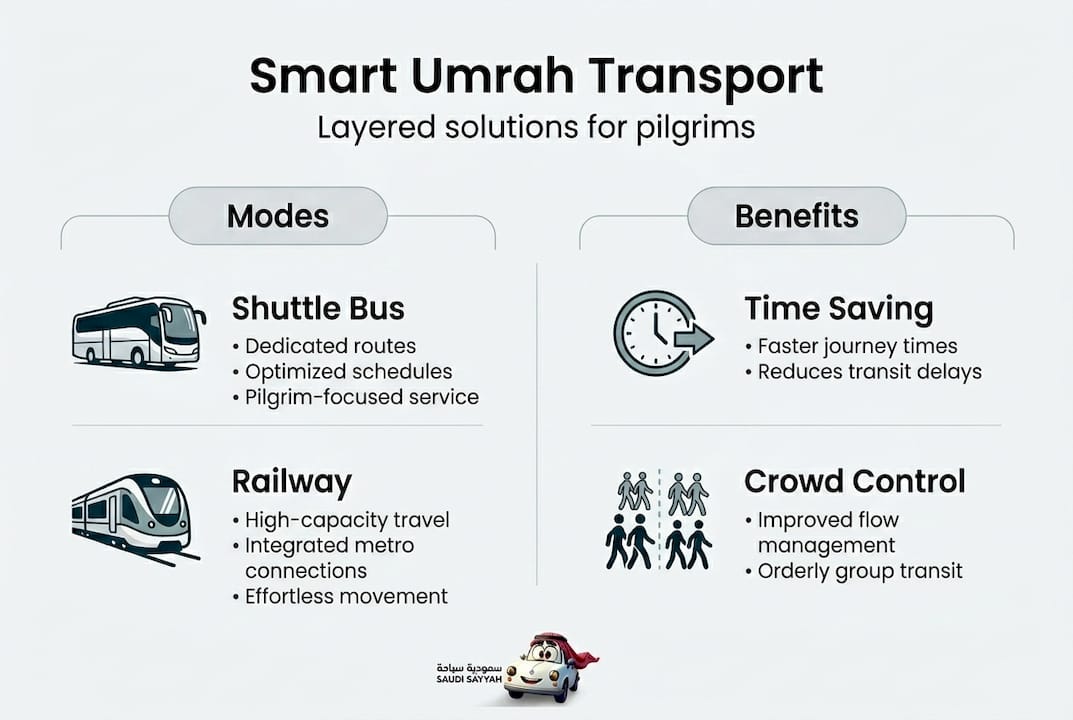
- Dedicated shuttle buses run on timed routes between key zones, such as airports, hotels, and the Haram.
- The Makkah Metro (Al Mashaaer Railway) handles large volumes quickly during specific pilgrimage stages.
- Taxis and private transfers provide flexibility for those with unique timing or accessibility needs.
- Designated walking paths cover the final stretch from drop-off zones to the Haram entrance.
Each layer handles a different function. Together, they reduce pressure on any single mode. A pilgrim who understands this system can make smarter choices about which layer to use at each stage.
Accessibility and group coordination also factor heavily into the definition of efficient transport. Traveling with elderly family members, young children, or individuals with mobility limitations changes which options are actually viable. The safe travel guide for Umrah pilgrims outlines how to approach these variables before departure. Transport reliability importance also plays a major role when schedules are tight and prayer times are fixed.
Note: Last-mile walking distances are frequently underestimated. A hotel listed as "near the Haram" may still require a 15 to 25 minute walk through dense crowds. Always verify the exact distance and walking route before finalizing your booking.
Pro Tip: Use Google Maps or a dedicated Umrah navigation app to measure the actual walking distance from your hotel to the nearest Haram entrance. Do this before you book, not after you arrive.
Building blocks: How efficient transport works during Umrah
Understanding the definition is one thing. Seeing how the system is built gives you the tools to actually use it well. Efficient Umrah transport is constructed in layers, each designed to handle a specific volume and journey type.
Here is a typical step-by-step journey from King Abdulaziz International Airport in Jeddah to your hotel near the Haram in Makkah:
- Airport arrival: Clear customs and immigration. Collect luggage. Move to the designated transport zone.
- First mile (Jeddah to Makkah): Choose between a pre-booked private transfer, a shared shuttle, or the Haramain High Speed Railway from Jeddah to Makkah station.
- City entry: Arrive at your drop-off zone in Makkah. Non-Muslims cannot enter the central Makkah area, so all transport providers must be verified and compliant.
- Hotel transfer: Reach your accommodation via hotel shuttle, taxi, or short transfer vehicle.
- Last mile (hotel to Haram): Walk through designated pedestrian routes or use a short shuttle if your hotel offers one.
That five-stage sequence involves at least three different transport modes for most pilgrims. Each handoff point is a potential delay. The accessible transport guide explains how to handle these transitions when traveling with someone who has mobility needs.
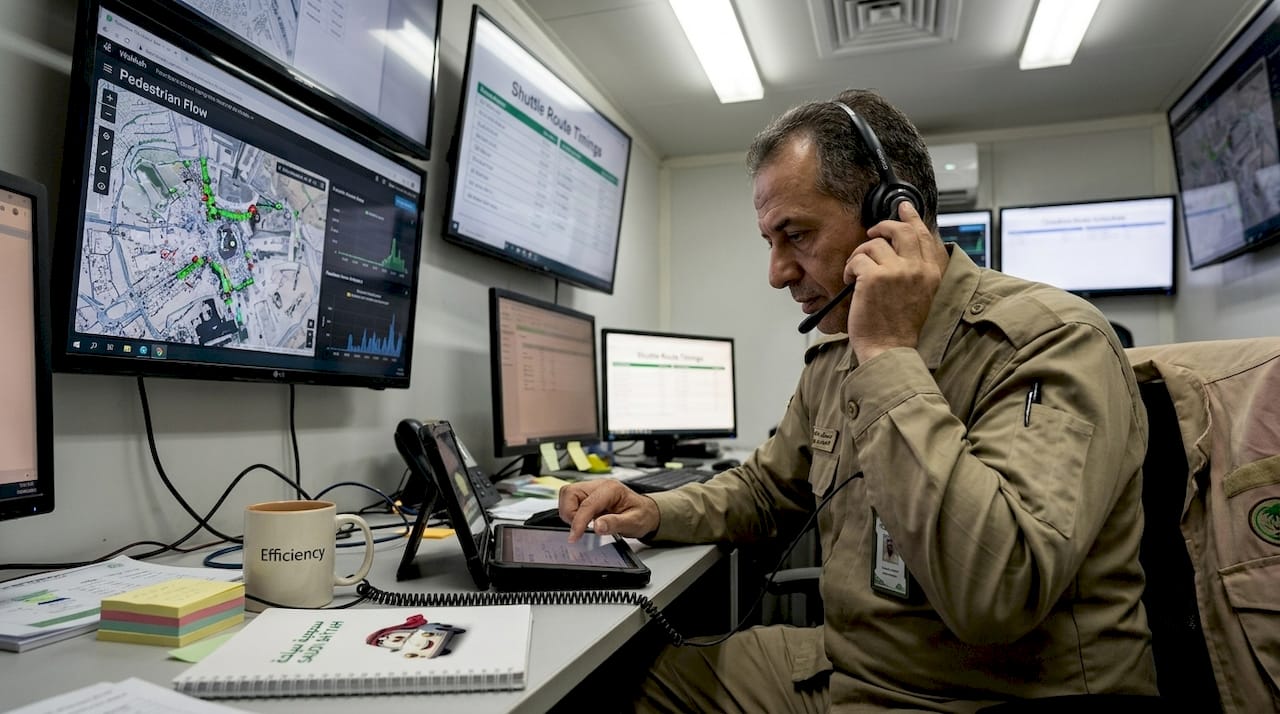
The role of technology in this system is significant. AI crowd management achieves 91% average accuracy in detecting abnormal crowd movement during Hajj and Umrah. That level of precision means shuttle routes can be adjusted in near real time when a bottleneck forms, reducing cascading delays before they spread.
Here is a comparison of the main transport options across key efficiency factors:
| Transport mode | Speed | Reliability | Flexibility | Best for |
|---|---|---|---|---|
| Private transfer | High | High | High | Small groups, elderly, families |
| Shared shuttle | Medium | Medium | Low | Budget travelers, solo pilgrims |
| Haramain Railway | Very High | High | Low | Intercity speed, peak periods |
| Taxi/ride-hail | Medium | Variable | High | Short city trips, off-peak hours |
| Walking | Low | Very High | Very High | Last mile, congested zones |
For Jeddah to Makkah options specifically, the Haramain Railway is frequently the fastest single-leg option, covering the distance in roughly 30 minutes. However, it requires transfer to the station, ticketing, and a last-mile solution on the Makkah end. A direct private transfer may take longer in total transit time but eliminates multiple handoffs, which is often worth it for groups with luggage or elderly travelers.
Common barriers to efficient transport and how to overcome them
Even well-designed systems face real-world friction. First-time pilgrims from Western countries face several specific barriers that can break an otherwise efficient plan.
The main obstacles include:
- Traffic and crowd congestion: Peak times near the Haram, particularly before Fajr and Isha prayers, can triple normal travel times. Roads that are clear at midday become gridlocked within minutes as prayer time approaches.
- Confusion at busy transport hubs: Jeddah airport, Makkah bus terminals, and hotel pick-up zones can be chaotic. Without clear signage knowledge or a local contact, finding your correct vehicle or shuttle bay takes valuable time.
- Language and communication gaps: Arabic is the operating language at most transport hubs. English is spoken at many international counters, but instructions, route names, and vehicle numbers are often displayed only in Arabic script.
- Unpredictable wait times: Shared shuttles and taxi queues can stretch to 45 minutes or more at peak times. Without a pre-booked option, wait time is almost entirely out of your control.
- Accessibility gaps: Pilgrims with mobility limitations often find that generic transport options are not equipped for their needs, leading to last-minute scrambles at the worst possible moments.
For each of these barriers, there are specific countermeasures. Arriving early and verifying last-mile distances are consistently identified as core efficiency boosters across pilgrimage transport research. These are not vague suggestions. They are operational practices that directly reduce the chance of a delay cascading into a missed prayer or a stressful scramble.
The airport transfer guide covers the Jeddah and Madinah airport scenarios in detail, including which exits to use and how to locate pre-booked vehicles. For those traveling with older family members, the elderly transport tips resource identifies the specific accommodations to request and confirm before departure.
Pro Tip: Download an offline map of Makkah and Madinah before you travel. Mobile data can be slow or unavailable in very crowded areas. An offline map lets you verify walking distances and routes without depending on a live connection.
Language gaps are easier to close than most pilgrims expect. Saving key Arabic phrases for transport needs, or using a translation app in download mode, handles the vast majority of communication situations at hubs. Many pre-booking platforms also provide driver contact details in advance, so you can message your driver directly before arrival.
Efficient transport in action: Step-by-step for every leg of your Umrah
Knowing the theory is valuable. Seeing it applied to a full Umrah journey makes it practical. Here is a scenario-based walk-through covering every major stage.
Scenario: A family of four, including one elderly parent, flying from London Heathrow to Jeddah, performing Umrah in Makkah, then spending three days in Madinah before returning home.
- Airport arrival (Jeddah): A pre-booked private transfer meets the group at the arrivals hall. Driver details, a photo, and vehicle information were sent via app 30 minutes before landing. No waiting at a taxi queue. Luggage goes directly into the vehicle.
- Intercity leg (Jeddah to Makkah): The private transfer drives directly to the hotel in Makkah. Travel time is approximately 90 minutes including airport exit. The family chose this over the Haramain Railway because of the elderly parent and the amount of luggage. Pre-booking the airport-to-hotel leg is identified as the single most important step in efficient Umrah transport planning.
- In-city movement (Makkah): The hotel offers a timed shuttle to the Haram, running every 20 minutes. The family uses this for most visits. For off-schedule trips, they use a pre-arranged taxi via app.
- Last mile: The shuttle drops them at the designated zone. From there, a 10-minute walk through pedestrian paths reaches the Haram entrance. They confirmed this distance before booking the hotel.
- Intercity (Makkah to Madinah): The Haramain Railway is chosen for this leg. Fast, comfortable, and direct. They booked tickets in advance online to guarantee seats during a busy period.
- Madinah in-city: Short taxi trips cover the distance from hotel to Masjid an-Nabawi. Walking is used for some visits given the shorter distance.
This scenario reflects mode selection by group size, luggage, and time buffers at each stage, which is the core methodology for efficient Umrah transport.
| Situation | Best transport mode | Reason | |---|---|---|---| | Group with elderly/children | Private transfer | Door-to-door, no transfers | | Peak prayer times | Walking or hotel shuttle | Roads gridlocked | | Solo pilgrim, flexible timing | Shared shuttle or taxi | Cost-effective, available | | Intercity speed priority | Haramain Railway | Fastest option | | Last mile in crowded zones | Walking | Avoids traffic entirely |
For groups, the best group transport resource provides additional options including full-size coaches and multi-vehicle arrangements for larger parties.
Why efficient transport means thinking differently as a first-time Umrah pilgrim
Western travelers often arrive in Saudi Arabia with a very specific mental model of efficiency: fastest route, lowest price, minimum friction. That model works well in cities with predictable traffic and on-demand ride apps that function smoothly. It does not work well in Makkah during Umrah.
The city handles millions of pilgrims within compressed timeframes. Road capacity, shuttle schedules, and pedestrian flow are all operating near their limits. In that environment, speed is not the defining variable. Reliability is.
A private transfer that costs more but arrives on schedule is more efficient than a cheaper shared option that runs late. A hotel that is slightly further from the Haram but has a reliable shuttle system is more efficient than a closer hotel with no transport coordination. Prebooking, flexible mode selection, and realistic time buffer planning are the three practices that consistently separate smooth Umrah journeys from difficult ones.
Adaptability also matters. No plan survives contact with peak-hour Makkah traffic completely intact. Smart pilgrims build in buffer time at every handoff point, identify alternative routes before they need them, and treat the planning a holy cities trip phase as a genuine investment, not an afterthought.
Patience is not a personality trait here. It is a logistical strategy. Pilgrims who accept that some stages will take longer than expected, and who plan accordingly, consistently report smoother journeys than those who optimize only for speed.
Let Saudi Sayyah make your Umrah journey truly efficient
The principles in this guide are most valuable when backed by a transport partner that actually delivers on them.
Saudi Sayyah offers pre-bookable airport pick-ups, intercity transfers, and in-city solutions designed around the realities of Umrah travel. Driver details, vehicle information, and real-time tracking are sent before every trip. Accessibility needs and group sizes are accommodated at the booking stage, not as an afterthought. Whether you want to explore car hire services, review the vehicle options available for your group, or check Makkah live updates before departure, Saudi Sayyah gives you the tools and the support to move through your pilgrimage with confidence.
Frequently asked questions
What is the most efficient way to travel from Jeddah airport to Makkah for Umrah?
Pre-booking a direct airport transfer or using the Haramain High Speed Railway are both strong options. The right choice depends on group size, luggage volume, and whether you have elderly or mobility-limited travelers.
How do crowd management systems improve transport efficiency during Umrah?
AI systems detect abnormal crowd movement with up to 91% accuracy, allowing shuttle routes and pedestrian flows to be adjusted in near real time. This reduces bottlenecks before they escalate into full delays.
How can elderly or disabled pilgrims ensure efficient transport during Umrah?
Book accessible vehicles in advance and confirm last-mile assistance options with your hotel and transport provider before departure. Do not leave accessibility arrangements to be sorted on arrival.
Is walking ever the most efficient option during Umrah?
Yes. In congested zones near the Haram, walking through designated pedestrian paths is often faster than waiting for road-based transport during peak prayer times. Short last-mile distances are almost always better covered on foot.