
TL;DR:
- Planning Umrah from a Western country requires a structured, dependency-based workflow that emphasizes sequence and buffers to prevent delays. Pilgrims must gather essential documents, set up digital platforms like Nusuk, and carry printed backups to ensure smooth border and entry processes. A meticulous, offline-proofed plan with pre-arranged transport and added buffers ensures a stress-free pilgrimage experience.
Planning Umrah from a Western country involves layers of logistics that can quickly become overwhelming. Visas, permits, flights, ground transport, hotel confirmations, vaccination records, and a new digital platform called Nusuk all need to line up in the right order before you step on that plane. Miss one step and the whole chain breaks. This article lays out a practical, phase-by-phase workflow that first-time pilgrims can follow to move from confusion to clarity, covering every stage from document prep to arrival day troubleshooting.
Table of Contents
- What you need: Essential tools and documents for Umrah planning
- Building your workflow: Step-by-step guide to a smooth pilgrimage
- Smart transport and booking strategies: Avoiding common mistakes
- Verification at every stage: Proof, backups, and troubleshooting
- A workflow mindset: Why dependency order and buffers matter more than tech
- Travel confidently: Seamless Umrah with Saudi Sayyah solutions
- Frequently asked questions
Key Takeaways
| Point | Details |
|---|---|
| Always use the Nusuk app | The Nusuk platform is required for Umrah permits and appointments in 2026. |
| Print your documents | Carry printed and offline confirmations for visas, hotels, and transport for border checks. |
| Add buffer time | Build 6–12 hour time buffers for groups with elderly or young pilgrims to prevent stress. |
| Follow a workflow order | Sequence bookings and document readiness in a Gantt-style workflow for seamless travel. |
| Offline verification is critical | Maintain offline and paper proofs to avoid disruptions from digital-only systems. |
What you need: Essential tools and documents for Umrah planning
Before a single booking is made, there is a fixed set of documents and tools that every pilgrim must gather. Think of these as the raw materials. Without them, no workflow can move forward.
The complete Umrah logistics guide breaks down the full scope of what is involved, but here is a focused list of the essentials you need in hand before the planning phase begins.
Core documents checklist:
- Valid passport (minimum 6 months validity beyond travel dates)
- Umrah visa confirmation
- Flight tickets (outbound and return)
- Hotel booking confirmations for Makkah and Madinah
- Ground transport receipts or booking confirmations
- COVID-19 vaccination certificate or equivalent health documentation
- Travel insurance documents
- Mahram documentation where applicable (for women traveling under certain rules)
The Nusuk app is not optional for 2026. It is the official Saudi platform used for managing Umrah permitting, appointments, and pilgrim entry rather than relying solely on conventional email confirmations. That means your permit, your Haram entry time slot, and several key logistics are managed inside one app. Download it early. Set it up before you travel. Confirm all linked bookings inside the platform.
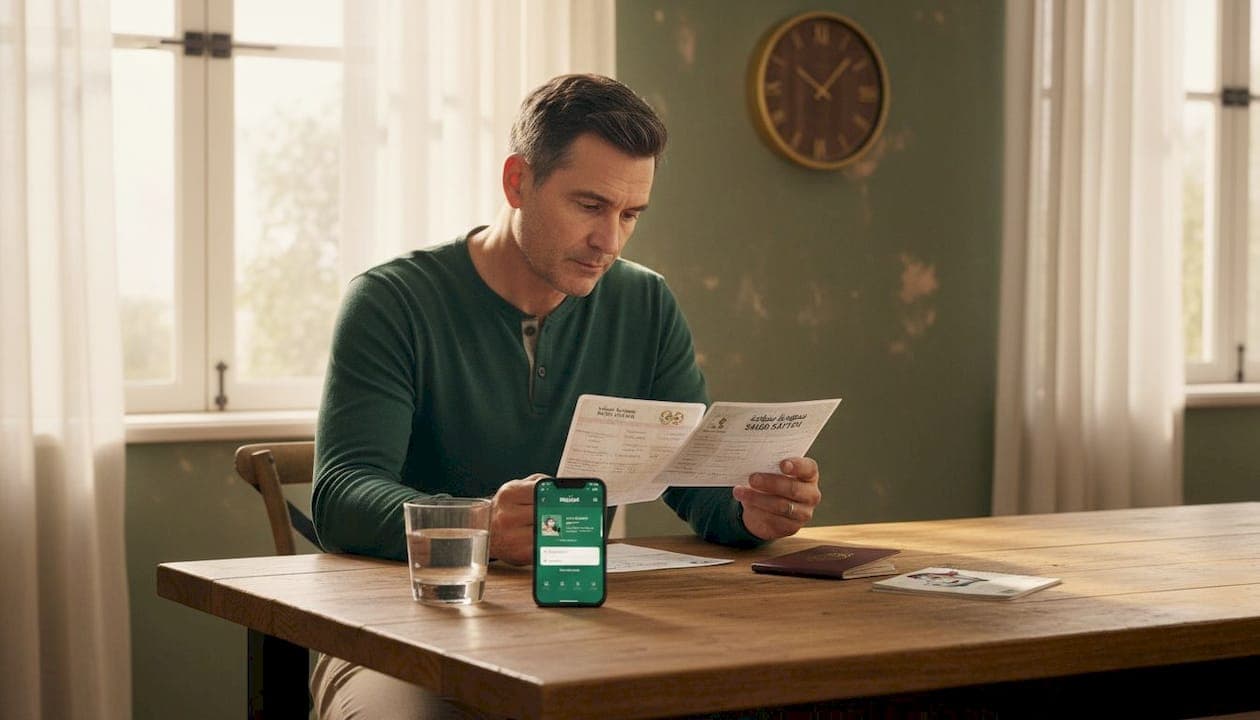
There is an important distinction between digital-only records and printed confirmations. Many first-time pilgrims assume that having everything on a phone is sufficient. It is not always the case. You must prove bookings at the border and access logistics at the airport. Carry printed and offline copies of visa documentation, flight tickets, hotel confirmations, transport receipts, and vaccination certificates.
| Document type | Digital copy | Printed copy required |
|---|---|---|
| Umrah visa | Yes | Yes |
| Flight tickets | Yes | Recommended |
| Hotel confirmations | Yes | Yes |
| Transport receipts | Yes | Yes |
| Vaccination certificate | Yes | Yes |
| Nusuk permit/QR code | Yes | Recommended |
Pro Tip: Screenshot every confirmation screen and save files to a folder on your phone that works offline. Then print everything and carry it in a dedicated folder. Two systems of access are always better than one.
Building your workflow: Step-by-step guide to a smooth pilgrimage
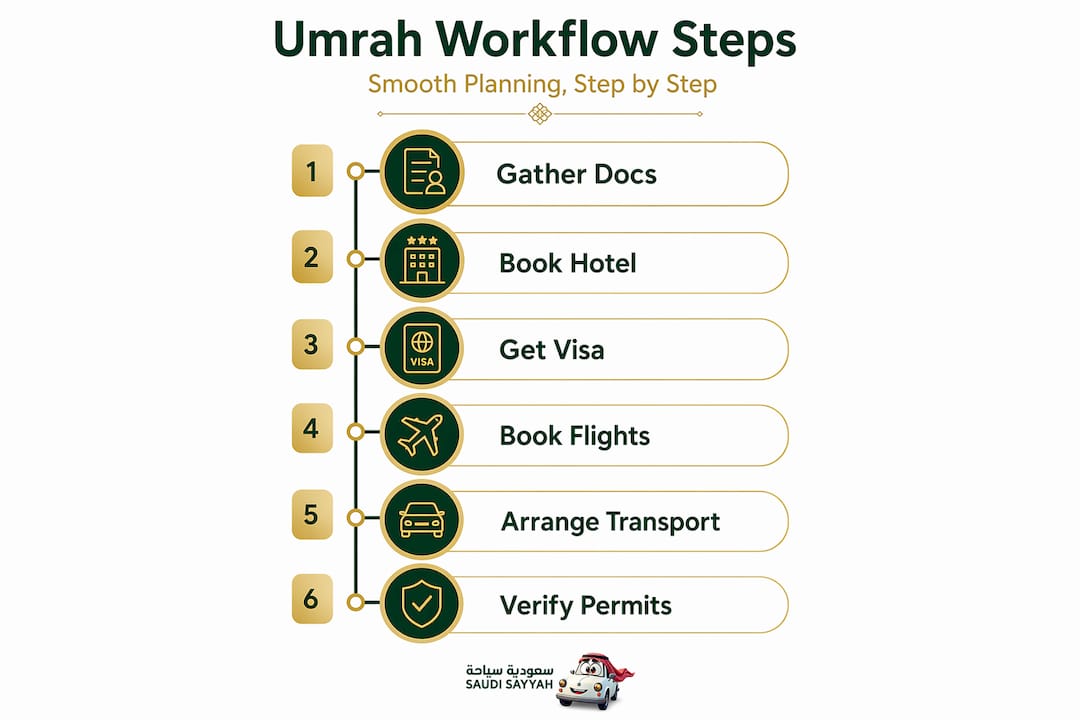
Knowing what you need is one thing. Knowing the order in which to secure each piece is what separates a smooth journey from a stressful one. A practical Umrah workflow is best treated like a Gantt chart approach: decide dates first, then lock documents and booked services in dependency order, with visa and permit readiness depending on accommodation and transport confirmations, then add operational buffers and offline backups for proof of bookings.
This dependency logic is critical. A visa application typically requires a confirmed hotel booking. A Nusuk permit requires a valid visa. Transport confirmations support your overall itinerary paperwork. Getting the sequence wrong means going back and repeating steps.
Phased workflow sequence:
- Fix your travel dates. Everything else depends on this. Approximate is not enough. You need exact dates before any booking can be confirmed or any permit applied for.
- Book your accommodation. Makkah and Madinah hotels fill up fast, especially for peak seasons. Lock this in first.
- Apply for your Umrah visa. Use your hotel confirmation as supporting documentation. Your country of residence will determine the specific application process.
- Set up and verify your Nusuk account. Once your visa is in progress, register on Nusuk and link your travel details. Apply for the relevant Umrah permits and time slots inside the platform.
- Book flights. After your visa timeline is clearer, finalize flights. Build buffer time around your permit windows.
- Arrange ground transport. Airport pickups, hotel transfers, and inter-city transport between Makkah and Madinah. Use a family transport planning guide if traveling with children or elderly members.
- Compile and verify all documents. Cross-check every confirmation. Print everything. Confirm Nusuk QR codes are active.
- Pre-departure check. 48 hours before departure, run through your full checklist one final time.
"The biggest planning mistake is treating bookings as independent tasks. Each one feeds the next. Accommodation unlocks the visa. The visa unlocks the permit. The permit drives everything else."
Compare the structured approach with an ad-hoc booking style:
| Approach | Risk level | Permit readiness | Stress on arrival |
|---|---|---|---|
| Gantt-style dependency workflow | Low | High | Low |
| Ad-hoc booking (as-you-go) | High | Variable | High |
| Partial planning with gaps | Medium | Unpredictable | Medium to high |
The structured approach consistently outperforms ad-hoc methods. It removes guesswork and gives you checkpoints rather than crisis moments.
Pre-arranged Umrah transport should be part of this planning from step six onward. Leaving transport to chance after arrival is one of the most common mistakes first-time pilgrims make.
Pro Tip: Add a 72-hour buffer between your planned visa approval date and your flight departure. Immigration processing times shift. A buffer protects the entire downstream sequence.
Smart transport and booking strategies: Avoiding common mistakes
Transport is where many otherwise well-planned Umrah trips hit serious problems. Flights that look fine on paper become stressful when connection times are tight. Airport arrivals in Jeddah or Madinah without a confirmed pickup can leave travelers stranded and exhausted after a long international journey.
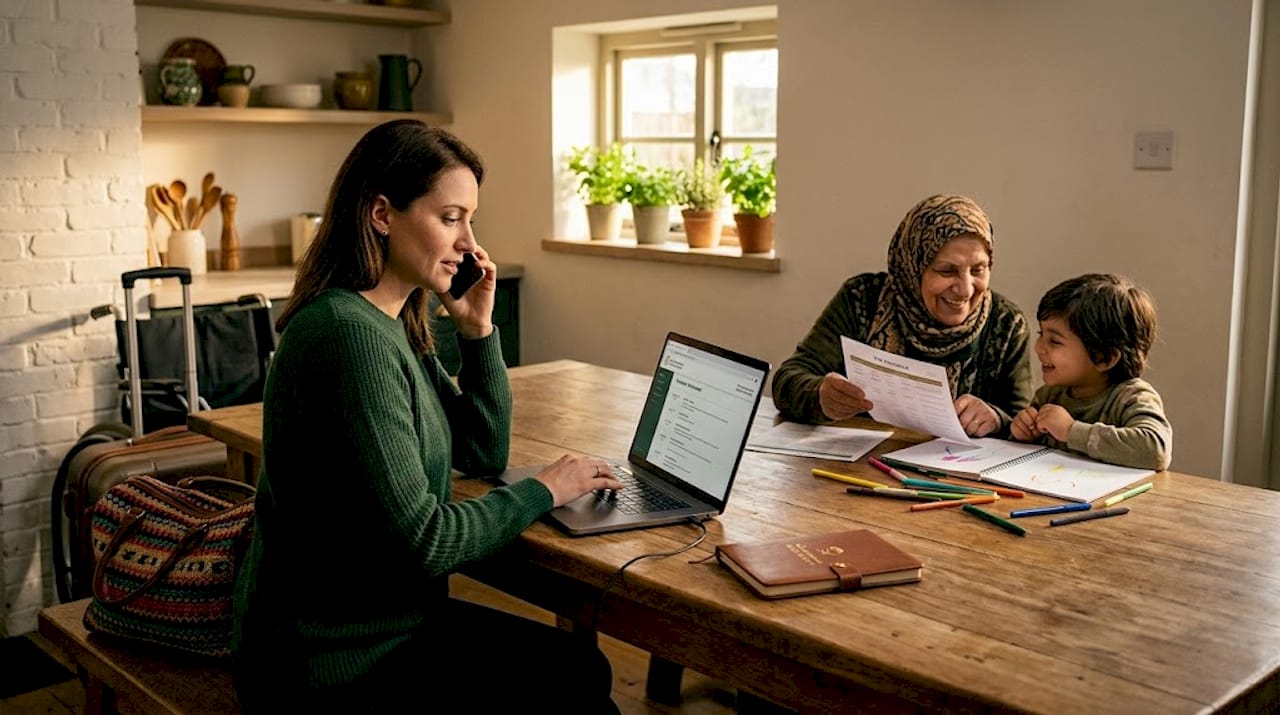
When it comes to building buffer time into flights, the guidance is clear: earlier arrival in the day and extra time for elderly travelers and small children can prevent missed connections and reduce last-minute stress on arrival day. This is not optional advice for vulnerable travelers. It is a planning standard.
Common transport mistakes to avoid:
- Booking the tightest possible connecting flight to save a few hours. A missed connection on the way to Umrah is devastating.
- Assuming you can find a taxi or shared shuttle at the airport without prior arrangement.
- Not confirming pickup logistics with your transport provider 24 hours before arrival.
- Booking inter-city transfers without accounting for prayer time stops and traffic near the Haramain.
- Forgetting to share flight details and updated arrival times with your driver or transport company.
For efficient Umrah transport solutions, the principle is simple: pre-arrange everything and over-communicate with your provider. A transport booking that includes real-time tracking, advance driver details, and direct contact options removes the biggest unknowns on arrival day.
Groups traveling with elderly pilgrims face specific challenges. Mobility, fatigue, wheelchair access, and slower processing times at immigration all add minutes and sometimes hours to arrival logistics. The elderly pilgrim transport guide covers this in detail, but the core rule is to add a minimum of 6 to 12 hours of buffer time in your itinerary for groups with elderly members or young children.
Statistic to note: Pilgrims traveling with elderly family members or young children who fail to build buffer time into their itinerary report significantly higher rates of missed connections and arrival-day complications. Pre-arranged transport with direct pickup reduces this risk substantially.
Pro Tip: Book your airport pickup before you finalize your flight. If your transport provider cannot accommodate your arrival window, you want to know that during planning, not after you land.
Vehicle selection also matters. Cramped vehicles are not appropriate for elderly pilgrims or for groups carrying significant luggage and equipment. Confirm vehicle size and specifications when booking, not as an afterthought.
Verification at every stage: Proof, backups, and troubleshooting
Even the best-organized pilgrims encounter issues at entry points. Border agents request specific documents. Digital systems fail. QR codes do not scan correctly. The travelers who move through these moments without major disruption are the ones who prepared for them in advance.
Your verification process should run continuously throughout planning, not just at the end. Check that each booking confirmation is received and saved. Verify that your Nusuk account shows active permits and correct travel dates. Confirm that your hotel and transport providers have your correct arrival details.
Nusuk-related requirements can meaningfully change the customer experience compared to traditional booking. Even if your visa is approved, you may still need Nusuk permits and QR codes for Haram entry and time-based services. A visa alone does not grant entry to all areas. This is a common misconception among first-time pilgrims.
Verification checkpoints:
- Confirm visa approval and check expiry dates carefully
- Verify Nusuk account is active with correct pilgrim details
- Check that Haram entry time slot is booked inside Nusuk
- Confirm hotel booking shows correct check-in and check-out dates
- Verify transport pickup details match your actual arrival flight
- Print all documents and store in a waterproof travel folder
- Save digital copies offline on your phone
You must prove bookings at every entry point. Carry printed and offline copies of visa documentation, flight tickets, hotel confirmations, transport receipts, and vaccination certificates. There is no shortcut here.
Coordinating Umrah airport pickups requires the same verification logic. Confirm your driver's details are sent to you in advance. Know the vehicle type, registration plate, and driver contact number before you clear customs.
| Verification item | When to check | Backup if missing |
|---|---|---|
| Umrah visa | Before and after approval | Contact issuing authority immediately |
| Nusuk permit/QR code | 1 week before and day of travel | Log in to Nusuk and reapply if needed |
| Hotel confirmation | After booking and 48 hours before | Call hotel directly with booking reference |
| Transport confirmation | After booking and day before arrival | Contact provider and re-confirm pickup time |
| Vaccination certificate | At booking and before travel | Obtain digital and physical copy from health provider |
Troubleshooting is faster when you have a contact name and number for every service. Do not rely only on email. Have phone numbers for your hotel, transport provider, and Nusuk support before you travel.
A workflow mindset: Why dependency order and buffers matter more than tech
There is a common assumption among first-time pilgrims from Western countries that the right app or platform will handle the complexity of Umrah planning. Nusuk is excellent. Digital booking systems are reliable. But technology does not sequence your decisions for you, and it does not protect you when one piece of the chain breaks.
The real foundation of a smooth pilgrimage is dependency order. Understanding that your hotel booking must come before your visa, and your visa before your Nusuk permit, and your permit before your flight finalization is not a detail. It is the entire structure. Pilgrims who skip this thinking and book things out of order spend enormous time correcting avoidable problems.
Buffers are the second most undervalued element. Every experienced traveler to Saudi Arabia will tell you the same thing: add more time than you think you need. Saudi airport processing, immigration queues, and the unique logistics of moving large numbers of pilgrims through Jeddah or Madinah airports do not always follow a predictable pace. A 2-hour connection that works perfectly in a European airport may not work at all during peak Umrah season.
The contrarian view worth stating plainly is this: digital tools are only as useful as the workflow behind them. You can have Nusuk installed, all bookings digitized, and real-time tracking on your transport, and still arrive at the border missing a printed document that the agent requires. The Umrah logistics experience backs this up consistently. The pilgrims who arrive most smoothly are not necessarily the most tech-savvy. They are the ones who planned in the right sequence, added operational buffers, and carried offline proof of everything.
This mindset shift matters because it changes where you focus your energy. Less time choosing the best app. More time ensuring the dependency chain is complete and every document is physically in your bag.
Travel confidently: Seamless Umrah with Saudi Sayyah solutions
Your workflow is now mapped. Documents are organized, permits are queued, and your itinerary has the right buffers built in. The next practical step is confirming that your ground transport matches the same standard of preparation.
Saudi Sayyah provides fully pre-arranged car hire services for Umrah built around exactly this kind of workflow. Airport pickups, inter-city transfers, and group transport are confirmed in advance, with driver photos, vehicle details, and real-time tracking sent before every trip. The premium Umrah transport fleet includes the latest model year vehicles suited for all group sizes, including elderly pilgrims and families. For real-time coordination on arrival day, check live Makkah transport updates directly through the platform. Pre-arranged. Verified. Tracked. Exactly what a solid workflow requires.
Frequently asked questions
Do I need to use the Nusuk app for Umrah permits in 2026?
Yes, the Nusuk app is required for Umrah permit management and Haram entry appointments in 2026. It is the official Saudi digital platform for pilgrim entry and permitting.
What documents should I carry for border checks during Umrah travel?
Carry printed and offline copies of your visa, flight tickets, hotel confirmations, transport receipts, and vaccination certificates. Border entry requirements confirm that digital access alone is not always sufficient at entry points.
How much buffer time should I add for elderly pilgrims and children?
Add a minimum of 6 to 12 hours of buffer in your itinerary for groups with elderly pilgrims or young children. Extra buffer time prevents missed connections and reduces arrival-day complications significantly.
Do I still need paper confirmations if I have digital bookings?
Yes, always carry printed documents and offline copies. Digital access at entry points is not always reliable, and border agents may specifically request physical documentation regardless of what is shown on a phone.