

TL;DR:
- Automated travel platforms significantly reduce planning time and costs for first-time Western Umrah pilgrims.
- They provide personalized, multilingual services with real-time updates, enhancing accessibility and convenience.
- Reliable automation frees pilgrims’ mental space, allowing them to focus on the spiritual experience.
Planning Umrah from a Western country often means juggling visa applications, hotel bookings, transport logistics, prayer timetables, and permit requirements all at once. For first-timers, this coordination is genuinely overwhelming. AI-powered platforms reduce planning time by up to 70%, cutting through the complexity that traditionally took weeks of agency back-and-forth. This article breaks down what automated travel actually means for Umrah pilgrims, where it delivers real value, where it falls short, and how to use it to get the most from your pilgrimage.
Table of Contents
- What is automated travel and how is it changing Umrah?
- Key benefits of automated travel for first-time Umrah pilgrims
- Navigating potential drawbacks and limitations
- How automated travel personalizes the Umrah experience
- The real value: What most Umrah guides miss about automation
- Plan your stress-free Umrah journey with trusted travel partners
- Frequently asked questions
Key Takeaways
| Point | Details |
|---|---|
| Save significant time | Automated travel solutions can reduce Umrah planning time by as much as 70%, streamlining preparation for first-timers. |
| Cut hidden costs | AI-powered platforms help you avoid inefficiencies and save up to 20% over traditional travel agencies. |
| Get real-time support | Automated services offer instant help in English—crucial for Western pilgrims handling language or cultural barriers. |
| Personalization for all needs | Modern AI travel tools adapt plans for families, elderly travelers, and group trips, ensuring comfort and accessibility. |
| Tech risks managed with care | Combining automation with on-ground support minimizes digital risks so you can focus on the spiritual journey. |
What is automated travel and how is it changing Umrah?
Automated travel refers to digital systems that handle bookings, permits, itineraries, and real-time logistics with minimal manual input. For Umrah pilgrims, this means apps and platforms that replace, or significantly reduce, the role of traditional travel agents.
The most prominent example is the Nusuk app, developed by the Saudi Ministry of Hajj and Umrah. It handles permit issuance, site visit scheduling, hotel recommendations, and crowd updates in one place. Another platform, Ibraheem, uses agentic AI (meaning an AI system that takes independent actions to complete multi-step tasks without needing constant human input) to build full Umrah itineraries, compare prices, and even flag real-time delays at key sites.
The market behind these platforms is substantial. The Saudi AI Hajj and Umrah market is valued at USD 1.1 billion, driven in large part by mandatory digital platform requirements introduced under Saudi Vision 2030. This is not a niche trend. It is becoming the standard infrastructure for pilgrimage travel.
What sets these tools apart from older online booking portals is their use of AI in travel logistics, which includes live data processing, predictive crowd management, and language-adaptive interfaces. These features are especially useful for pilgrims arriving from English-speaking countries who may have no Arabic language skills and no prior experience with the geography or customs of the holy cities.
"Agentic AI frameworks outperform traditional agency workflows by generating context-aware itineraries faster, with fewer errors, and in the traveler's native language."
The shift toward Umrah planning for first-timers using automated platforms is happening fast. Understanding how these tools work gives Western pilgrims a practical advantage before they even land in Saudi Arabia.
Core components of automated Umrah travel:
- AI-powered permit and scheduling systems (Nusuk, Ibraheem)
- Real-time crowd density monitoring at Masjid al-Haram and Masjid an-Nabawi
- Multilingual interfaces with English-first options
- Integrated transport booking and geolocation tracking
- Automated notifications for prayer times, slot changes, and permit approvals
| Platform feature | Traditional agency | Automated platform |
|---|---|---|
| Booking speed | 3 to 7 days | Minutes |
| Language support | Varies by agent | Multilingual, always on |
| Real-time updates | None | Continuous |
| Permit management | Manual | Automated |
| Cost transparency | Limited | Full upfront pricing |
Pro Tip: When evaluating automated platforms, look for ones officially recognized by the Saudi Ministry of Hajj and Umrah. Unofficial apps may have outdated permit data or unverified service providers, which creates unnecessary problems at checkpoints.
These travel hacks for pilgrims using digital tools are not just about convenience. They represent a structural change in how pilgrimage logistics are organized and delivered.
Key benefits of automated travel for first-time Umrah pilgrims
With the basics of automated travel clear, the tangible benefits for first-time Umrah pilgrims come into sharper focus. These are not abstract improvements. They show up in measurable ways across every stage of the journey.
Time savings. Planning time reduction of up to 70% is one of the most consistent findings across AI travel platforms. For a Western pilgrim coordinating across multiple time zones while managing work and family commitments, this difference is significant. What used to require weeks of calls, emails, and document gathering now takes a single session on a well-designed app.

Cost reduction. AI tools like Ibraheem cut Umrah costs by up to 20% by removing inefficiencies in traditional agency practices. These savings come from direct price comparison, automated hotel matching by proximity and budget, and eliminating the markup that agents typically add for manual coordination work.
Language accessibility. For Western pilgrims, the language gap has historically been one of the biggest friction points. Automated platforms with AI logistics capabilities now deliver full English-language interfaces, real-time translation of site signage information, and customer support that responds in the pilgrim's native language without requiring a human interpreter.
Permit and access management. The Nusuk app achieves 90% user satisfaction partly because it removes the uncertainty around sacred site access. Rawdah visit permits, for example, used to be distributed through a confusing, often opaque process. Automated issuance through Nusuk makes the process predictable and fair.
Numbered list: Key advantages for Western pilgrims
- Skip the language barrier entirely with English-first platforms
- Get instant permit confirmations instead of waiting days for agency responses
- Receive real-time crowd updates to plan visits at lower-density times
- Access integrated transport booking linked directly to your itinerary
- Use offline-capable apps in areas with limited connectivity
- Receive automated reminders for prayer times, site openings, and permit windows
- Compare hotel prices by distance to Haram in seconds, not hours
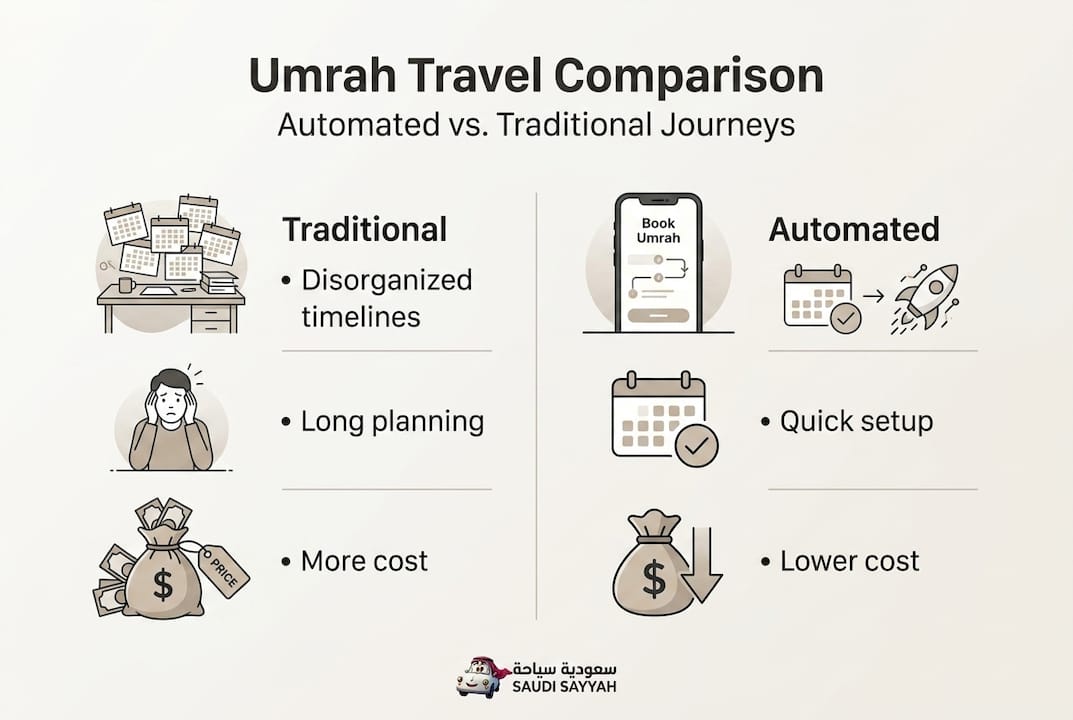
Comparison: Automated vs. traditional Umrah travel
| Category | Traditional agent | Automated platform |
|---|---|---|
| Planning time | 2 to 4 weeks | 1 to 3 days |
| Cost savings | Minimal | Up to 20% |
| Language support | Agent-dependent | Full multilingual |
| Permit tracking | Manual follow-up | Real-time automated |
| Personalization | Generic packages | AI-driven customization |
| 24/7 availability | No | Yes |
| Reliable Umrah transport integration | Separate booking | Built-in options |
Pro Tip: Activate real-time crowd notifications in your chosen platform at least 48 hours before you arrive at each site. This gives you enough lead time to adjust your schedule if a particular location is experiencing high foot traffic, which is common during peak Umrah seasons.
The data reinforces what experienced pilgrims already know: logistics determine whether a spiritual journey feels peaceful or stressful. Smart tool travel tips that remove planning friction directly improve the quality of the experience itself.
Navigating potential drawbacks and limitations
While the advantages are compelling, automated travel has real limitations. Knowing these in advance helps pilgrims plan more effectively rather than being caught off guard.
Technology dependency. Every automated platform requires a functioning smartphone and a reliable internet connection. In crowded areas near Masjid al-Haram, connectivity can be inconsistent. If a platform goes down during a critical booking window, there is no fallback unless the pilgrim has printed backup documents or knows how to reach a human support line.
Digital literacy gaps. Not every pilgrim is equally comfortable with app-based tools. Elderly pilgrims and those with limited smartphone experience can struggle with permit interfaces, navigation features, and digital payment systems. The technology assumes a baseline of comfort with devices that not all users share.
Reduced human touch. Traditional travel agents, at their best, provide culturally informed advice, emotional reassurance, and flexible problem-solving. Automated platforms handle predictable scenarios well. They handle unexpected, nuanced situations less reliably.
Top pitfalls to watch for:
- Slot scarcity: Popular time windows for Rawdah visits fill quickly. Automated systems show available slots but cannot create them.
- Emergency scenarios: Medical emergencies, lost documents, or sudden family needs require human intervention that no app fully replaces.
- Cultural nuances: AI platforms can miss context-specific etiquette or religious considerations that an experienced local guide would know instinctively.
- Connectivity outages: Peak pilgrimage periods strain local networks. Offline functionality is critical but not universally available across all platforms.
- Booking accessible Umrah transport for specific needs sometimes requires direct human confirmation beyond what apps currently support.
"Saudi Arabia's Vision 2030 digital mandates explicitly encourage hybrid solutions that combine AI efficiency with trained human support teams, recognizing that technology alone cannot serve every pilgrim's needs."
Pro Tip: Pair your automated platform with a local ground contact or a transport provider that offers real human support alongside its digital tools. The best outcomes come from combining both, not choosing one over the other entirely.
Acknowledging these limitations is not a reason to avoid automation. It is a reason to use it thoughtfully, with backup plans in place for the moments where human judgment genuinely adds value.
How automated travel personalizes the Umrah experience
Understanding the potential drawbacks sets the stage for seeing how automated travel platforms excel at customizing the journey for diverse first-time pilgrims. Personalization is where modern AI tools genuinely outperform the traditional agency model.
Agentic AI frameworks generate complete, context-aware Umrah itineraries with high completeness in English, outperforming manual services in personalization depth and accuracy. This is not just about language. It is about building a plan that reflects the specific circumstances of each traveler.
Personalized features across platform types:
| Traveler profile | Personalization feature | Platform capability |
|---|---|---|
| Elderly pilgrim | Wheelchair-accessible route mapping | Nusuk site filters |
| Family group | Adjacent room selection near Haram | Hotel integration with room type filters |
| Non-Arabic speaker | Bilingual menus and signage guidance | Multilingual AI interface |
| Solo Western pilgrim | Real-time prayer time notifications | Automated scheduling alerts |
| Large group | Coordinated transport with group tracking | Group booking and geolocation tools |
Special cases where personalization matters most:
- Elderly travelers: Platform accessibility settings allow larger text, simplified navigation, and step-free route guidance between sites
- Multi-generational groups: Family room clustering, shared scheduling tools, and group notification systems keep everyone coordinated without constant phone calls
- First-time Western pilgrims: English-language walkthroughs of rituals, site-specific etiquette guidance, and map overlays reduce confusion at key locations
- Pilgrims with mobility needs: Automated transport platforms that confirm accessible vehicle availability before booking, rather than assuming standard options will suffice
The personalization advantage is most visible when comparing experiences. A first-time Western pilgrim using a standard agency package receives a generic itinerary built for the average traveler. A pilgrim using an agentic AI platform receives a schedule built around their physical needs, language preferences, group size, and spiritual priorities.
Best Umrah transport options integrated into these platforms extend personalization to ground logistics as well. Real-time driver tracking, vehicle type selection, and pre-trip confirmations with driver details eliminate the anxiety of not knowing who is picking you up or whether the vehicle meets accessibility requirements.
Pro Tip: When setting up your profile on an automated Umrah platform, fill in every preference field, including mobility requirements, group size, language, and dietary needs. The more context the system has, the more accurate and useful its recommendations become. Partial profiles produce generic outputs.
Group travel options within automated platforms now support groups of 20 or more with shared itinerary management, which is a genuine innovation for families and community groups traveling together for the first time.
The real value: What most Umrah guides miss about automation
Most articles about automated Umrah travel focus heavily on time savings and cost reduction. These are real and measurable. But they are not the most important thing automation delivers to a first-time Western pilgrim.
The real value is cognitive space. When logistics are handled reliably by a system that works without constant attention, the pilgrim's mental energy is freed for what the journey is actually about. Worrying about whether a permit will arrive, whether a driver will show up, or whether a hotel room is close enough to Masjid al-Haram consumes attention that should be directed elsewhere.
Automated travel systems excel in efficiency and reliability for first-timers by handling complex logistics including visas, crowds, and transport through AI real-time data. This means the system is working even when the pilgrim is not looking at a screen.
There is also a dimension of empowerment that automated tools provide. Western pilgrims who cannot read Arabic, who have never navigated Makkah or Madinah, and who feel uncertain about cultural expectations arrive with a significant disadvantage compared to pilgrims from regions with closer geographic and cultural proximity to the holy cities. Automated platforms, particularly those with strong multilingual and contextual AI support, actively reduce that gap.
The uncomfortable truth most guides skip over is this: technology does not diminish the spiritual dimension of Umrah. It protects it. Every logistical failure, every missed permit, every confusing transport arrangement takes the pilgrim's focus away from prayer and reflection and redirects it toward problem-solving. Automation removes those interruptions.
Safe Umrah travel insights consistently highlight that pilgrims who arrive with confirmed, integrated logistics report higher satisfaction with their spiritual experience, not because the technology was impressive, but because they had space to be present.
The pilgrims switching to automated platforms are not doing so because they love apps. They are doing so because they want their attention during those sacred days to be undivided.
Plan your stress-free Umrah journey with trusted travel partners
Automated platforms handle permits, scheduling, and itinerary management well. Ground transport is where technology and human reliability need to work together seamlessly.
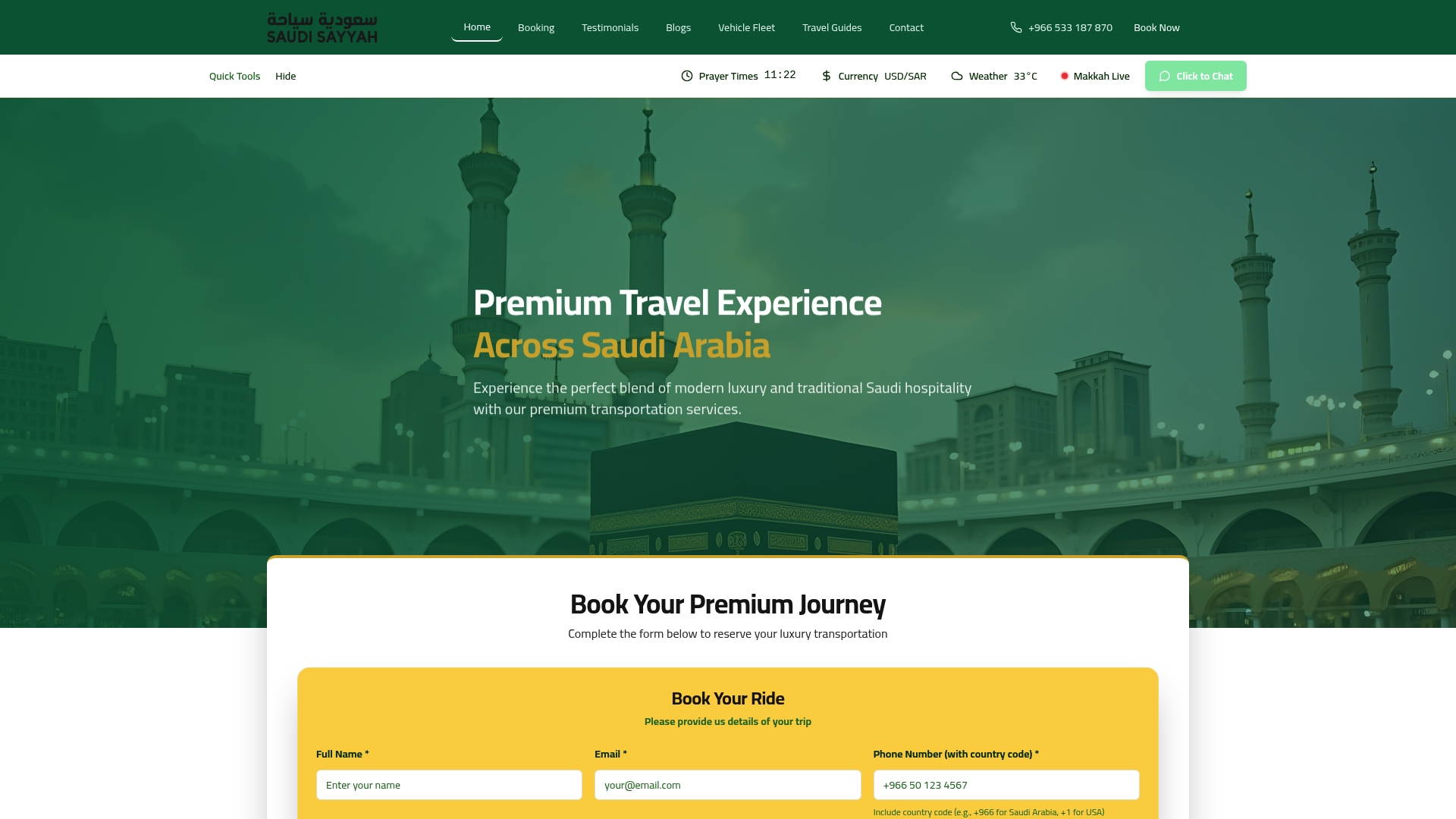
Saudi Sayyah's fully automated booking system delivers real-time driver tracking, vehicle details, and driver photos before every trip, so there are no surprises on arrival. The fleet includes the latest model year vehicles, professionally maintained, with experienced drivers who understand the specific needs of first-time pilgrims. Whether traveling solo or coordinating a large group, the car hire service for Umrah connects directly with your broader pilgrimage schedule. For groups and families, explore premium pilgrimage vehicle options designed to handle Umrah logistics with the reliability and communication that Western pilgrims expect.
Frequently asked questions
How much time can automated travel save for first-time Umrah pilgrims?
Automated platforms reduce Umrah travel planning time by up to 70% compared to manual booking through traditional agents. For Western pilgrims managing complex schedules, this translates to days of saved effort.
Can Western pilgrims get real-time assistance in English using automated travel apps?
Yes. AI tools like Ibraheem provide real-time personalized recommendations for flights, hotels, and services in multiple languages including English, making them well-suited for non-Arabic-speaking pilgrims.
What are the main risks of relying on automated travel solutions?
Key drawbacks include over-reliance on technology when connectivity is poor, digital literacy gaps particularly among elderly users, and reduced human interaction in complex or unexpected situations. Combining automated tools with a reliable ground support provider reduces these risks significantly.
How does automated travel improve access to key Umrah sites?
The Nusuk app achieves 90% user satisfaction by increasing Rawdah access from 7,000 to 54,000 daily visitors, a 671% increase, through real-time crowd updates, automated permit issuance, and offline functionality for low-connectivity environments.