

Contactless journeys are fully touch-free travel experiences powered by NFC, biometrics, and AI. They remove physical friction points such as paper tickets, cash, queues, and manual ID checks. Contactless transactions now represent about 60% of all U.S. in-person payments as of mid-2026, and Mastercard reported that contactless payments accounted for more than 75% of its network transactions in 2025. The shift is not incremental. It is structural.
Key aspects of the contactless journey model:
- Touch-free payment via NFC-enabled cards, phones, and wearables
- Biometric identity verification at airports and transit gates
- Digital booking and mobile ticketing without physical documents
- Real-time tracking and communication throughout the trip
- AI-driven queue management and flow prediction
What are the core benefits of contactless travel?
Speed is the most immediate gain. Tapping to pay on buses saves time compared to cash or swipe cards, and 57% of transit riders surveyed globally cited a faster payment experience as the top benefit of open-loop contactless systems. Reduced queues follow directly from that speed.
Security and hygiene rank close behind. Eliminating cash, kiosks, and ticket machines cuts surface contact and reduces theft risk. 84% of transit agencies surveyed said contactless payments helped convince riders to return to public transit post-pandemic. That figure reflects a real shift in traveler confidence, not just operator preference.
Operational cost savings are substantial for agencies. Washington, D.C. saves 6 cents per dollar on fares collected by bank card instead of cash. Transit agencies that move away from cash and ticket vending machines redeploy staff toward rider support and network management rather than revenue collection.
Financial inclusion is an underappreciated benefit. Prepaid cards allow riders without formal bank accounts to access transit, and fare-capping provides weekly and monthly discounts without requiring an upfront unlimited-ride pass. Environmental outcomes also improve: higher ridership from contactless adoption reduces private car use and vehicle miles traveled.
How do contactless systems work across the full travel lifecycle?
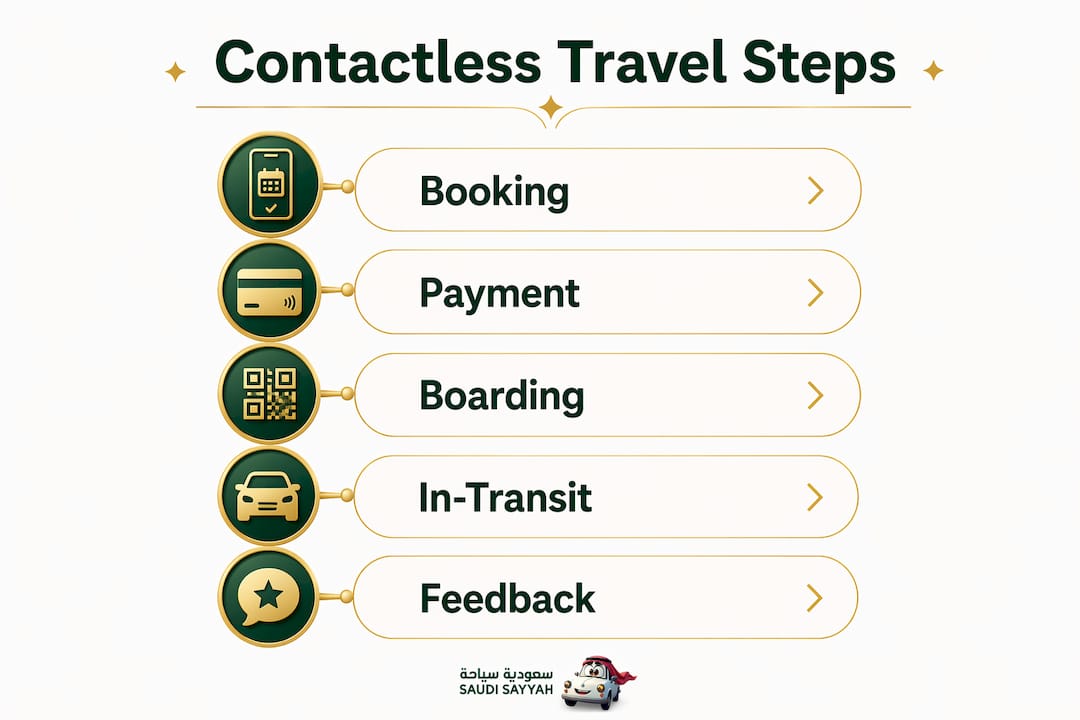
Contactless technology applies at every stage, not just payment.
Booking and ticketing. Mobile apps replace paper tickets. Digital IDs stored in wallets like Apple Wallet or Google Wallet allow travelers to book, confirm, and board without printing anything. Apple's Digital ID now lets U.S. travelers present passports at TSA checkpoints with a tap of an iPhone or Apple Watch.

Airport processing. Biometric face gates handle check-in, security, and boarding without paper boarding passes or physical ID checks. IATA's One ID initiative shows 73% of passengers prefer biometric recognition over traditional document checks. Baggage drop uses the same biometric token, linking the traveler's identity across every airport touchpoint.
Ground transport. Tap-to-ride is now standard across buses, trains, ferries, e-bikes, and e-scooters. The Netherlands introduced tap-to-ride on all public transit in 2023, and within two years, a quarter of its journeys were made by payment card. New York City's OMNY system expanded tap-and-go access across the entire MTA network through 2025.
- Taxis and ride-hail: contactless card terminals and in-app payment eliminate cash handling
- Tolls: ANPR combined with registered payment cards removes the need to stop entirely
- Pilgrimage transport: digital booking, driver photo sharing, and real-time GPS tracking replace paper vouchers and phone calls
Pro Tip: For multi-modal trips, choose platforms that consolidate payment history and trip data in a single app. Switching between separate apps for each transport mode is the primary driver of traveler frustration with contactless systems.
For pilgrimage-specific mobile booking for travelers, digital ticketing removes the friction that first-time visitors to the holy lands face most acutely.
What technologies power the contactless journey?
Four core technologies underpin the contactless travel ecosystem.
- NFC (Near Field Communication): Enables tap-to-pay and tap-to-ride at terminals. The Consumer Financial Protection Bureau confirms that digital wallet tap-to-pay transaction value will grow by over 150% by 2028.
- Biometric authentication: Face recognition, fingerprint, and iris scanning verify identity without physical documents. Biometric face gates use the same digital handshake protocol as contactless payments, enabling identity and payment to share a single token.
- AI and predictive analytics: AI systems predict queue lengths, adjust staffing in real time, and optimize passenger flow. AI-driven biometric boarding has reduced boarding times significantly at airports deploying these systems.
- Open-loop payment systems: Allow riders to use everyday credit, debit, or prepaid cards across multiple transit operators without a proprietary closed-loop card.
| Technology | Primary function | Key benefit |
|---|---|---|
| NFC | Tap-to-pay, tap-to-ride | Speed, hygiene |
| Biometrics | Identity verification | Security, no physical ID |
| AI | Queue and flow management | Reduced wait times |
| Open-loop payments | Multi-operator fare acceptance | Convenience, inclusion |
| Mobile wallets | Digital ID and payment storage | Single-device access |
Interoperability is the hardest problem. Fragmentation across apps causes traveler frustration; integrating payment history and trip data within a single platform is what separates functional contactless systems from ones that create new friction. For a broader view of technology trends in travel, the integration challenge is consistent across every transport mode.
What does the future of contactless travel look like?
Biometrics and AI are converging toward a single digital travel identity. Rather than separate tokens for payment, boarding, and ground transport, travelers will carry one verified digital ID that works across every mode and operator. IATA's One ID program is the clearest current example of this direction.

Mobility as a Service (MaaS) platforms aim to assemble multiple transport modes into one access point, typically an app. The concept is technically feasible today; the unresolved challenges are liability, service support, and commercial agreements between operators. Progress is real but uneven.
Privacy and data governance remain active concerns. Every biometric scan and tap-to-ride transaction generates behavioral data. Agencies and operators that are transparent about data use and give travelers control over their records will build trust faster than those that treat data collection as a background process.
The role of automation in travel will expand significantly through 2026 and beyond, with real-time decision-making systems handling everything from dynamic pricing to proactive passenger communication. Partners in the transport sector, including corporate transport operators adopting biometric and real-time data tools, are already building toward this model.
How Saudisayyah applies contactless technology to pilgrimage travel
Saudisayyah built its platform specifically for the friction points that pilgrims face. Many travelers visiting the holy lands do so for the first time, with no familiarity with local fare systems, transport networks, or documentation requirements. The platform addresses this directly.
- Fully automated digital booking: no paper vouchers, no phone confirmations
- Pre-trip driver photo and vehicle details sent via the app before every trip
- Real-time GPS tracking throughout each transfer
- Internationally compliant booking management covering documentation and scheduling
- Professional driver fleet with late-model vehicles and advanced in-vehicle technology
Pro Tip: First-time pilgrims benefit most from platforms that maintain constant communication before and during the trip. Receiving driver details and live tracking before departure eliminates the uncertainty that causes the most stress at unfamiliar airports and transit hubs.
The contactless model fits pilgrimage travel particularly well. Pilgrims often travel in groups, carry minimal cash, and need reliable ground transport between airports, hotels, and holy sites. Digital booking with real-time tracking removes the coordination burden that paper-based systems place on travelers who are unfamiliar with the local environment. For details on Saudisayyah's car hire and travel services, the platform covers the full transfer lifecycle from arrival to departure.

Saudisayyah's fleet and technology platform reflect the same principles that drive contactless adoption globally: reduce friction, increase transparency, and give travelers reliable information at every step. Explore Saudisayyah's vehicle fleet for a full view of the vehicles and technology supporting each pilgrimage transfer.
Key Takeaways
Contactless journeys reduce friction at every travel stage by combining NFC, biometrics, AI, and open-loop payments into a single, integrated experience that improves speed, security, and inclusion.
| Point | Details |
|---|---|
| Adoption scale | Contactless payments now represent about 60% of all U.S. in-person payments as of mid-2026, while Mastercard reported that contactless payments accounted for more than 75% of its global network transactions in 2025. |
| Rider benefit | 57% of transit riders globally cite faster payment as the top benefit of open-loop systems. |
| Cost savings | Washington, D.C. saves 6 cents per dollar on fares collected by bank card over cash. |
| Airport efficiency | AI-driven biometric boarding cuts boarding times by up to 20% at deploying airports. |
| Pilgrimage application | Saudisayyah's automated platform delivers digital booking, driver tracking, and real-time communication for first-time pilgrims. |