
TL;DR:
- Travelers planning for Ramadan in Saudi Arabia must adjust their schedules around fasting, prayer times, and cultural customs to ensure a respectful and smooth trip. It is essential to verify Ramadan dates early, book transportation and accommodations well in advance, and structure activities for indoor visits during fasting hours and outdoor or social activities after Iftar. Following modest dress codes, respecting local sensitivities, and coordinating logistics like transport and prayer schedules help travelers have an authentic and rewarding experience.
Ramadan travel planning is defined as the process of aligning your itinerary, cultural behavior, and logistics with the fasting, prayer, and social rhythms of the Islamic holy month. Saudi Arabia during Ramadan operates on a fundamentally different schedule than the rest of the year. Restaurants close during daylight hours, transportation patterns shift around prayer times, and evenings come alive with vibrant cultural gatherings that most travelers never expect. A well-built Ramadan travel guide does not just list rules. It helps you build a trip that is respectful, practical, and genuinely rewarding.
What is the best guide to Ramadan travel planning for Saudi Arabia?
The most effective Ramadan travel plan starts with one fact: Ramadan shifts 10–12 days earlier each year on the Gregorian calendar. That means the month's start date changes annually and is confirmed only by local moon sighting, not a fixed date on your wall calendar. For 2026, the expected Ramadan start falls around february 17, but travelers must verify the official announcement close to that date.
This date variability has a direct impact on flight and hotel availability. Peak travel congestion builds in the weeks surrounding Ramadan's start and end, particularly at major airports serving the Middle East. Book flights and accommodation at least two to three months in advance to avoid price spikes and sold-out options.
Your travel itinerary for Ramadan should be structured around two distinct halves of the day. Daytime hours call for low-energy activities: museum visits, indoor cultural sites, and rest. Evenings open up after Iftar, the meal that breaks the fast at sunset, and that is when markets, mosques, and social gatherings become fully active.
Syncing your schedule with prayer apps that show local prayer times and Qibla direction keeps your itinerary aligned with the city's rhythm. Public transportation and services often reduce availability around prayer breaks, so building buffer time into every transfer is not optional. It is necessary.
| Activity type | Best timing | Notes |
|---|---|---|
| Museum and indoor visits | Mid-morning to early afternoon | Cooler, quieter, and fasting-friendly |
| Outdoor sightseeing | After Fajr or post-Iftar | Avoid peak afternoon heat and fatigue |
| Dining and markets | After Iftar (sunset) | Full activity resumes after fast breaks |
| Long transfers and airport runs | Early morning | Avoid prayer-time service gaps |
| Tarawih prayer attendance | Late evening | Mosques fill quickly; arrive early |
Pro Tip: Book airport transfers for early morning departures. Service availability drops sharply around Maghrib prayer and Iftar time, and delays during that window are common.
What cultural etiquette should travelers follow during Ramadan?
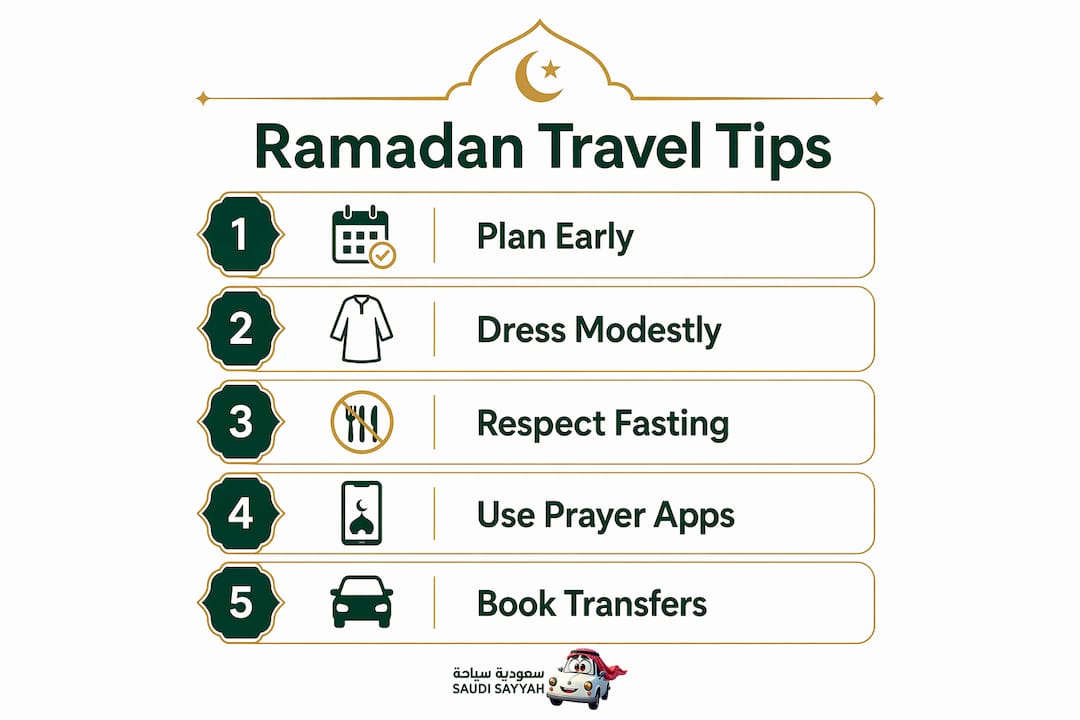
Modest dress is the baseline requirement for all travelers in Saudi Arabia during Ramadan. Official guidance requires both men and women to cover their shoulders and knees in public spaces. Women visiting mosques or religious sites should also carry a headscarf. This standard applies throughout the year in Saudi Arabia but carries greater social weight during Ramadan.
Eating, drinking, and smoking in public during fasting hours is not just frowned upon. In Saudi Arabia, it can result in a fine or removal from public spaces. Non-fasting travelers should eat discreetly, inside hotels or designated areas, and respect local sensitivities around food visibility. This is not a hardship. It is a straightforward act of respect that locals notice and appreciate.
Public displays of affection, loud music, and boisterous behavior are all considered inappropriate during Ramadan. The social atmosphere is more contemplative during the day and more celebratory after Iftar, so matching your energy to the moment matters.
Ramadan etiquette: do's and don'ts
- Do dress modestly in all public spaces, covering shoulders and knees
- Do greet locals with "Ramadan Kareem" or "Ramadan Mubarak" as a sign of respect
- Do accept an Iftar invitation if offered. It is one of the most generous gestures in Arab culture
- Do observe silence or lower your voice near mosques during prayer calls
- Don't eat, drink, or smoke in public during fasting hours
- Don't play loud music in shared or public spaces
- Don't photograph people praying without explicit permission
- Don't assume all businesses follow the same adjusted hours. Always confirm in advance
How do you manage worship, fasting, and health while traveling?
The three-system approach to Ramadan travel covers food timing, prayer scheduling, and recovery time. Each system depends on the others. Skipping rest to attend late-night Tarawih prayers without planning a lighter afternoon schedule leads to exhaustion by day three of a trip. Planning all three together prevents that collapse.
For fasting travelers, the practical sequence looks like this:
- Suhoor (pre-dawn meal): Eat a high-protein, slow-digesting meal before Fajr prayer. Oats, eggs, and nuts hold energy longer than bread or sweets.
- Fajr prayer: Confirm local prayer time the night before using a prayer app. Times shift by a few minutes daily.
- Daytime activity: Schedule low-intensity visits, rest periods, and indoor time. Afternoon hours are the hardest physically. Reserve them for rest, not sightseeing.
- Iftar preparation: Know your Iftar location before sunset. Restaurants fill fast. Hotel dining rooms are a reliable backup.
- Maghrib and Isha prayers: Plan transport around these times. Roads and public spaces shift dramatically at Iftar.
- Tarawih prayers: Attend at a local mosque for the full cultural experience. Makkah and Madinah mosques draw enormous crowds, so arrive 30 minutes early.
- Sleep and recovery: Prioritize at least six hours of sleep. Fatigue compounds quickly over a multi-day trip.
Carrying an emergency Iftar kit with dates, nuts, and water handles the situation where transport delays push your fast-breaking past sunset. Dates are the traditional first food at Iftar and are widely available across Saudi Arabia.
Pro Tip: Download a prayer app that shows both prayer times and Qibla direction before you land. Muslim Pro and Athan are widely used and reliable for Saudi cities.
For Umrah pilgrims traveling during Ramadan, the physical demands are higher. The Tawaf and Sa'i circuits at the Grand Mosque in Makkah are far more crowded during Ramadan than at any other time of year. Plan these rituals for off-peak hours, typically after Fajr or in the late morning, to manage crowd levels and heat.
What should travelers expect from services and transport during Ramadan?
Business hours in Saudi Arabia shift significantly during Ramadan. Restaurants typically close from Fajr until Iftar. Shops and malls often open late morning, close in the early afternoon, then reopen after Iftar and stay open past midnight. Confirming hours directly with venues before visiting saves wasted trips.
Hotels in major cities adapt their dining services for non-fasting guests. Most offer discreet dining rooms or packed lunch options during fasting hours. This service is standard at international hotel brands in Riyadh, Jeddah, and Makkah. Ask at check-in rather than assuming the main restaurant will be open.
Airport transfers carry specific risks during Ramadan. Flight delays cluster around the start and end of the holy month, and ground transport availability dips sharply around Iftar. Travelers managing airport transfer logistics should confirm pickup times with their driver the day before and build a 30-minute buffer around sunset arrivals.
| Service type | Ramadan adjustment | Best practice |
|---|---|---|
| Restaurants | Closed during fasting hours | Book Iftar reservations in advance |
| Retail and malls | Reduced daytime hours, extended evenings | Visit after Iftar for full access |
| Public transport | Reduced frequency near prayer times | Use pre-booked private transfers |
| Airport transfers | Delays common at Ramadan start and end | Book early, confirm day before |
| Hotel dining | Discreet options for non-fasting guests | Request at check-in |
Saudisayyah's geolocation-enabled platform sends driver details and real-time tracking before every pickup, which removes the uncertainty that comes with Ramadan's shifting schedules. For travelers managing tight connections between prayer times and transport windows, that level of visibility matters.
Key Takeaways
Effective Ramadan travel planning in Saudi Arabia requires aligning your itinerary, cultural behavior, and transport logistics with fasting hours, prayer times, and the adjusted service schedules of the holy month.
| Point | Details |
|---|---|
| Verify Ramadan dates early | Ramadan shifts 10–12 days annually; confirm the official start via local moon sighting. |
| Structure your itinerary by time of day | Schedule low-energy activities during fasting hours and cultural events after Iftar. |
| Follow modest dress and public conduct rules | Cover shoulders and knees; avoid eating, drinking, or smoking in public during fasting hours. |
| Use the three-system approach | Coordinate food timing, prayer scheduling, and rest to sustain energy across multi-day trips. |
| Confirm all service hours in advance | Restaurants, transport, and attractions all adjust hours during Ramadan. |
Ramadan travel taught me to stop fighting the schedule
The first time I traveled to Saudi Arabia during Ramadan, I planned my days the way I would any other trip. I booked lunch reservations, scheduled afternoon site visits, and assumed transport would run on its normal timetable. By day two, I had missed two restaurant bookings, sat in a stationary taxi for 45 minutes during Iftar, and arrived at a mosque 20 minutes after Tarawih started.
The shift I needed was not logistical. It was attitudinal. Ramadan does not pause for travelers. Travelers pause for Ramadan. Once I accepted that, the trip became genuinely interesting rather than frustrating. The evenings after Iftar in Jeddah's Al-Balad district are unlike anything I have experienced elsewhere. Streets that were quiet at 3:00 PM are full of families, street food, and conversation at 10:00 PM.
The practical lesson I carry from that trip: build your day around Iftar, not around your original plan. Know where you will be at sunset. Know your transport situation. Carry dates and water. Everything else is flexible. Travelers who approach Ramadan in Saudi Arabia with that mindset consistently report it as one of the most memorable trips they have taken, not despite the constraints, but because of the structure those constraints create.
The group pilgrimage checklist approach works well here even for solo travelers. Treating Ramadan travel like a structured pilgrimage, with planned timing, confirmed logistics, and clear priorities, removes most of the friction that catches first-time visitors off guard.
— Fa
Saudisayyah: reliable transport for Ramadan travel in Saudi Arabia
Ramadan's shifting schedules make reliable ground transport one of the most practical decisions you can make before landing in Saudi Arabia.
Saudisayyah's car hire services cover the full range of Ramadan travel needs, from airport pickups timed around prayer schedules to dedicated transfers between Makkah and Madinah for Umrah pilgrims. The platform sends driver photos, vehicle details, and real-time tracking before every trip, so you always know your pickup status without needing to call. The fleet options include late-model vehicles suited for families, groups, and solo travelers. For anyone managing the compressed logistics of Ramadan travel, pre-booked, tracked transport removes one major variable from an already full schedule.
FAQ
How far in advance should I book travel for Ramadan in Saudi Arabia?
Book flights and accommodation at least two to three months before Ramadan. Peak congestion builds around the start and end of the holy month, and availability drops fast.
What is the Ramadan start date for 2026?
The expected start is around february 17, 2026, but the official date depends on local moon sighting and may shift by one day. Confirm close to the date through Saudi official channels.
Can non-fasting travelers eat during the day in Saudi Arabia?
Non-fasting travelers can eat, but must do so discreetly inside hotels or designated areas. Eating or drinking in public during fasting hours is not permitted and can result in a fine.
What is an Iftar kit and why do travelers carry one?
An emergency Iftar kit typically contains dates, nuts, and water. It handles situations where transport delays push your fast-breaking past sunset without access to a restaurant.
How do I manage transport around Iftar time in Saudi Arabia?
Book private transfers in advance and build a 30-minute buffer around sunset. Roads and public transport experience sharp demand spikes at Iftar, and stress-free airport transfers require confirmed pickups rather than on-demand bookings during Ramadan.