
TL;DR:
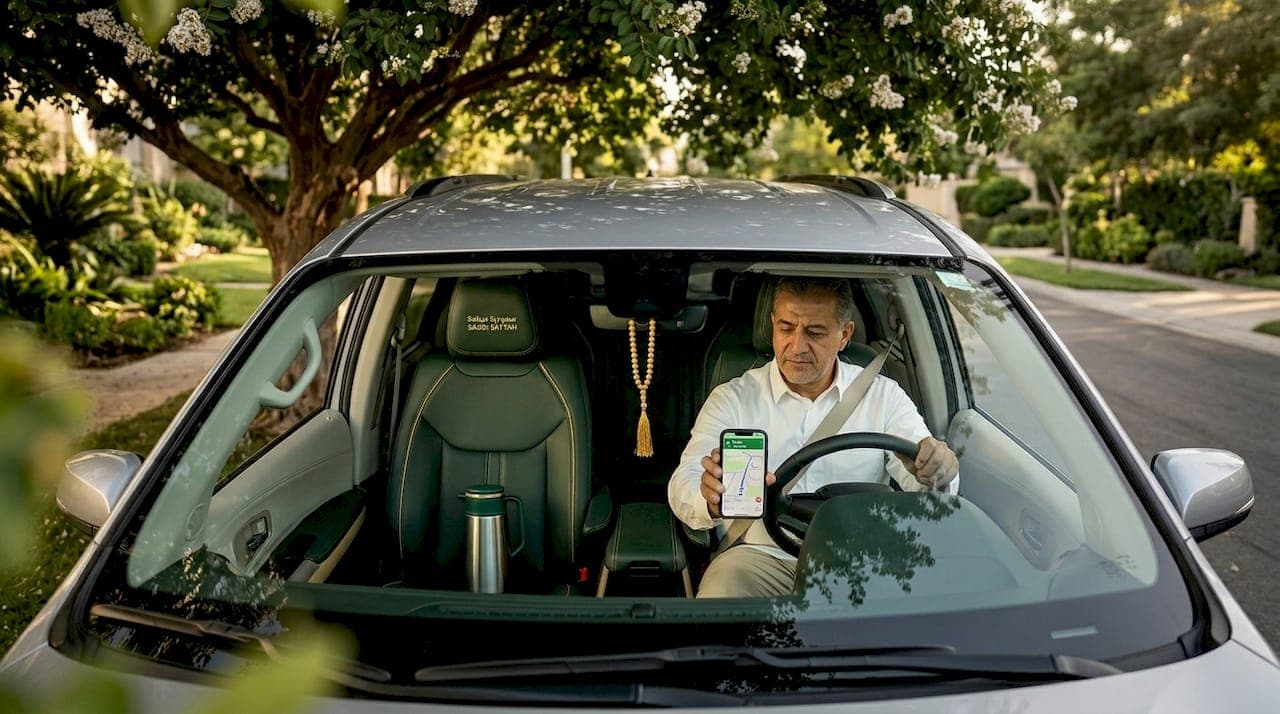
- Live driver tracking transforms the pilgrim experience by reducing anxiety, improving safety, and increasing ETA accuracy through continuous GPS updates. It enables proactive safety measures and fosters trust by providing real-time visibility, which is essential during high-traffic, time-sensitive Umrah travel. Using live location as a standard feature is vital for safer, more predictable journeys, especially in unfamiliar environments.
Most pilgrims arriving in Saudi Arabia for the first time assume that a confirmed booking means the hard part is done. It is not. Knowing your driver is coming is very different from knowing where your driver is right now, especially when you are standing outside a crowded airport in Makkah or Madinah with luggage, family members, and no local SIM card. The question of why offer live driver location has a practical answer: it turns an anxious wait into a calm, informed experience. This article covers the real benefits, the technology behind it, and how to use it well.
Table of Contents
- Key takeaways
- Why offer live driver location: core benefits
- How live driver tracking technology works
- Live vs. static location: what the difference means for pilgrims
- Practical tips for using live tracking effectively
- My take on live location and what pilgrims actually need
- How Saudisayyah handles live tracking for Umrah transport
- FAQ
Key takeaways
| Point | Details |
|---|---|
| Live location reduces anxiety | Knowing exactly where your driver is removes the guesswork that makes airport pickups stressful. |
| Safety improves measurably | Fleet data shows 19% fewer accident costs and significant fuel savings with live tracking in place. |
| Static updates are not enough | A single snapshot of location becomes outdated within minutes, especially in high-traffic Umrah zones. |
| Technology handles coverage gaps | Advanced apps queue GPS data locally and send updates when signal returns, so you are never truly off the map. |
| Demand transparency from providers | Pilgrims who ask for live tracking as a standard feature push the whole industry toward safer, more accountable service. |
Why offer live driver location: core benefits
Live driver tracking is not a premium add-on. For Umrah travelers, it is the difference between a predictable transfer and a stressful one. The benefits stack up across safety, communication, and overall trip quality.
Safety and accountability. When drivers know their route is being monitored, behavior changes. Real-time driver coaching reduces risky driving events by double digits within 60 to 90 days of implementation. That kind of measurable change matters when your vehicle is moving through congested routes near the Haram during peak pilgrimage periods.
Accurate ETAs and less anxiety. One of the most common complaints in pilgrim transport is not knowing when the driver will actually arrive. Live tracking fixes this directly. Platforms with live visibility cut customer support calls by up to 50% by giving travelers accurate, self-service ETAs. You check the app, you see where the car is, you stop worrying.
Here is a summary of the quantified benefits operators regularly report:
- 12% fuel savings from optimized routing
- 19% reduction in accident-related costs
- 44% productivity improvement across fleet operations
- 12% labor cost reduction through better dispatch coordination
- Up to 25 to 40% improvement in ETA accuracy for passengers
Trust through transparency. Pilgrims traveling to the holy lands for the first time have no local reference points. They cannot gauge whether a 20-minute wait is normal. Live location gives them that reference. They see the car moving toward them. That visibility builds trust in ways that a phone call from a dispatcher never fully can.
Emergency preparedness. Real-time GPS systems provide critical support for lost pilgrim recovery, SOS alerts, and health monitoring during high-density Umrah events. If something goes wrong, the response starts from a known location rather than from a panicked phone description of "near a large mosque."

Pro Tip: Before your trip, confirm whether your transport provider shares a live tracking link via SMS or app. If they only offer a driver phone number, that is a sign their tracking system may be limited.
How live driver tracking technology works
Understanding the mechanics helps you trust the system and troubleshoot it when needed.
-
GPS location updates. Modern tracking platforms refresh location every 10 to 30 seconds, giving you a near-continuous view of the driver's movement. This refresh rate is fast enough to generate accurate ETAs based on current road conditions, not just a static route estimate.
-
Noise filtering. Raw GPS data is not perfectly clean. Signals bounce off buildings, creating what engineers call "phantom movements," where the map shows the vehicle in a location it never actually visited. Advanced filtering algorithms use techniques like altitude gating and multi-sample confirmation to discard these false signals before they reach your screen.
-
Cellular coverage management. Parts of the route between Makkah, Madinah, and Jeddah can have inconsistent signal. Well-designed tracking apps handle this by caching GPS data locally on the device and sending SMS location updates when coverage resumes. The last known coordinates are still available to both the traveler and the operator.
-
Dispatch integration. The driver's live position feeds directly into the operator's dispatch system. This means if traffic suddenly blocks the planned route, the dispatcher can reroute the driver and push an updated ETA to the passenger portal automatically.
-
Proactive safety monitoring. Fleet managers watching live movement can identify speeding, hard braking, or unusual route deviations in real time. This creates an opportunity to coach the driver before a minor lapse becomes an incident, not after.
"Real-time tracking shifts fleet management from reactive to proactive. For Umrah transport specifically, the ability to see a problem developing, and act on it before it reaches the passenger, is what separates quality operators from average ones." — SafetyTrack Fleet Insights
The technology behind this is now widely adopted. 80% of fleet professionals use GPS tracking as of 2026, an 11-point increase year over year. It is no longer experimental. It is standard practice in any serious transport operation.
Live vs. static location: what the difference means for pilgrims
Many services offer what they call "location sharing" that is actually a static snapshot: a single GPS coordinate captured at the moment of request. This distinction matters more than most travelers realize.
Static location means a driver sends their current position once when asked. By the time you read it, the car has moved. In a city like Makkah during Umrah season, traffic conditions can change within two or three minutes. A static update from five minutes ago tells you almost nothing useful.
Live location means you see continuous movement on a map, updated every few seconds. You can see the driver turning onto your street. You can see if they are stuck in traffic two kilometers away. You can make real decisions based on real data.
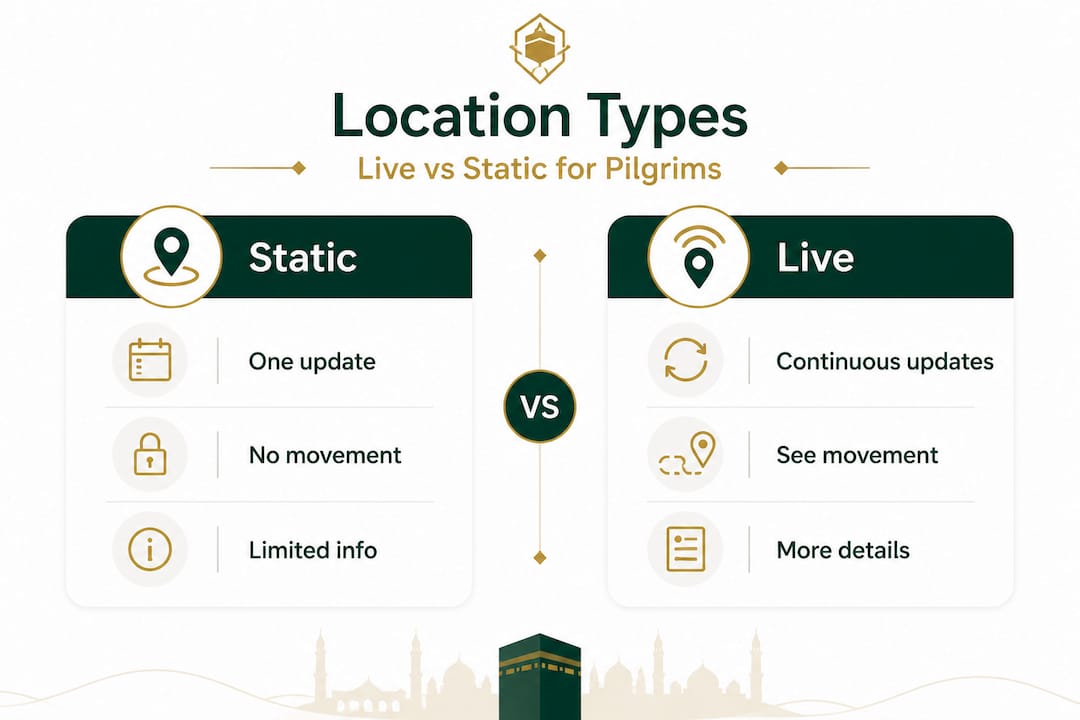
Here is a direct comparison:
| Feature | Static location | Live location |
|---|---|---|
| Update frequency | One-time snapshot | Every 10 to 30 seconds |
| ETA accuracy | Estimate only | Dynamic, traffic-adjusted |
| Emergency response | Delayed by manual check-in | Immediate, coordinates always current |
| Lost pilgrim support | Requires phone coordination | Automated alerts with last known position |
| Passenger anxiety reduction | Minimal | Significant |
| Route deviation detection | Not possible | Automatic flag to dispatcher |
For Umrah travelers managing group transport, the gap between these two methods is even wider. Coordinating multiple vehicles carrying family members across Makkah and Madinah without live tracking means constant phone calls and uncertain timing. Live tracking converts that coordination problem into something you can actually see and manage.
You can learn more about how professional drivers and technology work together to make Umrah transport safer and more predictable.
Practical tips for using live tracking effectively
Getting the most from live driver location requires a few deliberate habits on both sides of the transaction.
For travelers:
- Download the transport provider's app or confirm the live tracking link before your arrival date, not at the airport
- Check the driver's live position 10 to 15 minutes before the scheduled pickup rather than refreshing it constantly
- Save the dispatcher's contact number alongside the live link. If the map shows the driver has stopped unexpectedly, one call resolves it fast
- When traveling with elderly family members, assign one person in the group to monitor the live feed and relay updates to the others
For operators and providers:
- Push proactive updates to passengers when the driver's ETA shifts by more than five minutes. Silence creates anxiety faster than a short delay does
- Show driver photo and vehicle details alongside the live map. Pilgrims need to identify the car visually when it arrives, not just track a dot on a screen
- Treat coverage gaps as a system design problem, not an excuse. If your app cannot handle low-signal areas on standard Umrah routes, that is a known limitation worth fixing
Privacy and trust. Some travelers feel uneasy about a third party tracking their own movements through a shared app. The important point is that live driver location is one-directional. You see the driver. The driver does not gain access to your device location unless you explicitly share it. Clarifying this upfront removes a common objection.
Pro Tip: If your group is splitting across two vehicles, request separate live tracking links for each car. Monitoring both on one screen lets you coordinate arrivals at hotels or holy sites without phone tag.
Reviewing safe travel guidance for Umrah pilgrims alongside your transport setup gives you a fuller picture of what to prepare before you land.
My take on live location and what pilgrims actually need
I have seen how travelers describe transport stress after the fact, and the pattern is consistent. The problem is rarely a very late driver. It is the 12 minutes of not knowing. The "has he left yet?" moment while standing on a curb in unfamiliar surroundings. That specific anxiety is what live location eliminates, and it is more valuable than any comfort upgrade to the vehicle itself.
What I find underappreciated is how the importance of live driver location extends beyond the passenger. The driver benefits too. When operators can see route conditions in real time and communicate reroutes immediately, drivers spend less time guessing and more time moving. Fewer unnecessary stops, less idle time, less pressure.
The future is already forming. AI predictive routing will anticipate congestion and maintenance issues before they become delays. For Umrah routes, where the windows for reaching prayer times can be narrow, that kind of foresight will matter enormously. But the foundation has to be live location first. You cannot build predictive intelligence on top of a static snapshot.
My honest recommendation to any pilgrim reading this: treat live tracking as a non-negotiable, not a nice-to-have. If a provider cannot show you where your driver is before and during the trip, ask yourself what else they are not tracking.
— Fa
How Saudisayyah handles live tracking for Umrah transport
Saudisayyah was built around the idea that pilgrims should never have to wonder where their driver is. Before every trip, the platform sends driver photos, vehicle details, and a live tracking link directly to the passenger. No app download required for basic tracking. No phone calls needed to confirm arrival.
The fully automated booking system is internationally compliant and connects to real-time dispatch so that ETA updates reach passengers automatically when routes change. Drivers are experienced professionals, and every vehicle in the fleet is a current-model-year car with verified features. You can review available transport options or check the live tracking feature directly to see how it works before you book.
For first-time pilgrims especially, the goal is to remove every logistical unknown from the transport side of the trip so you can focus on the reason you came.
FAQ
What is live driver location and how is it different from a phone call?
Live driver location is a continuous GPS feed showing the driver's exact position on a map, updated every 10 to 30 seconds. A phone call gives you a verbal estimate; live tracking gives you real-time visual confirmation.
Why use driver location services for Umrah specifically?
Umrah routes involve high traffic density, time-sensitive prayer schedules, and unfamiliar surroundings for most travelers. Live tracking provides accurate ETAs and emergency location data in exactly the kind of environment where uncertainty is most costly.
Does live tracking work in areas with low cellular coverage?
Yes, when the system is well designed. Advanced apps cache GPS data locally and send SMS updates with last known coordinates once signal returns, so the location record stays intact even through coverage gaps.
How does live location improve safety for pilgrims?
Fleet data shows that live monitoring enables proactive driver coaching, which reduces risky driving events significantly within the first 60 to 90 days. For passengers, it also means emergency responders always have an accurate starting point if something goes wrong.
Can a single live tracking link cover multiple vehicles in a group booking?
Most providers issue one tracking link per vehicle. For group travel across multiple cars, request a separate link for each booking and monitor them simultaneously to coordinate arrivals at the same destination.