
TL;DR:
- Choosing a vehicle for Umrah travel requires evaluating safety features like ADAS systems and seat belts that perform reliably.
- Travel conditions in Saudi Arabia demand specific features such as blind-spot detection, adaptive cruise control, and lane assistance, which vary by model year and configuration.
- Avoid relying solely on feature names; verify actual functions through descriptions, model specifics, and pre-journey demonstrations to ensure safety and dependability.
Choosing a vehicle for Umrah travel means more than picking a car with a good reputation. Feature naming confusion is widespread, ADAS safety aids like automatic emergency braking, blind-spot warning, and lane keeping assistance appear under dozens of different brand names, and the stakes are high when you are traveling thousands of miles on unfamiliar highways. This article cuts through the clutter with a practical breakdown of essential vehicle features, how to evaluate them clearly, and how to avoid common pitfalls before your pilgrimage begins.
Table of Contents
- How to evaluate vehicle features for Umrah travel
- Essential safety and driver assistance features for pilgrims
- Understanding feature-name confusion and how to verify real functions
- Tech and connectivity: Balancing benefits and dependability risks
- Vehicle feature comparison summary for Umrah pilgrims
- Why too much tech can create its own risks for Umrah travel
- Explore premium vehicle options for your next Umrah journey
- Frequently asked questions
Key Takeaways
| Point | Details |
|---|---|
| Prioritize ADAS features | Automatic braking, lane and blind-spot assistance can greatly improve safety during long pilgrim journeys. |
| Beware of feature-name confusion | Check the actual function, not just the badge, since different brands use different names for the same technology. |
| Tech convenience vs. dependability | Advanced infotainment and smartphone features offer ease but are often sources of reliability issues. |
| Seat belts are essential | Never overlook the universal importance of seat belt use, even in highly automated or premium vehicles. |
| Plan for contingencies | Always keep offline navigation and manual options in case vehicle technology experiences problems. |
How to evaluate vehicle features for Umrah travel
Picking the right vehicle starts with understanding the conditions. Saudi Arabian highways are modern and well-maintained, but traffic patterns in Makkah and Madinah differ significantly from what most Western pilgrims experience at home. High-volume pedestrian movement, stop-and-go congestion near the Masjid al-Haram, and long highway stretches between cities all create unique demands on both driver and vehicle.
Here is a practical four-step process for evaluating any vehicle's features before booking transport:
- Map the journey type. Is the trip a short city transfer from the airport, a highway run between Makkah and Madinah, or a multi-day group itinerary? Each calls for different priorities. Highway trips demand strong adaptive cruise control and lane assistance. Urban transfers need tight blind-spot monitoring and a responsive braking system.
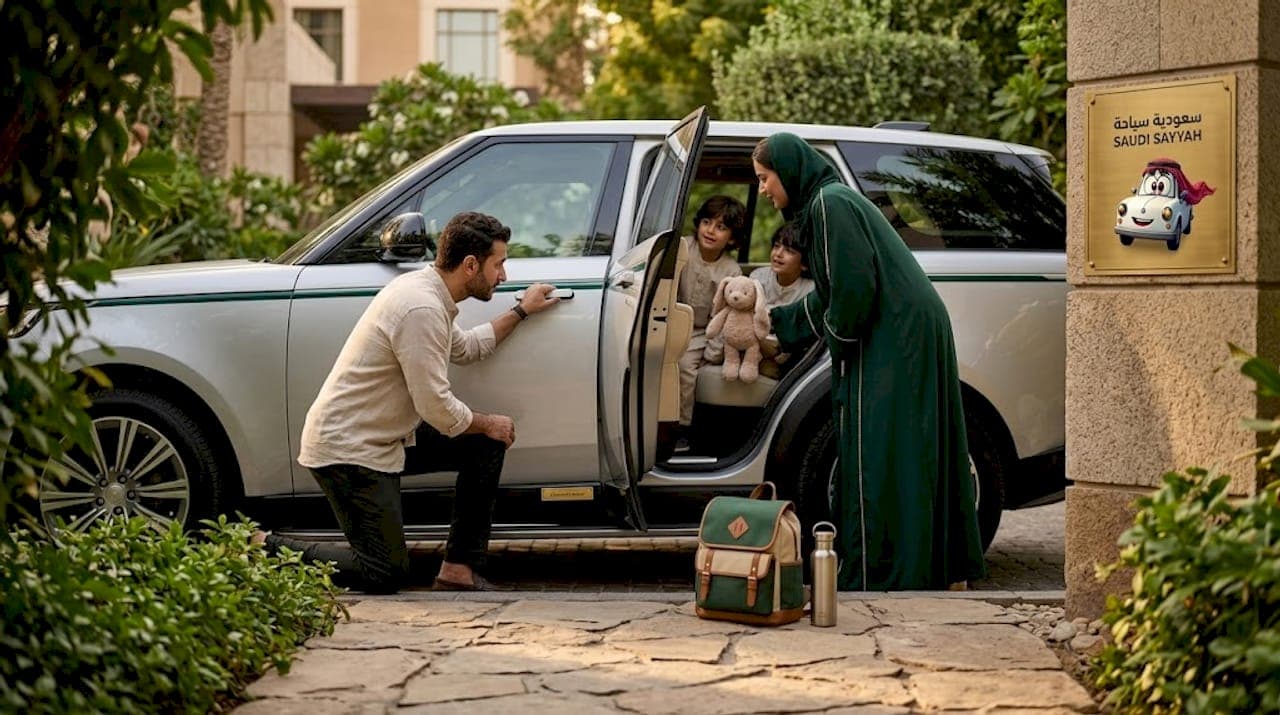
- Identify safety non-negotiables. Safe vehicle features for Umrah always start with functional seat belts, then active ADAS technology. The CDC's Hajj/Umrah guidance specifically prioritizes ADAS features that address common hazards on highways and urban roads, so those should be confirmed first, not treated as a bonus.
- Verify features by description, not name. Marketing labels vary widely across manufacturers. Ask the transport provider to describe what a feature actually does, not just what it is called.
- Check vehicle age and model year. Older vehicles may list legacy safety systems that are significantly less capable than current versions. Latest vehicle models for Umrah include far more refined sensor arrays and software than even five-year-old equivalents.
Pro Tip: Always request the actual vehicle model and year before confirming a booking. A modern SUV from 2024 or 2025 will typically carry a full suite of ADAS features as standard equipment, while a lower-spec or older model may only offer basic lane departure warnings without any corrective steering function.
Reliability is another key factor. A feature that works 95% of the time is not good enough when you are in an unfamiliar country with a group of pilgrims who depend on consistent, predictable transport. Ask specifically about the maintenance schedule and whether vehicles receive regular software updates.
Essential safety and driver assistance features for pilgrims
Once you know how to evaluate, it helps to understand each major feature category in detail. Here is a plain-language breakdown of the core systems you will encounter.
Automatic emergency braking (AEB). This system detects an imminent collision and applies the brakes without driver input. Some versions only detect vehicles; more advanced versions also detect pedestrians and cyclists. On congested streets near the Grand Mosque, pedestrian-detecting AEB is particularly valuable.
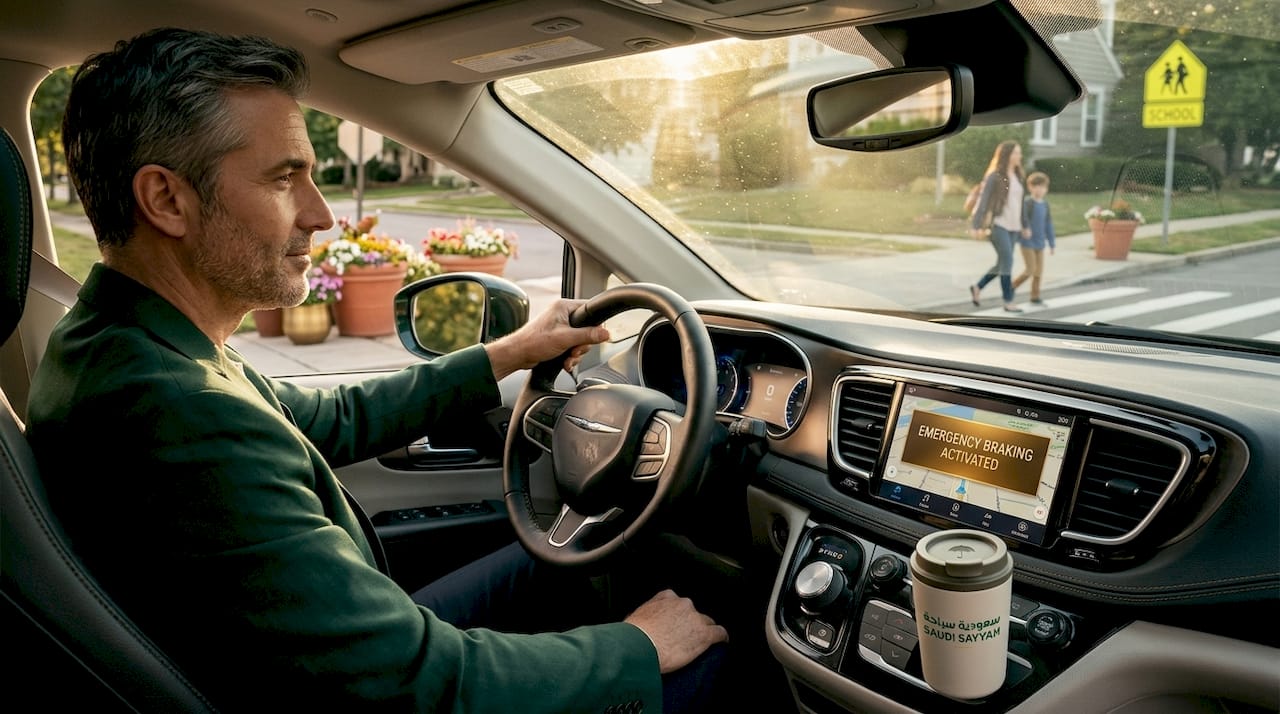
Blind-spot warning. A sensor system monitors the areas alongside and slightly behind the vehicle. When another vehicle enters that zone, the system triggers a visual alert, usually a light on the side mirror, and sometimes an audible tone. This is critical on multi-lane Saudi highways where lane changes at speed are common.
Lane departure warning vs. lane keeping assist. Lane departure warning is passive. It alerts you when the vehicle begins to drift across a lane line. Lane keeping assist is active. It applies mild steering or braking corrections to bring the vehicle back into its lane. The difference matters for long highway stretches where driver fatigue is a real risk.
Lane centering assist. This is the most advanced version, steering continuously to keep the vehicle centered in its lane without the driver needing to make constant micro-corrections. It is typically paired with adaptive cruise control for a semi-automated highway driving experience.
Adaptive cruise control (ACC). Unlike standard cruise control, ACC automatically adjusts vehicle speed to maintain a safe following distance from the car ahead. On the highway between Makkah and Jeddah, or during transfers to Madinah, this feature significantly reduces driver fatigue over a multi-hour journey.
Nearly all new vehicles now include at least one ADAS feature as standard. However, the quality and coverage of those systems vary considerably between a base trim and a fully-equipped model.
Seat belts are still the most important safety feature in any vehicle. Despite all the advances in active safety technology, seat belt use is explicitly emphasized in CDC Hajj/Umrah guidance for all occupants, including rear passengers. In Saudi Arabia, rear seat belt enforcement has increased, but the personal habit of buckling up must come from the passenger.
Pro Tip: When booking pre-arranged Umrah transport, confirm that rear seat belts are present and functional. Some older van configurations use bench seating without individual lap-shoulder belts. If you are traveling with elderly family members or pilgrims with mobility needs, this check is especially important.
Understanding feature-name confusion and how to verify real functions
This is where many pilgrims run into trouble. You request a vehicle with blind-spot detection, the booking confirmation says it has a "side awareness system," and you spend the first ten minutes of the trip wondering if they are the same thing. They are. But you should not have to guess.
AAA research found as many as 20 different names for a single ADAS feature across manufacturers. Audi calls it "side assist," Toyota calls it "blind spot monitor," Ford uses "blind spot information system," and Honda uses "blind side information." Same technology. Completely different labels.
This is not a minor inconvenience. It creates real uncertainty about whether a vehicle has what you need, and it makes comparing options across providers unnecessarily difficult. Here is a reliable three-step process for cutting through the naming confusion:
- Request a feature description, not a feature name. Instead of asking "Does it have lane keeping?", ask "Does the vehicle's lane system apply active steering corrections, or only issue a warning?" The answer tells you exactly what the system does regardless of what the manufacturer calls it.
- Cross-reference with the vehicle model and trim level. Manufacturer websites list feature availability by trim. If a provider confirms the vehicle is a Toyota Camry XSE, you can verify the exact standard and optional features directly on Toyota's website for that model year.
- Ask for a brief demo before the journey starts. Professional transport providers should be able to demonstrate key safety features on request. If a feature cannot be demonstrated or explained clearly, treat that as a yellow flag.
The same principle applies to comfort features. "Premium audio," "connected infotainment," and "smart display" can mean very different things across vehicles and providers. Verify function, not label.
Tech and connectivity: Balancing benefits and dependability risks
Modern vehicles come loaded with connectivity features, wireless charging pads, Apple CarPlay, Android Auto, over-the-air (OTA) software updates, built-in Wi-Fi hotspots, and multi-zone climate control apps. The convenience is real. So is the risk.
JD Power's 2026 US Vehicle Dependability Study identifies infotainment systems, mobile phone integration, and OTA software updates as the leading sources of owner-reported problems. The more connected a vehicle is, the more potential points of failure it introduces.
| Feature | Benefit | Dependability risk |
|---|---|---|
| Apple CarPlay / Android Auto | Familiar navigation on a large screen | Connection drops, software freezes |
| Over-the-air updates | Latest software without a dealer visit | Mid-trip update prompts, system reboots |
| Wireless charging | No cables needed | Heat issues, slow charge, compatibility gaps |
| Built-in Wi-Fi | Shared internet for the group | Data limits, signal dead zones |
| Multi-zone climate control | Individual temperature settings | Sensor errors, control panel glitches |
Here is what this means practically for your Umrah trip:
- Download offline maps before departure. Google Maps and Apple Maps both support offline areas. Download Makkah, Madinah, and the Jeddah corridor before you land. If CarPlay drops, your phone still works.
- Bring a USB-A to USB-C cable. Wireless CarPlay is convenient but less reliable than wired connections, especially in high-heat environments like those common in Saudi Arabia.
- Do not count on in-car Wi-Fi for critical communication. Use a local SIM card or a roaming plan from your home carrier for reliable data access.
- Know the manual controls. In many newer vehicles, climate and audio functions are buried in touchscreens. Ask the driver to show you the basics before the trip begins.
Viewing available vehicle fleet options ahead of time helps you match connectivity expectations to what is actually available in the vehicle you book.
Vehicle feature comparison summary for Umrah pilgrims
Different travelers have different priorities. The table below provides a quick summary of how key feature categories align with common Umrah travel scenarios.
| Feature category | Solo traveler | Family group | Large group / bus |
|---|---|---|---|
| AEB and pedestrian detection | High priority | High priority | High priority |
| Blind-spot warning | Medium | High (wider vehicle) | Essential |
| Lane centering assist | High (highway trips) | High | Medium |
| Adaptive cruise control | High | High | Medium |
| Rear seat belts | Standard seat | Required for all rows | Required for all rows |
| Third-row seating | Not needed | Optional | Standard |
| CarPlay / Android Auto | Convenient | Convenient | Less relevant |
| USB charging ports | 1-2 sufficient | 4+ recommended | Per-row ports preferred |
| Climate zones | Single zone fine | Dual zone minimum | Multi-zone preferred |
For group transport options, the priority shifts from individual comfort features toward overall capacity, belt availability across all rows, and reliable ADAS on larger vehicles where blind-spot management is more complex. Vans and minibuses with blind-spot camera systems are worth prioritizing over those with audio-only alerts.
Sedans generally work well for solo and paired travelers on city routes. SUVs cover most family needs with three-row configurations and stronger ADAS suites. For groups of eight or more, larger passenger vans with active safety features offer the best balance of capacity and protection.
Why too much tech can create its own risks for Umrah travel
There is a version of this story that goes wrong in a very specific way. A pilgrim family books what appears to be a premium vehicle, gets into it at King Abdulaziz International Airport, and immediately finds that the CarPlay screen has frozen, the third-row climate control is unresponsive, and the driver is trying to troubleshoot a software notification while navigating out of the terminal.
This is not a hypothetical. The more connected a vehicle's software ecosystem is, the more problems owners report. Advanced tech is a genuine convenience when it works. But when it does not, it pulls attention away from driving and creates friction at exactly the moments when focus matters most.
The practical lesson is this: treat ADAS safety features as non-negotiable, and treat connectivity features as a bonus rather than a baseline. A vehicle with reliable AEB, functional seat belts, and a clear offline navigation setup is far more valuable than one with eight connectivity features and a 30% chance of a software glitch mid-route.
Seat belts. Offline maps. A driver who knows the route. These are the foundations. Everything else is secondary. Passenger support tips from experienced Umrah transport operators consistently reinforce the same point: simplicity and reliability outperform novelty every time.
Trust the safety hardware. Be skeptical of connectivity software. Plan for the backup. That mindset will serve you far better than a checklist of impressive-sounding features that may or may not work on the day.
Explore premium vehicle options for your next Umrah journey
Knowing what features matter most, the next step is finding transport that delivers them consistently.
Saudi Sayyah's car hire services combine late-model vehicles, verified ADAS features, and experienced drivers who know Saudi Arabia's roads. Every booking includes driver photo sharing, real-time GPS tracking, and vehicle details sent to your phone before the trip starts. No guessing. No surprises. You can view our premium fleet to see exact vehicle models, features, and configurations before booking. For live conditions in the holy city, real-time Makkah updates are available directly through the platform so your transport plan stays current.
Frequently asked questions
Which vehicle safety features should Umrah pilgrims prioritize?
Pilgrims should prioritize ADAS functions like automatic emergency braking, blind-spot warning, and seat belts for maximum safety on Saudi Arabia's highways and city roads.
What is the difference between lane keeping and lane centering assist?
Lane keeping warns or nudges the driver when drifting out of a lane. Lane centering assist provides continuous steering support to keep the vehicle in the center of the lane.
Why can vehicle tech features cause reliability problems?
Infotainment systems and smartphone integration are consistently among the top sources of owner-reported problems, according to JD Power's 2026 study, making them the least dependable category in modern vehicles.
Does every car maker use the same name for features?
No. Consumers may encounter as many as 20 names for a single ADAS feature across different manufacturers, so always verify by function description rather than label.
Are seat belts required on buses too?
Yes. Seat belt use is recommended for all passengers on all vehicle types, including buses, in the CDC's Hajj and Umrah travel guidance.