

TL;DR:
- Centralized travel hubs improve connectivity and safety by consolidating multiple routes and services into one location. They enhance group coordination, provide better recovery options, and support pilgrimage safety and logistics through real-time tracking and unified booking. Decentralized models are less effective for large groups or complex itineraries due to fewer route options and weaker recovery infrastructure.
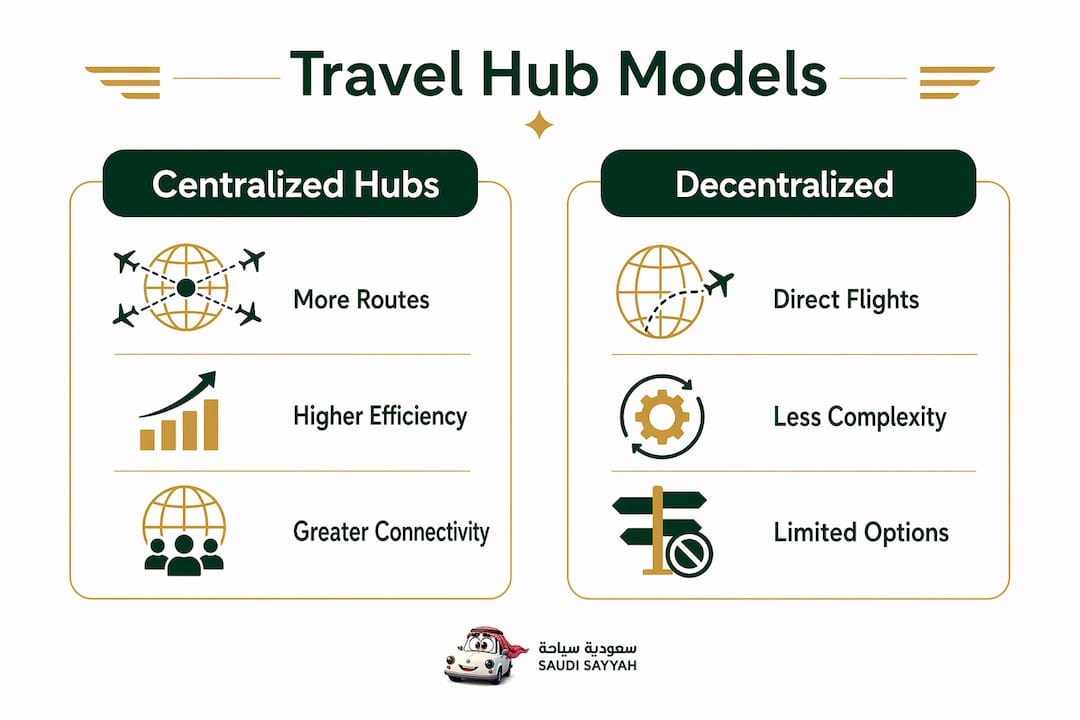
A centralized travel hub is a single transfer point that consolidates multiple flight routes, ground transport, and travel services into one coordinated location. This model, formally called the hub-and-spoke network in aviation logistics, sits at the core of why centralized travel hubs outperform scattered, point-to-point systems for complex travel. For pilgrims traveling to Mecca or Medina, often for the first time, that consolidation is not a convenience. It is a safety requirement.
Why centralized travel hubs improve connectivity and efficiency
The hub-and-spoke model works by routing passengers through a central airport before connecting them to their final destination. This creates a web of possible connections from a single location, rather than requiring direct flights between every city pair. The result is more departure options, shorter effective travel times, and far fewer missed connections.
Connection quality at hubs directly affects outcomes beyond travel comfort. One layover correlates with 20% fewer successful project coordinations, while two or more layovers push that figure to 34%. That finding, from an MIT SMART study on global business travel, shows that connection friction compounds quickly. For pilgrims coordinating group arrivals across multiple cities, every added transfer point multiplies the risk of separation or delay.
Hubs also provide recovery options that smaller airports cannot match. Hub airports offer superior hotel, dining, and transport infrastructure when delays or cancellations occur. That recovery resilience matters enormously when a group of 50 pilgrims misses a connection and needs rebooking within hours. Technology advances like biometric processing and real-time rebooking tools further reduce connection friction at major hubs.
Pro Tip: When booking pilgrimage travel through a hub, build in at least 90 minutes of connection time. Hubs are large, and immigration queues at international transfer points can consume 45 minutes alone.
| Metric | Hub network | Point-to-point network |
|---|---|---|
| Route options per city pair | High (via hub connections) | Low (direct only) |
| Recovery options on delay | Strong (multiple rebooking paths) | Limited |
| Group coordination ease | High (centralized arrivals) | Low (dispersed arrivals) |
| Technology integration | Advanced (biometrics, real-time tools) | Variable |
Economic advantages of hub airports for airlines and travelers
Hubs generate revenue in ways that direct-route networks cannot replicate. By pulling passengers from smaller regional markets and funneling them through a central airport, carriers fill seats on long-haul routes that would otherwise be unprofitable. Connecting passengers represent over 50% of total revenue at major hub airports. That revenue concentration is what funds the infrastructure, staffing, and technology that make hubs function reliably.
Carrier dominance at hubs is significant. At 12 of 31 large-hub airports, a single carrier controls over 60% of all enplanements. These are called fortress hubs. Fortress hub carriers exercise real pricing power, with fare premiums reaching $46 per person per direction, roughly 25.7% above the national average. Travelers planning pilgrimage routes through fortress hubs should factor that premium into their budget.
The economic concentration at hubs also drives airport capital investment. Dominant carriers negotiate long-term agreements that fund terminal expansions, gate upgrades, and ground transport infrastructure. That investment cycle benefits all travelers, including pilgrims, through better facilities and more reliable operations.
Pro Tip: Check whether your connecting airport is a fortress hub before booking. If one carrier controls the majority of routes there, compare prices against alternative hub connections. You may find a 20% cost difference by routing through a less concentrated hub.
| Hub type | Carrier concentration | Pricing premium | Infrastructure investment |
|---|---|---|---|
| Fortress hub | Over 60% single carrier | High (up to 25.7% above average) | Heavy, carrier-driven |
| Competitive hub | Multiple carriers | Moderate | Shared, airport-driven |
| Regional hub | Mixed | Lower | Government and airline co-funded |
How do centralized hubs support pilgrimage logistics and safety?
Pilgrimage travel presents logistics challenges that standard leisure travel does not. Hajj and Umrah groups arrive from dozens of countries, speak different languages, and often include elderly or first-time international travelers. A centralized hub system addresses each of those variables through coordinated tracking, unified booking, and real-time communication.

Centralized dashboards allow coordination teams to monitor arrivals, vehicle assignments, and passenger movement across multiple transport modes simultaneously. That real-time visibility is the difference between a group that arrives at their hotel together and one that scatters across three terminals. For pilgrimage operators, losing track of even one traveler in Jeddah or Madinah carries serious consequences.
Managed travel programs built around centralized hubs also fulfill Duty of Care obligations. Centralized systems unify booking, policy enforcement, and real-time updates across all trip stages, including ground transport. Unmanaged ground travel creates tracking gaps that no amount of flight coordination can fix. Pilgrims who have their flights centrally managed but their ground transfers left to informal arrangements face the highest risk of disruption.
The importance of managing ground transport as part of a unified system cannot be overstated. Saudisayyah integrates geolocation tracking, driver assignment, and vehicle confirmation into a single platform, so pilgrims receive driver photos and real-time location data before every trip. That level of coordination mirrors the centralized hub model applied to ground logistics.
- Real-time tracking of all group members across arrival terminals
- Pre-assigned vehicle and driver confirmation sent before pickup
- Unified booking covering flights, transfers, and accommodation
- Policy enforcement ensuring all transport meets safety standards
- Instant communication channels for delays or route changes
Pro Tip: For Umrah and Hajj groups, prioritize transportation safety by selecting a ground transport provider that integrates with your flight management system. Disconnected systems are the primary cause of group separation at major pilgrimage hubs.
How do centralized hubs compare to decentralized travel models?
A decentralized travel model routes passengers on direct flights between origin and destination, bypassing major hubs entirely. Low-cost carriers pioneered this approach using secondary airports to reduce costs. The tradeoff is fewer route options, less recovery infrastructure, and greater complexity for group coordination.
Decentralized models work well for simple, two-point trips. They fail under the conditions that define pilgrimage travel: large groups, multiple origin cities, tight schedules, and zero tolerance for separation. A group of pilgrims flying from five different cities cannot realistically coordinate arrivals through five different regional airports. A single hub arrival point solves that problem structurally.
Regional hub development demonstrates the scale of the difference. Central and Eastern Europe saw a threefold increase in international visitors between 2004 and 2019, driven directly by hub airport development. That growth did not come from adding more direct routes. It came from building centralized connection points that made the region accessible from more origin cities.
Multi-hub strategies represent the current evolution of centralized travel. Airlines now operate two or three coordinated hubs rather than one, giving travelers more entry points while maintaining the coordination benefits of centralization. For pilgrimage travel, this means more cities can connect to Saudi Arabia through a managed hub network rather than relying on scarce direct routes.
| Feature | Centralized hub model | Decentralized model |
|---|---|---|
| Route options | Extensive | Limited to direct routes |
| Group coordination | High | Low |
| Recovery on disruption | Strong | Weak |
| Cost at fortress hubs | Higher | Lower |
| Best for | Large groups, complex itineraries | Simple two-point travel |
Key Takeaways
Centralized travel hubs deliver superior connectivity, group coordination, and recovery resilience compared to decentralized models, making them the definitive infrastructure choice for pilgrimage travel.
| Point | Details |
|---|---|
| Hub-and-spoke efficiency | Centralized hubs create more route options and reduce missed connections for large groups. |
| Economic concentration | Connecting passengers drive over 50% of hub revenue, funding the infrastructure pilgrims rely on. |
| Pilgrimage safety | Real-time dashboards and unified booking prevent group separation and fulfill Duty of Care requirements. |
| Ground transport integration | Centralized air logistics only work when ground transport is managed within the same system. |
| Decentralized tradeoffs | Direct-route models cost less at non-fortress hubs but fail under complex group travel conditions. |
The case for centralized systems in pilgrimage travel
I have spent years studying how travel infrastructure affects the people who depend on it most. My clearest conclusion is this: the travelers who benefit most from centralized hubs are not business executives. They are first-time international travelers, elderly pilgrims, and large groups with no margin for error.
The conventional argument against hubs focuses on pricing premiums and carrier monopolies. That argument is valid for leisure travelers with flexible schedules. It does not apply to a group of 80 pilgrims who need to arrive at King Abdulaziz International Airport within a two-hour window and transfer to ground vehicles that are already waiting. For that group, the coordination infrastructure of a major hub is not optional.
What I find underappreciated is the risk management value of centralized systems. Policymakers and travel planners focus on route quantity. The MIT SMART research is clear that connection quality matters far more. A hub with three well-timed connections outperforms one with ten poorly timed ones. The same logic applies to ground transport. Three well-coordinated vehicle assignments beat ten unmanaged ones every time.
Technology is closing the gap between air and ground coordination. Platforms that combine geolocation tracking, real-time communication, and pre-trip confirmation are doing for ground transport what hub airports did for air travel. The next step is full integration, where a pilgrim's flight arrival automatically triggers a ground vehicle assignment. That future is closer than most travelers realize.
— Fa
Saudisayyah: ground transport built for pilgrimage hubs
Centralized hubs handle the air side of pilgrimage travel. The ground side requires the same level of coordination.
Saudisayyah provides vehicle hire services built specifically for Umrah and Hajj travelers arriving through Saudi Arabia's major airports. Every booking includes driver photo confirmation, vehicle details, and real-time geolocation tracking before pickup. The fleet covers the full range of group sizes, from individual pilgrims to large organized groups requiring multiple vehicles. Saudisayyah's automated booking system connects directly with arrival logistics, so ground transport is confirmed before the flight lands. For pilgrims who want the same coordination on the ground that a major hub provides in the air, Saudisayyah delivers that standard.
FAQ
What are centralized travel hubs?
Centralized travel hubs are airports or transport centers that consolidate multiple routes and services into one coordinated location, using the hub-and-spoke model to maximize connectivity and group coordination.
Why do centralized hubs matter for pilgrimage travel?
Pilgrimage groups require coordinated arrivals, real-time tracking, and unified ground transport. Centralized hubs provide the infrastructure and recovery options that decentralized models cannot match for large groups.
How do hubs affect travel costs?
Fortress hub carriers charge fare premiums averaging 25.7% above the national average. Travelers can reduce costs by routing through competitive hubs where multiple carriers share routes.
What is the difference between a hub and a point-to-point airport?
A hub connects passengers through a central transfer point with multiple onward routes. A point-to-point airport serves direct routes only, offering fewer options and weaker recovery infrastructure on delays.
How does ground transport fit into a centralized hub system?
Centralized air logistics require matching ground transport coordination. Unmanaged ground transfers create tracking gaps that undermine the safety benefits of hub-based flight management, particularly for pilgrimage groups.