
TL;DR:
- Visiting holy sites is a deliberate act of faith aimed at deepening spiritual connection and fulfilling religious obligations. Pilgrimage offers measurable benefits such as stress reduction, spiritual growth, and strengthened community bonds, supported by scientific research. Proper preparation, clear intentions, and mindful engagement enhance the transformative experience of sacred travel.
Visiting holy sites is a deliberate act of faith, not a sightseeing trip. Pilgrimage, the recognized term for this practice, is a purposeful spiritual journey to a sacred place with the intention of deepening one's relationship with God, fulfilling religious obligations, or seeking healing and renewal. Research from the Journal of Happiness Studies and the Catholic Review confirms that pilgrimage produces measurable improvements in well-being, life satisfaction, and spiritual clarity. Whether you are planning Umrah in Makkah, walking the Camino de Santiago, or visiting Lourdes, the reasons why visit holy sites matter are grounded in both faith and science.
Why visit holy sites? The core motivations explained
The reasons pilgrims travel to sacred places fall into several clear categories, and understanding yours before you depart shapes the entire experience. Pilgrimage fulfills ritual obligations, acts of penance, requests for healing or miracles, and the commemoration of personal life milestones. These are not abstract ideas. They are the lived reasons millions of people each year leave home, cross continents, and stand at the threshold of a sacred space.
Common motivations include:
- Ritual fulfillment: Completing a religious duty, such as Hajj for Muslims or a Jubilee pilgrimage for Catholics.
- Penance and reconciliation: Seeking forgiveness and spiritual cleansing through physical effort and prayer.
- Healing and miracles: Asking for physical or emotional healing at shrines like Lourdes in France or the Church of the Holy Sepulchre in Jerusalem.
- Gratitude and commemoration: Marking a birth, recovery, marriage, or loss with a sacred act of thanksgiving.
- Self-reflection: Using the distance from ordinary life to examine personal values and direction.
- Spiritual growth: Deepening faith through direct contact with the places and traditions that define it.
Motivations are also evolving. Researchers now recognize pilgrimage as a form of spiritual therapy, a structured ritual space where people reinterpret suffering and find coherence in their lives. This is not a replacement for clinical care. It is a distinct form of moral reflection that organized religion and secular therapy rarely provide together.
Pro Tip: Write down your personal intention before you travel. One clear sentence, such as "I am going to seek peace after my loss" or "I am fulfilling my obligation with gratitude," will anchor every moment of your pilgrimage and help you stay spiritually present.
How does visiting holy sites support well-being?
The psychological and spiritual benefits of sacred travel are documented, not assumed. Pilgrims experience significant reductions in stress, anxiety, and negative emotions, with lasting improvements in happiness and life satisfaction after returning home. That finding matters because it means the benefits of pilgrimage are not confined to the journey itself. They carry forward into daily life.
A study published in PsyPost identified six stages of spiritual growth experienced during pilgrimage, including yearning for change and the development of virtues such as surrender, gratitude, and compassion. Each stage builds on the last, creating a progression that reshapes how a person sees themselves and their place in the world.
"Pilgrimage functions as a ritualized space where individuals can reinterpret personal suffering and find coherence in their lives, going beyond what clinical therapy typically offers." — MDPI Religion Journal, 2025
The therapeutic dimension of pilgrimage is now a recognized area of academic study. Researchers describe it as spiritual therapy: a process that uses movement, ritual, physical hardship, and sacred environment to catalyze psychological renewal. Walking the Camino de Santiago, for example, involves hundreds of kilometers of physical effort. That effort is not incidental. It is the mechanism. The body's repetitive movement, combined with silence and prayer, produces a mental state that ordinary life rarely allows.
Pilgrims also report stronger alignment between their personal values and their daily actions after returning. That realignment is one of the most practical and lasting benefits of sacred travel.
How do holy sites connect believers to history and faith?
Sacred places are physical anchors for living faith traditions. They connect you to the people, events, and narratives that define your religion, not as abstract history, but as tangible reality. Relics and shrines serve as physical reminders that connect believers' faith to body and soul, counteracting the spiritual emptiness that secularized societies often produce.
The importance of visiting holy sites for historical and faith connection can be understood through four clear dimensions:
- Scripture becomes geography. Standing in the Holy Land, where the events of the Bible or the Quran took place, transforms abstract belief into lived understanding. The Jordan River, the Mount of Olives, and the Cave of Hira are not just names. They are places you can stand in.
- Saints and martyrs become real. Sites like the Basilica of Saint Francis in Assisi or the shrine of Our Lady of Lourdes draw hundreds of thousands of visitors each year because they make holiness tangible. Theologians note that these sites maintain spiritual connection to historical figures and values that written texts alone cannot replicate.
- Tradition is preserved through practice. Pilgrimage routes like Santiago de Compostela in Spain have been walked for over a thousand years. Joining that tradition places you inside a living chain of faith that stretches across generations.
- Secularism is countered by presence. Theologians emphasize that pilgrimage connects believers to their faith's embodied history, providing a direct antidote to the spiritual emptiness that modern secular life can create.
What makes pilgrimage different from religious tourism?
Pilgrimage and religious tourism are not the same thing, and the difference is not about distance or destination. It is about intention. A pilgrimage is defined by intentionality, detachment from modern distractions, and ritual practice, even in short journeys. A tourist visits a cathedral to admire its architecture. A pilgrim visits the same cathedral to pray, reflect, and encounter the sacred.
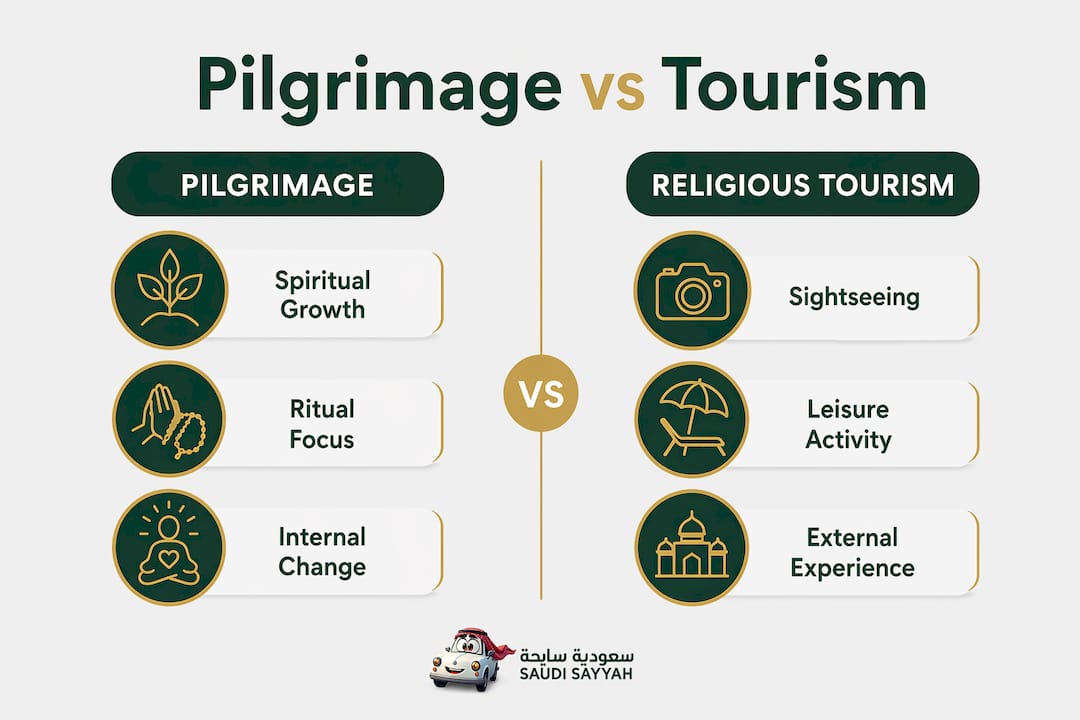
| Feature | Pilgrimage | Religious tourism |
|---|---|---|
| Primary goal | Spiritual growth and transformation | Sightseeing and cultural experience |
| Mindset | Intentional, prayerful, open | Observational, informational |
| Relationship to hardship | Embraced as part of the journey | Minimized or avoided |
| Use of technology | Limited, used for navigation only | Active, used for documentation |
| Community experience | Deep bonds formed through shared purpose | Casual social interaction |
Ritual markers define the pilgrim's experience. Prayer at specific times, periods of silence, physical acts like prostration or walking barefoot, and symbolic gestures such as touching a relic or circling the Kaaba all serve a purpose. They shift attention inward and signal to the mind and body that this is not ordinary travel.
Community bonds formed on pilgrimage often become a lasting source of support and spiritual fellowship. Researchers call this phenomenon "communitas," a shared sense of purpose among pilgrims that creates resilience and connection that outlasts the journey itself. You may arrive alone and leave with relationships that define your faith life for years.
Pro Tip: Leave your phone in your bag for the first hour at each holy site. Resist the urge to photograph immediately. Let the place register in your body and spirit before you document it. That first unmediated encounter is often the most powerful.
How to prepare for visiting holy sites on your pilgrimage
Preparation for a pilgrimage is both logistical and spiritual. The two are not in conflict. Practical readiness frees your attention for the spiritual work ahead.
- Set a clear intention. Know why you are going before you book anything. Your intention shapes every decision that follows, from how long you stay to which sites you prioritize.
- Research the rituals. Each holy site has specific practices, dress codes, prayer times, and protocols. Arriving informed shows respect and allows you to participate fully rather than observe from the outside.
- Plan your transport carefully. Reliable, comfortable transport between sites removes logistical stress and protects your focus. For pilgrims visiting Saudi Arabia, group transport planning is especially important given the scale of movement between Makkah, Madinah, and other sacred locations.
- Build in unscheduled time. The most meaningful moments of a pilgrimage often happen outside the itinerary. Leave space for spontaneous prayer, conversation with fellow pilgrims, or simply sitting in silence.
- Engage with local traditions. Ask questions, observe local worshippers, and participate where appropriate. The living community around a holy site is part of its spiritual significance.
- Prepare physically. Many pilgrimage sites involve significant walking on uneven terrain. Physical readiness is not separate from spiritual readiness. It is part of it.
For first-time visitors to Saudi Arabia's holy cities, a guide for first-time pilgrims covers the practical essentials that make the difference between a stressful trip and a spiritually focused one.
Key takeaways
Visiting holy sites produces documented spiritual, psychological, and communal benefits that ordinary travel cannot replicate, making intentional pilgrimage one of the most transformative practices in any faith tradition.
| Point | Details |
|---|---|
| Pilgrimage is defined by intention | Spiritual focus, not destination or distance, separates pilgrimage from religious tourism. |
| Documented well-being benefits | Pilgrims report lasting reductions in stress and anxiety, plus stronger value alignment after returning. |
| Historical and faith connection | Sacred sites make scripture and tradition tangible, countering spiritual emptiness in secular life. |
| Communitas builds resilience | Shared purpose among pilgrims creates lasting social and spiritual bonds that support long-term faith. |
| Preparation enhances the experience | Setting clear intentions and planning logistics frees attention for genuine spiritual engagement. |
What pilgrimage has taught me about showing up fully
I have spent years writing about sacred travel, and the single most consistent observation I can share is this: the pilgrims who get the most from their journey are not the most devout or the most prepared. They are the most present.
Most people arrive at a holy site carrying the weight of everything they left behind. The unfinished work, the unresolved relationships, the mental noise of daily life. The physical act of traveling to a sacred place does not automatically dissolve that weight. What dissolves it is the deliberate choice to set it down, even briefly, and be where you are.
The fellowship dimension surprises almost everyone. You expect to find God at a holy site. You do not expect to find a stranger from another country who shares your grief or your gratitude, and to feel, in that brief exchange, that you are part of something much larger than your individual faith. That is communitas in practice, and it is real.
My honest view is that the importance of visiting holy sites is not primarily about the sites themselves. It is about what the journey does to you when you approach it with honesty and openness. The place is the occasion. The transformation is yours to make.
— Fa
Plan your pilgrimage transport with Saudisayyah
Getting to and between holy sites in Saudi Arabia requires transport that works without friction. Saudisayyah provides pilgrim car hire services built specifically for the demands of Umrah and Hajj travel, with real-time tracking, professional drivers, and a fully automated booking system that removes uncertainty from every trip. The platform sends driver photos and vehicle details before each journey, so you always know who is picking you up and when. For pilgrims focused on spiritual preparation, that kind of reliability matters. Explore Saudisayyah's premium vehicle fleet and book your transport before peak season fills available slots.
FAQ
Why visit holy sites instead of practicing faith at home?
Holy sites provide a physical, sensory encounter with sacred history that prayer at home cannot replicate. Research shows pilgrimage produces measurable reductions in stress and lasting improvements in life satisfaction that ordinary religious practice alone does not consistently deliver.
What is the spiritual significance of holy places?
Sacred places connect believers to the foundational events, figures, and traditions of their faith in a direct, embodied way. Theologians describe this connection as a counter to secular spiritual emptiness, making the physical visit an act of faith in itself.
How long does a pilgrimage need to be to have spiritual benefits?
A pilgrimage requires only intentionality and spiritual openness, not a specific length or scale. Research confirms that even short, focused visits to sacred sites can catalyze meaningful psychological and spiritual shifts when approached with clear purpose.
What is the difference between pilgrimage and religious tourism?
Pilgrimage centers on internal transformation through prayer, ritual, and detachment from daily life. Religious tourism prioritizes observation and cultural experience. The distinction is entirely one of intention, not destination.
How do I prepare spiritually for visiting holy sites?
Set a clear personal intention before you travel, research the specific rituals and protocols of your destination, and build unscheduled time into your itinerary. Physical preparation, including fitness for walking, is also part of spiritual readiness.