

TL;DR:
- A transport protocol governs how data is packaged, transmitted, and verified between applications across a network. It operates at Layer 4, using port numbers to ensure data reaches the correct process, not just the device. Selecting the appropriate protocol, such as TCP, UDP, SCTP, or QUIC, depends on application needs like reliability, latency, and security considerations.
Transport protocol is one of those foundational concepts that every developer, network administrator, and tech-curious professional encounters, yet few can explain with real precision. Understanding what is transport protocol means understanding how your data actually travels from one application to another across a network, not just from machine to machine. The wrong protocol choice can mean laggy video calls, broken file transfers, or silently dropped data. This guide covers core functions, major types, practical trade-offs, and the emerging protocols reshaping modern networking.
Table of Contents
- Key Takeaways
- What is transport protocol and what it actually does
- Types of transport protocols: TCP, UDP, SCTP, and QUIC
- How transport protocols work under the hood
- Choosing the right transport protocol
- Future directions in transport protocols
- My take on what most people get wrong
- Reliable transport for your pilgrimage
- FAQ
Key Takeaways
| Point | Details |
|---|---|
| Transport protocols enable app-to-app communication | They use port numbers to route data between specific processes, not just between devices. |
| TCP and UDP serve different needs | TCP guarantees delivery and order; UDP skips those guarantees for speed and low latency. |
| QUIC is replacing TCP in many contexts | Built on UDP, QUIC integrates TLS 1.3 and eliminates head-of-line blocking for faster connections. |
| Protocol selection depends on application type | Real-time apps favor UDP; file transfers, email, and web pages typically require TCP. |
| Security is moving into the transport layer | Modern peer-to-peer protocols now embed identity and authentication directly at the transport level. |
What is transport protocol and what it actually does
A transport protocol is a set of rules governing how data is packaged, sent, received, and confirmed between two applications running on different machines. It operates at Layer 4 of the OSI model, sitting above the network layer (which handles routing between machines) and below the application layer (which handles protocols like HTTP or SMTP).
The key distinction is this: the network layer moves packets between IP addresses. The transport layer moves data between processes, using port numbers for multiplexing. When you load a webpage while a video call runs in the background, the transport layer keeps those two data streams separate on the same machine at the same IP address.
According to foundational networking documentation, transport protocols implement seven core elements that make end-to-end communication reliable despite network imperfections:
- Service types: Whether the connection is connection-oriented (like TCP) or connectionless (like UDP).
- Error control: Detection and, in some protocols, automatic retransmission of corrupted or lost data.
- Flow control: Mechanisms like the sliding window algorithm that prevent a fast sender from overwhelming a slow receiver.
- Connection management: Procedures for establishing and terminating connections, such as TCP's three-way handshake.
- Multiplexing and demultiplexing: Using 16-bit port numbers to direct data to the correct application process on a host.
- Fragmentation and reassembly: Breaking large data blocks into smaller segments for transmission and reassembling them at the destination.
- Port addressing: Identifying source and destination applications so data reaches the right process, not just the right machine.
Pro Tip: When debugging a network issue, check whether the problem is at the transport layer before assuming the application or network is at fault. Tools like netstat or Wireshark can isolate transport layer behavior quickly.
Types of transport protocols: TCP, UDP, SCTP, and QUIC
Not all transport protocols are built the same. Each one makes deliberate trade-offs between reliability, speed, complexity, and overhead. The right choice depends entirely on what your application actually needs.
TCP: reliable but heavy
TCP, or Transmission Control Protocol, is the dominant transport protocol for most internet traffic. It is connection-oriented, meaning it establishes a session between sender and receiver before sending any data. TCP guarantees reliable, ordered data streams through sequence numbers, acknowledgments, and selective retransmission. Every byte that leaves the sender is tracked, and if something goes missing, TCP automatically requests retransmission.

That reliability comes with overhead. TCP's three-way handshake adds latency before any data moves. Congestion control algorithms slow transmission when the network is busy. And TCP's head-of-line blocking means that if one packet in a stream is lost, all subsequent packets wait until the missing one is recovered, even if they arrived perfectly.
UDP: fast but unguaranteed
User Datagram Protocol takes the opposite approach. UDP is connectionless, sending packets without establishing a session, without acknowledgments, and without retransmission. If a packet is lost, it's gone. That sounds problematic, but for applications where speed matters more than completeness, UDP is exactly right. Real-time gaming, VoIP, and live video streaming all use UDP because a slightly corrupted video frame is far better than a frame that arrives 500 milliseconds late.
SCTP: the underused middle ground
Stream Control Transmission Protocol combines message-orientation with reliability, and it supports multihoming (associating multiple IP addresses with a single connection) and full-duplex communication. SCTP fits telecommunication and WebRTC needs where you need reliability without forcing all data through a single stream. It avoids head-of-line blocking across streams, which is a genuine technical improvement over TCP.
QUIC: the modern standard
QUIC is the newest entrant and arguably the most significant shift in transport protocols in decades. QUIC integrates TLS 1.3 and runs on top of UDP, giving it the speed benefits of UDP while adding built-in encryption and independent stream handling. It eliminates TCP's head-of-line blocking and reduces connection setup time. QUIC is the foundation for HTTP/3.
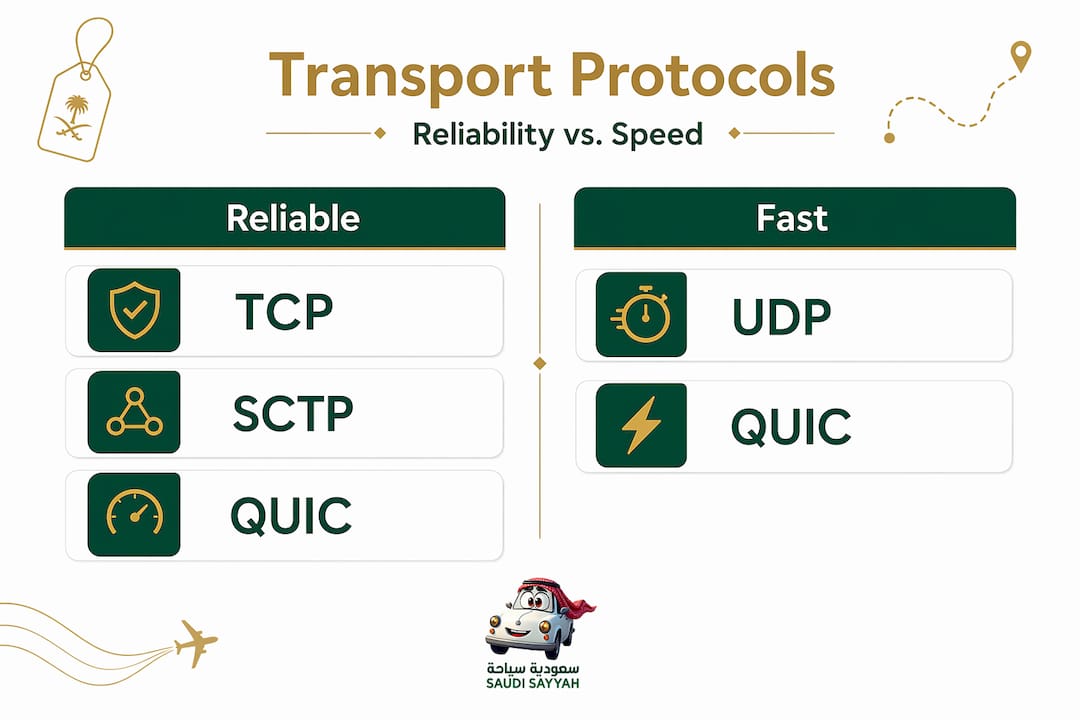
| Protocol | Connection type | Reliability | Latency | Best use cases |
|---|---|---|---|---|
| TCP | Connection-oriented | Guaranteed | Higher | Web, email, file transfer |
| UDP | Connectionless | Not guaranteed | Low | Gaming, VoIP, live video |
| SCTP | Connection-oriented | Guaranteed | Medium | Telecom, WebRTC, signaling |
| QUIC | Connectionless (UDP-based) | Selective | Very low | HTTP/3, real-time web apps |
Pro Tip: If you are building a new application in 2026 and defaulting to TCP out of habit, take 30 minutes to evaluate QUIC. For any application that requires low latency and security, the connection overhead of TCP is likely costing you real performance.
How transport protocols work under the hood
Understanding the mechanics behind transport protocols separates developers who debug fast from those who spend hours guessing.
-
Segmentation. Large blocks of application data are split into smaller segments that fit within the Maximum Transmission Unit (MTU) of the underlying network. Each segment gets a header containing source and destination port numbers, sequence numbers, and error-checking data.
-
Transmission. Segments travel independently across the network. They can take different routes and arrive out of order. This is the network layer's job. The transport layer hands off segments and waits.
-
Flow control. TCP uses a sliding window mechanism to regulate how many bytes can be in transit without an acknowledgment. The receiver advertises its available buffer size, and the sender adjusts accordingly. This prevents overwhelming a slow receiver.
-
Error detection and retransmission. TCP includes a checksum in every segment header. If a segment arrives corrupted, the receiver discards it and withholds acknowledgment. The sender's timer expires, and it retransmits. TCP's selective acknowledgment (SACK) allows the receiver to acknowledge non-contiguous blocks, improving efficiency during partial packet loss.
-
Reassembly. The destination transport layer uses sequence numbers to reorder segments that arrived out of sequence, reconstruct the original data, and pass it to the correct application process.
-
Demultiplexing. The destination port number in each segment header tells the transport layer which application process should receive the data. Port 80 goes to the web server, port 443 to the HTTPS server, and so on.
One critical issue that catches developers off guard: TCP requires custom message boundary handling because it transmits a continuous byte stream. Unlike UDP, which preserves message boundaries, TCP can split or combine application messages as it sees fit. Without fixed-size headers or length-prefixed framing in your application protocol, your message parsing will break under load.
Choosing the right transport protocol
Selecting a transport protocol is not a default decision. The wrong choice creates problems that are genuinely hard to diagnose because they show up as application-level symptoms, not network errors.
Reliability is not free. Every guarantee TCP provides costs time and processing. For applications where data completeness is non-negotiable, that cost is justified. For applications where timeliness matters more than completeness, it is not.
Key considerations when selecting a transport protocol:
- Latency sensitivity. Does your application break if a packet arrives 200ms late? If yes, UDP or QUIC. If no, TCP is fine.
- Data completeness. Is every byte non-negotiable? Financial transactions, file transfers, and email need TCP's guarantees.
- Connection state. Short-lived requests (like DNS lookups) benefit from connectionless protocols. Long-lived sessions may benefit from connection setup costs amortized over time.
- Built-in security. QUIC includes TLS 1.3 by default. With TCP you must add a TLS layer separately, which adds handshake steps.
- Multiplexing needs. If you need multiple independent data streams over a single connection, QUIC or SCTP handle this natively. TCP forces all streams through one ordered queue.
- Network conditions. High-latency, high-packet-loss environments (like satellite connections) expose TCP's weaknesses more than low-latency fiber connections do.
For developers building real-time communication systems in 2026, modern systems increasingly replace TCP with QUIC to eliminate latency caused by head-of-line blocking. This is not a minor optimization. It is a structural improvement.
Future directions in transport protocols
The transport layer is not static. QUIC and HTTP/3 represent the most visible shift, but a deeper change is coming from decentralized and AI agent networks. Modern peer-to-peer protocols embed identity and mutual authentication directly at the transport layer, moving security out of external certificate chains and into the connection handshake itself.
In AI agent networks specifically, specialized transport layers handle NAT traversal and encrypted peer-to-peer communication in ways that generic protocols like HTTP cannot. The boundary between what counts as a transport protocol and what counts as an application protocol is blurring. Developers who understand both layers clearly will have a real advantage as these systems mature.
Congestion management and latency reduction remain open research problems. As network infrastructure diversifies (satellite internet, 5G, mesh networks), transport protocols will continue adapting. The core principles stay constant. The implementations will keep changing.
My take on what most people get wrong
I have worked through enough network debugging sessions to recognize the pattern: most developers do not understand where the transport layer ends and the application layer begins. Many developers confuse application protocols with transport protocols, which leads to insecure or inefficient designs that are hard to fix after the fact.
The second thing I see constantly is people treating TCP as "reliable" without understanding what that actually means. TCP guarantees ordered, complete delivery within a session. It does not protect against application-level errors, session timeouts, or broken connection handling. Plenty of TCP-based systems lose data because the application layer does not acknowledge receipt correctly, even though the transport layer did everything right.
My practical advice: do not just read about protocols. Build a small application using raw TCP sockets, handle the byte-stream framing yourself, and watch what happens when packets arrive fragmented or out of order. Then build the same thing over UDP and implement your own basic acknowledgment system. That experience is worth more than any textbook chapter. When you eventually reach for QUIC, you will actually understand what problems it is solving for you.
— Fa
Reliable transport for your pilgrimage
The principles behind transport protocols, matching the right tool to the task, eliminating latency, and building reliability where it matters most, apply just as directly to physical transport logistics as they do to networking.

Saudisayyah applies that same thinking to Umrah and Hajj transportation. Every booking runs through a fully automated, internationally-compliant system that sends real-time driver details and live location tracking before your trip begins. No dropped connections. No surprises. You can review the full Saudisayyah services to see how technology-backed transport works in practice, or explore the premium vehicle fleet available for pilgrims traveling to the holy lands. For those visiting Saudi Arabia for the first time, reliable transport for Umrah pilgrims is not a convenience. It is peace of mind.
FAQ
What is a transport protocol in simple terms?
A transport protocol is a set of rules that controls how data is sent between two applications on different devices. It manages reliability, ordering, and delivery using port numbers to route data to the correct process.
What are the most common transport protocols?
TCP, UDP, SCTP, and QUIC are the primary transport protocols in use today. TCP provides guaranteed delivery, UDP offers low-latency transmission without guarantees, and QUIC combines UDP's speed with built-in encryption.
How does TCP differ from UDP?
TCP is connection-oriented and guarantees ordered, error-free delivery through acknowledgments and retransmission. UDP is connectionless, skips those guarantees, and delivers data faster with less overhead.
What is QUIC and why does it matter?
QUIC is a modern transport protocol built on UDP that integrates TLS 1.3 and eliminates TCP's head-of-line blocking. It is the foundation for HTTP/3 and significantly reduces connection setup time for high-latency environments.
When should I use UDP instead of TCP?
Use UDP when your application requires low latency and can tolerate occasional data loss, such as live video streaming, VoIP, online gaming, or DNS lookups. Use TCP when every byte must arrive correctly and in order.