

TL;DR:
- Effective trip coordination reduces last-minute stress for first-time Umrah pilgrims by organizing logistics into clear stages. Starting planning 3 to 6 months early and using a structured framework ensures smooth booking of flights, visas, accommodation, and transport. Centralizing documents digitally and confirming all arrangements before departure enables pilgrims to focus on worship and reflection.
Planning your first Umrah is one of the most meaningful decisions you will make. But the role of trip coordination is something most first-time pilgrims underestimate until they are already in the middle of it. Fragmented bookings, missing documents, and last-minute transport scrambles have a way of pulling attention away from what actually matters: worship, reflection, and presence. This guide breaks down how to coordinate trips for Umrah into five clear stages, covering everything from budget to transport to final confirmation, so you can arrive spiritually ready instead of logistically overwhelmed.
Table of Contents
- Key takeaways
- The role of trip coordination in Umrah planning
- A five-stage framework for coordinating your Umrah trip
- Transportation and accommodation coordination
- Common coordination pitfalls to avoid
- Tools and tactics for staying coordinated on the ground
- My perspective on what coordination actually does for pilgrims
- How Saudisayyah supports your Umrah transport coordination
- FAQ
Key takeaways
| Point | Details |
|---|---|
| Start planning 3 to 6 months early | Early planning prevents costly errors and gives you time to secure visas, flights, and accommodation. |
| Use a five-stage coordination framework | Breaking the trip into intention, dates, budget, bookings, and confirmation reduces stress at every step. |
| Integrate transport and hotel bookings | Booking accommodation and transfers together prevents transitions from becoming the hardest part of the trip. |
| Centralize all documents digitally | A single digital folder for passports, confirmations, and itineraries prevents lost paperwork and delays. |
| Carry enough local currency | Having SAR 500 to 1,000 in cash covers immediate expenses that digital payments cannot. |
The role of trip coordination in Umrah planning
Trip coordination, in the context of Umrah, is the process of organizing every logistical decision into a connected, functioning system. It is not just booking a flight and hoping everything lines up. It covers travel dates, visa timelines, accommodation, ground transport, ritual preparation, and the budget that holds all of it together.
The reason this matters so much is that each decision affects the next. If you book a hotel without knowing your arrival time, you may pay for a night you cannot check into. If you arrange a visa without accounting for peak season demand, you may find your preferred dates unavailable. Trip logistics management requires treating these pieces as interdependent, not isolated.
The core trip coordination tasks most first-time pilgrims face include:
- Securing an Umrah visa within the correct window
- Booking international flights aligned with visa validity
- Arranging airport transfers in advance of arrival
- Selecting accommodation based on proximity to the Haram and budget
- Gathering and organizing all travel documents before departure
Pro Tip: Treat Umrah planning like a project with defined stages. When you divide it into manageable decisions rather than one giant task, the mental load drops significantly and last-minute surprises become rare.
The benefits of trip coordination become clear the moment something does not go according to plan. Pilgrims with structured plans adapt. Those without one scramble.
A five-stage framework for coordinating your Umrah trip
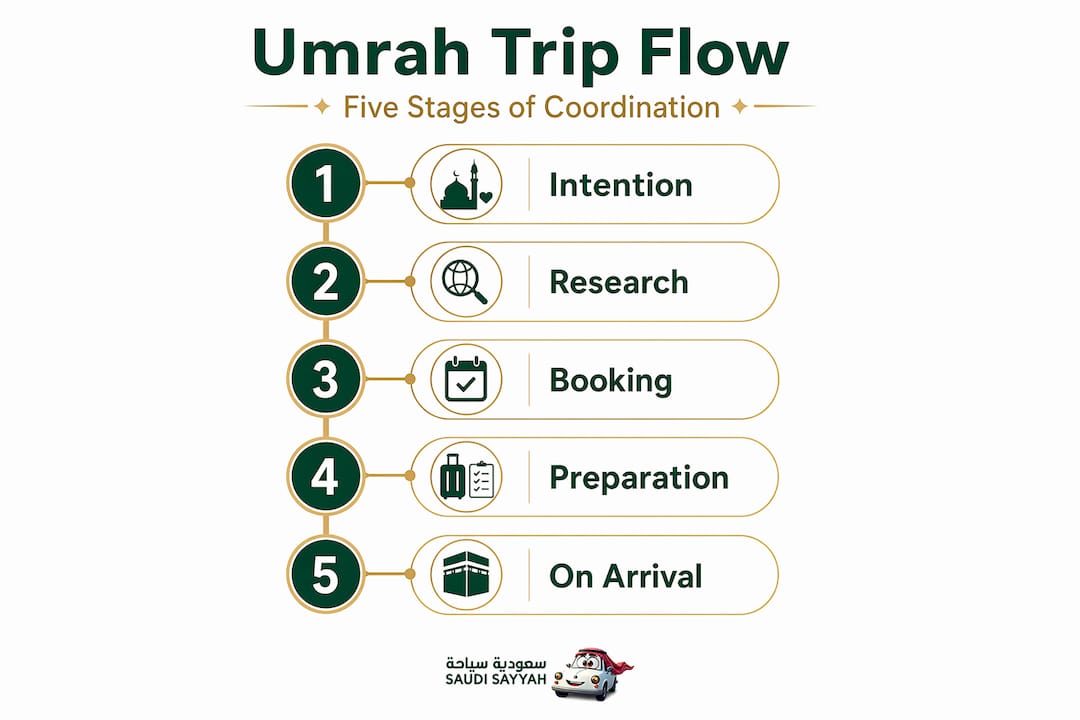
Structured trip coordination broken into five stages consistently reduces last-minute stress and decision fatigue. Here is how each stage works in practice.
-
Define your intention and constraints. Before anything is booked, clarify your non-negotiables. How many days do you want in Makkah and Madinah? Are you traveling alone or with family? Do you have physical limitations that affect transport choices? These answers shape every decision that follows.
-
Select your travel dates. Factor in your work schedule, school calendar if applicable, and visa processing timelines. Avoid peak periods like Ramadan if you are sensitive to large crowds. Visa approval can take two to four weeks, so build that window into your timeline.
-
Build a segmented budget. First-time pilgrims should budget $3,000 to $5,500 for a 10-day trip. Break this into airfare, accommodation, ground transport, meals, and a contingency reserve of at least 10 percent. Without this segmentation, it is easy to overspend on hotels and leave nothing for transfers or emergencies.
-
Book flights, hotels, and transport as a connected system. This is where most trip schedule organization falls apart. Booking these separately, without considering how they link together, creates gaps. Confirm your flight arrival time before selecting a hotel check-in policy. Book your airport transfer at the same time you confirm your hotel.
-
Final confirmation before departure. Two weeks before leaving, run through a complete checklist. Confirm visa status. Collect digital and physical copies of all documents. Reconfirm hotel reservations and transport bookings. Prepare ritually: ihram clothing, personal care items, and a printed itinerary with emergency contacts.
| Stage | Task | Timing |
|---|---|---|
| 1. Intention | Define travel constraints and goals | 4 to 6 months before |
| 2. Dates | Confirm visa window and travel schedule | 3 to 4 months before |
| 3. Budget | Segment costs across all categories | 3 months before |
| 4. Bookings | Flights, hotels, and transport together | 2 to 3 months before |
| 5. Confirmation | Documents, packing, final checks | 1 to 2 weeks before |
Pro Tip: Use short, scheduled planning blocks rather than open-ended to-do lists. Thirty minutes of focused planning three times a week accomplishes more than one overwhelming session.
Starting this process 3 to 6 months before departure is not overcautious. It is the difference between choosing your preferred options and accepting whatever is left.
Transportation and accommodation coordination
Transport is where the importance of trip planning becomes most visible on the ground. The options between Jeddah and Makkah each carry different trade-offs in cost, time, and convenience.

| Transport Option | Estimated Cost | Best For |
|---|---|---|
| Private car hire | SAR 250 to 400 | Families, elderly pilgrims, groups |
| Bus or van service | SAR 100 to 200 | Budget travelers, solo pilgrims |
| Haramain high-speed train | SAR 150 to 300 | Pilgrims prioritizing speed and comfort |
| Electronic transport shuttle | Varies by package | Door-to-door convenience from hotel |
Private car transfers cost SAR 250 to 400, while shared buses run SAR 100 to 200. The Haramain train is fast but requires a separate transfer from the station to your hotel. For pilgrims who want the least friction, the hotel-to-Haram electronic transport service offers scheduled door-to-door shuttles with professional escort options. It reduces physical strain and eliminates wait times, which matters a great deal after a long international flight.
Hotel proximity to the Haram is the other major variable. Hotel prices range from SAR 150 to over SAR 10,000 per night depending on zone and distance. A hotel two kilometers from the Masjid al-Haram costs significantly less than one inside the central zone. That distance becomes meaningful when you are walking to prayer five times daily.
When planning transport and accommodation together, look for alignment in check-in times and pickup windows. A hotel that allows early check-in when you arrive at 6 a.m. is worth more than one that is slightly cheaper but locks you out until 2 p.m. after a 12-hour flight.
Here are the most common transport coordination tasks to complete before departure:
- Book your airport pickup at least two weeks in advance for detailed coordination of your Umrah airport transfer
- Confirm driver details, vehicle type, and pickup location in writing
- Have a backup contact number for your transport provider saved on your phone
- If traveling with elderly pilgrims or family members, review accessible transport options in advance
Pro Tip: Arrival timing without a confirmed transport plan is one of the most common causes of first-day exhaustion. Pre-booked pickups eliminate the guesswork and let you focus on the reason you came.
Common coordination pitfalls to avoid
Even well-prepared pilgrims run into problems. Most are predictable, and most are avoidable with a little foresight.
- Overpacking. Most Umrah essentials are available locally, often at lower prices near the Haram. Heavy bags become a burden in crowded spaces and slow group movement considerably.
- Scattered documents. Storing your visa confirmation in one email, hotel booking in another, and flight itinerary in a third app creates confusion. One centralized folder, digital or physical, is the standard for effective trip coordination.
- Ignoring buffer time. Back-to-back scheduling feels efficient on paper. In practice, a delayed flight or slow customs line cascades into a missed transfer, a hotel check-in dispute, and a stressful first evening.
- Going fully cashless. Most vendors near the Haram accept cards, but markets, small restaurants, and taxis often do not. Carrying SAR 500 to 1,000 in cash covers immediate expenses without friction.
- Booking the cheapest option without checking how it connects to everything else. A budget hotel with no transport links and a 3 a.m. check-in policy is not a saving. It is a problem waiting to happen.
- No designated coordination lead in group travel. Someone needs to own the itinerary. In groups, coordination falls apart when everyone assumes someone else is handling confirmations.
Pro Tip: Create a single group chat or shared document where all confirmations, contact numbers, and schedules live. Every traveler in your group should have access before the trip begins.
Tools and tactics for staying coordinated on the ground
The best coordination plan still needs active management once you are traveling. Here is what works in practice.
- Use a dedicated digital folder (Google Drive, iCloud, or a travel app) to store all passports, visas, flight confirmations, hotel bookings, and transport details in one accessible location
- Schedule a brief daily check-in for group travelers each morning to confirm the day's transport, prayer times, and meeting points
- Confirm hotel check-in times and airport pickup details 48 hours before arrival, not just at booking
- Print one physical copy of your full itinerary including emergency contacts. Phones die and data connections fail
- Use the Nusuk app for booking electronic transport and managing daily logistics within the holy cities
- Keep contingency plans for group separation: a designated meeting point and a shared emergency contact in Saudi Arabia
Creating a centralized digital command center for all documents and bookings is the single habit that separates organized pilgrims from stressed ones. It takes less than an hour to set up and saves multiple hours of searching during the trip itself.
My perspective on what coordination actually does for pilgrims
I have watched pilgrims arrive at King Abdulaziz International Airport with every detail confirmed and walk through the process calmly. I have also watched pilgrims arrive with a printout of their flight and nothing else. The difference in their first 24 hours is significant and not just logistically.
What I have come to believe is that trip coordination is not just about logistics. It is a spiritual enabler. When you know your driver will be waiting, your hotel room is confirmed, and your documents are in order, your mind is free. That freedom is where the real purpose of the trip lives.
What I have also learned is that most pilgrims do not struggle because they are disorganized people. They struggle because no one framed this as a project that deserves structured thinking. Viewing pilgrimage planning as a sequence of decisions allows you to handle each stage calmly, without letting one uncertain piece hold up everything else.
My honest advice: treat your Umrah preparation the same way you would treat anything that matters deeply to you. Give it time, structure, and attention. Not because the logistics are complicated, but because you deserve to arrive at the Haram without carrying the weight of unresolved details.
— Fa
How Saudisayyah supports your Umrah transport coordination
Transport is the one coordination variable that affects every other part of your trip. A missed pickup creates a ripple effect across your whole first day. Saudisayyah was built specifically to eliminate that risk for Umrah and Hajj pilgrims.
Every booking through Saudisayyah includes confirmed driver details, vehicle information, and real-time tracking before your trip begins. The pilgrim transport services cover airport pickups, intercity transfers, and daily travel between the holy cities. The fleet uses current-year vehicles and experienced drivers who understand the specific rhythms of pilgrimage travel.
For first-time pilgrims especially, knowing who is picking you up and exactly when removes the single biggest source of arrival anxiety. You can review fleet options and vehicle classes in advance to match your group size and comfort needs. For more detailed planning, the Umrah transport costs guide on the Saudisayyah blog breaks down current pricing across every transfer type so your budget stays accurate. Coordination starts with reliable information, and Saudisayyah provides both.
FAQ
What is the role of trip coordination for Umrah pilgrims?
Trip coordination organizes every logistical element of Umrah, including flights, visas, accommodation, and transport, into a connected plan that reduces stress and keeps spiritual focus intact.
How early should I start coordinating my Umrah trip?
Starting 3 to 6 months before departure gives you enough time to secure visas, compare hotel zones, and book transport without accepting last-minute options.
What are the most important trip coordination tasks before departure?
Key tasks include confirming visa status, booking airport transfers in advance, centralizing all documents in one folder, and aligning hotel check-in times with your arrival.
What transport options are available between Jeddah and Makkah?
Options include private car hire at SAR 250 to 400, shared buses at SAR 100 to 200, the Haramain high-speed train at SAR 150 to 300, and the hotel-to-Haram electronic shuttle service for door-to-door transfers.
How do I avoid losing important travel documents during Umrah?
Store all confirmations, passports, and booking details in a single digital folder and carry one printed backup. This prevents the fragmented storage that causes delays and lost paperwork.