
TL;DR:
- Proper planning and document organization facilitate smooth airport pickups for Umrah pilgrims.
- Early booking, clear communication, and flexible timing are crucial for successful coordination.
- Using real-time tracking apps and human confirmation minimizes delays and miscommunications.
Landing in Saudi Arabia after hours of travel is one thing. Finding your driver, organizing your group, and moving efficiently toward Makkah or Madinah is another challenge entirely. For many pilgrims, the airport arrival moment is where well-planned Umrah trips begin to unravel. Missed connections, language barriers, delayed immigration processing, and unfamiliar surroundings turn what should be a peaceful beginning into a scramble. This guide walks through every step of airport pickup coordination so your arrival matches the intention behind your journey.
Table of Contents
- What you need to coordinate a smooth pickup
- Step-by-step guide to coordinating your airport pickup
- Common mistakes and troubleshooting tips
- Comparison of pickup coordination methods
- A seasoned travel coordinator's take: What really works for Umrah pickups
- Take the stress out of your Umrah airport pickup
- Frequently asked questions
Key Takeaways
| Point | Details |
|---|---|
| Buffer your time | Plan to arrive early and allow extra time after landing to smooth out delays. |
| Share all details | Send flight info and contacts to your pickup service well ahead of travel. |
| Choose the right method | Consider if you need group-friendly tech, live updates, or prefer traditional pickups. |
| Prepare for surprises | Anticipate potential delays or changes and have backup options in place. |
What you need to coordinate a smooth pickup
Good coordination starts before you board your flight. The right documents, tools, and contacts in place make everything that follows far easier.
Start with Umrah travel preparation well in advance. You will need your passport, Umrah visa, hotel booking confirmation, and your transport booking reference. Keep digital and printed copies of each. Saudi Arabia's airports process thousands of international arrivals daily, and having your paperwork organized saves time at every checkpoint.
Here are the core items to gather before departure:
- Passport and valid Umrah visa
- Flight itinerary with arrival terminal noted
- Transport provider name, phone number, and booking reference
- Hotel address and check-in details
- Group leader contact number (if traveling with others)
- A local SIM card or international roaming plan activated before landing
- Offline map of Jeddah King Abdulaziz International Airport or Madinah Prince Mohammad Bin Abdulaziz Airport
Digital tools matter just as much as documents. WhatsApp is widely used across Saudi Arabia for communication. Google Maps works well, but download offline maps before landing in case data connections are slow inside the terminal. Flight tracking apps like Flightradar24 help both you and your driver monitor real-time arrival status.
| Tool | Purpose | Works offline? |
|---|---|---|
| Communicate with driver or group | No | |
| Google Maps (offline) | Navigate airport and pickup zone | Yes |
| Flightradar24 | Track flight status in real time | No |
| Notes app | Store booking references, contacts | Yes |
| Your transport provider's app | Real-time driver tracking | No |
Pro Tip: Immigration delays of 45 to 60 minutes are standard for international arrivals. Build that buffer into every pickup booking. If your flight lands at 2:00 PM, schedule your pickup for 3:15 PM at the earliest. Add extra time during peak Umrah season when terminals handle significantly higher volumes.
Step-by-step guide to coordinating your airport pickup
Once you have the basics in place, move through coordination step by step.
Step 1: Book transport as early as possible. Last-minute bookings during Umrah season are unreliable. Reputable services fill up weeks in advance. Booking early also gives you time to confirm vehicle capacity if you are traveling with a large group. Review the best airport transfer types for Umrah pilgrims to match your group size and budget to the right vehicle class.
Step 2: Share your complete arrival details with your transport provider. This means flight number, airline, arrival terminal, and estimated landing time. Do not just send a departure time. Drivers need your landing time at the Saudi airport, not when you leave your home country. A complete airport transfer guide for Umrah pilgrims covers the specific terminal layouts at Jeddah and Madinah airports, which differ significantly.
Step 3: Designate a group leader for all communications. If you are traveling with family or a larger group, appoint one person to handle all transport coordination. Multiple people messaging the driver at the same time creates confusion. The group leader should have the driver's contact saved and be responsible for sending updates if anything changes.
Step 4: Confirm your booking 24 hours before departure. Send a quick message to your transport provider to confirm the booking is active and the driver assignment is set. Ask for driver name, vehicle description, and license plate number. This prevents any confusion about who to look for at the arrivals gate.
Step 5: Set a clear meeting point in advance. Saudi airports have designated meeting zones for private transfers. Agree on an exact spot before you land, not after. Trying to locate a driver by phone in a crowded arrivals hall is stressful and slow.
Step 6: Update your driver immediately if anything changes. Flight delayed? Gate changed? Immigration backed up? Send a message the moment you know. Drivers who receive timely updates can adjust their timing and avoid unnecessary waiting charges.
Immigration processing for international Umrah arrivals typically takes between 45 and 60 minutes, and during peak Umrah months this window can extend even further. Plan accordingly when communicating your expected exit time.
Pro Tip: Avoid scheduling your airport pickup in the window just before Maghrib prayer. Traffic in and around Saudi airports increases sharply during this period, and transportation services may face delays of 20 to 40 minutes beyond normal wait times. A pickup window that falls mid-afternoon or well after Isha prayer tends to move faster.
Common mistakes and troubleshooting tips
Even with careful planning, obstacles arise. Here is how to be ready for the most common ones.
Consider building buffer time after every arrival to minimize missed rides. Delays happen, and even well-coordinated plans need room to flex.
Delayed flights. This is the most common disruption. If your flight is delayed, notify your transport provider as soon as the airline confirms the new arrival time. Do not wait until you land. Most reputable providers will accommodate flight delays at no extra charge if informed in advance, but last-minute surprises may result in missed pickups or additional fees.
Communication breakdowns. International SIM cards often experience connectivity issues during arrival. Download your transport provider's confirmation, driver contact details, and meeting point instructions to an offline location before you board. Screenshots work perfectly. If your phone fails entirely, ask airport staff at the information desk to assist with contacting your driver.
Driver no-shows. Rare, but they happen. Keep your transport provider's main office number saved separately from your driver's number. If your driver is not reachable, call the company directly. Established providers have backup protocols. The smart travel hacks resource covers exactly these scenarios with practical contingency options.
Here is a quick checklist for troubleshooting on arrival:
- Driver not visible: check your agreed meeting point, then call the driver's number
- No answer from driver: call the transport company's main line
- Flight arrived early: message driver immediately and wait at the designated zone
- Group member separated: have a backup meeting point agreed before landing
- Lost luggage delay: notify driver of extended wait as soon as you know at baggage claim
Last-minute bookings. For group transfer options, last-minute requests almost always mean inadequate vehicle size, higher pricing, or unavailability. During peak Umrah periods, booking within 48 hours of arrival is a significant risk. Providers prioritize advance reservations. Groups of eight or more should book at least two weeks ahead.
Unclear instructions to the driver. "Meet me at the airport" is not a useful instruction. Specify the terminal, the arrivals exit number, and the exact meeting zone. Saudi airports use both Arabic and English signage, so confirming the exit landmark in both languages reduces confusion significantly.
Comparison of pickup coordination methods
Having seen what can go wrong, compare which coordination approach best fits your situation.
| Method | Pros | Cons | Best for |
|---|---|---|---|
| Phone calls and SMS | No internet required | Slow, easy to miss messages | Poor connectivity areas |
| WhatsApp messaging | Fast, easy to share details | Needs data connection | Most individual travelers |
| App-based platforms with tracking | Real-time updates, driver location | Requires smartphone and data | Groups, first-time visitors |
| Pre-scheduled automated systems | Confirmation sent in advance | Less flexible for changes | Structured itineraries |
| On-arrival taxi booking | No advance planning needed | Unpredictable availability, no vetting | Last resort only |
App-based coordination is the strongest option for most Umrah pilgrims. Real-time tracking removes the uncertainty of "where is my driver?" It also creates a record of communication if disputes arise. The modern fleet options available through technology-enabled providers come with built-in geolocation sharing, which updates your driver's position every few minutes.
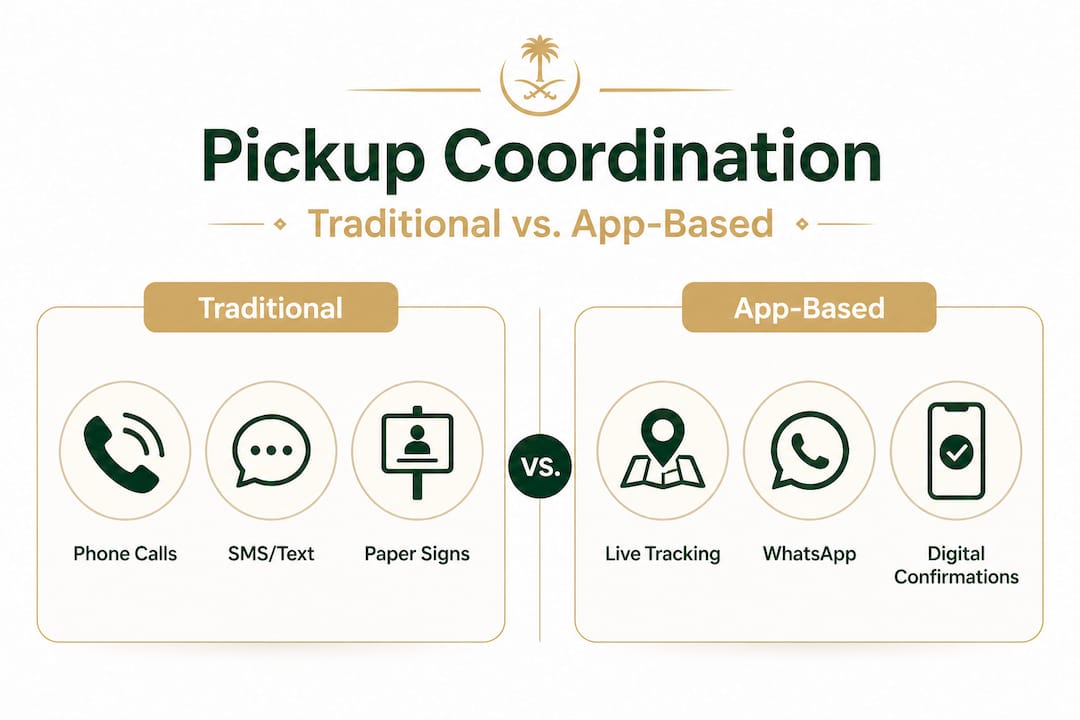
Traditional phone coordination still works in specific circumstances. If you are traveling to a remote area, if your group includes elderly pilgrims unfamiliar with apps, or if your destination has weak data coverage, having direct phone numbers is essential. Consider keeping both methods active regardless of your primary approach.
Recommended platforms and tools for real-time coordination:
- Your transport provider's dedicated booking app (if available)
- WhatsApp with location sharing enabled
- Google Maps live location sharing (works between contacts)
- Flightradar24 for flight tracking shared with your driver
- Notes apps with offline access to all booking details
Accessible transport features matter for pilgrims with mobility needs. When comparing methods, confirm that your chosen platform allows you to specify accessibility requirements at the booking stage. Not all apps surface these options clearly.
A seasoned travel coordinator's take: What really works for Umrah pickups
The conventional advice says: book early, confirm your driver, and have a backup plan. All of that is accurate. But it misses what actually determines whether a pickup goes smoothly.
The real variable is flexibility, not planning. Coordinators who have managed hundreds of Umrah group arrivals know that strict schedules routinely fail at airports. Flights land early, luggage belts stop working, immigration officers change shifts and queues double in length. A plan built around exact times almost always requires adjustment. What protects you is not a perfect schedule. It is how quickly you and your transport provider can adapt when the schedule breaks.
Luxury transport insights often mention comfort and vehicle quality. Both matter. But the more important factor is whether the provider has a communication infrastructure that responds to real-time changes. A premium vehicle with a driver who does not pick up the phone is less useful than a standard vehicle with a driver available on WhatsApp within two minutes.
Buffer time is also undervalued. Most pilgrims know to account for immigration delays. Fewer account for the time between clearing customs and actually reaching the pickup zone. In a large international airport like King Abdulaziz, that walk, combined with trolley navigation, terminal exits, and finding the correct zone, easily adds another 15 to 20 minutes. Build that in.
The blend that works best is this: use technology to track and communicate, but maintain a human connection with your driver. Know their name. Confirm the plan verbally, not just through an app. Human-to-human confirmation before landing eliminates the silent misunderstandings that app systems cannot always catch.
Take the stress out of your Umrah airport pickup
Coordinating a smooth airport arrival is manageable with the right tools, the right timing, and the right transport partner.
Saudi Sayyah handles the coordination complexity so you do not have to. The platform sends driver photos, vehicle details, and live tracking before every trip, so you know exactly who to look for and where they are. Our fully automated booking system manages confirmations, updates, and communication in real time. Whether you are traveling solo or coordinating a group, our reliable car hire services are built specifically for Umrah pilgrims navigating Saudi Arabia's major airports. Our latest-model fleet covers every group size. See our vehicle options and arrange your pickup before your departure date.
Frequently asked questions
How early should I schedule my airport pickup after arriving for Umrah?
Allow at least 45 to 60 minutes after landing for immigration and baggage processing on international flights, and add extra buffer during peak Umrah season when terminals handle much higher volumes.
What should I do if my flight is delayed?
Contact your driver or pickup service as soon as the airline confirms the delay, before you board if possible, to update your expected arrival time and confirm rescheduling.
Is group pickup coordination different from solo traveler pickups?
Group pickups require a designated group leader who handles all driver communication, shares arrival updates, and confirms vehicle capacity and meeting point details ahead of landing.
Why avoid scheduling pickups near prayer times like Maghrib?
Traffic around Saudi airports peaks in the pre-Maghrib window, which can add 20 to 40 minutes of delay to transportation services already operating at high demand.