

TL;DR:
- Structured van sharing for pilgrimage travel works best when co-ownership, technology, insurance, and care standards are established from the beginning. A formal written agreement and centralized management platform are essential to prevent disputes and ensure smooth operation. Saudisayyah offers a fully managed service with modern vehicles and real-time monitoring, simplifying logistics for first-time pilgrims.
Structured van sharing for pilgrimage travel works when co-ownership, technology, insurance, and care standards are set up correctly from the start. Here are the core steps:
- Form a co-ownership group of two to five households and draft a written agreement covering ownership shares, usage rights, financial duties, care standards, and exit options
- Use a centralized platform such as Co-oto to manage booking calendars, split costs automatically, and track vehicle location
- Verify insurance coverage before any keys change hands; most standard policies do not cover third-party lending without a declared rental module
- Set documented care standards for cleaning, fueling, waste handling, and damage reporting so every user receives the van in ready condition
- Choose a luxury van sized for your group, with comfort features suited to long pilgrimage routes
Table of Contents
- How do you set up a van sharing co-ownership program?
- Which technology platforms help manage scheduling and expenses?
- What insurance and legal rules apply to shared van use?
- How do you set care standards and maintenance routines?
- What are the real benefits of organized luxury van sharing for pilgrims?
- How should co-owners track and split costs transparently?
- What US legal compliance and permits apply to van sharing?
- How do co-owners and passengers communicate effectively?
- How do you choose the right van type and size for pilgrimage travel?
- What safety protocols apply during shared van trips?
- Saudisayyah handles the complexity so you don't have to
- Key Takeaways
How do you set up a van sharing co-ownership program?
A formal written agreement is the single most important step in any van sharing guide. Ozk Customs recommends a five-pillar structure: ownership percentages, usage rights, financial responsibilities, care standards, and exit options. Without it, cost disputes and scheduling conflicts tend to fracture personal relationships before the first long trip is finished.
- Ownership shares: Spell out each party's percentage and voting rules for major decisions
- Booking system: Choose rotating priority months, a points model, or a credits auction for high-demand periods like Hajj season
- Financial split: Divide capital costs (down payment, financing) from operating costs (insurance, registration, maintenance); split fixed costs evenly and charge variable costs to the user who incurred them
- Contingency reserve: Set aside 1–2% of vehicle value annually to cover surprise repairs without emergency cash calls
- Exit terms: Define a valuation method and buyout timeline if an owner wants to leave
Forming an LLC simplifies titling and gives the group a shared bank account for automatic bill pay. Both owners deposit a fixed monthly amount for fixed expenses and a buffer for maintenance.
Pro Tip: Set blackout windows in the booking calendar for scheduled maintenance. This prevents any user from booking the van during service periods and keeps the rig road-ready.
Which technology platforms help manage scheduling and expenses?
Relying on WhatsApp threads for scheduling and expense tracking commonly leads to confusion and program failure. A dedicated app removes that friction entirely.
Co-oto is built specifically for this use case. It supports up to 25 drivers and 10 vehicles per account, making it practical for pilgrimage groups of varying sizes. Key features include:
- Shared booking calendar: Every user sees who has the van and when, with no back-and-forth messaging
- Automatic fixed-cost splitting: Enter annual costs such as insurance, maintenance, and depreciation; the app calculates each person's share
- Variable expense logging: Fuel, tolls, and campsite fees are logged per trip with receipt photo uploads
- Location tracking: The last user marks where the van is parked; the next user knows exactly where to find it
- Maintenance history: All service records stay centralized and visible to every co-owner
A typical workflow runs like this: check the calendar, confirm availability, book in seconds, pick up the van at its logged location, log expenses during the trip, and mark the return position on drop-off. The centralized booking platform approach used by professional operators like Saudisayyah follows the same logic, adding real-time driver tracking and automated trip confirmations on top.
What insurance and legal rules apply to shared van use?
Insurance is where informal van sharing arrangements most often collapse. Most standard vehicle policies do not cover lending to third parties even when no money changes hands. Insurers frequently classify this as rental, which can void coverage entirely and damage the owner's no-claims record.
- Declare all drivers: Additional drivers must typically be named on the policy before they take the wheel
- Check for a rental module: Verify whether your policy allows "rental to third parties" and add that module if it does not
- Agree on excess payments: Decide in writing who pays the deductible and who covers any premium increase after a claim
- Roadside assistance: Confirm whether roadside coverage extends to all named drivers or only the primary policyholder
- Joint use contracts: A formal joint use agreement defines each party's liability in plain language, removing ambiguity after an incident
Temporary insurance for the loan period is one practical option. It keeps the owner's no-claims intact while giving the borrower proper coverage for the duration.
How do you set care standards and maintenance routines?
Clear post-trip protocols are what keep a shared van ready for the next user without negotiation. Ozk Customs frames this as the backbone of sustainable co-ownership: documented responsibilities, not goodwill, are what prevent conflicts.
- Cleaning: Define the expected interior condition on return, including vacuuming, surface wipe-down, and odor control
- Fueling: Agree on a fuel level standard, full tank or half tank, so no user inherits an empty vehicle
- Waste handling: Set rules for dumping waste tanks and disposing of trash before return
- Damage reporting: Require photo documentation of any new damage at pickup and drop-off
- Monthly inspection checklist: Cover tires, batteries, fluid levels, and exterior condition on a fixed schedule
- Centralized storage: Keep the van near a trusted service provider to reduce missed maintenance tasks
Mileage-based service intervals work well alongside calendar-based checks. A 2026 vehicle selection checklist can help co-owners establish baseline standards for any new van before the first trip.
What are the real benefits of organized luxury van sharing for pilgrims?
Structured van sharing improves access to luxury amenities, reduces individual costs, and increases scheduling reliability. For pilgrimage travel specifically, those three factors matter more than on a typical road trip.
- Cost distribution: Premium vans with advanced comfort features become affordable when purchase, insurance, and maintenance costs are shared across a group
- Reliability: Formal booking systems and maintenance schedules mean the van is serviced and available when needed, not sitting idle or in disrepair
- Security: Written agreements and named insurance coverage protect every traveler, not just the primary owner
- Comfort access: Luxury outfitting, climate control, and ample luggage space are realistic at a shared cost that would be prohibitive individually
Pro Tip: Establish a shared equipment inventory list covering items like prayer mats, luggage organizers, and charging cables. Keeping these in the van permanently reduces pre-trip packing stress for every user.
How should co-owners track and split costs transparently?
Splitting van expenses into two clear buckets prevents most financial disputes. Capital costs cover the down payment and any financing. Operating costs cover insurance, registration, storage, maintenance, tires, and consumables. Fixed operating costs are split evenly; variable costs are charged to the individual user who incurred them that period.
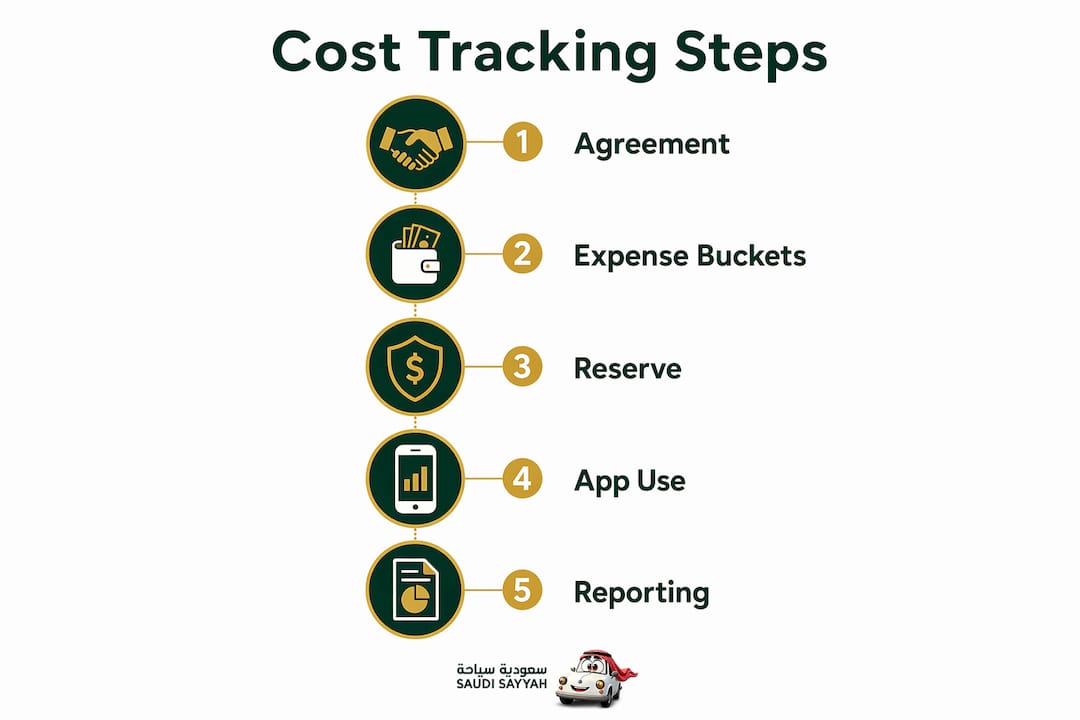
A contingency reserve of 1–2% of vehicle value annually cushions surprise repairs. Apps like Co-oto automate this tracking with receipt uploads and automatic allocation, so no one is manually reconciling a spreadsheet at the end of each month. For group transport logistics, centralized expense visibility also builds trust among co-owners who may not travel together on every trip.
What US legal compliance and permits apply to van sharing?
Van sharing in the US sits in a distinct legal category from commercial rental. A joint use agreement charges only for maintenance cost recovery, not profit, which keeps it outside the commercial carrier permit requirements that apply to for-hire transportation businesses.
Key compliance points for US-based groups include registering as an LLC for liability protection and simplified titling, maintaining commercial auto insurance rather than personal coverage, and confirming that all named drivers hold valid licenses. If the van crosses state lines, Federal Motor Carrier Safety Administration rules may apply depending on vehicle weight and passenger count. Groups should verify local permit requirements with their state DMV before the first trip.
How do co-owners and passengers communicate effectively?
The social dimension is the biggest risk factor in shared van arrangements. Centralizing all communication through one platform, rather than splitting it across text threads, group chats, and email, removes the most common source of booking conflicts.
Assign one co-owner as the primary contact for maintenance coordination. Use the app's messaging or comment function for trip-specific notes rather than personal phones. Set a response time standard for booking requests, 24 hours works for most groups, and document any rule changes in the written agreement rather than in a chat thread that gets buried.
How do you choose the right van type and size for pilgrimage travel?
Group size drives the decision. A standard passenger van seats 12–15 and suits most pilgrimage groups traveling together. Smaller groups of four to six travelers often prefer a full-size luxury van with captain's chairs, extra legroom, and dedicated luggage space. For Hajj and Umrah routes specifically, climate control and suspension quality matter more than cargo volume.

Check that the van's wheelbase and ground clearance suit the roads between holy sites. Newer model year vehicles with advanced driver-assistance systems add a meaningful layer of safety on unfamiliar routes. Saudisayyah's premium pilgrimage fleet uses latest-model vehicles with geolocation tracking built in, which sets a useful benchmark for what a well-equipped shared van should include.
What safety protocols apply during shared van trips?
Every shared van trip needs a pre-departure inspection covering brakes, tires, lights, and fluid levels. Assign a designated driver for each leg and confirm that driver is named on the insurance policy before departure. Keep an emergency kit in the van at all times: first aid supplies, a reflective triangle, a fire extinguisher, and a list of local emergency contacts for each region on the route.
For pilgrimage routes, add the contact numbers for local medical facilities and the nearest embassy or consulate. Real-time GPS tracking, a standard feature on platforms like Co-oto and on Saudisayyah's booking system, lets co-owners monitor the van's location throughout the trip. Vans with any defect or unresolved safety issue should not be shared until the repair is documented and confirmed.
Saudisayyah handles the complexity so you don't have to
Setting up co-ownership agreements, insurance declarations, maintenance schedules, and booking platforms takes real time and coordination. Saudisayyah offers a fully managed alternative: a premium fleet of latest-model vehicles, professional drivers with years of pilgrimage route experience, and an automated booking system that sends driver photos, vehicle details, and real-time GPS tracking before every trip.
For first-time pilgrims especially, the platform's constant communication removes the uncertainty that informal arrangements leave in place. No spreadsheets, no insurance gaps, no last-minute scheduling conflicts. Saudisayyah's pilgrimage transport services are available to book directly, with full trip monitoring from pickup to drop-off.
Key Takeaways
Organized van sharing for pilgrimage travel requires a formal agreement, a centralized platform, and verified insurance before the first trip departs.
| Point | Details |
|---|---|
| Written agreement first | Cover ownership shares, usage rights, financial duties, care standards, and exit options before any trip. |
| Contingency reserve | Set aside 1–2% of vehicle value annually to cover unexpected repairs without emergency cash calls. |
| Insurance verification | Declare all drivers and confirm a rental module is active; standard policies often void coverage for third-party lending. |
| Centralized platform | Apps like Co-oto support up to 25 drivers and 10 vehicles, automating cost splits and location tracking. |
| Saudisayyah option | Saudisayyah provides fully managed pilgrimage transport with real-time tracking, professional drivers, and automated booking. |