

TL;DR:
- Buying a vehicle in 2026 requires thorough analysis of total ownership costs, safety features, and powertrain options. Proper research, inspections, and negotiation prevent overpaying and ensure the right vehicle choice for your lifestyle. Preparing beforehand minimizes risks and makes the purchase more confident and financially sound.
A vehicle purchase is one of the largest financial decisions most people make, and the checklist for vehicle selection in 2026 looks more complex than ever. New safety mandates, a fragmented powertrain market, and rising ownership costs mean that buyers who skip structured evaluation routinely overpay or end up with the wrong vehicle. This guide covers every critical criterion, from total cost of ownership to hands-on inspection steps, so you can make a confident, well-researched decision before you sign anything.
1. How to assess total ownership costs
Total cost of ownership (TCO) is the full financial picture of owning a vehicle, covering purchase price, insurance, fuel, maintenance, taxes, and financing. Most buyers focus on the sticker price and miss the real number.

Financial experts apply the 15% rule: your total monthly vehicle expenses, including loan payment, insurance, fuel, and maintenance, should not exceed 15% of your gross monthly income. That threshold keeps car costs from crowding out savings and other financial goals.
Financing terms matter as much as the purchase price. Credit unions average 5.8% APR on auto loans versus 7.1% at dealerships, according to industry data. Getting pre-approved before you visit a showroom puts you in a stronger position and removes the dealer's ability to control the conversation around monthly payments.
Insurance premiums vary by as much as 40% between vehicles with similar sticker prices. A sports trim or a vehicle with a high theft rate can cost hundreds more per year than a comparable sedan. Always get specific insurance quotes for the exact model and trim before committing.
Key TCO components to calculate before any purchase:
- Purchase price (new, used, or certified pre-owned)
- Loan interest over the full term
- Insurance premium for your specific model and trim
- Fuel or energy costs based on your annual mileage
- Scheduled maintenance and expected repair frequency
- Registration, taxes, and fees
Pro Tip: Get insurance quotes for your top three vehicle choices before visiting any dealership. The premium difference alone can shift your decision.
2. Essential safety features for 2026 vehicles
Advanced driver-assistance systems (ADAS) are now the primary safety evaluation metric for 2026 models. These are not optional upgrades. ADAS features like automatic emergency braking and blind-spot monitoring are standardized across most new vehicle lines in 2026.
Safety technology also reduces long-term costs. Vehicles equipped with full ADAS suites typically qualify for lower insurance premiums. Fewer at-fault accidents mean lower lifetime insurance spend and fewer out-of-pocket repair bills.
Mandatory ADAS features to verify on any 2026 vehicle:
- Automatic emergency braking (AEB) with pedestrian detection
- Blind-spot monitoring with rear cross-traffic alert
- Lane-keeping assist and lane departure warning
- Adaptive cruise control with stop-and-go capability
- Rear-view camera (federally required on all new U.S. vehicles)
Secondary technology features worth evaluating include wireless Apple CarPlay and Android Auto integration, over-the-air software update capability, and USB-C charging ports throughout the cabin. These are not safety-critical, but they affect long-term satisfaction and resale value.
During any test drive or inspection, verify that every ADAS feature activates correctly. A system that is listed in the specs but has a faulty sensor is worthless. Ask the dealer to demonstrate each feature, or have a technician confirm function during a pre-purchase inspection.
3. Choosing the right powertrain: electric, hybrid, or conventional
Powertrain selection in 2026 requires analysis beyond engine type. Your commute length, access to charging infrastructure, and five-year cost projections all determine which option fits your life.
| Powertrain | Best for | Key advantage | Key limitation |
|---|---|---|---|
| Battery electric (BEV) | Urban commuters with home charging | Lowest fuel and maintenance cost | Range anxiety; charging time |
| Plug-in hybrid (PHEV) | Mixed urban/highway drivers | Electric daily driving, gas backup | Higher purchase price |
| Full hybrid (HEV) | Highway-heavy drivers | No charging needed; better MPG | Less electric-only range |
| Conventional ICE | Rural areas, long hauls | Widest fueling network | Higher fuel and maintenance costs |
Certified pre-owned (CPO) vehicles offer a practical middle ground for buyers weighing new versus used. CPO vehicles can save $8,000–$12,000 versus new models while retaining manufacturer warranty coverage. For buyers considering a hybrid or electric CPO vehicle, battery health certification is the single most important document to request.
For a deeper look at hybrid powertrain tradeoffs, the hybrid fleet guide from Saudisayyah covers total cost comparisons and infrastructure considerations in detail.
Pro Tip: If you drive fewer than 40 miles per day and have access to home charging, a BEV will almost certainly cost less to operate over five years than any hybrid or ICE alternative.
4. Key inspection steps for used and new vehicles
A structured inspection process separates buyers who get good vehicles from those who inherit someone else's problems. Vehicle history reports reveal hidden accidents, flood or fire damage, and title issues that create expensive ownership problems down the road. Run a report on every used vehicle, no exceptions.
Physical inspection checklist
Walk around the vehicle in daylight and check:
- Body panel alignment — gaps should be even on all sides; uneven gaps signal prior collision repair
- Paint overspray on rubber seals, trim, or glass — a sign of repainted panels
- Tire tread depth and wear pattern — uneven wear points to alignment or suspension problems
- Fluid levels and color — dark, gritty oil or milky coolant indicates neglect or engine issues
- Undercarriage condition — rust, leaks, or damaged components visible from below
- Interior wear — seat condition, dashboard cracks, and odor inconsistent with reported mileage
Test drive requirements
A test drive of 20 or more minutes on varied road conditions is the minimum standard. Short parking-lot loops hide braking, suspension, and transmission problems that only appear at highway speeds or on rough pavement. Test hard braking, acceleration from a stop, highway merging, and low-speed parking maneuvers.
Pre-purchase inspection
For any used vehicle, budget $100–$200 for a professional pre-purchase inspection by an independent mechanic. This single step catches hidden issues that cost thousands to fix after purchase. Never skip it, regardless of how clean the vehicle looks.
Also verify: open recalls (check via the NHTSA database using the VIN), a clean title with no liens, and that the VIN on the dashboard matches the VIN on the door jamb and title document.
Pro Tip: Have your mechanic inspect the vehicle at their shop, not in a parking lot. A lift inspection of the undercarriage takes ten minutes and reveals what no visual walkaround can.
5. How to research pricing and negotiate effectively
Pricing research is the foundation of any 2026 car comparison checklist. Emailing 3–5 dealerships for out-the-door quotes on the same vehicle creates direct price competition without the pressure of a showroom floor. Dealers respond to written requests with better numbers because they know you are comparing.
Focus your negotiation on the out-the-door price, not the monthly payment. Dealers can manipulate loan terms to make a higher-priced vehicle appear affordable on a monthly basis. The total amount you pay over the loan term is the only number that matters.
First-time buyers overpay by $3,000–$8,000 due to lack of preparation. That gap closes almost entirely with pricing research, pre-approval, and multiple competing quotes. Understanding UK and international transport pricing models also provides useful context on how vehicle costs vary by market and use case.
6. Verifying paperwork and finalizing the purchase
Paperwork errors and add-on products are where buyers lose money at the final stage. Review every line of the purchase agreement before signing. Dealers routinely add extended warranties, paint protection packages, and gap insurance to the contract without explicit discussion.
Gap insurance is worth considering if your loan amount exceeds the vehicle's market value, which is common when financing a new vehicle with a small down payment. Extended warranties from third-party providers are generally less reliable than manufacturer-backed coverage. Read the terms before accepting any add-on.
Confirm the final out-the-door price matches the quote you received in writing. Check that the loan APR, term length, and total interest paid match your pre-approval terms. If any number differs from what was agreed, stop and ask for a written explanation before proceeding.
Key takeaways
A complete vehicle selection checklist for 2026 buyers must address total ownership cost, ADAS safety standards, powertrain fit, and thorough inspection before any purchase decision.
| Point | Details |
|---|---|
| Apply the 15% rule | Total monthly vehicle costs must not exceed 15% of gross monthly income. |
| Verify all ADAS features | Confirm automatic emergency braking, blind-spot monitoring, and lane-keeping assist are functional. |
| Match powertrain to lifestyle | Choose BEV, PHEV, hybrid, or ICE based on commute length and charging access. |
| Run a pre-purchase inspection | Budget $100–$200 for an independent mechanic check on any used vehicle. |
| Negotiate on out-the-door price | Email multiple dealers for quotes and focus on total cost, not monthly payments. |
What I have learned from watching buyers get this wrong
Most vehicle purchase mistakes happen in the first ten minutes of a dealership visit. Buyers arrive without a pre-approved loan, without insurance quotes, and without a written price target. The salesperson controls the entire conversation from that point forward.
The monthly payment trap is the most damaging pattern I see. A buyer fixates on keeping payments under $500 per month, and the dealer stretches the loan to 84 months to hit that number. The buyer pays $6,000–$10,000 more in total interest and ends up underwater on the loan within two years.
The 2026 powertrain decision deserves more time than most buyers give it. Choosing between a BEV and a PHEV is not just a preference question. It requires knowing your average daily mileage, whether you have access to Level 2 home charging, and what your local electricity rate is. Buyers who skip that analysis often end up with a BEV they cannot charge conveniently, or a hybrid they never plug in.
My strongest recommendation: complete your budget math, get pre-approved, and gather insurance quotes before you set foot in a showroom or contact a seller. The 2026 buyer's guide from Saudisayyah covers modern vehicle advantages worth reviewing before you finalize your criteria. Skipping inspections and rushing paperwork are the two steps that cause the most regret. Neither saves enough time to justify the risk.
— Fa
Saudisayyah fleet options for your 2026 transport needs
Planning travel in Saudi Arabia alongside your vehicle research? Saudisayyah operates a fleet of late-model vehicles with advanced safety features, geolocation tracking, and professional drivers for Umrah and Hajj transport.
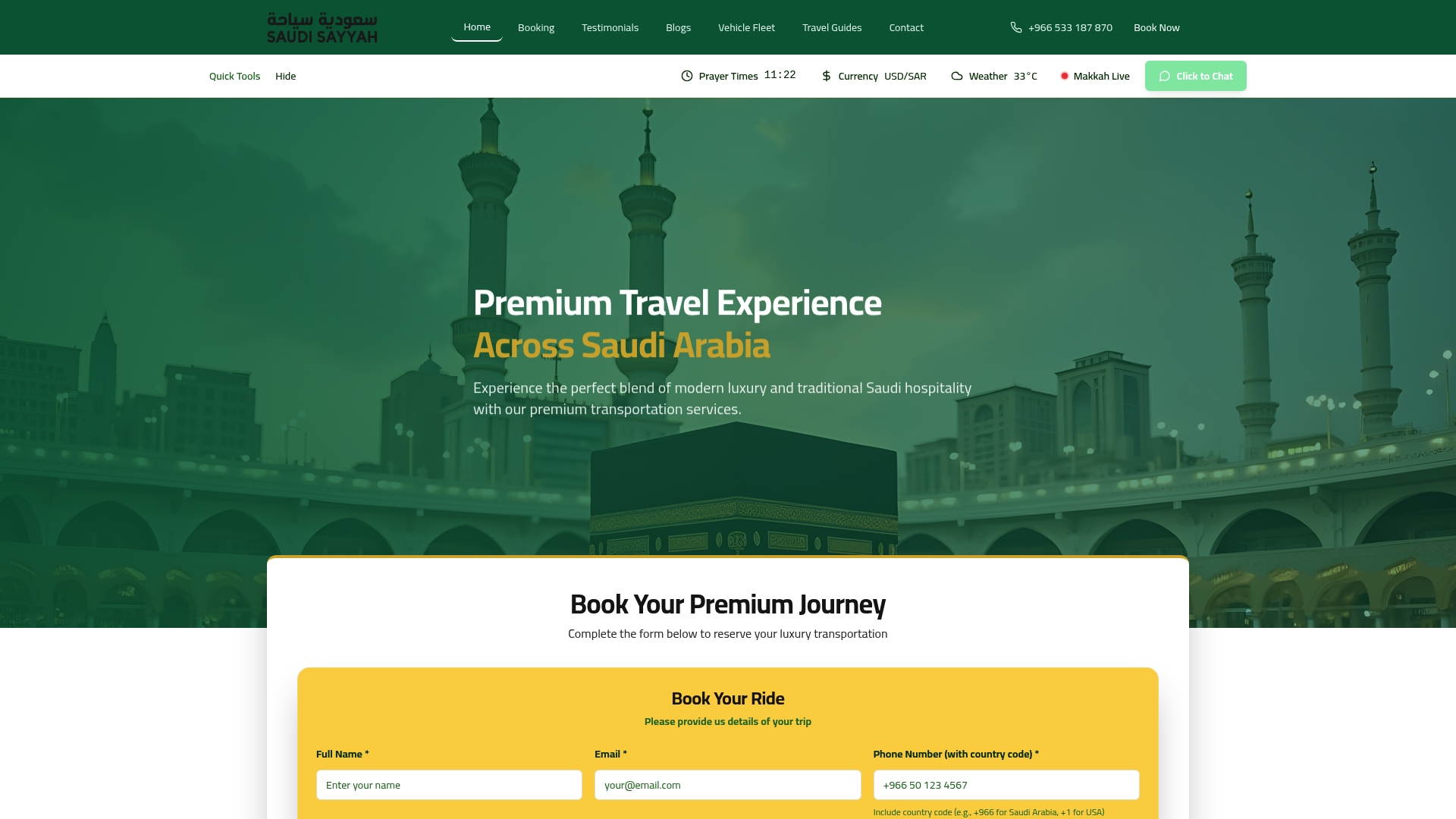
Every booking through Saudisayyah includes real-time driver tracking, verified vehicle details sent before departure, and a fully automated reservation system. For pilgrims visiting the holy lands for the first time, that level of transparency removes uncertainty at every step. Browse the full fleet options or review the complete range of vehicle hire services to find the right transport for your 2026 trip.
FAQ
What is the 15% rule for car buying?
The 15% rule states that total monthly vehicle costs, including loan payment, insurance, fuel, and maintenance, should not exceed 15% of your gross monthly income. Staying within this threshold prevents vehicle expenses from crowding out savings and other financial priorities.
Which ADAS features are standard on 2026 vehicles?
Automatic emergency braking with pedestrian detection, blind-spot monitoring, lane-keeping assist, and rear-view cameras are standardized across most 2026 new vehicle lines. Always verify these systems function correctly during a test drive or inspection.
How long should a test drive be?
A test drive should last at least 20 minutes and include varied road conditions such as highway speeds, rough pavement, and low-speed parking. Short loops hide braking, suspension, and transmission problems that only appear under real driving conditions.
Is a pre-purchase inspection worth the cost?
A pre-purchase inspection costs $100–$200 and regularly uncovers hidden issues worth thousands in repairs. For any used vehicle purchase, it is the single most cost-effective step in the buying process.
How do I avoid overpaying at a dealership?
Email 3–5 dealerships for written out-the-door quotes on the same vehicle, get pre-approved for financing before visiting, and negotiate on total price rather than monthly payments. Unprepared first-time buyers overpay by $3,000–$8,000 on average.