

Continuous monitoring in premium passenger transport means real-time GPS tracking, automated stage notifications, and constant communication from booking to drop-off. For pilgrims and international tourists, this combination removes the guesswork from every pickup. You know where your driver is, when they will arrive, and who to call if anything changes.
The core elements passengers should expect:
- Live location link sent before the driver departs
- Automated notifications at each trip stage: booking confirmed, driver assigned, driver en route, driver arrived
- Driver photo, vehicle make/model, and plate number delivered in advance
- A direct support contact available throughout the trip
Passenger-facing outcomes:
- Reduced uncertainty at airports and pilgrimage sites
- Safer, confirmed pickups with no guessing at the curb
- Predictable arrival windows based on live traffic
- Easier hand-offs for group leaders coordinating multiple travelers
Key Takeaways
Continuous monitoring in premium transfers delivers real-time visibility, proactive communication, and verifiable safety signals that pilgrims and tourists should treat as minimum booking requirements.
| Point | Details |
|---|---|
| Confirm live tracking before booking | Ask for a secure live-tracking link or passenger app — it should activate when the driver departs. |
| Driver and vehicle details are non-negotiable | Photo, plate, and vehicle make/model should arrive before the driver leaves the depot. |
| Automated notifications mark every stage | Expect updates at booking, driver assignment, en route, arrival, and trip completion. |
| 24/7 support is part of the service | Verify a direct contact number or chat channel is available for in-trip issues. |
| Prioritize visibility alongside comfort | A monitored transfer with clear pickup SLAs protects the trip as much as vehicle quality does. |
Table of Contents
- What does continuous monitoring look like in a premium transfer?
- Why does continuous monitoring matter for pilgrims and tourists?
- How operators use monitoring to keep trips on track
- What should you confirm about monitoring before you book?
- What technology powers live tracking and notifications?
- How does monitoring affect price and what is the trip timeline?
- Privacy and safety questions to ask about live tracking
- How continuous monitoring connects to fleet management and dispatch
- An operator's view on what monitoring actually delivers
- Sources
What does continuous monitoring look like in a premium transfer?
Passenger transparency is now a baseline expectation in premium transport, not a premium add-on. The features below are what a properly monitored transfer delivers.
| Feature | What it does for you | What the operator monitors |
|---|---|---|
| Live vehicle map link | Shows driver position in real time | Route adherence, staging location |
| Automated stage notifications | Confirms each trip milestone without you asking | Missed triggers, delayed stages |
| Driver photo + plate | Lets you identify your driver at pickup | Driver assignment and compliance |
| Dynamic ETA | Updates based on live traffic | Congestion, rerouting needs |
| Shareable booking link | Lets a family member or group leader track the trip | Group coordination, multi-vehicle dispatch |
GPS tracking for precise ETA updates and pre-planned routes is a recognized standard in five-star chauffeur services. A provider that cannot deliver these features is operating below that standard.
Why does continuous monitoring matter for pilgrims and tourists?
Airport terminals in Jeddah and Madinah are busy. Pilgrimage sites add crowds, language barriers, and time pressure. In that environment, a missed pickup is more than an inconvenience.
Key benefits of ongoing monitoring for pilgrims and international tourists:
- Peace of mind. Knowing the driver's location removes the anxiety of waiting at an unfamiliar curb.
- Predictable arrival windows. Live traffic data means ETAs reflect reality, not optimism.
- Safe hand-offs. Driver photo and plate confirm identity before you approach any vehicle.
- Group coordination. A shareable trip link lets a tour leader track all vehicles simultaneously.
Consider a practical example: a pilgrim lands at King Abdulaziz International Airport after a long flight. The transfer provider sends a notification the moment the driver is assigned, then a second alert when the driver enters the arrivals zone. The passenger opens the live link, sees the vehicle on the map, and walks directly to it. No phone calls, no searching, no stress. Live driver location materially reduces anxiety and improves coordination for exactly this scenario.
Trust signals to look for in provider materials: published driver vetting procedures, advance vehicle details, and clear pickup windows or service-level commitments. Trust for VIP transport is built before the ride begins through confirmation details and accurate timing.
How operators use monitoring to keep trips on track
Behind the passenger-facing features, operators run a set of workflows that convert raw GPS data into proactive service.
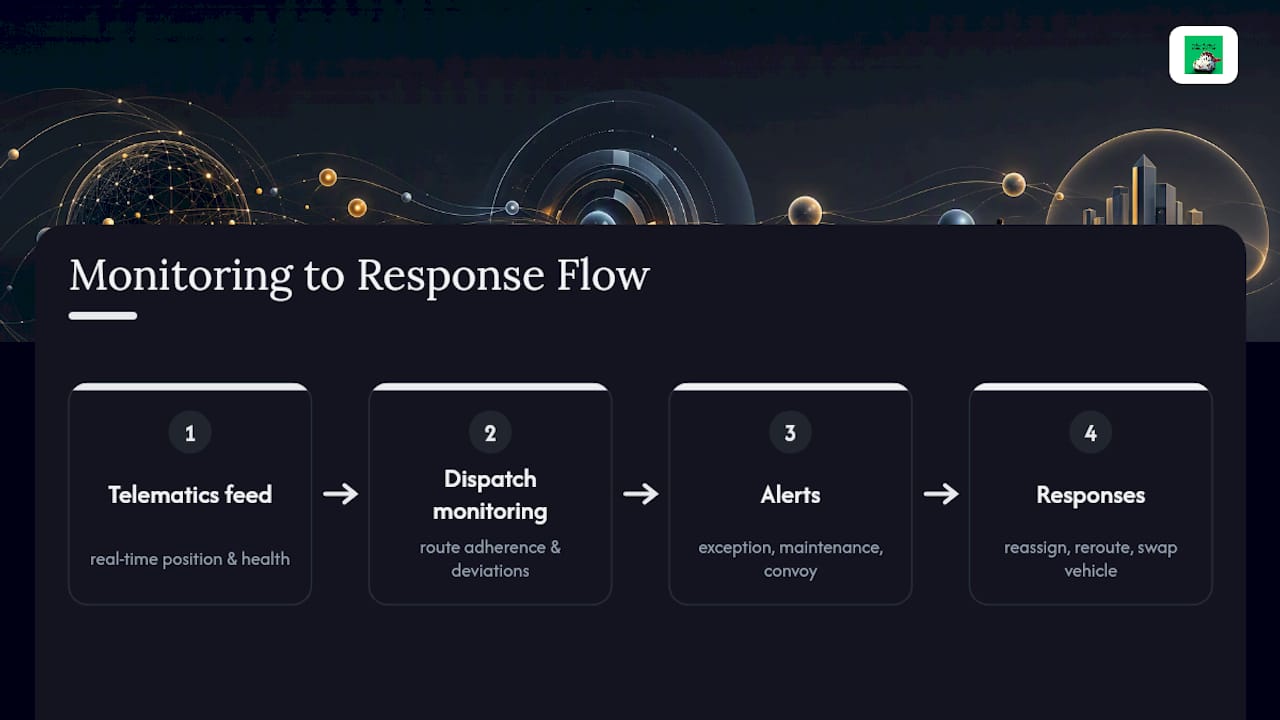
Live GPS and telematics feed real-time position and vehicle health data into a dispatch platform. Operators watch route adherence, flag deviations, and push rerouting instructions to drivers when congestion builds. GPS fleet tracking helps operators monitor route adherence, set driver behavior alerts, and generate maintenance notifications — all of which directly affect passenger safety.
Exception alerts are the operational core. When a flight lands 40 minutes late, a monitored system detects the delay, holds or reassigns the driver, and sends the passenger an updated ETA before they reach baggage claim. No call required.
Maintenance alerts flag vehicle issues before they become trip failures. A tire pressure warning or engine fault code triggers a vehicle swap, not a roadside stop.
For a Ziarah tour convoy, monitoring prevents the most common failure: a vehicle falling behind and losing the group. Dispatch sees every vehicle's position, identifies the gap, and radios the driver before the group reaches the next site. Experienced drivers paired with monitoring technology deliver the consistency that ad hoc coordination cannot.
What should you confirm about monitoring before you book?
Use this checklist before committing to any transfer provider:
- Booking confirmation with pickup window. Confirm you receive a written confirmation with a specific arrival time range.
- Driver photo and plate number. Ask when these are sent — they should arrive before the driver departs.
- Secure live-tracking link or passenger app. Verify the link is accessible without downloading an app if you prefer.
- Automated stage notifications. Confirm the provider sends updates at each trip stage, not just at booking.
- Shareable trip link. Check whether you can forward the link to a family member or group organizer.
- 24/7 support contact. Get the direct number or chat channel for in-trip issues before you travel.
Pro Tip: When reviewing a provider's service page, look specifically for the phrases "live vehicle tracking" and "driver details sent before pickup." Providers who use this language have built the feature into their standard workflow, not as an exception.
Helpful add-ons to ask about: flight monitoring for airline delays, multilingual driver or dispatch support, and itinerary sharing for group or tour leader coordination. Digital concierge features that include messaging and itinerary sharing complement live tracking for complex pilgrim itineraries.
What technology powers live tracking and notifications?
Four components work together to deliver continuous monitoring:
GPS and telematics hardware installed in each vehicle transmits position, speed, and vehicle health data continuously. A fleet management platform receives that data, applies traffic and routing logic, and generates ETAs. A passenger-facing app or secure web link displays the vehicle position and pushes notifications. Support and communications channels (SMS, in-app chat, or phone) connect passengers to dispatch when needed.
Data flows in one direction: vehicle to platform to passenger. Latency is typically a few seconds on a reliable mobile network. In areas with weak signal, the platform holds the last known position and flags the gap to dispatch.
Pro Tip: When you receive your pre-trip message, open the live link immediately and confirm the driver photo and plate match what you expect. If either is missing, contact support before the driver departs — not after you are standing at the curb.
How does monitoring affect price and what is the trip timeline?
In premium transfer services, real-time tracking and automated notifications are standard inclusions, not paid upgrades. Budget services may offer tracking as an optional add-on or omit it entirely. The price difference between a monitored and unmonitored transfer reflects the infrastructure cost, but also the service reliability gap.
A typical monitored trip timeline:
- Booking confirmed — immediate notification with pickup details
- Driver assigned — photo, vehicle make/model, and plate sent
- Driver en route — live link activated, ETA displayed
- Driver arrived — arrival alert sent to passenger
- Trip completed — receipt or summary sent
Monitoring does not typically change cancellation policies, but it does affect waiting-time charges. Ask specifically: how long will the driver wait after the scheduled pickup time, and does the live-tracking system log the driver's arrival timestamp? That log protects both parties in a dispute.
Privacy and safety questions to ask about live tracking
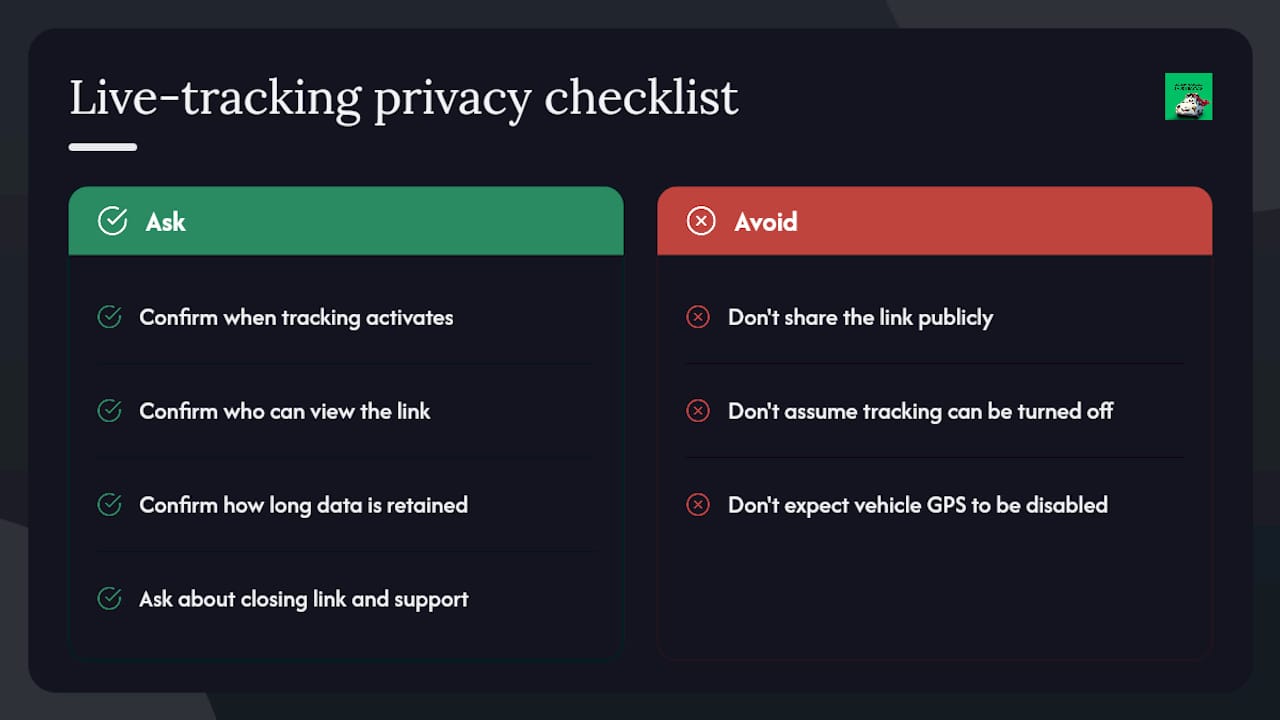
Passengers share location data when they use a live-tracking link. Luxury chauffeur etiquette standards include preserving passenger privacy, and that principle extends to how tracking data is handled.
Before booking, confirm: when tracking activates (typically when the driver departs), who can view the link (only the link holder), and how long location data is retained after the trip ends. Discreet chauffeur services handle reservation and location data with the same care they apply to passenger identity.
Safety features enabled by monitoring: vehicle maintenance alerts prevent mechanical failures mid-trip; driver behavior monitoring flags harsh braking or speeding; and a direct support line connects passengers to dispatch or emergency services without delay. Saudisayyah's premium fleet supports these safety layers across all vehicle classes.
Who sees my live location? Only people who have the specific tracking link. The link is not public and expires after the trip ends.
Can I turn off tracking during the trip? The vehicle's GPS remains active for safety and dispatch purposes, but the passenger-facing link can be closed or not shared. Contact the provider's support line if you have specific privacy concerns before departure.
How continuous monitoring connects to fleet management and dispatch
Continuous monitoring does not operate in isolation. It feeds directly into a fleet management and dispatch system that coordinates every vehicle in real time. When a driver's GPS position updates, the dispatch platform recalculates ETAs for all affected trips, adjusts staging queues, and alerts coordinators to exceptions — a delayed vehicle, an unscheduled stop, or a route deviation.
This integration means a single flight delay can trigger an automated chain: the system detects the updated arrival time, holds the assigned driver, notifies the passenger, and logs the exception for operational review. No manual intervention required until a human decision is needed. Saudisayyah's services are built on this kind of automated, internationally-compliant booking and dispatch infrastructure.
For multi-vehicle pilgrim groups, dispatch integration is what keeps a convoy together. Each vehicle's position is visible on the same platform, and coordinators can redirect individual drivers without disrupting the rest of the group.
An operator's view on what monitoring actually delivers
Continuous monitoring changes how a transfer operation runs at a fundamental level. Rather than reacting to problems after a passenger calls, a monitored operation identifies the issue first and resolves it before the passenger notices. A driver running five minutes late triggers a notification and a dispatch check, not a complaint.
Saudisayyah's geolocation-enabled platform sends driver photos, vehicle details, and live tracking before every trip. That is not a feature list. It is the operational standard that makes consistent service possible across airport pickups, Ziarah tours, and intercity transfers.
For pilgrims traveling to the holy lands for the first time, that consistency is what the entire experience rests on.
Sources
- Why passenger transparency is now a competitive advantage | Autocab
- Tour bus companies can benefit from GPS fleet tracking | LiveViewGPS
- Why a Discreet Chauffeur Service Matters - DA Executive Service
- Luxury Chauffeur Service Etiquette Every Client Should Know