

Automated reminders reduce missed obligations and recover operational capacity. That is their core function. For any organization managing scheduled appointments, the operational verdict is direct: deploy reminders and no-show rates drop, cancellations arrive earlier, and staff spend less time on manual follow-up.
Top measurable benefits:
- Lower no-show rates. Targeted IVR calls added to SMS reminders reduced no-shows by 1.7 percentage points in a large randomized trial, with net appointment completions rising by 1.9 percentage points.
- Higher slot utilization. Early cancellations triggered by reminders free slots for rebooking before the window closes.
- Faster rescheduling. Two-way reply flows and single-tap cancellation links cut the time between cancellation and slot reallocation.
- Reduced frontline labor. Automated outreach replaces manual phone trees, freeing staff for higher-value tasks.
For smaller organizations piloting for the first time, start with a single SMS channel and one appointment type. Larger operations with existing EHR or CRM infrastructure should move directly to multimodal, interactive flows.
Automated reminders are pre-scheduled or event-triggered messages sent to patients, clients, or customers before a scheduled obligation. They differ from recall systems, which proactively contact people who are overdue for care or a service. Reminders confirm what is already booked; recall systems initiate new contact.
Common delivery channels include:
| Channel | Reach | Interactivity | Relative Cost |
|---|---|---|---|
| SMS/text | High (mobile-first) | Two-way replies possible | Low |
| Automated voice (IVR) | Broad, including non-smartphone users | Menu-driven responses | Medium |
| High for professional audiences | Links, attachments | Low | |
| Push/in-app notifications | App users only | Tap-to-confirm | Low |
| EHR/CRM clinician prompts | Internal staff only | Workflow-integrated | Varies |
Each channel carries tradeoffs. SMS reaches the widest mobile audience at low cost, but IVR extends to populations without smartphones. Email suits professional and legal contexts. Push notifications work only when a patient or client has installed the relevant app. Regulatory bodies like AHRQ and frameworks like HIPAA and TCPA govern what content can travel through each channel and under what consent conditions. Saudisayyah's booking platform, for example, sends driver photos, vehicle details, and real-time tracking links before every trip, a practical model of "reminder plus" content delivered through mobile channels.
Table of Contents
- How do automated reminder systems actually work?
- What does the evidence say about reminder effectiveness?
- How do benefits differ across clinical, legal, and business settings?
- What are the best practices for designing effective reminders?
- What U.S. legal requirements apply to automated reminders?
- How do you measure ROI from a reminder program?
- When do reminders underperform, and what are the risks?
- Real-world examples: what happened when organizations deployed reminders?
- Step-by-step checklist to pilot and scale a reminder program
- What is the operational verdict on automated reminders?
- Key Takeaways
- Why operational leaders should rethink what reminders actually do
- Useful sources for further reading
How do automated reminder systems actually work?
Workflow elements
A complete reminder workflow moves through five stages:
- Message template selection based on appointment type and channel.
- Send logic: time window, channel priority, and retry rules.
- Delivery tracking: gateway confirmation, bounce handling, and undeliverable flags.
- Response handling: inbound replies parsed for confirmation, cancellation, or rescheduling intent.
- Slot reallocation: cancelled slots automatically returned to the booking pool or flagged for staff action.
User journeys
A standard attendee receives an SMS 72 hours out, confirms with a reply, and receives a final reminder 2 hours before. A high-risk patient gets the same SMS plus an IVR call 48 hours out with a menu option to reschedule. A client who cancels via a single-tap link triggers an immediate slot-release event and receives a rebooking confirmation. Staff receive an escalation alert only when a high-risk contact is unreachable after all automated attempts.
What does the evidence say about reminder effectiveness?
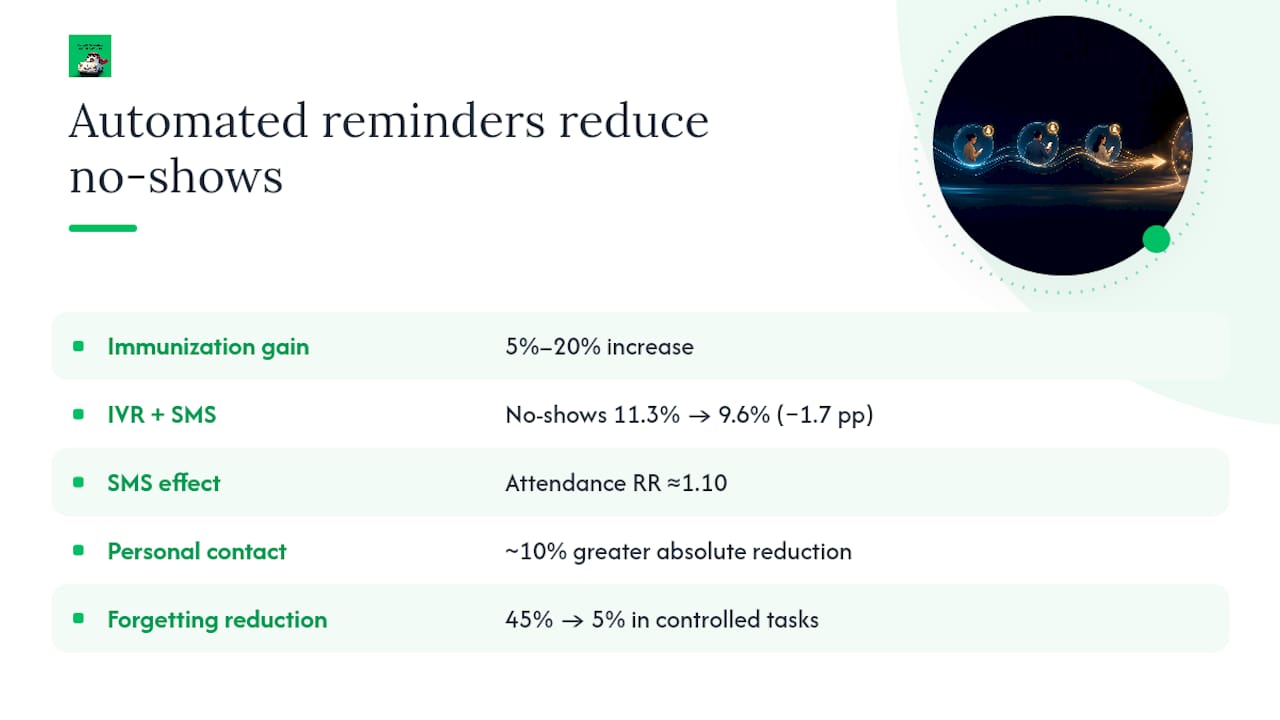
The research base is substantial. Systematic reviews and AHRQ guidance document that reminder and recall systems improve immunization rates and preventive service uptake, with immunization increases ranging from 5% to 20% across interventions. Telephone reminders consistently rank among the most effective single-channel approaches for driving cancellations and rescheduling.
Key trial result: Adding an IVR call to standard SMS reminders reduced no-show rates from 11.3% to 9.6% among high-risk patients, a 1.7 percentage point drop, with sustained results across more than 244,000 patients when scaled.
The TURNUP systematic review concludes that automated reminders are consistently effective but not optimal on their own. Interactive designs, those that allow patients to confirm, cancel, or reschedule within the reminder itself, outperform passive notifications. "Reminder plus" approaches that bundle directions, preparation instructions, or cancellation links show stronger engagement than date-and-time-only messages.
A PMC literature review covering automated alerts and reminders targeting patients found effectiveness across age groups and socioeconomic segments, with text messaging as the most common intervention type studied. The same review supports integration with EHR systems as a mechanism for sustaining impact.
Channel comparisons from the TURNUP channel analysis show SMS improves attendance (relative risk approximately 1.10), while telephone reminders produce higher cancellation and rebooking rates. Neither channel dominates across all outcomes; the best results come from combining them.
A PMC systematic review and its companion Dove Press publication both note that personal contact can show roughly 10% greater absolute reduction in non-attendance compared with automated reminders alone, which is the primary argument for hybrid models that reserve human outreach for high-risk cohorts.
Framing and personalization also move the needle. Trials testing message language found that positive or social-benefit framing and messages that identify the sender as the patient's own provider improve response rates compared with generic automated text.
Finally, experimental psychology research on intention offloading explains the behavioral mechanism: external reminders can cut forgetting rates from roughly 45% to roughly 5% in controlled tasks. That reduction in cognitive load is what makes reminders effective across settings, not just in healthcare.
How do benefits differ across clinical, legal, and business settings?
Clinical settings
- Improved preventive care rates — AHRQ evidence links reminder systems to immunization rate increases of 5–20%.
Key metrics to track: appointment attendance rate, no-show rate by provider and appointment type, cancellation lead time, and recovered slots per week.
General business and transportation
For service businesses managing scheduled pickups, deliveries, or appointments, reminders serve a logistics function. Sending driver details, vehicle information, and real-time tracking links before a pickup, as Saudisayyah does for pilgrim transfers, reduces missed pickups and eliminates the uncertainty that leads clients to cancel. Optimizing trip scheduling becomes more reliable when clients receive timely, specific pre-trip information rather than a generic booking confirmation.
Key metrics: on-time pickup rate, last-minute cancellation rate, recovered slots per week, and client satisfaction score.
What are the best practices for designing effective reminders?
Timing and cadence
Send the first reminder 5–7 days before the appointment to allow meaningful rescheduling lead time. A second reminder 24–48 hours before serves as a confirmation prompt. A final reminder 1–2 hours before reduces day-of no-shows. For high-value or complex appointments, a three-touch cadence outperforms a single message.
Message design
- Add "reminder plus" content — Include directions, parking instructions, preparation steps, or a cancellation link. The TURNUP review documents that these additions increase perceived value and engagement.
Operational design
- Enable two-way replies on SMS so clients can confirm, cancel, or request a callback without calling the front desk.
- For IVR, offer a menu: press 1 to confirm, press 2 to reschedule, press 3 to speak with staff.
- Route high-risk contacts to IVR plus SMS rather than SMS alone, based on predictive scoring.
- Build automatic slot reallocation: a cancellation response should immediately trigger a slot-available notification to a waitlist.
Pro Tip: Prioritize interactive cancellation flows for your highest-risk cohort first. A single-tap cancel link recovers capacity that a passive reminder never would, and the operational ROI is visible within the first week of deployment.
Admin processes
- Verify contact details at every booking, not just at registration.
- Capture and store consent at the point of booking, with a timestamp and channel-specific record.
- Define fallback rules: if SMS is undeliverable, escalate to IVR; if IVR fails, flag for manual outreach.
- Run monthly data hygiene checks to remove or update stale phone numbers and email addresses.
Sample SMS skeleton:
Sample IVR skeleton:
Launch readiness checklist:
- Contact data verified and consent captured for all records in scope
- Message templates reviewed by legal/compliance
- Opt-out handling tested end-to-end
- Delivery receipts logging confirmed
- Staff escalation rules defined and tested
- Slot reallocation workflow connected to booking system
What U.S. legal requirements apply to automated reminders?
Two federal frameworks govern automated reminders in the United States: HIPAA and TCPA. Compliance with both is non-negotiable.
HIPAA
- Protected health information (PHI) in messages must be limited. A reminder should confirm an appointment exists, not describe the reason for the visit or the patient's condition.
- Vendors that handle PHI must sign a Business Associate Agreement (BAA) before any data is shared.
- Message logs, consent records, and delivery receipts must be retained per HIPAA's minimum six-year record retention standard.
- Patients have the right to request restrictions on how their information is communicated; reminder systems must honor those preferences.
TCPA
- The Telephone Consumer Protection Act requires prior express consent before sending autodialed calls or texts to a mobile number.
- For healthcare appointment reminders, the FCC has recognized a healthcare treatment exception that permits certain informational calls without prior written consent, but the scope is narrow and conditions apply.
- Marketing messages require prior express written consent, a higher standard than informational reminders.
- Every message must include a clear opt-out mechanism, and opt-outs must be honored immediately.
Operational compliance steps
- Capture consent at booking with a timestamp and channel-specific record (SMS, voice, email).
- Maintain a suppression list of opted-out contacts and sync it to the reminder platform before every send.
- Execute BAAs with all reminder platform vendors before go-live.
- Conduct a compliance review at least annually, or whenever message content or channels change.
- Log all outbound messages with delivery status, response, and opt-out events for audit purposes.
How do you measure ROI from a reminder program?
Data sources
Pull delivery data from the SMS gateway or IVR provider logs. Pull attendance and no-show data from the EHR or booking system. Revenue per slot comes from the billing or practice management system.
Simple ROI example
Assume a clinic runs 500 appointments per week at $150 revenue per slot. Pre-reminder no-show rate: 12% (60 no-shows per week, $9,000 in lost revenue). Post-reminder no-show rate: 9% (45 no-shows per week, $6,750 in lost revenue). Weekly revenue recovered: $2,250. Annual revenue recovered: approximately $117,000. If the reminder platform costs $1,000 per month ($12,000 per year), the net annual gain is approximately $105,000. That is a straightforward break-even calculation any finance team can adapt with their own slot value and volume.
Measurement cadence
- Review delivery and confirmation rates weekly during the first 90 days.
- Measure no-show rate monthly and compare to the pre-deployment baseline.
- Run A/B tests on message framing and send timing every quarter. Test one variable at a time: subject line vs. body copy, 72-hour vs. 48-hour send window, SMS-only vs. SMS plus IVR.
When do reminders underperform, and what are the risks?
Equity and access risks
Channel analysis from the TURNUP review flags that populations without stable phone access or smartphone ownership are systematically underserved by SMS-only reminder programs. Mitigation requires multimodal outreach: IVR for those without smartphones, mailed reminders for those without reliable phone access, and accessible transport options or service accommodations where relevant. Predictive models that prioritize high-risk cohorts for human follow-up can partially offset equity gaps.
Security risks
- Message content that includes PHI creates a data exposure risk if the message is intercepted or the recipient's device is compromised.
- Vendor systems that store message logs are targets for data breaches; BAAs and vendor security assessments are required controls.
- Recommended protective measures: limit PHI in message content to the minimum necessary, require encryption in transit and at rest, and conduct annual vendor security reviews.
Mitigation strategies
- Run monthly data hygiene checks and prompt contact verification at every booking.
- Define fallback channels: SMS fails, escalate to IVR; IVR fails, flag for manual outreach.
- Monitor opt-out rates weekly; a rising opt-out rate signals message fatigue or content problems.
- Reserve human outreach for high-risk and equity-sensitive cohorts rather than attempting to automate every contact.
Real-world examples: what happened when organizations deployed reminders?
Penn Medicine IVR plus SMS trial
Penn Medicine ran a rapid randomized trial adding targeted IVR calls to standard SMS reminders for high-risk patients. The NEJM Catalyst report documents a no-show rate drop from 11.3% to 9.6%, a 1.7 percentage point reduction, with net appointment completions rising by 1.9 percentage points. When scaled to more than 244,000 high-risk patients, the results held. The equity dimension was explicit: the trial targeted patients identified as high-risk by a predictive model, concentrating the more intensive IVR outreach where it would have the greatest impact.
Lessons:
- Predictive targeting makes the IVR investment efficient; calling every patient is unnecessary and expensive.
- Sustained results at scale validate the model beyond a small pilot.
- Equity-focused targeting improves outcomes for the populations most likely to miss appointments.
Clinic-level reminder-plus for preventive services
Clinics that added preparation instructions, directions, and cancellation links to standard appointment reminders saw stronger engagement than those sending date-and-time-only messages. AHRQ's guidance on reminder systems documents immunization rate increases of 5–20% when reminder and recall systems are deployed with supportive administrative processes. The operational lesson: content richness in the reminder itself reduces the number of patients who arrive unprepared or not at all.
Legal practice scheduling
A legal practice using automated reminders for client meetings and hearing confirmations reduced missed client meetings by standardizing a 48-hour SMS confirmation with a single-tap rescheduling link. Early cancellations allowed the firm to fill slots with other clients, improving billing predictability. The practice tracked confirmed meeting rate and rescheduled-within-48-hours rate as its primary KPIs, both of which improved within the first month of deployment.
Lessons:
- Legal settings benefit from the same interactive cancellation flows as clinical settings.
- Billing predictability is a direct financial outcome, not just an operational convenience.
- Measuring rescheduled-within-48-hours rate captures capacity recovery that a simple no-show rate misses.
Step-by-step checklist to pilot and scale a reminder program
Pre-pilot preparation
- Define primary objective: reduce no-show rate, improve slot utilization, or both.
- Set baseline KPIs: current no-show rate, cancellation lead time, staff time on manual outreach.
- Audit contact data quality: what percentage of records have verified phone numbers and email addresses?
- Confirm consent capture process is in place for all channels you plan to use.
- Select a vendor with a signed BAA (for clinical settings) and documented TCPA compliance controls.
- Choose a single appointment type and a manageable cohort size for the pilot (100–500 appointments).
Pilot steps
- Build message templates for each channel and have them reviewed by legal or compliance.
- Integrate the reminder platform with your booking system or EHR via API; confirm data fields are mapping correctly.
- Configure trigger rules: time-based send windows, retry logic, and opt-out suppression.
- Soft-launch with a small cohort (10–20% of the target volume) and monitor delivery rates daily.
- Review response data after the first two weeks: delivery rate, confirmation rate, opt-out rate.
- Adjust message timing or content based on early data, then expand to the full cohort.
Pilot duration and success thresholds
Run the pilot for 30–60 days before evaluating. Success thresholds worth targeting: delivery rate above 90%, confirmation rate above 60%, and a measurable reduction in no-show rate compared to the pre-pilot baseline. If all three hold, proceed to scaling.
Scaling steps
- Extend trigger rules to all appointment types and patient or client segments.
- Automate slot reallocation so cancelled slots are immediately returned to the booking pool, as supported by cloud-based booking systems that update capacity in real time.
- Define staff handoff rules: which escalation events require human follow-up and within what timeframe.
- Establish a QA process: monthly review of delivery logs, opt-out trends, and no-show rate by segment.
- Schedule annual compliance reviews covering HIPAA, TCPA, and vendor BAA status.
- Continue A/B testing message variables quarterly to maintain performance as audience behavior shifts.
What is the operational verdict on automated reminders?
Automated reminders reduce no-shows, recover capacity, and free staff from manual outreach. The evidence from randomized trials and systematic reviews is consistent: well-designed reminder systems improve attendance, and interactive or multimodal designs improve it further. The operational upside is clearest when reminders are integrated directly with booking or EHR systems so that cancellations immediately free capacity for rebooking.
The recommended next action for most organizations:
- Run a 30–60 day pilot on one appointment type using predictive targeting for high-risk contacts and an interactive cancellation flow.
- Measure delivery rate, confirmation rate, and no-show rate against the pre-pilot baseline.
- If success thresholds are met, scale to all appointment types and add multimodal channels.
Measure results against the KPIs defined in the metrics section above. The break-even calculation is straightforward; most organizations reach it within the first quarter of deployment.
Key Takeaways
Automated reminders reduce no-shows and recover operational capacity when deployed with interactive cancellation flows, multimodal channels, and direct integration into booking or EHR systems.
| Point | Details |
|---|---|
| No-show reduction is measurable | Adding IVR to SMS cut no-show rates significantly in a large randomized trial. |
| Interactive flows outperform passive alerts | Single-tap cancellation links and two-way SMS replies recover slots that passive reminders never would. |
| Compliance is non-negotiable | HIPAA and TCPA require consent capture, opt-out handling, BAAs, and audit logs before go-live. |
| Pilot before scaling | A 30–60 day pilot on one appointment type with 100–500 records is enough to validate delivery rate, confirmation rate, and no-show impact. |
| Equity requires multimodal design | SMS-only programs underserve older adults and low-income populations; IVR and human fallback channels close the gap. |
Why operational leaders should rethink what reminders actually do
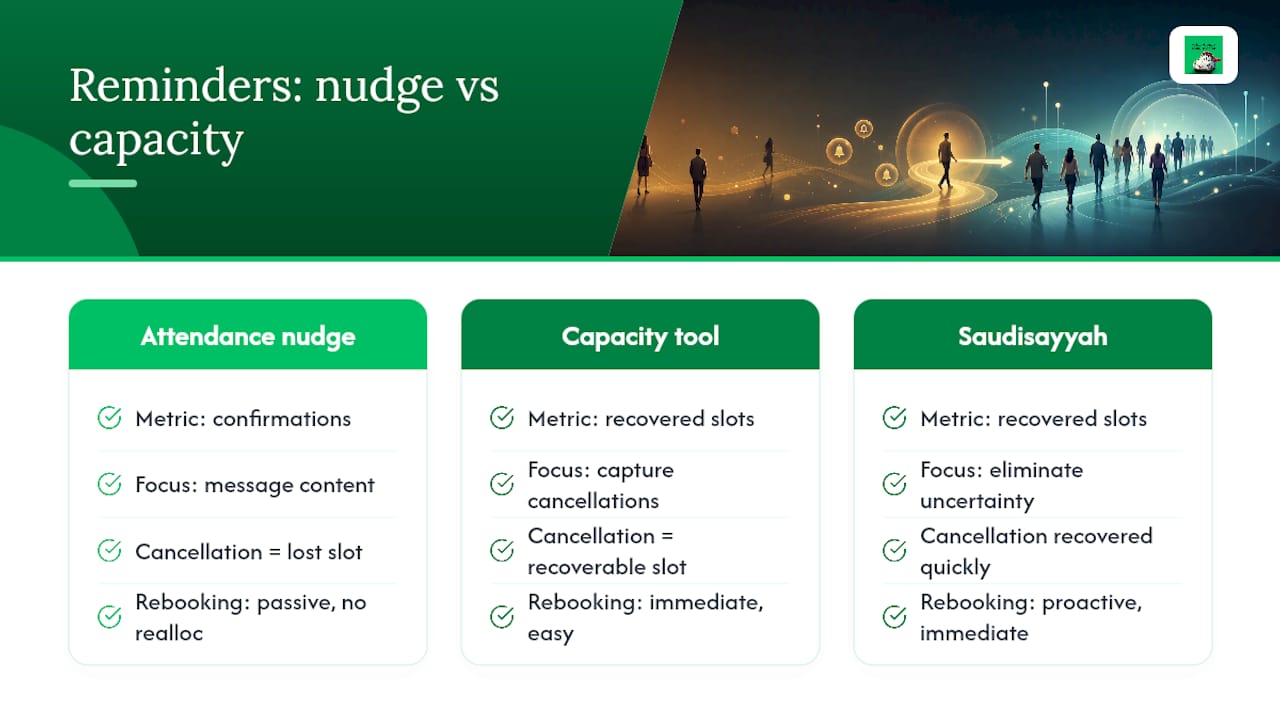
The common framing treats automated reminders as attendance nudges, a polite prompt to show up. That framing undersells them and leads to underinvestment in design.
The more accurate frame: reminders are capacity management tools. A reminder that triggers an early cancellation is worth more than one that produces a confirmation, because the cancellation creates a recoverable slot. A system that captures that cancellation and immediately reallocates the slot is doing something fundamentally different from a system that just sends a text. The operational design of easy rebooking is where the real ROI resides, not in the reminder itself.
Saudisayyah's approach to pre-trip communication, sending driver photos, vehicle details, and real-time tracking before every pickup, reflects this same logic. The goal is not just to remind; it is to eliminate the uncertainty that causes clients to cancel or simply not show up. That distinction shapes every design decision, from message content to cancellation flow to staff escalation rules.
Organizations that treat reminder systems as attendance nudges will optimize for confirmation rates. Organizations that treat them as capacity tools will optimize for recovered slots, and that is the metric that shows up in revenue.
Useful sources for further reading
The claims in this article draw on peer-reviewed systematic reviews, randomized controlled trials, and federal agency guidance. The sources below are the primary references for validation and internal business cases.
- Automated Calls Added to SMS Reminders Reduce Missed Appointments among High-Risk Patients | NEJM Catalyst
- Strategy 6R: Reminder Systems for Immunizations and Preventive Services | Agency for Healthcare Research and Quality
- Targeting the Use of Reminders and Notifications for Uptake by Populations (TURNUP) — a systematic review and evidence synthesis - NCBI Bookshelf
- Advantages and disadvantages of reminder systems - Targeting the Use of Reminders and Notifications for Uptake by Populations (TURNUP) — a systematic review and evidence synthesis - NCBI Bookshelf
- Automated Alerts and Reminders Targeting Patients: A Review of the Literature — PMC
- Appointment reminder systems are effective but not optimal — PMC
- Outsourcing Memory to External Tools: A Review of ‘Intention Offloading’ | Psychonomic Bulletin & Review
For organizations managing transportation logistics alongside appointment scheduling, Saudisayyah's services and booking platform demonstrates how automated pre-trip communications, driver details, and real-time tracking integrate into a complete reminder-plus experience. Corporate logistics teams can also reference Coventry Transportation's corporate account model for examples of how automated communications support fleet and scheduling operations at scale.