
TL;DR:
- Efficient travel routes for Umrah pilgrims involve planning sequences that minimize backtracking and wasted time. Locking in flights and accommodations first ensures a realistic and organized itinerary, especially during peak seasons. Using geographical sequencing and applying the one anchor per day rule improves the pilgrimage experience and reduces exhaustion.
Efficient travel routes for Umrah pilgrims are defined as planned sequences of movement between sacred sites, transport hubs, and accommodations that minimize wasted time and unnecessary backtracking. This guide to efficient travel routes covers every step from booking timelines to on-the-ground navigation within Saudi Arabia. 68% of travelers regret poor route planning, citing wasted time, unexpected costs, and missed experiences. For Umrah pilgrims, those costs carry spiritual weight, not just financial ones. Saudisayyah's geolocation-enabled platform and experienced drivers are built specifically for this context, giving pilgrims reliable transport at every stage of the route.
What is the best guide to efficient travel routes for Umrah?
The best travel routes guide for Umrah starts with two non-negotiable anchors: your flights and your main accommodation in Makkah or Madinah. Lock in flights and accommodations first, then build everything else around those fixed dates and locations. This order of operations prevents the most common planning error, which is building a day-by-day itinerary before knowing where you will sleep or when you land.
Timing matters as much as sequence. Peak-season bookings require 3–4 months of lead time, while standard periods allow 6–8 weeks. Umrah peaks during Ramadan and the weeks surrounding Hajj, when transport availability tightens and prices rise sharply. Booking early is not a preference during those windows. It is a requirement.
The table below summarizes the core tools and prerequisites for planning efficient Umrah travel routes.
| Tool or prerequisite | Purpose | When to use |
|---|---|---|
| Flight booking platform | Lock anchor travel dates | 3–4 months before peak travel |
| Makkah/Madinah hotel booking | Fix geographic base points | Alongside flight booking |
| Saudisayyah app | Real-time transport tracking and booking | Before and during the trip |
| Google Maps or Apple Maps | Geographic sequencing of holy sites | During itinerary design |
| Saudi Ministry of Hajj portal | Visa and permit requirements | 2–3 months before departure |
Key prerequisites before building the itinerary:
- Confirm Umrah visa status and any permit requirements for visiting specific sites
- Identify the holy sites you plan to visit and their geographic locations relative to your accommodation
- Research prayer times and site-specific access windows, since some areas have restricted entry hours
- Assess your physical capacity honestly, because Umrah involves significant walking on uneven terrain
- Identify transport options between Makkah and Madinah, including the Haramain High Speed Railway
How to design an efficient Umrah travel route step by step
Geographical sequencing is the single most impactful route efficiency decision a pilgrim can make. Moving consistently in one direction and grouping nearby sites into clusters eliminates backtracking and cuts total transit time. For Umrah, this means treating Makkah and Madinah as two distinct clusters rather than alternating between them.
Follow these steps to build an optimized travel itinerary for your pilgrimage.
-
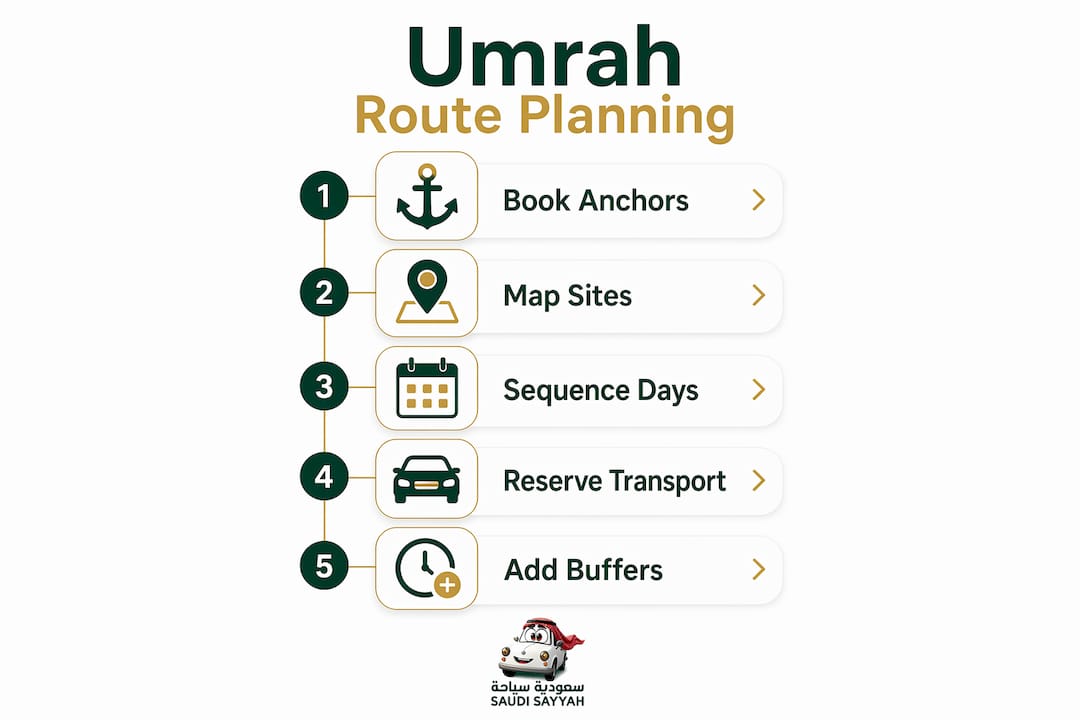
Map all sites geographically. List every location you plan to visit, then plot them on a map. Group sites within Makkah together and sites within Madinah together. Do not plan a day that requires crossing between the two cities unless it is a dedicated travel day.
-
Decide your city order. Most pilgrims complete Madinah first, then travel to Makkah for the Umrah rituals. This sequence aligns with the spiritual progression and keeps logistics clean. Confirm this order matches your flight arrival city.
-
Apply the open-jaw flight strategy where possible. Linear routes paired with open-jaw flights minimize transit overhead. If you fly into Madinah and out of Jeddah, you avoid retracing the same ground at the end of your trip. Check this option when booking.
-
Apply the one anchor per day rule. Limiting major activities to one or two per day prevents exhaustion and allows pilgrims to absorb the spiritual significance of each site. Umrah is not a sightseeing sprint. Pacing matters.
-
Build in buffer time at every transfer point. Total door-to-door transit time is often 2–3 times the advertised travel duration when you include airport transfers, security, and waiting. Account for this in every leg of the route.
-
Assign transport for each leg in advance. Book ground transport before you arrive. Saudisayyah provides pre-trip driver photos, vehicle details, and real-time tracking, removing uncertainty from every transfer.
-
Review the full itinerary for backtracking. Read through the route from day one to the last day. Any day that requires returning to a location you already visited is a candidate for restructuring.
Pro Tip: Invest 3–5 hours in itinerary planning before you travel. Research shows this upfront effort saves over 10 hours of wasted time during the actual trip.
For group pilgrims, the sequencing logic applies at a larger scale. Read more about group transport planning to adapt these steps for families or organized groups.
How do AI tools and human judgment work together in route planning?
65% of travelers use AI tools for travel inspiration, but only 38% trust them for final booking decisions. That gap exists for a good reason. AI itinerary generators produce fast first drafts, but they miss real-world friction like fatigue, prayer schedules, and the emotional weight of sacred sites.
The right approach treats AI as a starting point, not a finished plan. Use an AI tool to generate a rough sequence of sites and travel days, then apply human judgment to adjust for the following:
- Prayer time windows. The five daily prayers shape every pilgrim's schedule. Build the itinerary around Fajr, Dhuhr, Asr, Maghrib, and Isha rather than treating them as interruptions.
- Physical fatigue. Tawaf and Sa'i involve sustained physical effort. Schedule lighter activities or rest on days following major rituals.
- Transfer realities. AI tools miss transit overhead, such as the time needed to reach King Abdulaziz International Airport from central Makkah during peak hours.
- Crowd patterns. The Masjid al-Haram is significantly more crowded after Isha prayer and on Fridays. Adjust timing to visit during lower-traffic windows when possible.
Pro Tip: After generating an AI itinerary, add 30 minutes of buffer time to every transfer and cut the number of daily activities by one. The result will be far more realistic for pilgrimage conditions.
The role of automation in travel planning is growing, but the pilgrim's own judgment remains the most reliable filter for what works on the ground.
What are the most common challenges in Umrah route planning?
Peak-season scarcity is the most disruptive challenge pilgrims face. During Ramadan, transport options book out weeks in advance, and prices for ground transfers can increase significantly. The solution is early booking, not last-minute flexibility.
The five most common planning mistakes, and how to fix them:
- Booking itinerary before flights. Fix: lock flights and accommodation first, then build the day-by-day plan around those anchors.
- Underestimating transfer time. Fix: calculate door-to-door time for every leg, not just the advertised travel duration.
- Over-scheduling each day. Fix: apply the one anchor per day rule and treat rest as a planned activity, not a luxury.
- Ignoring site access restrictions. Fix: check the Saudi Ministry of Hajj and Umrah website for current entry requirements and permitted visiting hours before finalizing the route.
- No contingency plan. Fix: identify one backup transport option and one flexible accommodation night for each major city in case of delays.
Unexpected delays are inevitable. Flights are delayed, roads are congested during peak prayer times, and health issues arise. The pilgrims who handle disruptions best are those who built slack into the schedule from the start.
Efficient route planning for Umrah is not about fitting in more sites. It is about protecting the time and energy needed to be fully present at each one. A tight schedule that breaks down under pressure costs far more than a relaxed schedule that holds.
Real-world examples of how pilgrims have adapted routes under pressure are documented in Saudisayyah's Umrah travel case studies, which cover practical pivots from transport disruptions to last-minute accommodation changes.
Key Takeaways
Efficient Umrah route planning requires locking anchor bookings first, sequencing sites geographically, applying the one anchor per day rule, and using AI tools only as a first draft adjusted by human judgment.
| Point | Details |
|---|---|
| Book anchors first | Lock flights and accommodation before building any day-by-day itinerary. |
| Sequence geographically | Group Makkah and Madinah sites separately to eliminate backtracking. |
| Apply the one anchor rule | Limit major activities to one or two per day to prevent exhaustion. |
| Adjust AI drafts manually | Add buffer time and account for prayer schedules that AI tools ignore. |
| Plan for disruptions | Build at least one flexible day and one backup transport option into every trip. |
Why route efficiency changes the entire Umrah experience
Pilgrims who plan their routes well arrive at each site with energy and focus. Those who over-schedule arrive exhausted and distracted. I have seen this pattern repeat consistently, and it has nothing to do with fitness level or age. It comes down entirely to how the itinerary was built.
The most common mistake I observe is treating Umrah like a checklist. Pilgrims pack in as many sites as possible each day, then spend the final days of the trip too tired to engage meaningfully with any of them. The one anchor per day rule sounds conservative until you experience what it actually feels like to arrive at the Masjid al-Nabawi without rushing.
Technology has genuinely improved route planning. The Haramain High Speed Railway between Makkah and Madinah, combined with geolocation-enabled transport platforms like Saudisayyah, removes a lot of the uncertainty that used to make Umrah logistics stressful. But technology does not replace the judgment call of knowing when to slow down.
My honest advice: build the itinerary you think you want, then remove one activity from every day. What remains will be the trip you actually remember.
— Fa
Saudisayyah transport for your Umrah route
Reliable ground transport is the part of Umrah planning that most pilgrims underestimate until something goes wrong.
Saudisayyah's vehicle hire services are built for pilgrims traveling between Makkah, Madinah, and Jeddah. Every booking includes driver photos, vehicle details, and real-time tracking sent before the trip starts. The fleet options cover solo travelers, families, and groups, with late-model vehicles and experienced drivers who know the routes. Booking early during Ramadan and peak Umrah seasons secures both availability and better rates. For pilgrims who want to plan their customized tour itinerary with full transport flexibility, Saudisayyah's platform handles the logistics so the focus stays on the pilgrimage itself.
FAQ
What is the most efficient route order for Umrah?
Most pilgrims visit Madinah first, then travel to Makkah for the core Umrah rituals, then depart from Jeddah. This linear sequence avoids backtracking and aligns with the spiritual progression of the pilgrimage.
How far in advance should Umrah transport be booked?
Book ground transport 3–4 months ahead for peak seasons like Ramadan, and at least 6–8 weeks ahead for standard periods to secure availability and competitive rates.
Can AI tools plan a complete Umrah itinerary?
AI tools are useful for generating a first draft, but only 38% of travelers trust them for final booking decisions. Manual adjustments for prayer times, fatigue, and real-world transfer times are required before the plan is usable.
What is the one anchor per day rule?
The one anchor per day rule limits major activities or site visits to one or two per day. This prevents exhaustion and gives pilgrims the mental and physical capacity to be fully present at each location.
How do I handle transport delays during Umrah?
Build at least one flexible day into the itinerary and identify a backup transport option for each major city. Saudisayyah's real-time tracking and communication platform reduces delay risk by keeping pilgrims informed before every transfer.