

A customer care checklist for travelers, built for pilgrim and tourist transfers, runs on five fixed pillars: pre-trip confirmations, verified driver and vehicle details, real-time ticket-linked tracking, on-trip support with clear escalation, and post-trip follow-up. Embedding passenger communication into dispatch software lets controllers trigger proactive, ticket-linked contact for roughly 95% of on-day incidents. Live GPS sharing does the rest: it cuts inbound dispatch calls because passengers can see their own ETA instead of calling to ask. Saudisayyah builds its own transfer operations around this exact structure, pairing driver photos and geolocation with constant outbound updates.
Here's the checklist in one pass:
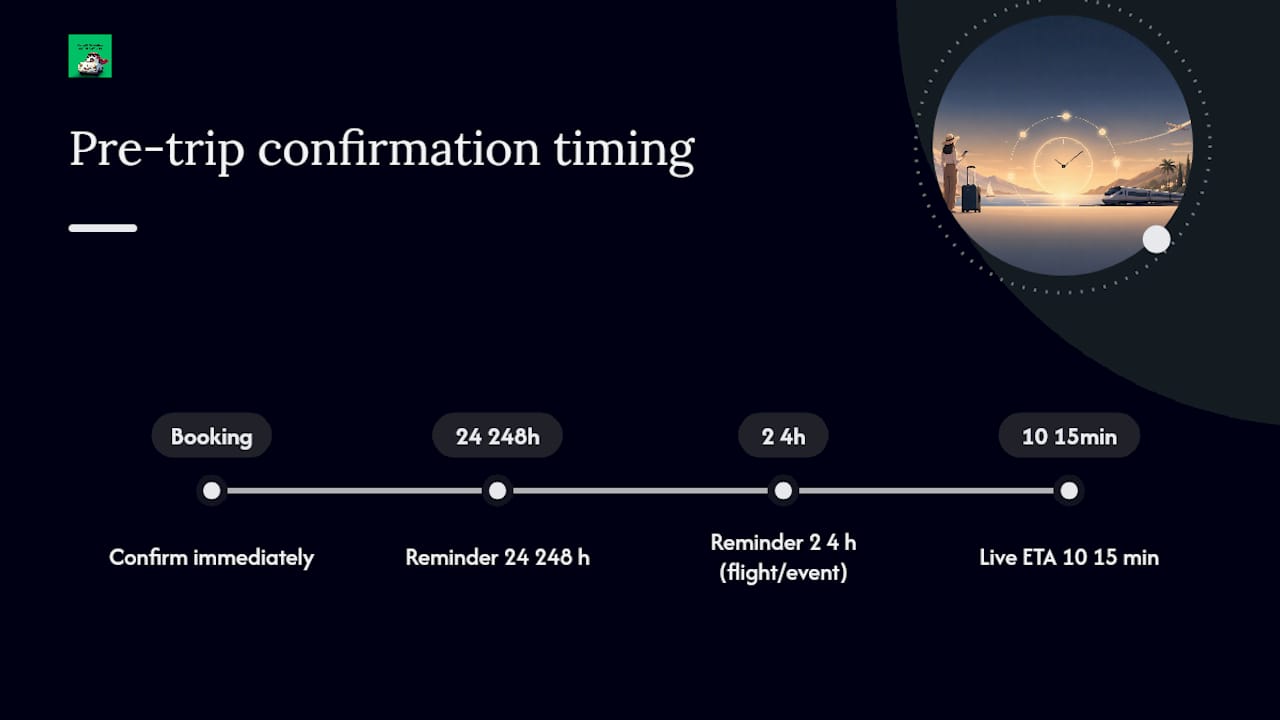
- Send booking confirmation immediately, with a 24 to 48 hour reminder and a 2 to 4 hour pre-arrival note
- Verify driver ID, vehicle condition, and passenger preferences before dispatch
- Push a live ETA and driver photo 10 minutes before arrival
- Staff on-trip support with a defined incident escalation path and response windows
- Collect feedback within 24 hours of drop-off and log any lost items same-day
Quick stat: Providers who wire passenger messaging into dispatch resolve or acknowledge close to 95% of on-day incidents through proactive contact, rather than waiting for the traveler to call in first.
Pro Tip: Fix the timing before you fix the wording. A perfect message sent at the wrong hour still reads as poor service to a jet-lagged pilgrim.
Table of Contents
- Pre-Trip Confirmations: What to Send and When
- Driver and Vehicle Verification Before Every Pickup
- Real-Time Tracking and Proactive Ticket-Linked Alerts
- On-Trip Support and How to Handle Incidents
- Post-Trip Follow-Up, Feedback, and Lost and Found
- Building SOPs and Training Drivers to Follow Them
- Technology, Integrations, and Passenger Data Handling
- The Copyable Checklist to Paste Into Your SOP
- Aligning Transfers With Pilgrimage and Event Peaks
- Health and Safety Protocols for Transfers
- Emergency Contacts and Escalation During High-Density Periods
- How Long Each Stage of a Transfer Actually Takes
- What Actually Moves the Needle on This Checklist
- Frequently Asked Questions
- Sources
Pre-Trip Confirmations: What to Send and When
Every booking needs a confirmation message the moment payment clears. That message should include the booking ID, passenger name, pickup time, exact meeting point (a landmark plus a map link or gate number), vehicle description, driver photo, driver ID number, and a 24/7 support line. Vague meeting instructions are the single biggest cause of airport pickup confusion, especially for first-time visitors unfamiliar with terminal layouts.
After that, cadence matters more than content. Four touchpoints cover nearly every trip type:
- Booking confirmation: full trip details, sent instantly
- 24 to 48 hour reminder: pickup notes, document reminders, contact number
- 2 to 4 hour reminder: flight or event tie-in, weather or traffic notes if relevant
- 10 to 15 minute ETA share: live driver location and photo
Keep the tone short and neutral. Mirror the passenger's formality rather than adding idioms or slang that don't translate cleanly for non-native English speakers.
| Send window | Trigger | Core content |
|---|---|---|
| At booking | Payment confirmed | Booking ID, driver name placeholder, support line |
| 24 to 48 hours before | Fixed schedule | Pickup notes, document reminders |
| 2 to 4 hours before | Flight/event linked | Live status check, contact number |
| 10 to 15 minutes before | GPS proximity trigger | Driver photo, plate number, live ETA link |
Pro Tip: Route anything beyond a simple status question to a live agent immediately. Automated replies that loop a confused traveler waste more goodwill than they save in labor.
Driver and Vehicle Verification Before Every Pickup
Passengers need four things before they'll recognize their ride: driver name and photo, vehicle make, model, and color, the license plate, and any relevant amenities like child seats, wheelchair access, or charging ports. A pre-departure checklist signed off by the driver before every trip prevents most comfort and equipment complaints before they start.
Dispatch runs its own parallel check. This is internal, not passenger-facing, but it's what makes the passenger-facing details trustworthy:
- Match driver ID against the assigned trip in the booking system
- Run the vehicle readiness checklist: fuel, cleanliness, AC, working meter or app device
- Confirm passenger preferences and accessibility needs are visible on the driver's device
- Timestamp the sign-off before the driver departs for pickup
A short driver introduction script keeps first contact calm and clear: "Good [morning/afternoon], I'm [name], your driver to [destination]. Please confirm your name so I can start the trip." That single line does three jobs at once: confirms identity, sets destination, and opens the door for the passenger to flag a special need.
Standardized frameworks like the RIDE model give drivers a consistent script for pick-up, in-ride behavior, and drop-off, which cuts down on the inconsistency that generates most chauffeur complaints.
Push the confirmed driver name, photo, and plate into the passenger notification the moment dispatch signs off, not before.
Real-Time Tracking and Proactive Ticket-Linked Alerts
Embedding passenger messaging directly into dispatch software is what makes proactive contact possible at scale. When comms and operations share one system, close to 95% of on-day incidents generate an automatic, ticket-linked outreach instead of a reactive one. That's the difference between telling a passenger about a delay and getting a call from a passenger asking where the car is.
Live GPS sharing does the heavy lifting on the passenger side. When travelers can see the vehicle moving toward them in real time, inbound "where are you" calls drop sharply, freeing dispatchers for actual problems. Live driver location is especially valuable for pilgrim groups navigating unfamiliar streets near crowded sites.
Set automation rules in advance:
- Delay past 10 minutes triggers an automatic SMS or WhatsApp update with a revised ETA
- Missed pickup window opens an urgent ticket automatically, no manual entry required
- Group transfers, VIP bookings, or any trip flagged with a special need routes straight to a live agent, skipping automated replies entirely
SLA targets to hold your team to: acknowledge within 5 minutes, send a substantive update within 15 minutes, and escalate to a manager if the issue is unresolved after 30 to 60 minutes.
Pro Tip: Automated ETA revisions should recalculate off live GPS position, not off the original schedule. A stale ETA erodes trust faster than no ETA at all.
On-Trip Support and How to Handle Incidents
Drivers handling international passengers should default to neutral, professional mirroring: match the traveler's tone, keep language plain, and skip idioms that don't translate. A quiet passenger gets a quiet ride; a chatty one gets brief, friendly responses. Neither gets slang or regional expressions that add confusion.
Keep driver scripts short. A greeting: "Welcome, we're heading to [destination], estimated [X] minutes." A simple FAQ response: "Yes, there's water in the side pocket, please help yourself." Nothing elaborate, just clear.
When something goes wrong, the flow needs four steps with owners attached:
- Acknowledge immediately, driver or dispatcher, within minutes of the issue surfacing
- Remedy on the spot where possible, driver's call within defined limits
- Log and escalate to the dispatcher or manager if the issue exceeds the driver's authority
- Follow up with the customer on a stated timeline, dispatcher or manager owns this
Documented protocols matter here: transparent workflows that acknowledge within minutes and resolve within a day where possible build trust even when something breaks.
Match the recovery gesture to severity. A short delay might warrant a sincere apology and a small credit. A missed flight connection warrants a manager call, a documented remedy plan, and a compensation offer that preserves the passenger's dignity rather than a scripted discount.
- Open a proactive outbound contact the moment a delay is detected, don't wait for the passenger to notice
- Route anything involving safety, a missed connection, or a distressed passenger straight to a controller, bypassing the standard queue
Pro Tip: Train drivers to say "let me get my dispatcher" rather than guessing on compensation. A confident escalation reads better than an improvised promise the company can't keep.
Post-Trip Follow-Up, Feedback, and Lost and Found
Send a short feedback request within 24 hours of drop-off, by SMS, WhatsApp, or email. Keep it to one question: "How was your ride today? Reply 1 to 5." Anything below a 4 should trigger an automatic flag for a human callback within 24 hours, not another automated message.
Lost and found needs its own quick workflow:
- Log the item immediately with trip ID, driver name, and a photo
- Store it in a designated, access-controlled location
- Notify the passenger the same day with retrieval instructions or a shipping option
- Set a disposal date (commonly 30 days) and communicate it upfront
Link every post-trip ticket back to the driver's record. Repeated complaints against one driver should trigger retraining automatically rather than sitting in a spreadsheet nobody reviews.
- Feedback request: sent within 24 hours, one question, easy reply format
- Negative response: escalated to a human within 24 hours, resolution timeline stated upfront
- Lost item: logged same-day, passenger notified same-day
Building SOPs and Training Drivers to Follow Them
A checklist only works if drivers actually run it. That means onboarding covers etiquette and safety checks, followed by ride-alongs, periodic refreshers, and role-play sessions specifically for incident recovery and language briefings. New drivers should practice the introduction script and a delay-notification script before their first solo pickup, not after.
Track a handful of KPIs consistently rather than a long dashboard nobody reads:
| KPI | What it tells you |
|---|---|
| On-time pickup rate | Whether dispatch timing and traffic buffers are realistic |
| Incident tickets per trip | Where recurring failure points sit in the process |
| Feedback-response SLA adherence | Whether the 24-hour follow-up promise is being kept |
| Vehicle readiness pass rate | Whether pre-trip checks are catching problems before dispatch |
Document SOPs as single-sheet references, not manuals. A driver should be able to glance at a laminated card before a shift and see the full pre-trip, on-trip, and post-trip flow in one look.
Saudisayyah's own platform reflects this structure directly: experienced drivers, a modern fleet, and a geolocation-enabled system that pushes driver photos and vehicle details to passengers before every trip, which is the proof-point version of the SOP described above.
Pro Tip: Refresh training quarterly, not annually. Pilgrim season volume shifts fast enough that a driver trained in January may need a refresher by summer.
Technology, Integrations, and Passenger Data Handling
The checklist above only runs on time if five systems talk to each other: dispatch, ticketing, GPS, the booking engine, and an SMS/WhatsApp gateway feeding a shared CRM. When a passenger message becomes a ticketed event inside dispatch automatically, nothing gets lost between the office and the driver's phone.
Track these metrics to know if the integration is actually working:
- Live ETA accuracy against actual arrival time
- Reduction in inbound dispatch calls month over month
- Proactive contact rate (the share of incidents triggering outbound messages before the passenger complains)
- Maintenance alert compliance, since emergency repairs run several times the cost of scheduled maintenance
- Passenger satisfaction score from post-trip feedback
On privacy: only share the driver and vehicle details a passenger actually needs for that specific trip, nothing more. State plainly in pre-trip messages that data is used solely for trip coordination. Assign one owner per integration, someone who monitors alerts daily rather than reviewing logs weekly, since a missed GPS outage during a pickup window is the kind of failure that shows up as a bad review fast.
| Integration | Owner | Alert monitored |
|---|---|---|
| Dispatch + ticketing | Operations manager | Unresolved tickets past SLA |
| GPS + booking engine | Dispatch supervisor | Vehicle offline or delayed |
| SMS/WhatsApp gateway | Customer care lead | Message delivery failures |
The Copyable Checklist to Paste Into Your SOP
Paste this directly into a dispatch or driver briefing document:
- At booking (Reservation): Send confirmation with booking ID, meeting point, driver photo placeholder, support number
- 48 to 24 hours before (Reservation): Send reminder with pickup notes and document checklist
- 4 to 2 hours before (Dispatcher): Confirm flight/event status, verify driver assignment
- 10 to 15 minutes before (Dispatcher/Driver): Push live ETA, driver photo, plate number via SMS template: "Your driver [name] is 10 minutes away, plate [XXX-XXX]"
- On arrival (Driver): Use greeting script, confirm passenger name and destination
- During trip (Driver): Neutral mirroring, escalate any request beyond driver authority
- Post-trip, within 24 hours (Manager/Reservation): Send feedback SMS, log any lost items same-day
Emergency quick-reference: any safety issue routes straight to the shift manager's direct line, not the general support number. State the trip ID and location first, then the issue. Escalate to management if unresolved past 15 minutes given the density of pilgrimage-season traffic and crowd conditions.
| Stage | Timing | Owner |
|---|---|---|
| Confirmation | Immediate | Reservation |
| Reminder | 48 to 24h before | Reservation |
| Pre-arrival check | 4 to 2h before | Dispatcher |
| ETA share | 10 to 15 min before | Dispatcher |
| Feedback request | Within 24h after | Manager |
Aligning Transfers With Pilgrimage and Event Peaks
Pilgrim transfer demand doesn't spread evenly across a year, or even across a week. It spikes hard around specific religious calendar dates and major site access windows, then flattens out between them. A checklist built only for average daily volume breaks exactly when it matters most.
Build a buffer system tied to known peak windows rather than reacting to congestion after it starts. That means pulling schedules for major gathering points and site access times in advance, then padding pickup windows by an extra 15 to 30 minutes during those stretches. Predictive scheduling works because it treats known peak dates as a planning input, not a surprise.
Dispatch should flag any trip booked within a known peak window automatically, triggering a longer pre-arrival buffer and an earlier reminder cadence. A 2 to 4 hour reminder might need to become a 4 to 6 hour reminder when roads near major sites are expected to be congested.
Coordinate driver shift scheduling around these same windows too. Peak periods need more drivers on standby, not just longer buffers, since a single missed pickup during a high-density window can cascade into several delayed trips behind it. Track which specific dates and windows caused the most delays last cycle and build that data into next season's staffing plan, rather than starting from scratch every time.
Health and Safety Protocols for Transfers
Pilgrim and tourist groups bring specific health and safety needs that a standard taxi checklist doesn't cover. Heat exposure is the most common one: passengers moving between air-conditioned vehicles and crowded outdoor sites need vehicles that are pre-cooled before pickup, not cooled after boarding.

Vehicle-side protocols should include a working first-aid kit checked on a fixed schedule, clearly marked emergency exits, and a driver briefing on basic heat-exhaustion signs, since older pilgrims and those fasting or fatigued from travel are more vulnerable. Preventative maintenance ties directly into this: a strict vehicle check schedule catches mechanical issues before they become on-road emergencies, which matters more during high-volume pilgrimage periods when replacement vehicles are harder to source quickly.
Group transfers need a headcount protocol at both pickup and drop-off, confirmed against the booking manifest, since a missed passenger in a large group is far easier to overlook than in a single-passenger transfer. Wheelchair access and mobility support should be confirmed at booking, not discovered at the vehicle door.
Build a simple pre-trip safety line into the driver's checklist: confirm working seatbelts for every seat, confirm AC function before departure, and confirm the first-aid kit is stocked and accessible. None of this needs to be complicated, but it does need to be consistent across every driver and every shift, especially when volume is high and shortcuts become tempting.
Emergency Contacts and Escalation During High-Density Periods
A generic support number isn't enough when hundreds of thousands of pilgrims move through the same corridors at once. Escalation protocols need a dedicated emergency line, separate from routine customer service, that routes directly to a shift manager or safety officer without going through a general queue.
Every driver should carry three numbers memorized or saved as favorites: dispatch, the emergency line, and local emergency services. The escalation script stays simple: state the trip ID, exact location, and nature of the issue in that order, so the person answering can act without asking follow-up questions first.
Set time-to-escalate thresholds by severity. A medical concern escalates immediately, no delay. A vehicle breakdown escalates within 5 minutes if a passenger is stranded. A lost passenger in a crowd escalates within 2 minutes given how quickly separation can become dangerous in dense pilgrimage crowds.
During peak pilgrimage windows, staff the emergency line with extra controllers rather than relying on the standard shift roster, since call volume during incidents tends to spike well above normal patterns. Document a clear handoff protocol too: if a controller can't resolve an issue within the threshold, it moves to a manager automatically, not on request. That single rule removes the hesitation that turns a small delay into a much longer one.
How Long Each Stage of a Transfer Actually Takes
Setting passenger expectations means giving them real numbers, not vague reassurance. Airport pickups typically run 10 to 20 minutes from flight landing to vehicle departure, accounting for baggage claim and the walk to the pickup zone. During peak arrival hours, that window can stretch to 30 minutes if the meeting point is far from the terminal exit.
Point-to-point transfers within a city generally run 15 to 45 minutes depending on distance and traffic, while transfers to or from major pilgrimage sites during peak periods can run considerably longer due to controlled traffic zones and pedestrian volume near entry points. Intercity journeys vary widely by distance, so those need trip-specific estimates rather than a blanket figure.
The 10 to 15 minute ETA share should reflect real-time GPS position, not a static estimate set at booking. If traffic conditions change that number, the passenger needs to see the update, not discover the delay by watching the clock.
Here's a rough breakdown operators can adapt:
- Booking to confirmation: Immediate, automated
- Pre-trip reminder to pickup: 24 to 48 hours before, then 2 to 4 hours before
- Driver dispatch to arrival: 10 to 15 minutes, live-tracked
- Pickup to destination: Varies by trip type, communicated at booking with a range, not a single number
- Drop-off to feedback request: Within 24 hours
Setting these ranges upfront, rather than a single overly precise number, protects trust when real-world traffic or crowd density pushes a trip slightly past its estimate.
What Actually Moves the Needle on This Checklist
Most customer care advice for travel operators treats communication as a courtesy layer bolted onto operations. That's backward. The checklist only works when passenger messaging lives inside the dispatch system itself, not next to it.
The overrated piece of conventional advice is the scripted apology. Recovery gestures matter far less than speed and clarity. A passenger delayed 20 minutes who gets an honest, timestamped update within 5 minutes generally forgives the delay. The same passenger, kept guessing for 20 minutes and then handed a polished apology, remembers the silence, not the script.
Prioritize the boring infrastructure first: GPS integration, ticket linking, and a maintenance schedule that prevents breakdowns before they happen. Training and tone matter, but they can't compensate for a system that doesn't notify anyone until the passenger calls first.
Frequently Asked Questions
What should be in a customer care checklist for travelers using a transportation provider?
The core items are pre-trip confirmations with driver and vehicle details, real-time GPS tracking with proactive updates, a defined on-trip incident escalation flow, and post-trip feedback collection within 24 hours. Each item needs a fixed timing window, not just a general policy.
How early should a travel provider send pre-trip confirmations?
Send the initial confirmation immediately at booking, a reminder 24 to 48 hours before pickup, another 2 to 4 hours before for flight or event-linked trips, and a live ETA share 10 to 15 minutes before arrival.
Why does real-time tracking reduce customer service workload?
When passengers can see the vehicle's live location, they stop calling to ask where the driver is. GPS-based tracking shifts that information from a phone call to a passive glance at a screen, freeing dispatchers for genuine issues.
How should drivers handle international or first-time pilgrim passengers?
Match the passenger's tone and keep language plain, avoiding idioms or slang that don't translate cleanly. Confirm destination and any special needs at the start of the ride using a short, neutral script.
What's the fastest way to recover from a missed pickup or delay?
Acknowledge the issue within minutes, send a revised ETA immediately, and escalate to a live agent if the delay affects a flight or event connection. Speed of acknowledgment matters more to most travelers than the size of any compensation offered afterward.
Sources
- Connecting passenger communication to live operations
- 8 Keys to excellence in customer service (Samsara / Windy City example)
- Elevating customer care in tourist transport operations • The Tourism Institute
- My