Predictive scheduling, in passenger transport, uses historical trip data and live signals like flight status, traffic, and weather to forecast when a passenger will be ready at the curb, then dispatches the driver at exactly the right moment. The result: fewer missed pickups, less idle waiting, and more reliable arrivals. Research on large-scale dispatch systems shows average passenger waiting times drop significantly, with reductions reaching over half in high-demand zones during peak periods.
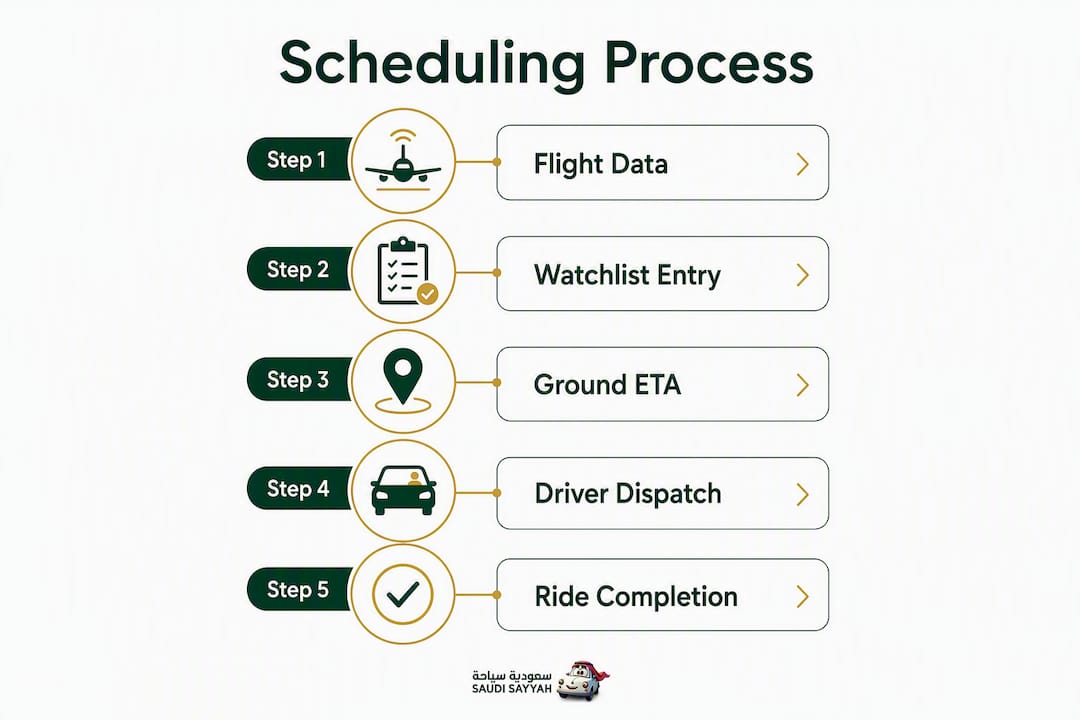
From booking to curb, the sequence is straightforward:
- Booking enters a monitored watchlist tied to your flight number
- Live flight milestones (touchdown, taxi-in, on-blocks) trigger a Ground ETA calculation
- Driver dispatch fires automatically when the Ground ETA window opens
- You receive a notification with driver photo, vehicle details, and a live tracking link
Pro Tip: Check your booking confirmation for a live tracking link and a named Ground ETA. If neither appears, ask the provider before your travel date.
Table of Contents
- How does predictive scheduling work from booking to curb?
- What are the real benefits for pilgrims and international travelers?
- What should you expect when booking a transfer or tour?
- Why human oversight still matters in automated transport
- Limitations and red flags to watch for
- How to choose a reliable provider for pilgrimage transfers
- Key Takeaways
- The Saudisayyah perspective on predictive scheduling for pilgrims
How does predictive scheduling work from booking to curb?
The system connects several layers: a booking engine, a historical data store, external live feeds, a forecasting model, a dispatch engine, and a driver app. Each layer hands off to the next.

When a booking is created, it enters a watchlist. The system monitors your flight through a live flight data API, capturing touchdown, taxi-in, and on-blocks status in real time. Those milestones feed a Ground ETA model that estimates when you will actually reach the curb, accounting for baggage wait and terminal walk time. Static pickup times ignore all of this. Ground ETA does not.
Once the Ground ETA window opens, the dispatch engine selects the best driver. That selection goes beyond proximity. Auto-dispatch platforms factor in driver acceptance likelihood, past punctuality, job-type preferences, and fallback pool availability. If the preferred driver cannot accept, a pre-vetted fallback driver is assigned automatically, with no manual delay.
For a guided Ziarah tour, the same logic applies across multiple stops. The system calculates travel time between sites, buffers for group assembly, and flags conflicts before they cascade.
What the system cannot predict: extreme weather disruptions, sudden gate closures, or a passenger who does not follow the pickup instructions. Those cases require human intervention, covered in a later section.
Pro Tip: For group pilgrimage transfers, ask your provider whether the dispatch engine handles multi-flight arrivals or whether a human coordinator manages them manually.
What are the real benefits for pilgrims and international travelers?
The measurable headline: integrating predictive demand forecasting with automated dispatch cuts average waiting times by roughly 30%, with peak-zone improvements near 55%. A separate two-stage prediction and scheduling study reported approximately 45% reductions in average waiting time alongside an 18% increase in overall system welfare.
For pilgrims, those numbers translate into practical differences:
- Drivers arrive when you reach the curb, not 20 minutes before or after
- Curb congestion drops because vehicles are not queuing while passengers are still in customs
- Group pickups stay coordinated across multiple arrival gates
- Cascading delays at one stop do not automatically wreck the next leg of a Ziarah itinerary
- Driver idle time is recovered and redirected to serve more passengers per shift
The traveler-facing signals that confirm a provider is actually running this system: proactive SMS or app notifications before dispatch, a live tracking link that updates in real time, a named driver with photo and vehicle plate, and a dynamic ETA that adjusts if your flight lands early or late.
Pro Tip: When you receive your dispatch notification, note the stated arrival window. If the driver has not appeared within that window, contact support immediately rather than waiting at the wrong exit.
What should you expect when booking a transfer or tour?
A provider running genuine demand forecasting will deliver specific, verifiable service behaviors. Before paying, confirm the following:
- Live flight-tracking integration. The provider polls your flight number in real time, not just the scheduled arrival time.
- Ground ETA or curb ETA policy. Ask for the buffer they apply between on-blocks and driver arrival at the curb.
- Real-time notifications. You receive an SMS or app alert when the driver is dispatched, and again when the driver is nearby.
- Driver photo and vehicle details. Sent before the driver departs, not on arrival.
- Fallback driver pool. Confirmed in writing: if your assigned driver has a conflict, a vetted replacement is assigned automatically.
- Clear SLA for wait time. A stated maximum wait window and a defined escalation path if it is exceeded.
- Group handling procedure. For multi-passenger or multi-flight arrivals, a documented coordination process.
Beyond the checklist, your booking confirmation should include a precise pickup point (terminal, exit number, or meeting zone), a direct driver contact number, and an expected arrival range rather than a single fixed time.
For pilgrims with mobility requirements, confirm in advance that the vehicle accommodates wheelchairs or walking aids and that the driver is briefed.
Pro Tip: If you are combining a Ziarah tour with an airport transfer on the same day, ask the provider to confirm fallback coverage for both legs in one written response. A provider that cannot answer this clearly has not planned for it.
Why human oversight still matters in automated transport
Automation handles the optimization. Humans handle everything else.
Operational case studies in travel services consistently recommend keeping staff in the loop for customer-facing decisions, even with heavy automation. Algorithms reassign drivers and recalculate ETAs efficiently. They do not call a distressed first-time pilgrim to explain a terminal change or coordinate a VIP group with three connecting flights.
The typical division of labor looks like this:
- Algorithm: demand forecasting, driver selection, fallback reassignment, ETA recalculation
- Human dispatcher: exception handling, direct passenger communication, gate or terminal rerouting, safety judgment calls
After predictive allocation is introduced, manual interventions drop significantly, but they do not disappear. Some cases, particularly complex multi-stop tours or large pilgrimage groups, still require a coordinator to make judgment calls the system is not built to handle.
Scheduling engines validate over 160 constraints during real-time edits, covering driver hours, rest requirements, and vehicle qualifications. Even so, a dispatcher reviews flagged exceptions before they affect passengers.
Pro Tip: Ask any provider about after-hours escalation. For large pilgrimage groups, you need a direct line to a human coordinator, not just an automated chatbot, if something goes wrong at 2 AM.
Limitations and red flags to watch for
Predictive systems are only as good as their data. Common failure points:
- Missing or delayed flight API feeds produce Ground ETA errors that send drivers too early or too late
- Thin historical data in low-volume corridors reduces forecast accuracy
- No integration with local event calendars or weather feeds leaves the system blind to surges
- Low driver coverage in remote zones means fallback pools are too small to be useful
On privacy: providers typically use your flight number, phone number, and real-time location to run the system. Ask whether location data is retained after trip completion and whether it is shared with third parties.
Red flags to avoid when booking:
- A provider that promises zero wait times under any conditions
- No live tracking link or driver photo in the booking confirmation
- No stated fallback plan for driver conflicts
- No clear SLA or wait-time policy for group pickups
- No after-hours support contact for international arrivals
One realistic note: at severely congested airports or during extreme weather, even well-designed predictive systems experience delays. Any provider claiming otherwise is overpromising.
How to choose a reliable provider for pilgrimage transfers
Work through this checklist before confirming any booking:
- Confirm the provider polls live flight data, not just scheduled times.
- Ask for the Ground ETA buffer policy for international arrivals.
- Request a sample notification timeline showing when alerts fire relative to landing.
- Verify fallback driver pools exist and are documented.
- Confirm real-time tracking and driver photo are sent before dispatch.
- Check SLAs: maximum wait window, reassignment trigger, escalation path.
- Ask how multi-flight group arrivals are coordinated.
- Confirm after-hours human support is available.
Exact questions to copy and send to any provider:
- "Do you poll live flight data for my flight number?"
- "What is your Ground ETA buffer for international arrivals?"
- "How do you handle a driver conflict 30 minutes before my landing?"
- "What is the maximum wait time in your SLA, and what happens if it is exceeded?"
- "How do you coordinate multi-flight group arrivals for pilgrimage groups?"
For airport pickups, choose curb-side pickup only if the provider sends a precise meeting-point code. For large groups or baggage-heavy arrivals, staged pickup inside the terminal is often more practical. Add at least 30 minutes of buffer for customs and baggage on international flights.
Pro Tip: Run a quick pre-arrival check 60–90 minutes before landing: confirm your booking is active, your driver is assigned, and a tracking link is live. If any of those three are missing, call support before you land.
Key Takeaways
Predictive scheduling for passenger transport cuts average waiting times by roughly 30% by using live flight data and forecasting to dispatch drivers at the right moment, not just the scheduled one.
| Point | Details |
|---|---|
| Wait-time reduction | Research shows average passenger waiting times drop by roughly 30%, with improvements up to 55% in high-demand zones. |
| What to ask providers | Confirm live flight tracking, Ground ETA policy, fallback driver pools, and a stated wait-time SLA before booking. |
| Top red flags | No live tracking link, no fallback plan, zero-wait guarantees, and no after-hours human support are all warning signs. |
| Human staff still matter | Automation handles dispatch and reallocation; human coordinators handle exceptions, communication, and complex group logistics. |
| Group pilgrimages need extra steps | Confirm multi-flight coordination procedures and fallback coverage for combined Ziarah and airport transfer days in writing. |
The Saudisayyah perspective on predictive scheduling for pilgrims
Most travelers do not think about what happens between booking confirmation and the moment a driver appears at the curb. That gap is where transfers fail or succeed.
At Saudisayyah, the platform monitors live flight feeds, calculates a Ground ETA for every airport pickup, and sends driver photos and vehicle details before dispatch. The fleet is tracked in real time through a geolocation-enabled system, and every booking confirmation includes a direct driver contact and a live tracking link.
What the algorithm does not replace: the coordinator who calls a pilgrim group when a terminal changes, or the dispatcher who manually reroutes three vehicles when a Ziarah site closes unexpectedly. Automation handles the routine. People handle the rest.
For pilgrims making this trip for the first time, that combination matters more than any single feature. Explore Saudisayyah's transfer and tour services to see how the booking system, fleet, and coordination work together.