

TL;DR:
- Accurate vehicle details are essential for safety, legal compliance, and insurance during Umrah travel.
- Proper vehicle inspection and documentation prevent breakdowns, delays, and legal issues in Saudi Arabia.
- Planning and verifying vehicle information ensures a seamless spiritual journey without logistical disruptions.
Traveling to Saudi Arabia for Umrah is a deeply meaningful experience, especially for first-time pilgrims from Western countries. But the physical journey itself carries real risks that are easy to underestimate. Saudi road fatality rates are among the highest in the world, particularly in pilgrimage regions like Makkah and Madinah. Vehicle details, meaning everything from maintenance records to documentation and mechanical condition, directly affect safety, legal compliance, and insurance coverage. Getting these details right before the trip is not optional. It is essential.
Table of Contents
- What vehicle details really mean for Umrah travelers
- Saudi road realities: Safety risks and how vehicle details help
- Legal requirements and documentation for vehicles in Saudi Arabia
- Practical tips for inspecting and choosing vehicles for Umrah
- What most guides miss about vehicle details for Umrah
- Ready for Umrah? Choose vehicles with confidence
- Frequently asked questions
Key Takeaways
| Point | Details |
|---|---|
| Vehicle details affect safety | Proper documentation and maintenance can make the difference between smooth travel and serious roadside incidents. |
| Saudi Arabia has unique risks | High road fatality rates and extreme weather require careful vehicle checks and compliance for Umrah travelers. |
| Documentation is non-negotiable | Missing or incorrect paperwork can cause fines, delays, or denied entry at checkpoints. |
| Inspection protects your trip | A thorough pre-trip vehicle check prevents breakdowns and insurance headaches for both private and rental cars. |
| Choose quality for peace of mind | Reliable vehicles and trusted local services reduce stress and ensure a safer, more spiritual journey. |
What vehicle details really mean for Umrah travelers
Most people think "vehicle details" means the make, model, and color of the car. For a trip to a Western grocery store, that might be enough. For Umrah in Saudi Arabia, the definition needs to be much wider.
Vehicle details, in the context of Umrah travel, cover four categories:
- Technical specifications: Engine size, fuel type, vehicle identification number (VIN), and year of manufacture
- Maintenance status: Recent service records, tire condition, battery health, brake performance, and fluid levels
- Documentation: Registration certificate, insurance policy covering Saudi Arabia, roadworthiness inspection results, and any clearance certificates required for border crossings
- Regulatory compliance: Whether the vehicle meets Saudi Arabia's standards for road use, including emission requirements and age restrictions for certain regions
Why does this matter beyond just getting from A to B? Because inaccurate vehicle details create problems that go far beyond inconvenience. Valuation errors in insurance can reach up to $15,000 when vehicle records are incomplete or incorrect. At checkpoints throughout the kingdom, officers verify documentation. A mismatch between your paperwork and the actual vehicle can lead to delays, fines, or being turned away entirely.
"Vehicle details are not just for ownership records. They are the foundation of your safety, legal standing, and financial protection while traveling in Saudi Arabia."
For first-time pilgrims, reviewing your Umrah safety guide before departure gives a strong baseline for understanding what the journey actually involves on the ground.
The practical step here is simple: before any Umrah trip involving a vehicle, compile a complete file. Include every document, every service record, and every technical specification. Do not assume the rental agency or travel agent has handled it. Verify it yourself.
Saudi road realities: Safety risks and how vehicle details help
Understanding what details matter is just the start. Here is how they directly affect safety given Saudi Arabia's unique travel environment.
Saudi Arabia's roads are statistically dangerous, particularly in the holy cities. In 2023, Makkah alone recorded 1,157 road deaths and 9,143 injuries. Madinah also reported high rates relative to its population. These are not abstract statistics. They represent real hazards that pilgrims encounter on roads shared with local drivers who have years of experience navigating local conditions.
Key risk factors on Saudi roads include:
- Extreme heat exceeding 45°C (113°F) in summer months, which accelerates tire wear, battery drain, and brake fluid degradation
- Long stretches of open desert highway with minimal shade or roadside assistance
- Dense urban traffic around the Grand Mosque in Makkah and the Prophet's Mosque in Madinah, especially during peak pilgrimage periods
- High-speed driving culture on intercity roads, where lane discipline differs significantly from Western norms
- Sand and dust on rural roads reducing visibility and affecting engine air filters
| Risk factor | Vehicle component affected | Recommended check |
|---|---|---|
| Extreme heat | Tires, battery, coolant | Monthly pressure check, 3-month battery test |
| Desert dust | Air filter, engine | Replace filter before trip |
| Long highway driving | Brakes, fluids | Full brake inspection pre-departure |
| Urban stop-start traffic | Transmission, cooling system | Fluid top-up and leak inspection |
| Sand on roads | Undercarriage, tires | Post-trip inspection for damage |
Proper vehicle checks before any long-distance trip in Saudi Arabia are not just good practice. They are a direct response to conditions that regularly cause mechanical failures in vehicles that were not prepared.
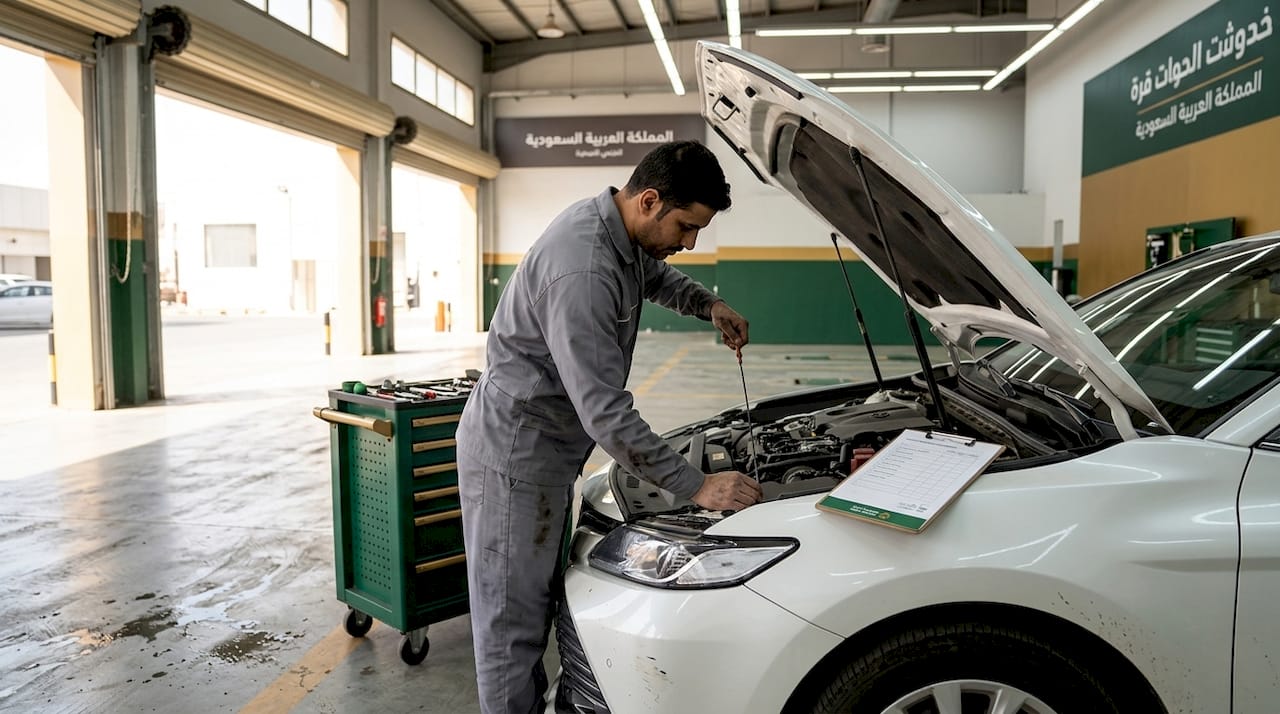
For the Saudi travel challenges that Western pilgrims specifically face, the environment is genuinely unfamiliar. Roads that look normal on a map can be grueling in practice during summer Umrah seasons.
Pro Tip: Check tire pressure when the tires are cold, before driving in the morning. Heat causes air to expand, which means a tire that reads correctly after driving might already be dangerously overinflated or masking an underlying pressure problem. Also check the battery terminals for corrosion before the trip. A failing battery in 45°C heat, far from a city, is a serious emergency.
Heat-related failures are the leading cause of roadside breakdowns in Saudi Arabia during summer months. A vehicle that passed a basic inspection in a temperate Western country may not be prepared for the conditions pilgrims encounter on the road between Jeddah and Makkah or along the highway to Madinah.
Legal requirements and documentation for vehicles in Saudi Arabia
Staying safe is only part of the equation. Ensuring paperwork is in order makes the trip smoother and avoids legal trouble at checkpoints or border crossings.
Vehicles entering or operating in Saudi Arabia for Umrah require a specific set of documents, whether privately owned or rented. Missing even one item can result in being held at a checkpoint, denied entry, or fined.
Required documents for Umrah vehicle travel:
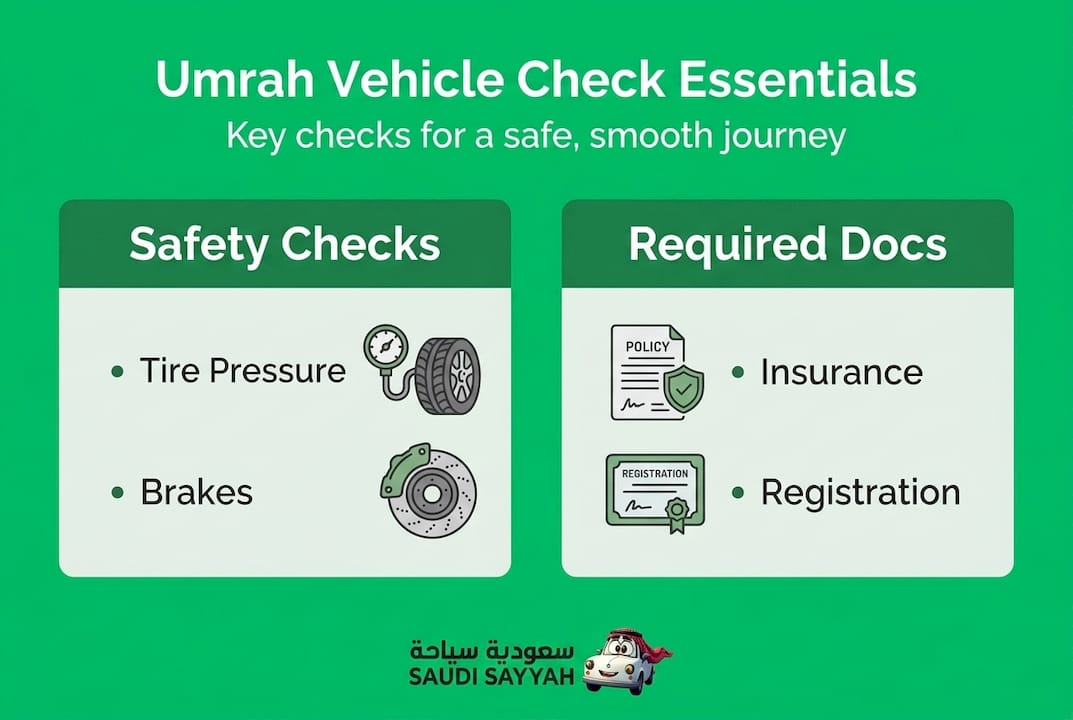
- Valid vehicle registration certificate (matching the vehicle's VIN exactly)
- Insurance policy with explicit coverage in the Kingdom of Saudi Arabia
- Roadworthiness certificate or mechanical inspection results from an approved center
- Clearance certificate (if driving from another country, such as the UAE)
- Driver's license valid in Saudi Arabia (plus International Driving Permit for Western nationals)
- Visa documentation for Umrah, carried alongside vehicle papers for checkpoint verification
| Document | Private vehicle | Rental vehicle |
|---|---|---|
| Registration certificate | Required (owner's name) | Provided by rental agency |
| Saudi Arabia insurance | Must arrange separately if policy doesn't cover KSA | Included or add-on from agency |
| IDP (International Driving Permit) | Strongly recommended | Strongly recommended |
| Clearance certificate | Required for cross-border entry | Required if renting abroad and crossing |
| Mechanical check record | Recommended, not always mandatory | Rental agency responsibility |
| Rental agreement copy | Not applicable | Required at all times in vehicle |
Pro Tip: Keep both digital and physical copies of every document. Take photos of every document page before you travel and store them in a cloud folder you can access offline. At Saudi checkpoints, officers may ask for originals. If a physical document is lost or damaged, having a digital backup helps with consular assistance and insurance claims.
Understanding the Umrah documentation steps involved in the full trip workflow helps pilgrims see vehicle papers as part of a broader compliance picture, not a separate checklist.
If using a rental vehicle, confirm in writing with the agency that the insurance policy covers all regions of Saudi Arabia, including Makkah and Madinah. Some policies have regional exclusions that are buried in the fine print. Rental companies are required to provide a valid registration certificate, but the insurance add-on often requires the renter to explicitly select Saudi-wide coverage. Verify this before signing.
Reviewing the latest vehicle rules for 2026 also helps pilgrims understand if there are any new model year requirements or updated emission standards that affect vehicle eligibility for travel into restricted zones near the holy cities.
Practical tips for inspecting and choosing vehicles for Umrah
With your documents ready, here is how to pick and prepare the safest vehicle, whether it is your own or a rented one.
Pre-trip inspection steps:
- Tires: Check pressure, tread depth, and sidewall condition. Monthly tire checks are the minimum standard for Saudi conditions, but check again the day before any long journey.
- Battery: Test the battery every three months. Heat shortens battery life significantly. Replace any battery over two years old before a desert trip.
- Fluids: Engine oil, brake fluid, coolant, power steering fluid, and windshield washer fluid. Top up everything and look for leaks.
- Brakes: Listen for squealing or grinding. Have the pads and rotors inspected by a mechanic if the vehicle has covered more than 30,000 km since the last brake service.
- Air filter: A clogged filter in dusty desert conditions reduces engine performance and fuel economy sharply. Replace it if it has not been changed in the last 15,000 km.
- Lights: Test all exterior lights including hazard lights, reverse lights, and interior courtesy lights. Carry spare bulbs.
For rental vehicles specifically:
- Renting a car for Umrah requires the renter to be at least 21 years old, hold a valid license recognized in Saudi Arabia, and carry an IDP. Confirm the age requirement with your specific agency before booking.
- Before accepting the keys, conduct a full walk-around inspection. Photograph every existing scratch, dent, or damage from multiple angles. Record a short video. Upload or email these to yourself as timestamped evidence.
- Check the spare tire. Many rental vehicles in the region have deflated spares or spares missing entirely. Confirm the jack and wheel wrench are present.
- Ask about roadside assistance coverage explicitly. Get the emergency contact number in writing.
Choosing the right vehicle type:
For solo pilgrims, a midsize sedan handles both city driving in Makkah and intercity highway travel comfortably. For families or small groups, an SUV or minivan is a better choice. SUVs offer higher ground clearance on uneven roads near older parts of the holy cities, better visibility in traffic, and more cargo space for luggage. They also handle heat better in terms of cabin cooling.
For groups larger than five, a best vehicle for Umrah is typically a seven-seater SUV or a minivan with full air conditioning throughout, not just front-seat vents.
Avoiding peak traffic hours around the Grand Mosque in Makkah, specifically between Fajr and sunrise and around Isha prayer time, significantly reduces the risk of accidents and vehicle overheating from stop-and-go traffic. For pilgrims exploring best transport for pilgrimage options, a pre-booked professional driver removes the stress of navigating unfamiliar roads entirely.
Pro Tip: If renting, request a vehicle manufactured in 2023 or later. Newer vehicles have updated safety features such as automatic emergency braking, lane departure warnings, and better thermal management systems, all of which matter significantly in Saudi Arabia's driving environment.
What most guides miss about vehicle details for Umrah
Most guides stop at the checklist. Check the tire pressure. Get the insurance. Bring your IDP. That list is correct, but it misses the deeper point.
The real issue is not that Western pilgrims skip steps. It is that they underestimate how much is riding on each detail. A missing clearance certificate at the border does not just mean a short delay. It can mean missing your Umrah window entirely if you are traveling during a restricted visa period. An incorrect vehicle model on an insurance claim form can void the policy entirely. Insurance valuation errors tied to incomplete vehicle records already cost claimants up to $15,000 in repair disputes. For a pilgrim far from home, that financial exposure is a serious problem.
There is also an emotional cost that rarely appears in practical guides. Pilgrims who encounter documentation problems or vehicle failures on the way to Makkah describe the experience as devastating. The spiritual focus of the trip gets disrupted. Anxiety replaces intention. The physical journey, which should be seamless, becomes the story instead of the pilgrimage itself.
The solution is not to be more anxious about checklists. It is to treat vehicle preparation with the same seriousness as visa applications or flight bookings. Both involve bureaucratic precision. Both have hard consequences for errors. Vehicle details are no different.
For pilgrims who want to understand the full picture of what makes reliable Umrah transport insights worth the attention, the answer comes down to this: preparation done right means the physical journey disappears into the background, and the spiritual journey takes its rightful place.
Ready for Umrah? Choose vehicles with confidence
Planning Umrah transport involves more moving parts than most first-time pilgrims expect.
Saudi Sayyah provides a fully automated, internationally-compliant booking system designed for pilgrims who need reliability without complexity. Every vehicle in the fleet is a latest model year with advanced safety features. Before every trip, the platform sends driver photos, vehicle details, and real-time tracking directly to your device. No surprises. No paperwork gaps. Professional drivers with years of experience in Makkah and Madinah handle the road so you can focus on the pilgrimage. Visit saudisayyah.com to review fleet options and book transport that meets every checkpoint requirement from day one.
Frequently asked questions
What are the essential vehicle documents for driving during Umrah?
Valid insurance covering Saudi Arabia, vehicle registration, a clearance certificate, and proof of a mechanical inspection are all required. Having all four in physical and digital form prevents checkpoint delays.
How can I check if a rental vehicle is safe for long trips in Saudi Arabia?
Inspect tires, brakes, fluids, battery, and lights before accepting the vehicle, and document the condition with dated photos. Vehicle checks specific to Saudi heat and desert conditions are essential before any long trip.
Do I need an International Driving Permit (IDP) for renting a car for Umrah?
An IDP is strongly recommended for Western pilgrims renting in Saudi Arabia, as rental requirements include age 21 or older and a license recognized by Saudi authorities. Carrying an IDP avoids disputes at checkpoints or with rental agencies.
How do accurate vehicle details impact insurance claims during Umrah trips?
Accurate records prevent insurers from disputing the vehicle's value or coverage scope, protecting against valuation errors that can reach $15,000. Keeping complete and correct vehicle documentation before travel is the most effective protection.