

Prioritize data protection to prevent costly breaches, meet legal obligations, protect brand reputation, maintain business continuity, and create measurable competitive advantage. The case is direct: organizations that treat data security as a business function, not an IT task, reduce financial exposure and build the trust that drives growth.
Five core reasons to prioritize data protection:
- Breaches carry direct financial and operational costs that damage the bottom line
- Noncompliance with U.S. regulations generates fines, legal costs, and contract loss
- Privacy failures reduce customer trust, retention, and share value
- Strong data governance enables faster recovery and business continuity
- Privacy programs produce measurable ROI and open new business opportunities
Organizations that invest in data privacy management programs report fewer and less severe reportable breaches, and the majority cite reputation protection as a direct benefit. The CIPL/Cisco study reports that many organizations experience fewer breaches and avoid reputational damage when implementing a privacy program.
Key Takeaways
Organizations that treat data protection as a business function, not an IT task, reduce financial exposure, meet legal obligations, and build the trust that enables growth.
| Point | Details |
|---|---|
| Breaches carry real costs | Detection, containment, legal response, and reputational repair combine into a substantial financial hit. |
| Compliance is not optional | FTC, HIPAA, PCI DSS, and state privacy laws create active enforcement risk for U.S. organizations. |
| Trust drives revenue | Many organizations with formal privacy programs report avoiding reputational damage as a direct benefit. |
| Privacy produces ROI | Lower incident costs, better commercial terms, and new business opportunities all follow from strong governance. |
| Culture sustains controls | Leadership modeling and role-based training turn policy into durable behavior across the organization. |
Table of Contents
- 1. Why data breaches harm your business more than you expect
- 2. Legal and compliance risks U.S. organizations cannot ignore
- 3. Privacy failures damage brand trust in ways that take years to repair
- 4. Data protection produces measurable ROI, not just cost avoidance
- 5. Strong data protection builds operational resilience
- 6. How leaders can prioritize data protection right now
- 7. Cultural change makes data protection stick across the organization
- 8. Which frameworks and standards should guide your program?
- Sources
1. Why data breaches harm your business more than you expect
Breaches cause measurable financial and operational damage that extends well beyond the immediate incident. IBM's data security research identifies breach costs as a primary business risk, covering detection, containment, legal response, regulatory notification, and long-term reputational repair.
The average cost of a data breach runs into the millions when direct remediation, lost business, and regulatory response are combined — a figure that makes prevention spending look modest by comparison.
Operational disruption compounds the financial hit. Systems go offline. Customer-facing services stop. Staff shift from productive work to incident response. Recovery timelines often stretch weeks, not days, and the resource burden falls across IT, legal, communications, and executive leadership simultaneously.
Consider a mid-size healthcare organization that experiences unauthorized access to patient records. Detection alone may take weeks. Containment requires forensic analysis, system isolation, and vendor support. Regulatory notification under HIPAA triggers a formal investigation. Legal fees accumulate. Patients receive breach notices. The organization's reputation in its local market takes a hit that no press release fully repairs. Each cost component is real, measurable, and avoidable with earlier investment in controls.
For practical incident-response lessons that apply across sectors, data breach guidance for small businesses outlines the cost components leaders often underestimate until they face one.
2. Legal and compliance risks U.S. organizations cannot ignore
Noncompliance generates fines, legal costs, and contract fallout that compound the original breach damage. The U.S. regulatory environment now covers most industries and data types, and enforcement is active.
Key frameworks affecting U.S. operations:
- FTC Act (Section 5): The Federal Trade Commission pursues unfair or deceptive data practices across industries, with enforcement actions resulting in consent decrees, audits, and civil penalties
- HIPAA: Covered entities and business associates face tiered penalties for protected health information violations, ranging from corrective action plans to significant civil monetary penalties
- PCI DSS: Payment card processors and merchants must meet Payment Card Industry Data Security Standard requirements or face fines and potential loss of card-processing privileges
- State privacy laws: California's CCPA/CPRA, Virginia's CDPA, Colorado's CPA, and a growing list of state statutes create overlapping obligations for companies handling resident data
- GDPR (cross-border): U.S. companies with EU customers or EU-based operations remain subject to General Data Protection Regulation enforcement
Regulatory risk translates directly into procurement barriers. Enterprise buyers and government contractors increasingly require documented privacy programs as a condition of doing business. Cyber insurance underwriters use security posture assessments to set premiums, and organizations without baseline controls face higher rates or coverage exclusions.
The trigger for regulatory action is usually a reported breach or a consumer complaint, not a routine audit. That means the window between an incident and a formal investigation is short. Organizations without documented policies, training records, and incident response plans have little to show regulators when the inquiry arrives.
ICO guidance makes the point plainly: compliance saves time and money and improves reputation, benefits that go well beyond avoiding fines.
3. Privacy failures damage brand trust in ways that take years to repair
Reputation damage reduces revenue, increases customer churn, and depresses share value. Statista survey data shows a substantial share of U.S. adults already feel their personal information is vulnerable to hackers. A breach confirms that fear and gives customers a concrete reason to leave.
The CIPL/Cisco study found that many organizations with a formal data privacy management program report avoiding reputational damage as a direct benefit. That figure reflects what the absence of a program costs.
| Business outcome | Privacy program impact |
|---|---|
| Customer churn | Reduced when breach frequency and severity decrease |
| Partner and vendor deals | Easier to close when documented controls exist |
| Investor confidence | Strengthened by demonstrable governance and low incident rates |
| Regulatory standing | Improved through proactive compliance posture |
Pew Research found Americans broadly feel a lack of control over their personal information. Organizations that communicate clearly about data use, offer opt-in controls, and respond transparently to incidents convert that anxiety into trust rather than churn.
Proactive transparency works. Publishing a clear privacy policy, notifying customers promptly when incidents occur, and offering practical controls over data use all reduce the reputational damage of any given event. The organizations that recover fastest from breaches are those that had already built a credibility reserve with their customers.
4. Data protection produces measurable ROI, not just cost avoidance
Privacy programs can produce measurable return on investment through lower incident costs, better commercial terms, and new business opportunities. Harvard Business Review's 2026 analysis positions privacy-forward practices as growth enablers, noting that strong data governance supports new product development, stronger partner relationships, and investor confidence.
The CIPL/Cisco study provides the clearest quantified evidence: organizations with formal privacy management programs report fewer severe breaches and significant reputation benefits. Lower breach frequency means lower incident costs, lower insurance premiums, and fewer legal fees. Those savings are real budget line items.
Trustworthy data governance also enables business activities that would otherwise be too risky. Secure data-sharing agreements with partners, analytics programs built on properly classified data, and new digital services all depend on a governance foundation. Without it, legal and compliance teams block or delay these initiatives. With it, they become faster to approve.
The role of data in travel planning illustrates how data governance directly enables service innovation in customer-facing industries.
Pro Tip: To make the ROI case to a CFO or board, calculate the avoided cost of a single breach scenario using your industry's average figures, then compare it to the annual cost of your privacy program. The ratio typically favors investment by a wide margin, and it converts a compliance conversation into a capital allocation decision.
5. Strong data protection builds operational resilience
Data protection reduces the impact and recovery time of cyber incidents. The NIST NCCoE recommends building security around the confidentiality, integrity, and availability (CIA) model, with incident response and recovery planning as core capabilities, not optional additions.
Core resilience capabilities every organization should have in place:
- Backup and restore: Regular, tested backups stored separately from production systems, with documented recovery time objectives
- Incident response playbooks: Written procedures for detection, containment, notification, and recovery that staff have practiced
- Detection and monitoring: Tools and processes that identify anomalous activity before it becomes a full breach
- Recovery SLAs: Defined targets for how quickly critical systems must be restored after an incident
Microsoft's security guidance identifies layered controls, including encryption, access control, endpoint protection, and monitoring, as the practical building blocks that reduce breach risk and support continuity.
Pro Tip: Require a tabletop exercise at least twice a year. A tabletop is a structured discussion where leadership walks through a simulated breach scenario. It costs almost nothing, reveals gaps in your playbooks, and gives executives direct familiarity with the decisions they will face in a real incident.
6. How leaders can prioritize data protection right now
Five program steps, in priority order, give decision-makers a clear path from current state to a defensible posture.
- Establish governance and ownership. Assign a named owner (CISO, DPO, or equivalent) with board-level reporting authority. Define cross-functional accountability across legal, IT, product, and operations.
- Complete a data map and classification. Identify what data you hold, where it lives, who can access it, and how sensitive it is. TechTarget's data protection guidance ties this step directly to GDPR compliance and practical governance.
- Implement baseline controls. Apply encryption at rest and in transit, enforce least-privilege access, and activate multi-factor authentication across critical systems.
- Build detection and incident response capability. Deploy monitoring tools, write and test an IR playbook, and define notification timelines for regulators and customers.
- Launch training and build a data protection culture. Role-based training, recurring awareness programs, and leadership modeling turn policy into behavior.
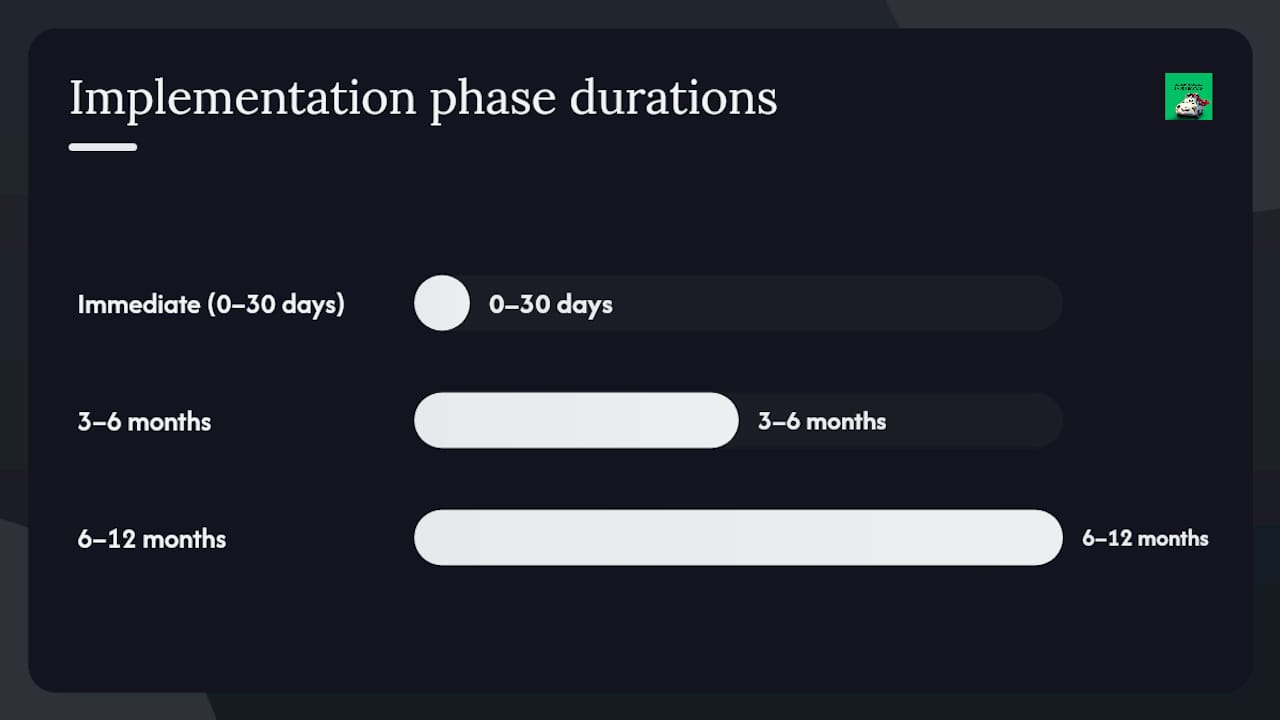
Phased timeline:
- Immediate (0–30 days): Governance structure, ownership assignment, quick-win controls (MFA, access review)
- 3–6 months: Data mapping, classification, baseline control deployment, policy documentation
- 6–12 months: Detection tooling, IR playbook testing, training program launch, third-party risk review
Pro Tip: Track three KPIs your board will understand: number of critical systems with MFA enabled, time to detect and contain incidents (mean time to detect / mean time to respond), and percentage of staff completing annual privacy training. These metrics convert a technical program into a governance conversation.
7. Cultural change makes data protection stick across the organization
Cultural change and clear leadership accountability are the most durable defenses against data incidents. Technical controls fail when people bypass them. Policies fail when no one enforces them. The human element determines whether a program holds under pressure.
Concrete tactics that shift accountability beyond IT:
- Leader modeling: Executives who visibly follow data handling policies signal that the rules apply to everyone
- Role-based training: Tailor content to what each function actually handles — finance teams need different scenarios than customer service teams
- Near-miss sharing: Circulate anonymized examples of close calls internally so staff learn from real events without blame
- Positive incentives: Recognize teams that report potential incidents promptly rather than treating every report as a problem
Framing data protection as protecting employees' and customers' rights, rather than satisfying a compliance requirement, increases engagement. People respond to purpose. When staff understand that the data they handle belongs to real individuals who trust the organization with it, the motivation to protect it becomes personal rather than procedural.
NTIA survey data confirms that privacy and security concerns remain high among Americans, reinforcing why customers notice and respond to how organizations handle their data.
Pro Tip: For HR and learning teams: make privacy training annual at minimum, but add short quarterly refreshers tied to current events (a recent breach in the news, a new regulation). Relevance drives retention. A 5-minute scenario-based module tied to something employees just read about outperforms a 90-minute annual compliance course.
8. Which frameworks and standards should guide your program?
Use a small set of authoritative frameworks as program anchors. Each covers a different scope, and most U.S. organizations need more than one.
| Framework | Scope | Primary focus | Who it applies to |
|---|---|---|---|
| NIST CSF | Broad | Cybersecurity risk management | All sectors |
| NIST NCCoE guidance | Specific | Data security, CIA model, IR | All sectors |
| HIPAA | Sector | Health data privacy and security | Healthcare and business associates |
| PCI DSS | Sector | Payment card data security | Any organization processing card payments |
| FTC Act (Section 5) | Cross-sector | Unfair/deceptive data practices | U.S. commercial entities |
| CCPA/CPRA | State | Consumer data rights | Companies handling California resident data |
Quick next steps for implementation teams:
- NIST NCCoE data security resources for CIA-model controls and IR planning
- Microsoft's data security primer for layered control architecture
- TechTarget's data protection definition for governance fundamentals and GDPR alignment
- ICO benefits of data protection for a plain-language case for compliance investment
- FTC.gov enforcement actions for current U.S. regulatory precedents
- HHS.gov for HIPAA compliance guidance and breach notification rules
For organizations in transportation and logistics, Umrah transport compliance guidance shows how compliance considerations apply in service-delivery contexts.
Saudisayyah's approach to data stewardship
Saudisayyah operates a technology platform that handles pilgrim and traveler data at every point of a booking, from initial reservation through real-time trip tracking. That responsibility shapes how the platform is built. The booking management system is fully automated and built to international compliance standards. Before every trip, passengers receive driver photos, vehicle details, and live tracking, giving them direct visibility into their own data and their journey status.
Data stewardship at Saudisayyah is not a separate compliance function. It is built into the service design. The Saudisayyah fleet and the platform's communication architecture reflect the same principle: transparency and reliability are not features added after the fact. They are the product. For organizations planning travel to Saudi Arabia, that commitment to operational transparency and data integrity is part of what makes the service trustworthy.

Book a transfer or tour through Saudisayyah's services and experience a platform built on the same data protection principles this article outlines.
Sources
- Data privacy is a growth strategy — Harvard Business Review (2026)
- NCCoE — Data security
- What is data security? — Microsoft Security
- Statista — Share of adults who feel personal data vulnerable to hackers (USA)
This article is general information, not a substitute for advice from a qualified lawyer. Consult a qualified legal professional about your own circumstances before acting on anything here.