

TL;DR:
- Reporting journey incidents ensures proper documentation and swift resolution by Saudisayyah.
- Passengers should report emergencies immediately and keep detailed records for non-emergencies.
Journey incident reporting is the process of notifying Saudisayyah about a problem, safety concern, or lost item that occurred during your booked trip. If you are reading this now, here is what to do first:
- If you are in danger: Call emergency services immediately. In the U.S., dial 911. If you are abroad, use the local emergency number.
- For all other issues: Contact Saudisayyah through the app, by phone, or by email.
- Record these three things right now:
- Your trip ID or booking receipt
- Driver name and vehicle details (make, model, plate number)
- Exact time and location of the incident
Keep that information somewhere safe before doing anything else.
Table of Contents
- How do you report a non-emergency problem to Saudisayyah?
- What should you do if the incident involves danger or criminal activity?
- What happens after you submit a report to Saudisayyah?
- What are your options if Saudisayyah's response is unsatisfactory?
- What exactly should you include in your report?
- How does Saudisayyah investigate and resolve journey incidents?
- Key Takeaways
- The part most passengers skip — and why it matters
- Saudisayyah support: where to go for direct help
- Useful sources and next-step links
How do you report a non-emergency problem to Saudisayyah?
Regulators and transport authorities consistently advise that passengers contact the transport company first for non-emergency complaints. Saudisayyah's support channels are the fastest route to a resolution.
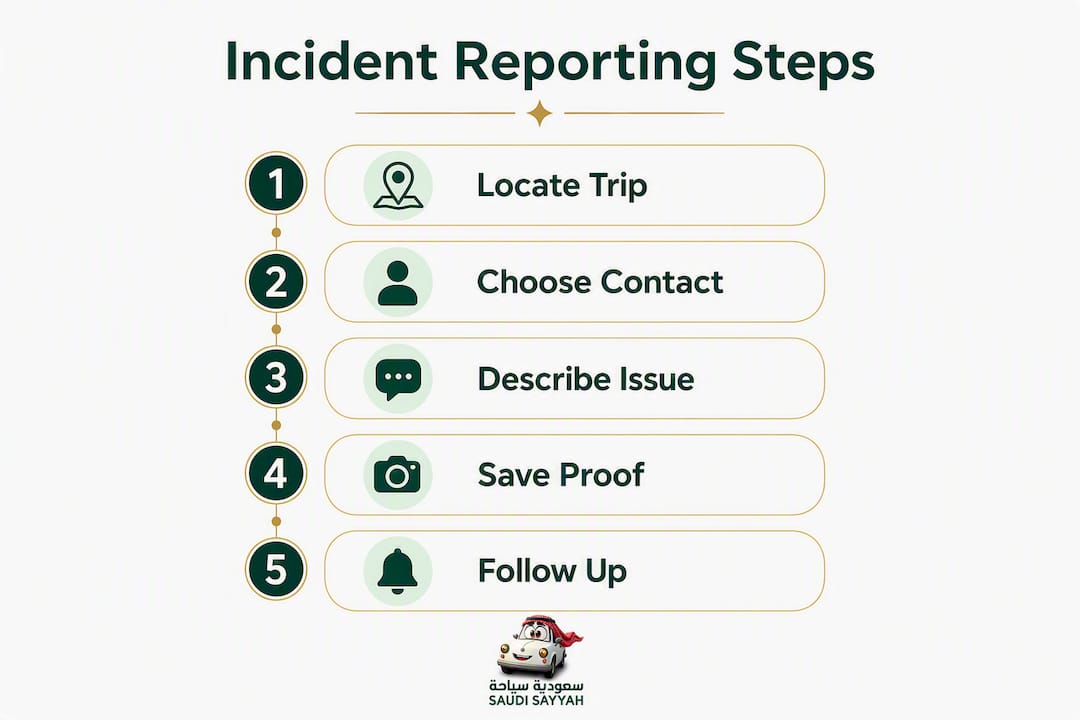
Step 1. Locate your trip ID. Open the Saudisayyah app or check your booking confirmation email. The trip ID, driver name, and vehicle details appear on your receipt.
Step 2. Choose your contact method. In-app support is the preferred channel because it automatically attaches your trip data. Phone and email work if the app is unavailable.

Step 3. Describe the issue clearly. Keep it factual: what happened, when, and where. Attach photos, screenshots of the ride map, or any receipts that support your claim.
Step 4. Save every communication. Screenshot or export chat transcripts. Note the date and time of each contact. Maintaining records of interactions supports formal complaints and any later escalation.
For lost items, contact the driver directly first through the app's messaging feature. If the driver is unreachable, use Saudisayyah's lost-and-found process. If the lost item is a phone, call it immediately and check nearby hotel or transit-hub lost-and-found desks.
Pro Tip: Report within two hours of the trip ending. Polite, specific language ("I left a black backpack on the rear seat at approximately 3:15 PM near Al-Masjid Al-Haram") increases the chance of a driver-assisted recovery. See customer service tips for pilgrims for more phrasing guidance.
What should you do if the incident involves danger or criminal activity?
Personal safety comes before any report.
- Call emergency services first. In the U.S., dial 911. Outside the U.S., use the local emergency number. This applies to violence, assault, impaired driving, or any situation where you feel at risk.
- Request a police report. Ask the responding officer for a case or report number. You will need it for insurance claims, credit card disputes, and any formal complaint.
- Contact Saudisayyah after you are safe. Notify the company as soon as you can so the incident is logged and the driver is flagged.
- Reach your embassy or consulate if you are abroad. U.S. citizens traveling overseas can contact the nearest U.S. embassy or consulate for emergency travel assistance. The U.S. Department of State's traveler assistance line is available 24 hours a day at 1-888-407-4747 (from the U.S.) or +1-202-501-4444 (from abroad).
Safety note: Never delay calling emergency services to file an app report. The police report you obtain will also serve as documented evidence for every subsequent escalation step.
What happens after you submit a report to Saudisayyah?
Saudisayyah logs every report into its incident management system. You receive an acknowledgment containing a case reference number and an outline of next steps. For straightforward complaints, initial contact typically comes quickly. For safety incidents, the timeline may be longer because the investigation is more thorough.
The internal workflow covers four stages: case logging, driver outreach, evidence review, and resolution recording. Possible outcomes include direct driver contact for lost items, refund or credit decisions for service failures, and driver discipline or safety reviews for conduct complaints. Transport providers operate formal incident management systems designed to trigger structured safety audits, not just one-off responses.
Keep your own records regardless of what the company retains. Companies and regulators often retain complaint records for a defined period, commonly two years, so escalate within that window and preserve your evidence to meet that timeline.
What are your options if Saudisayyah's response is unsatisfactory?
Start with internal escalation: ask for a supervisor review or request that your case be reopened with additional evidence. If that does not resolve the issue, the following external routes are available.
Credit card chargeback. Contact your Visa or Mastercard issuer and file a dispute. Provide your trip receipt, the case reference number from Saudisayyah, and any written communication showing the unresolved complaint. Most issuers require you to attempt resolution with the merchant first.
Travel insurance claim. Review your policy for trip interruption, personal liability, or lost-item coverage. Submit the police report, your trip receipt, and Saudisayyah's written response as supporting documents.
U.S. embassy or consulate. For serious incidents abroad, the nearest U.S. embassy or consulate can provide emergency assistance, help you navigate local authorities, and connect you with legal resources.
Police report and formal complaint. Where a lost item or conduct suggests criminal intent, a police report may be required for insurance or regulator investigation. Regulators can examine complaint records that companies are required to keep, so a formal complaint to the relevant transport authority is a legitimate final step.
On liability for lost items: Many providers state they are not liable for personal items left behind. Knowing this before you escalate helps you direct your claim to the right channel — insurer or card issuer — rather than expecting a full reimbursement from the company.
What exactly should you include in your report?
A complete report speeds resolution. Use this checklist and the copy-and-paste templates below.
| Report Field | Why It Matters |
|---|---|
| Trip ID / booking reference | Identifies the exact ride in Saudisayyah's system |
| Full name on booking | Confirms account ownership |
| Date, time, and pick-up/drop-off locations | Establishes the incident timeline |
| Driver name and vehicle details | Links the incident to the correct driver record |
| Fare amount | Supports refund or dispute calculations |
| Photos or screenshots | Provides visual evidence for investigation |
| Witness contact information | Corroborates your account |
Copy-and-paste templates:
Lost item: Conduct complaint: Safety report: Your digital receipt contains driver identifiers and trip metadata required for regulator complaints, insurance claims, or police reports. Save it the moment your trip ends.
How does Saudisayyah investigate and resolve journey incidents?
Saudisayyah's incident management process begins the moment a report is submitted. The case is logged, a reference number is assigned, and the relevant driver is contacted. Evidence — trip data, GPS records, driver account, and any materials you submitted — is reviewed before a resolution is recorded.
What passengers can expect: Saudisayyah's geolocation-enabled platform generates a timestamped trip record for every booking. That record, combined with pre-trip driver and vehicle details sent to passengers before each ride, means the company has documented evidence to cross-reference against your report from the start.
Trust signals built into the platform support this process. Drivers are vetted professionals. Vehicle details and driver photos are shared before every trip. Real-time tracking is active throughout. For more on how driver vetting and smart technology underpin safe transport, Saudisayyah's blog covers the specifics.
During an investigation, Saudisayyah may ask you to provide additional evidence, witness contacts, or clarification. Responding promptly keeps your case moving. For context on Umrah transport compliance and passenger responsibilities, that resource outlines what the process looks like from both sides.
Key Takeaways
Reporting a journey incident promptly, with complete evidence and a clear description, gives Saudisayyah the best chance to resolve the issue quickly and gives you the documentation needed for any escalation.
| Point | Details |
|---|---|
| Safety comes first | Call emergency services before filing any app or email report. |
| Contact Saudisayyah first | For non-emergencies, use in-app support, phone, or email and attach your trip ID and evidence. |
| Keep your own records | Save receipts, screenshots, and chat transcripts; escalation windows are time-limited. |
| Escalation options exist | Credit card chargeback, travel insurance, and U.S. embassy assistance are available if needed. |
| Saudisayyah's system is documented | Pre-trip driver details, GPS records, and case logging support every investigation from the start. |
The part most passengers skip — and why it matters
Most passengers who have a bad trip experience do one of two things: they say nothing, or they post a review. Neither produces a resolution. The journey safety reporting process exists precisely because transport companies need a documented record to act. Without a report, there is no case number, no driver contact, no investigation, and no refund path.
The copy-and-paste templates in this guide exist for a reason. Vague messages ("the driver was rude") are harder to act on than specific ones ("at 14:30 on [date], near [location], the driver [specific behavior]"). Specificity is what moves a complaint from a general note to an actionable case.
One more thing worth saying plainly: keep your receipts. Not just for Saudisayyah's process, but for your card issuer, your insurer, and your embassy if it ever comes to that. A digital receipt takes two seconds to save and can be the difference between a successful dispute and a closed case.
Saudisayyah support: where to go for direct help
Pilgrims and passengers booked with Saudisayyah get direct access to a support team that already has your trip data on file. No need to reconstruct the details from scratch.
Primary support channels:
- In-app support: Fastest route. Your trip ID and driver details attach automatically.
- Phone: Available for passengers who prefer direct voice contact.
- Email: Use the copy-and-paste templates above for a complete, ready-to-process report.
For a full overview of available services, the Saudisayyah services page covers booking options, fleet details, and support contacts in one place. If you want to review vehicle and driver standards before or after a trip, the fleet page has the specifics. To get help now, go to saudisayyah.com and use the live chat or contact form.
Useful sources and next-step links
- U.S. Department of State — International Travel Emergencies: 24-hour emergency line for U.S. citizens abroad.
- NYC Taxi & Limousine Commission — Report Lost Property: Guidance on using trip receipts and driver records for lost-item recovery.
- Passenger Transportation Board — Your Rights, Safety, and Complaints: Explains record-keeping requirements and regulatory escalation for unresolved complaints.
- Saudisayyah — Services: Booking options, support contacts, and service details.
- Saudisayyah — Troubleshooting Common Travel Issues: Practical guidance for passengers dealing with non-emergency incidents.
- Saudisayyah — Pilgrimage Passenger Support: Safety guidance and support resources for pilgrims.