
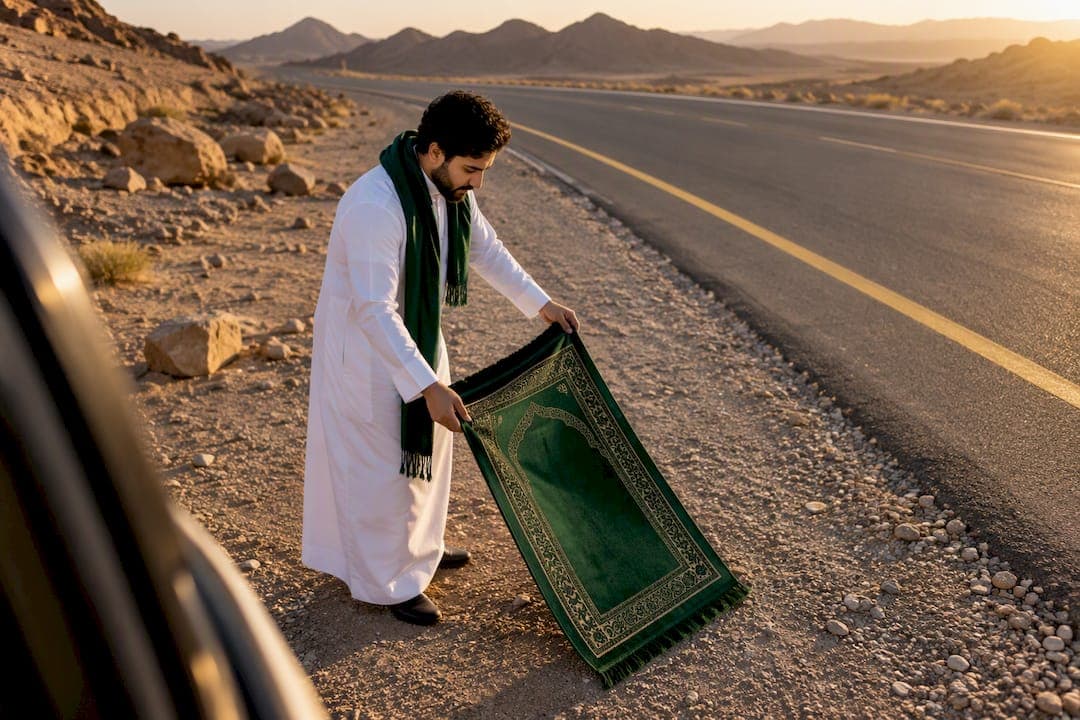
Stop and pray on the ground whenever it is safe to do so. Praying inside a moving vehicle is a last resort, not a first option. Travel of about 80 km or more qualifies for qasr, shortening Dhuhr, Asr, and Isha prayers, and Saudi highways are required to provide rest areas roughly every hour, so a proper stop is almost always possible on main routes.
TL;DR:
- Traveling more than 80 km generally qualifies for prayer shortening and combining, with Dhuhr, Asr, and Isha shortened to two rak'ahs.
- Most Saudi highways have rest areas roughly every hour, each equipped with prayer facilities, making proper stops feasible without shortcutting the rules.
- Planning routes in advance, including mapping rest stops and setting prayer alerts, is essential to avoid praying while the vehicle is moving out of necessity.
- Praying in a moving vehicle is only permitted when it is impossible to stop safely before the prayer time ends, and the driver must never pray while operating the vehicle.
- Using real-time tracking and pre-booked driver communication helps ensure timely prayer stops and minimizes the risk of missing prayers during long trips.
Table of Contents
- When qasr and jam' apply on a journey
- Finding a safe place to stop on Saudi roads
- Is praying inside a moving vehicle ever allowed?
- Apps and route planning that prevent missed prayers
- How Saudi Sayyah supports prayer stops on the road
- What travelers get wrong about prayer stops
- Sources
- FAQ
When qasr and jam' apply on a journey
Qasr means shortening a four-rak'ah prayer to two. Jam' means combining two prayers into one time slot. Both exist for travelers, and Saudi scholarship treats them as a mercy, not an obligation to skip prayer altogether.
Distance is the first test. Scholars commonly place the qasr threshold at about 80 km, treated as a day-and-night stage of travel. Below that distance, the traveler generally prays in full. Saudi fatwa authorities, including Bin Baz, give the same guidance and add detail on combining and residency.
About 80 km of travel opens the door to qasr, the shortening of four-rak'ah prayers to two, according to IslamQA's guidance on shortening prayers. That single distance rule shapes most of the decisions below.
- Dhuhr, Asr, and Isha shorten from four rak'ahs to two.
- Fajr stays at two rak'ahs, unchanged.
- Maghrib stays at three rak'ahs, unchanged.
- Jam' taqdim means praying the second prayer early, combined with the first, before leaving.
- Jam' ta'khir means delaying the first prayer to combine it with the second, once you arrive or stop.
A driver leaving before Dhuhr and expecting to be on the road through Asr can pray both at the Dhuhr time before departure (jam' taqdim). A driver already on the road as Maghrib approaches, with Isha still ahead, can delay Maghrib and pray both together once stopped after Isha begins (jam' ta'khir). The choice depends on which stop is realistic, not on preference alone.
Residency changes the picture. Staying in one place for more than four days generally means the traveler resumes praying in full, according to Bin Baz's rulings on travel prayer. Praying behind a resident imam also matters: a traveler who joins a congregation led by a non-traveler typically completes the prayer in full rather than shortening it, since he is following the imam's prayer, not his own independent one.

Finding a safe place to stop on Saudi roads
Saudi road standards classify rest areas by type and require them to appear often enough that drivers are never far from a break. Regulatory standards require rest areas spaced so driving time between them does not exceed roughly one hour, and each is required to include dedicated prayer facilities. The Road Tent initiative adds seasonal, pilgrim-focused stops with shaded areas and hospitality along major routes connecting the holy cities, part of broader SPA reporting on road services for pilgrims.
Use this sequence when a prayer time is approaching:
- Check the route ahead for the next marked rest area rather than waiting until the time is nearly over.
- Signal early and move into the exit lane with enough distance to slow down safely.
- Park fully off the traveled roadway, set the parking brake, and turn off the engine.
- Confirm the direction of qibla using a phone app or the marked prayer area if one is provided.
- Perform wudu at the facility's washroom, or use dry ablution if water is unavailable.
- Pray without rushing, then return to the vehicle only once everyone in the group is ready.
Coordinating with a bus or coach driver takes the same logic but needs communication ahead of time. Passengers should ask the driver, before departure, roughly when the next scheduled stop will fall relative to prayer times, so nobody is caught mid-route with no realistic option. Private drivers working with a booking platform can often be asked directly to plan a stop around Dhuhr or Asr rather than leaving it to chance.
Pro Tip: Keep a small prayer kit in the car: a travel prayer mat, a compact Quran or phone app, a bottle of water for wudu, and a scarf or ihram cloth, so a stop never turns into a search for supplies.
Is praying inside a moving vehicle ever allowed?
Praying inside a moving vehicle is permitted only under narrow conditions, and it is not meant to replace planning. According to guidance on the ruling of praying in a car, the concession applies when two conditions are both true: the prayer time is about to end, and there is no safe way to stop before that happens.
- Not wanting to stop is not the same as being unable to stop, and the ruling does not extend to convenience.
- Standing, bowing, and prostrating fully are the norm; a passenger who cannot perform them properly approximates the movements while seated and facing qibla as closely as possible.
- The driver himself must never attempt to pray while driving; if no one else can drive, the vehicle must be stopped.
- Voluntary (nafl) prayers allow more flexibility while traveling, including praying seated in a moving vehicle in a direction other than qibla, but obligatory (fard) prayers carry the stricter standard above.
A passenger on a coach approaching Fajr's end with no rest area in sight, and no way for the driver to pull over safely, may pray seated, facing qibla as best as possible, rather than let the time-lapse. The same passenger, ten minutes from a marked rest stop with time remaining, does not qualify for this concession and should wait.
Apps and route planning that prevent missed prayers
Planning removes most of the guesswork that leads to praying in a vehicle out of necessity. Fiqh guidance on car prayer makes the same point directly: the vehicle concession exists for genuine inability, not for travelers who never planned ahead.
- Set prayer time alerts using Saudi location settings, and download offline prayer time tables before leaving areas with reliable signal.
- Use a qibla compass app before departure, and as backup, note that the sun's position near solar noon aligns roughly north-south, giving a rough check when signal drops.
- Map the rest areas along the route in advance and add buffer time around Dhuhr, Asr, Maghrib, and Isha rather than assuming the next stop will arrive exactly on time.
- Time departure so that the highest-risk prayer windows, sunrise, midday, and sunset, land near a planned stop rather than mid-highway.
Pro Tip: On a multi-hour intercity drive, mark your planned Dhuhr and Asr stop on the map before you leave rather than deciding on the fly.
Group travel adds coordination on top of planning. Designating one person as the prayer coordinator, someone who tracks the time and flags the next stop to the driver or group, keeps a full van or bus from discovering a missed window too late. That role matters more on long Ziarah routes between historical sites, where the pace of a private guide or driver directly affects whether prayer breaks happen on schedule.
How Saudi Sayyah supports prayer stops on the road
Coordinating a prayer stop is easier when the driver already knows the plan. A geolocation-enabled platform may share driver photos, vehicle details, and real-time tracking before every trip, helping passengers know who is driving and where the vehicle is at any point on the route.
- Real-time tracking lets passengers see progress against the route and judge how far the next rest area is.
- Pre-trip driver and vehicle details mean a prayer stop request is made to a known, identified driver, not a stranger.
- Constant communication through the platform allows a rider to flag a prayer stop need in advance rather than mid-journey.
Booking ahead through Point to Point Transportation, Ziarah Packages, or Hire by the Hour gives a traveler the chance to set expectations about stop timing before the trip even starts, particularly useful on longer routes covered in the guide to planning a trip to the holy cities. Group travelers coordinating multiple prayer stops across a shared itinerary may also find the group travel tips for Saudi Arabia useful alongside a booked driver who already understands the plan.
What travelers get wrong about prayer stops
The common mistake is not ignorance of the rules, it is treating the vehicle concession as a backup plan instead of a genuine last resort. Travelers memorize the qasr distance and the combining options, then still end up praying in a moving car simply because they didn't check the map for the next rest area.

The rules themselves are simple once distance and timing are clear. What's underrated is the planning step: knowing that Saudi highways are built to put a rest area within roughly an hour's drive removes most of the pressure that leads to shortcuts. A traveler who marks stops before leaving rarely needs the darurah exception at all.
Prioritize the stop, not the shortening. Qasr and jam' are conveniences for a traveler already praying properly. They are not a substitute for pulling over.
— Fa
Sources
- Is it permissible to shorten the prayer when travelling?
- مشروعية القصر للمسافر - Bin Baz
- Road code standard rest areas
- The ruling of praying in a car - MuftiWP
FAQ
What is the distance rule for shortening prayers while traveling?
Travel of about 80 km generally qualifies for qasr, according to IslamQA's guidance on travel prayer. At that distance, Dhuhr, Asr, and Isha can be shortened from four rak'ahs to two, while Fajr and Maghrib stay the same.
Can I combine Dhuhr and Asr while driving?
Yes, travelers can combine Dhuhr with Asr, and Maghrib with Isha, either early (jam' taqdim) or delayed (jam' ta'khir), based on which stop fits the route. Saudi scholarly rulings on combining prayers confirm this applies for genuine travel, not everyday local trips.
Is it permissible to pray while sitting in a moving car?
Only when stopping safely is genuinely impossible and the prayer time is about to end, according to guidance on praying in a car. Preferring not to stop does not meet that standard, and the driver must never attempt to pray while operating the vehicle.
How far apart are rest areas on Saudi highways?
Saudi road standards require rest areas to be spaced so that driving time between them does not exceed roughly one hour, and each must include prayer facilities. This spacing, set out in the Saudi road code for rest areas, makes a proper stop realistic on most main routes.
How can I make sure I don't miss a prayer on a long trip?
Map rest stops before departure, set prayer alerts with offline backup, and build buffer time around Dhuhr, Asr, Maghrib, and Isha into the schedule. Booking with a driver through a service like Saudi Sayyah that communicates stop timing in advance also reduces the chance of a prayer window slipping by unplanned.