
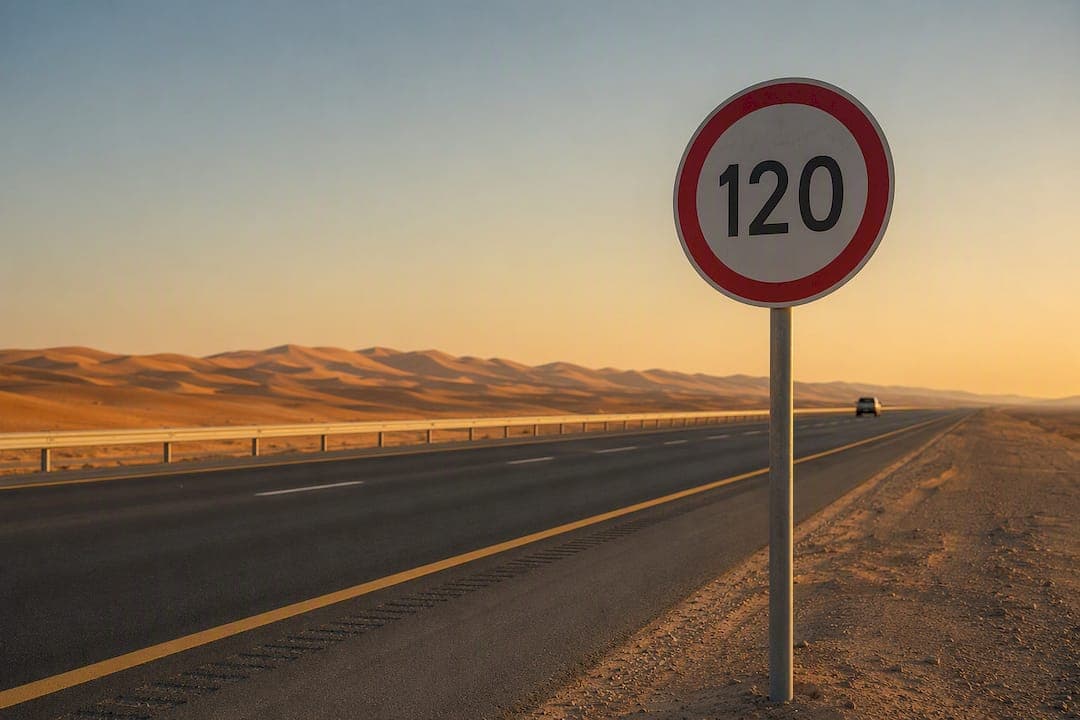
Speed limits in Saudi Arabia follow the road type: 30 to 40 km/h in school and residential zones, 60 to 80 km/h on urban main roads, 100 to 120 km/h on dual carriageways, and up to 140 km/h on designated highway lanes. The Saher camera network logs every violation directly to your Absher account, and fines escalate by bracket depending on how far over the posted limit you were.
- Pay within 30 days for a 25% discount.
- File an objection through Absher within that same 30-day window if you believe the fine is wrong.
Pro Tip: Never assume routes with higher posted limits have extra buffer room. Enforcement tolerance on such routes can be stricter than on standard highways.
Key Takeaways
Saudi Arabia's speed limits vary by road type, from lower limits near schools to higher limits on select highways, and Saher cameras enforce speed violations through automated logging to Absher.
| Point | Details |
|---|---|
| Posted limits vary by road type | Expect 40 km/h near schools, 60 to 80 km/h on urban roads, and 100 to 140 km/h on highways. |
| Fines escalate by overage bracket | On 120 km/h roads, fines run SAR 150 to SAR 2,000 depending on how far over you were. |
| 140 km/h roads have narrower tolerance | Fines there can start once you exceed the limit by more than 5 km/h. |
| Absher controls payment and disputes | Pay within 30 days for a 25% discount, or file an objection in the same window. |
| Verified transport reduces compliance risk | Saudisayyah's tracked drivers and modern fleet support safe, fine-free pilgrimage and travel routes. |
Table of Contents
- Typical Posted Speed Limits by Road Type in Saudi Arabia
- How Graduated Speeding Fines Work in Saudi Arabia
- How Saher Cameras and Absher Enforce Speed Limits
- Smart Driving Habits That Keep You Fine-Free
- What To Do If You Receive a Speeding Fine
- Why Saudi Arabia Regulates Speed the Way It Does
- Recent Changes to Speed Limit Enforcement in Saudi Arabia
- Speed Limits and Their Role in Reducing Accidents
- A Traveler's Note on Staying Safe and Compliant
- Book a Compliant, Tracked Ride for Your Saudi Arabia Trip
- Sources
Typical Posted Speed Limits by Road Type in Saudi Arabia
Signs, not habit, decide your legal speed on any given stretch of road. The posted limit for that specific road is the only number that matters legally, since Saudi traffic law measures a violation against the sign in front of you, not against some general sense of what feels safe. That distinction shows up clearly in legal commentary on speeding offenses, which notes that driving 140 km/h is not automatically an offense if that road's posted limit is 140 km/h.
Here is the general pattern you will encounter across the Kingdom:
- School zones: commonly around 40 km/h, often with tighter windows during arrival and dismissal times.
- Residential and older urban streets: commonly around 50 km/h.
- Urban main roads and ring roads: typically 60 to 80 km/h, depending on lane count and median design.
- Dual carriageways and intercity expressways: typically 100 to 120 km/h.
- Select highway stretches: posted at up to 140 km/h, usually on long, straight intercity corridors with wide shoulders.
These ranges match what House of Saud's driving guide documents for standard road classifications, and they hold fairly consistently whether you're driving between Riyadh and Dammam or navigating Jeddah's inner ring roads.
Temporary conditions override all of this. Construction zones, fog corridors near mountain passes, and market crowding near mosques or souks can drop a posted 100 km/h limit down to 40 km/h or lower with almost no warning. The sign always wins, even when it contradicts what you remember from your last trip on the same road.
Vehicle type matters too. Trucks, buses, and other heavier commercial vehicles often carry lower posted limits than passenger cars on the same stretch of highway, reflecting longer stopping distances and higher rollover risk. If you're driving a loaded pickup or towing anything, check for vehicle-specific signage rather than assuming the passenger-car limit applies to you.

How Graduated Speeding Fines Work in Saudi Arabia
Fines don't jump straight to a flat penalty. They climb in brackets tied to exactly how many kilometers per hour you exceeded the posted limit, and the brackets differ depending on whether you're on a standard highway or a 140 km/h corridor.
On roads posted at 120 km/h or lower, official fine guidance lays out example brackets like these:
- 10 to 20 km/h over: SAR 150 to SAR 300
- 20 to 30 km/h over: SAR 300 to SAR 500
- 30 to 40 km/h over: SAR 800 to SAR 1,000
- 40 to 50 km/h over: SAR 1,200 to SAR 1,500
- More than 50 km/h over: SAR 1,500 to SAR 2,000
Roads posted at 140 km/h use a stricter scale that starts penalizing smaller overages. According to ArabWheels' breakdown of highway limits, fines on these routes can begin once you exceed the limit by more than 5 km/h:
- 5 to 10 km/h over: SAR 300 to SAR 500
- 10 to 20 km/h over: SAR 800 to SAR 1,000
- 20 to 30 km/h over: SAR 1,200 to SAR 1,500
- More than 30 km/h over: SAR 1,500 to SAR 2,000
Notice the pattern: a 140 km/h posted limit does not buy you a wider cushion. It buys you a narrower one, because the consequences of a crash at those speeds are severe enough that regulators built the penalty structure around discouraging even modest overages.
How Saher Cameras and Absher Enforce Speed Limits
Saudi Arabia's enforcement runs almost entirely through automation. The Saher camera network sits along highways, urban corridors, and intersections, and it clocks vehicle speed continuously rather than relying on officer patrols to catch violations in real time.
- Detection: Saher cameras record your speed and vehicle plate the moment you exceed the posted limit.
- Transmission: The violation routes automatically to the Ministry of Interior's traffic system, known as Moroor, and syncs to your national Absher account.
- Notification: You'll typically see the fine appear in Absher, often alongside a notification, rather than receiving a physical citation on the spot.
- Payment window: You get a 25% discount if you pay within 30 days, and the same 30-day window applies if you want to file an objection.
Payment channels run through Absher directly or through linked bank portals, and both let you settle the fine without visiting a traffic office in person.
Pro Tip: Screenshot your Absher fine details the moment they appear, including timestamp, location, and recorded speed. If you dispute later, having your own copy of the original record protects you if the app updates or the case gets reassigned.
Smart Driving Habits That Keep You Fine-Free
Most speeding fines in Saudi Arabia come down to a driver assuming a margin that doesn't exist. Here's what actually keeps you clear:
- Treat every posted sign as the final word, even if the road looks like it should support faster speeds.
- Watch for new signage whenever you cross from a city into open highway, since limits often shift within a few hundred meters of a city boundary.
- Use cruise control or your vehicle's speed alert system on long stretches, especially on 140 km/h corridors where the fine brackets start early.
- Keep a small, deliberate margin below the posted limit rather than driving exactly at it, since GPS speedometers and vehicle odometers can read slightly differently.
- If you're booking hired transport for Umrah or Hajj, ask whether the provider tracks driver speed and enforces compliance, since that accountability protects you as a passenger too.
Pro Tip: A vehicle's dashboard speedometer often reads a few kilometers per hour higher than your actual GPS speed. That's intentional manufacturer calibration, but it means trusting your dash number alone can put you closer to a violation than you think.
What To Do If You Receive a Speeding Fine
Getting a notification doesn't mean the process is over. Here's the practical sequence:
- Check Absher first. Confirm the recorded location, timestamp, and speed, along with any photo evidence attached to the citation.
- Pay early if the fine is valid. Settling within 30 days locks in the 25% discount through Absher or a linked bank portal.
- File an objection if something looks wrong. Submit it through Absher within the same 30-day window, and support it with dashcam footage, GPS logs, or witness details if you have them.
- Escalate serious cases. Repeat violations or higher penalty brackets may require in-person follow-up at a local traffic office rather than a purely digital resolution.
Why Saudi Arabia Regulates Speed the Way It Does
Speed limits in Saudi Arabia trace back to national traffic law that ties every violation to the posted limit for that specific road, not to a single Kingdom-wide number. This is why you'll see such a wide range of limits, from 40 km/h near a school to 140 km/h on an open highway corridor. The law is built around road design and context rather than a flat rule.
The rationale is straightforward from a physics standpoint: stopping distance and crash severity both increase sharply with speed, so roads engineered for higher-speed travel, wide medians, limited cross traffic, gentle curves, get higher posted limits, while roads with pedestrians, intersections, or tight geometry get lower ones. TheLawSA's legal analysis makes this explicit: a numerical speed alone isn't a violation until it's measured against the posted limit for that road.
This framework also explains why Saudi Arabia leans so heavily on automated enforcement instead of officer-issued citations. A national camera network can apply the posted-limit standard consistently across thousands of kilometers of road, something that would be far harder to do uniformly with patrol officers alone. The system treats speed regulation as a matter of engineering and data, matching penalty severity to the road's actual design speed rather than applying a blanket rule that ignores context. That's also why fine brackets scale with the road classification rather than staying flat nationwide.
Recent Changes to Speed Limit Enforcement in Saudi Arabia
Enforcement has tightened rather than loosened over the past few cycles, and the trend points toward closer integration between traffic cameras and centralized digital identity. Fines now sync to Absher almost immediately after a Saher camera records a violation, cutting down the lag that once existed between an infraction and a driver actually learning about it.
The 140 km/h designation on select highway corridors reflects an ongoing shift toward differentiating road types more precisely rather than applying one intercity speed standard everywhere. Alongside that, the stricter tolerance on those higher-speed routes, where fines can begin at just 5 km/h over, signals that regulators are treating higher-speed corridors as requiring more precise compliance, not less.
Guides tracking these rules, including ArabWheels' ongoing coverage of Moroor updates, note that drivers should check current signage regularly rather than relying on limits from a previous trip, since roadworks and seasonal adjustments (fog season in the west, market congestion during pilgrimage periods) can shift posted speeds with little advance notice. If you're planning a long intercity drive, treat every trip as a fresh check of the signage rather than an assumption based on memory.
Speed Limits and Their Role in Reducing Accidents
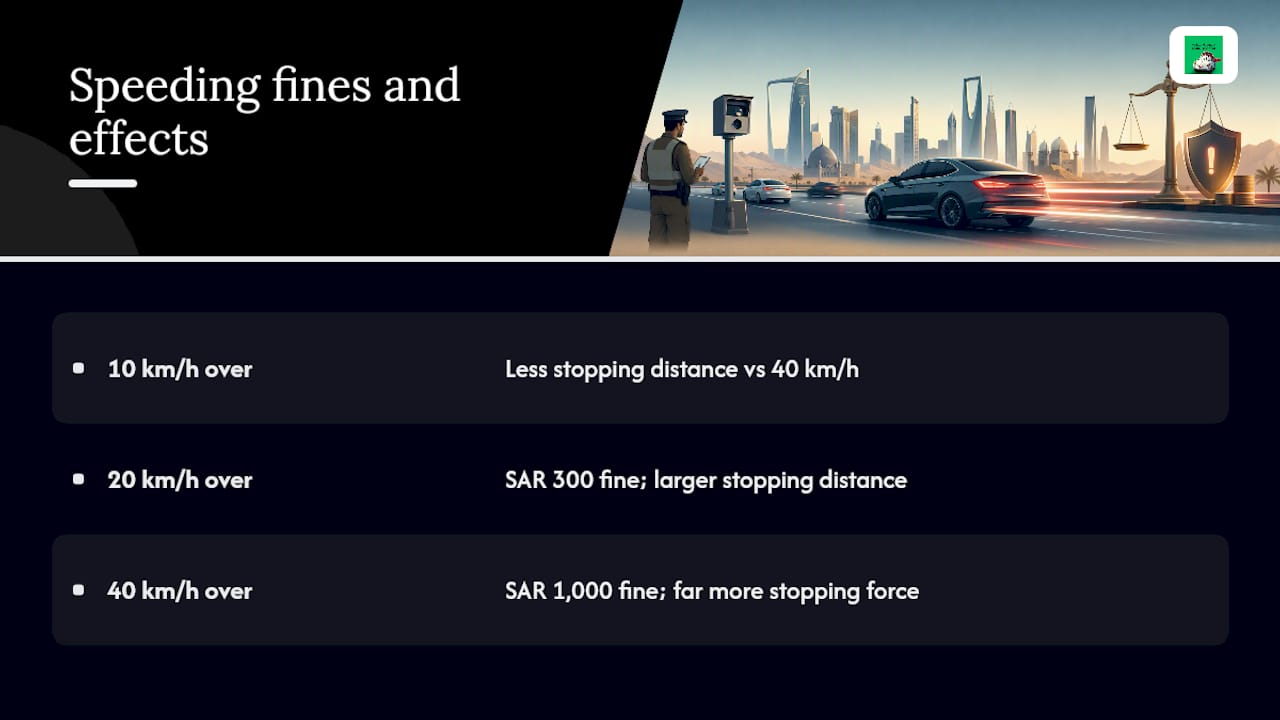
Graduated fines exist because speed and crash severity move together, not because slower driving alone eliminates risk. The jump in fine amounts between brackets, say from SAR 300 at 20 km/h over to SAR 1,000 at 40 km/h over, mirrors how dramatically braking distance and impact force increase as speed climbs. A vehicle traveling 40 km/h over the limit needs significantly more room to stop and delivers far more force in a collision than one traveling 10 km/h over.
The narrower tolerance on 140 km/h corridors reflects this same logic taken further. At highway speeds, even a moderate overage compounds risk quickly, since reaction time stays constant while stopping distance grows nonlinearly with speed. Vehicle safety monitoring systems, including driver behavior technology used in fleet safety programs, are built around this exact principle: tracking and correcting small speed deviations before they become dangerous ones.
For travelers, this translates into a simple takeaway: the posted limit isn't a bureaucratic suggestion. It's calibrated to the specific geometry and traffic pattern of that road, and driving within it directly reduces your exposure to the kind of severe, high-speed collisions that dominate serious accident statistics on intercity corridors.
A Traveler's Note on Staying Safe and Compliant
Compliance isn't just about avoiding a fine. For pilgrims and first-time visitors, a driver who respects posted limits and a platform that shows you real-time tracking removes a layer of anxiety you didn't know you were carrying. Following the signs protects everyone in the vehicle and keeps a sacred journey from turning into an unplanned detour.
— Fa
Book a Compliant, Tracked Ride for Your Saudi Arabia Trip
Saudisayyah gives you a way to skip the guesswork entirely. Instead of hoping a rental car or an unverified driver respects posted limits, you get professional drivers, a modern fleet, and a geolocation-enabled platform that sends you driver photos, vehicle details, and real-time tracking before every trip.

That visibility matters most on the long intercity stretches this article just covered, the 120 km/h dual carriageways and 140 km/h highway corridors where fine brackets get strict fast. Saudisayyah's drivers operate within a system built for accountability, and if you ever need trip records for any reason, the tracking data is already there. If you're planning airport pickups, Ziarah tours, or point-to-point transfers for Umrah or Hajj, check Saudisayyah's services to see current options, or browse the fleet page to pick a vehicle that fits your group size before you book.
Sources
- New Saudi Speeding Fine Update: Fines and Rules Explained - ArabWheels
- Driving rules in Saudi Arabia: speed limits, fines and road tips - House of Saud
- مخالفة السرعة في السعودية وما هي حدود السرعة المسموح بها - TheLawSA