
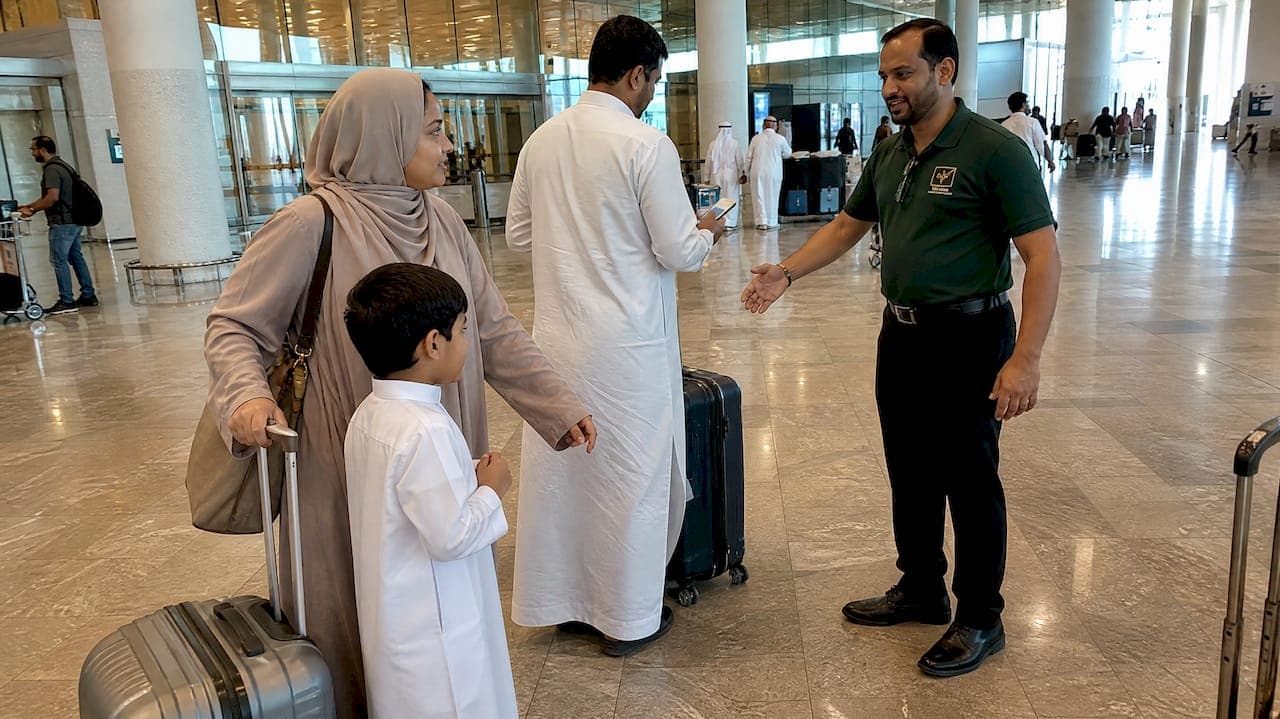
The fastest way most families reach Makkah and complete Umrah without chaos: secure a valid eVisa or Umrah permit through Nusuk, book a hotel within walking distance of Al-Masjid al-Haram, prebook flexible transport for arrival and daily trips, and build rest windows into every day. Four pieces: get those right and the rest falls into place.
TL;DR:
- Booking refunds on hotels and prearranging airport transfers at least a month before departure ensures smoother logistics, especially for families with elderly members or small children.
- Families should confirm their Nusuk permit and eVisa for every member, including infants, and keep digital and physical copies accessible to avoid delays at immigration checks.
- Staying close to Al-Masjid al-Haram, with family suites and elevator access, reduces walking distance and makes managing rest and naps easier during busy prayer times.
- Booking transport with driver details and live tracking prior to arrival minimizes stress and prevents last-minute negotiations or mix-ups at crowded airports.
- A flexible three-day itinerary, with planned rest periods and off-peak mosque visits, helps maintain energy levels and manage crowd-related stress for all ages.
Table of Contents
- Your Family Umrah Planning Checklist From Booking to Departure
- How the eVisa and Nusuk Permit Work for Families
- Choosing a Family-Friendly Hotel Near the Haram
- Managing Airport Transfers and Daily Transport as a Family
- Caring for Children and Elderly Relatives During Crowds
- A Flexible 3-Day Family Umrah Itinerary
- Packing, Health, and Insurance for a Family Umrah Trip
- Umrah Ritual Steps and Where to Find Official Guidance
- What Families Consistently Get Wrong About Umrah Logistics
- A Practical Transport Option for Family Umrah Trips
- FAQ
- Sources
Your Family Umrah Planning Checklist From Booking to Departure
A family trip needs more lead time than a solo one. Children, elderly relatives, prescriptions, strollers: each adds a task. Break the work into stages.
8+ weeks before departure:
- Confirm passports are valid for at least six months past your return date.
- Apply for the tourist eVisa or arrange your Umrah permit through Nusuk.
- Book refundable hotel rates near the Haram in both Makkah and Madinah.
- Research transport options for airport pickup and daily movement.
4-6 weeks before departure: 5. Request family suites or adjoining rooms directly with the hotel. 6. Confirm pediatric and elderly prescriptions, and ask your doctor for extra supply. 7. Buy travel insurance that covers the whole family, including medical needs abroad.
1-2 weeks before departure: 8. Prebook airport transfers and any planned ziarah trips. 9. Print or save digital copies of visas, insurance, and hotel confirmations. 10. Pack Ihram items for children and check that strollers fold for airline storage.
24 hours before departure:
- Charge phones and power banks fully.
- Confirm pickup times with your transport provider.
- Pack a small carry-on with medicine, snacks, and a change of clothes for young children.
Pro Tip: Ask your hotel in advance whether rooms include a kettle or small fridge. It matters more than almost any other amenity when you have infants or elderly relatives who need medication kept cool.
Some of the biggest wins come from decisions made weeks before travel, not during it. A first-time visitor planning guide covers the broader groundwork if your family has never made this trip before.

How the eVisa and Nusuk Permit Work for Families
Two separate systems control entry and access for Umrah, and families need to understand both.
The Saudi tourist eVisa is a one-year, multiple-entry visa that permits Umrah (not Hajj) and allows stays of up to 90 days per visit. This is the visa most international families use. It covers children listed on the application the same way it covers adults.
Separately, the Ministry of Hajj and Umrah requires every pilgrim, including children, to hold an official Umrah permit booked through the Nusuk app. There is no minimum age for children to enter the Grand Mosque or perform Umrah, but the permit slot still has to be reserved for them.
Before you travel, work through this list:
- Apply for the eVisa with accurate names matching passports exactly.
- Register each family member, including infants, for a Nusuk permit slot.
- Save the Nusuk confirmation and eVisa approval as PDFs on every adult's phone.
- Carry physical passport copies in your carry-on, separate from the originals.
- Check the permit slot time against your flight and hotel check-in schedule.
Immigration officers at Jeddah, Madinah, or Riyadh airports will ask for the eVisa and may check the Nusuk permit. Keep both ready rather than searching through emails at the counter.
Choosing a Family-Friendly Hotel Near the Haram
Distance from Al-Masjid al-Haram is the single factor that affects your family's daily energy the most. Every extra ten minutes of walking or transit adds up when you are managing a toddler's nap schedule or a grandparent's mobility.
Staying close cuts down on the number of times you have to coordinate everyone for a move, and it makes it realistic to return to the room for naps, feeding, or rest between prayer times instead of pushing through exhaustion in the heat.
When booking, look for:
- Family suites or two adjoining rooms rather than a single standard room.
- A kitchenette or at least a mini-fridge for bottles, snacks, and medication.
- Elevator access on every floor, confirmed directly with the hotel rather than assumed.
- Stroller-friendly entrances and hallways wide enough for wheelchairs.
- Blackout curtains, since prayer times mean early mornings and late nights.
Booking tactics matter as much as the room type. Choose refundable rates whenever the price difference is small, since family plans change. Ask about early check-in if your flight lands in the morning, and specify a high floor if you want quiet, or a low floor if an elderly relative struggles with elevator waits during busy hours.
Pro Tip: Call the hotel directly after booking online to confirm your room request in writing. Online booking platforms do not always pass special requests through to the front desk.
For elderly relatives specifically, short walking distance and elevator access are the two features worth prioritizing above almost anything else, including room size.
Managing Airport Transfers and Daily Transport as a Family
Transport logistics make or break the early hours of a family Umrah trip. Landing after a long flight with children and bags, then trying to negotiate a taxi, is where most of the stress happens.
On arrival at Jeddah, Madinah, or Riyadh airport, prioritize getting your group and luggage together before anything else. Buy a local SIM card at the airport kiosk if you have not arranged connectivity in advance, since you will need data for maps, the Nusuk app, and messaging your transport provider.
Compare your transport options before you land:
- Prebooked point-to-point transfer: fixed price, driver waiting at arrivals, best for predictable airport runs with kids and luggage.
- Hourly vehicle hire: flexible for families who want to visit multiple sites in one day without re-booking each leg.
- Hotel shuttles: convenient but often shared and on a fixed schedule, less ideal with nap times to protect.
- Street taxis: available everywhere but inconsistent on price and vehicle condition for a family with strollers or a wheelchair.
If anyone in your group uses a stroller or wheelchair, confirm vehicle size before booking. A guide to booking accessible transport in Saudi Arabia walks through what to ask for when reserving a larger vehicle or requesting a child seat.
Before any pickup, ask for the driver's photo, the vehicle's make and plate number, and live tracking if the provider offers it. These three details confirm you are getting into the right vehicle, which matters more at a crowded airport than it might sound.
Pro Tip: Screenshot your driver and vehicle details before you leave the arrivals hall. Airport Wi-Fi can be unreliable, and you want that information available offline.
A closer look at airport transfer types for Umrah pilgrims breaks down the trade-offs in more depth if your family is still deciding.
Caring for Children and Elderly Relatives During Crowds
Crowds around the Haram build and ease in predictable patterns, and planning around them protects both the youngest and oldest members of your group.
Off-peak windows, generally mid-morning and mid-afternoon away from the five daily prayer times, give families more room to move and shorter waits. Agree on a designated meeting point near your hotel entrance before entering crowded areas, in case your group gets separated.
Strollers work well in the outer courtyard areas but are often impractical inside the Haram during Tawaf, where the crowd moves in a continuous circular flow. A carrier is usually safer for infants during the ritual itself, with the stroller used for transit to and from the mosque.
Plan feeding and nap breaks around ritual activity rather than trying to do everything at once:
- Warm bottles using your room's kettle rather than searching for options outside.
- Time naps to fall during the rest window between Tawaf and Sa'i.
- Bring familiar snacks from home, since availability varies by location.
- Keep a simple daily rhythm: ritual, rest, meal, rest, next activity.
Pro Tip: Keep one adult in your group designated as the "documents and medicine" carrier each day, so nobody has to search multiple bags during an emergency.
Carry copies of prescriptions and know the location of the nearest clinic to your hotel before you need it. Confirm your travel insurance covers emergency medical treatment for every family member, not just the policyholder, before you depart. For families traveling with wheelchair users, a transport guide for elderly pilgrims covers vehicle features worth requesting at booking.
A Flexible 3-Day Family Umrah Itinerary
This plan assumes a family with young children and at least one elderly relative, arriving in Makkah with a Nusuk permit already confirmed.
- Day 1, afternoon: Arrive, check into your hotel, rest for two to three hours before attempting any rituals. Travel fatigue affects children and elderly relatives the most.
- Day 1, evening: Enter Ihram if not already done at the Miqat, then perform Tawaf during a quieter evening window. Split the group if needed, with one adult managing Tawaf while another stays with young children nearby.
- Day 2, morning: Complete Sa'i at a relaxed pace, pausing for water and rest between laps if elderly relatives need it.
- Day 2, midday: Return to the hotel for lunch and a long rest period before the afternoon heat peaks.
- Day 2, evening: Optional light ziarah to a nearby historical site, kept short to avoid overloading the group.
- Day 3, morning: Free time for additional personal prayer at the Haram, with no fixed ritual obligation.
- Day 3, afternoon: Depart for Madinah or home, depending on your itinerary.
For infants and toddlers, shorten each circuit and expect to manage Tawaf in shifts rather than as one continuous family unit. For elderly relatives, plan for a single, unhurried Tawaf and Sa'i rather than trying to combine them with sightseeing on the same day. If you want to add a ziarah or city visit, slot it into an evening rather than stacking it onto a ritual day, so the group has one clear focus at a time.
Packing, Health, and Insurance for a Family Umrah Trip
A family packing list needs more categories than an individual traveler's, and missing one item usually means a stressful search for it locally.
- Passports, eVisa printouts, and Nusuk permit confirmations for every family member.
- Prescription medicines in original packaging, with a doctor's note for controlled substances.
- Ihram garments sized for children, plus a change of regular clothes.
- Baby supplies: diapers, formula, a travel kettle adapter if your hotel room lacks one.
- Chargers, a power bank, and a universal adapter for Saudi outlets.
- A compact first-aid kit with fever and rehydration basics.
Before you buy travel insurance, check that the policy covers the whole family under one plan, includes medical treatment abroad, and allows changes if a flight or hotel booking shifts. Not every basic travel policy includes family medical cover by default, so confirm this line item specifically before you buy.
For money, carry Saudi riyals in small denominations for taxis and street vendors, since card acceptance is inconsistent outside hotels and major malls. Keep your passport and visa documents in a hotel safe rather than carrying originals all day, and photograph every document as a backup before you leave home.
Umrah Ritual Steps and Where to Find Official Guidance
Umrah follows a fixed sequence, and knowing it in advance helps a family move through each stage without confusion.
- Intention (Niyyah): declare your intention to perform Umrah before entering the state of Ihram.
- Ihram: enter the sacred state at the Miqat, wearing the prescribed garments.
- Tawaf: circle the Kaaba seven times.
- Sa'i: walk between the hills of Safa and Marwah seven times.
- Shaving or trimming: men typically shave or trim their hair; women trim a small portion.
If your family is already inside Makkah and needs to perform Umrah again, the Ministry's guidance points to local exit points such as Masjid at-Taneem as the commonly used Miqat for entering Ihram again.
Following your assigned Nusuk slot time rather than arriving whenever is convenient matters more for families than for solo travelers, since it directly affects how crowded the Haram will be when you arrive with children or elderly relatives in tow. The Ministry's official Umrah visit guide is the most reliable place to confirm current rules before you travel, since requirements are occasionally updated.
What Families Consistently Get Wrong About Umrah Logistics
Most families overplan the ritual sequence and underplan everything around it. They research Tawaf and Sa'i in detail but treat transport and rest as afterthoughts, then get worn down by the parts of the trip nobody warned them about.
The real failure point is usually the gap between arrival and the first ritual. A family lands exhausted, has no transport confirmed, and ends up negotiating with a taxi driver at the curb while a toddler cries and a grandparent needs to sit down. None of that has anything to do with faith or preparation in the religious sense, and all of it is preventable with a confirmed pickup and a known driver.
Driver photos, vehicle details, and live tracking sent before a trip solve a specific problem: they remove the uncertainty of standing in an unfamiliar arrivals hall wondering which car is actually yours. That single piece of information, available before pickup rather than after, changes how the first hour of the trip feels for everyone in the group, especially children and anyone traveling who has never left home before.
When you are booking any transport provider for a family trip, ask directly whether they send driver and vehicle details ahead of pickup, whether the vehicle fits your stroller or wheelchair, and whether someone is reachable if your flight is delayed.
— Fa
A Practical Transport Option for Family Umrah Trips
We built our booking system around the exact problem families run into most: not knowing who is picking them up or what vehicle is coming. Through our geolocation-enabled platform, we send driver photos, vehicle details, and real-time tracking before every trip, so you know exactly what to expect at the airport or outside your hotel.

Our services cover typical family itinerary needs: point-to-point transfers between hotels and the Haram, airport pickups timed to your flight, hourly hire for days when you want to visit multiple sites without rebooking each leg, and ziarah packages for guided visits to historical sites.
- Prebooked transfers can work better than street taxis when you have strollers, extra luggage, or an elderly relative who needs a steady, predictable pickup.
- Hourly hire can suit families planning a flexible day with several stops rather than one fixed destination.
- Our fleet consists of recent-model vehicles sized for family groups and accessibility needs.
If your family wants door-to-door help without negotiating each ride, our services page covers transfers, hourly hire, and ziarah packages in detail, and you can check vehicle options on our fleet page before booking.
FAQ
What are the detailed steps of performing Umrah?
Umrah follows five steps: declaring intention (Niyyah), entering Ihram at the Miqat, performing Tawaf around the Kaaba seven times, walking Sa'i between Safa and Marwah seven times, and finishing with shaving or trimming the hair. Families can perform these steps at a relaxed pace, splitting Tawaf into shifts if children or elderly relatives need breaks.
What is the new Umrah rule for 2026?
No minimum age applies to children performing Umrah, but every pilgrim, including children, needs an official Umrah permit booked through the Nusuk app. Families should confirm current requirements directly through the Ministry's official guidance before traveling, since rules are updated periodically.
What is the latest decision on Umrah in Saudi Arabia?
The Ministry of Hajj and Umrah has clarified that children of all ages may enter the Grand Mosque and perform Umrah with their families, provided they hold a Nusuk permit. Separately, the tourist eVisa remains valid for Umrah visits of up to 90 days per entry.
What does the Nusuk platform offer for Umrah pilgrims?
Nusuk is the official platform for booking Umrah permit slots, and it applies to every pilgrim in a family, including infants and young children. Families use it to reserve entry times to the Grand Mosque, which helps manage crowd density and gives each group a confirmed window to perform their rituals.
How far in advance should a family book Umrah transport?
Booking airport transfers and daily transport one to two weeks before departure gives you confirmed pickup times and avoids last-minute searching at a crowded airport. Prebooked transport with driver and vehicle details sent in advance works better for families than arranging a taxi on arrival.
Sources
- Ministry allows children of all ages to enter Grand Mosque — Saudi Gazette
- Saudi eVisa | The Official website for Tourist Visa to Saudi Arabia
- Umrah visit guide — Ministry of Hajj and Umrah (English PDF)