

TL;DR:
- Hybrid fleets combine internal combustion engines with electric motors without requiring charging infrastructure, making them practical for short-term emissions reduction. They deliver consistent fuel savings of 15–25% and lower maintenance costs, especially in urban routes with stop-and-go traffic. While PHEVs often underperform due to inconsistent charging, hybrids serve as reliable transition vehicles that build operational and organizational readiness for full electrification.
Hybrid fleets are defined as vehicle fleets that combine internal combustion engines with electric motors to reduce fuel consumption and emissions without requiring charging infrastructure. Fleet managers evaluating why choose hybrid fleets in 2026 have a clear data point to anchor their decision: traditional hybrids represented about 11.8% of U.S. light-duty vehicle sales in mid-2025, outpacing both plug-in hybrids and battery electric vehicles. That adoption rate reflects a practical reality. Hybrids require no charging infrastructure and are nearly invisible to drivers, making them the lowest-friction path into fleet electrification available today.
Why choose hybrid fleets over conventional options?
Hybrid fleet advantages over conventional gasoline fleets are measurable and consistent. Fuel consumption drops 15–25% in real fleet operations, and maintenance costs fall 10–20% due to regenerative braking reducing wear on brake components. Those two savings categories alone change the total cost of ownership calculation for most mid-size fleets.
The operational benefits extend beyond fuel and maintenance:
- No charging infrastructure required. Hybrids refuel at existing petrol stations, eliminating capital expenditure on charging hardware and site upgrades.
- Reduced downtime. A five-minute refuel replaces a 30-to-60-minute charging stop, keeping vehicles on the road longer each shift.
- Clean Air Zone savings. In cities with Clean Air Zones, such as London's ULEZ, hybrids are often exempt or charged less, saving city fleets thousands of dollars annually.
- Lower driver retraining burden. Hybrid vehicles handle gear changes and power management automatically, so drivers operate them like conventional vehicles.
- Emissions reduction. Lower fuel burn translates directly into lower CO2 output, supporting corporate sustainability reporting without requiring a full fleet overhaul.
Pro Tip: Track brake pad replacement intervals after switching to hybrids. Regenerative braking extends pad life significantly, and that maintenance gap is one of the clearest early indicators of cost savings.
The benefits of hybrid fleets are strongest in urban and mixed-cycle duty patterns. Stop-and-go traffic is where regenerative braking captures the most energy, and where the electric motor contributes most to reducing fuel burn. Long-haul highway routes deliver smaller gains, which is why duty cycle analysis must precede procurement decisions.

How do hybrids compare to BEVs and PHEVs?
Fleet managers evaluating powertrain options typically weigh three categories: conventional hybrids (HEVs), plug-in hybrids (PHEVs), and battery electric vehicles (BEVs). Each has a distinct operational profile.
| Factor | Conventional Hybrid (HEV) | Plug-In Hybrid (PHEV) | Battery Electric (BEV) |
|---|---|---|---|
| Charging infrastructure | Not required | Required for full benefit | Required |
| Driver behavior impact | Low | High | Medium |
| Refuel/recharge time | 5 minutes | 1–4 hours (partial) | 30–60+ minutes |
| Range anxiety | None | Low to moderate | High for some routes |
| Upfront cost | Moderate premium | Higher premium | Highest premium |
| Maintenance savings | Moderate | Moderate to high | Highest |
| Ideal duty cycle | Urban and mixed | Short urban runs | Predictable, depot-based |
The PHEV column deserves a closer look. More than 80% of plug-in hybrid drivers do not plug in consistently. That behavior gap eliminates most of the fuel and emissions savings PHEVs are designed to deliver. Fleet managers who cannot enforce consistent charging discipline will see PHEV performance converge toward a conventional gasoline vehicle, not a hybrid.
BEVs offer the highest long-term emissions reduction but carry the highest adoption friction. Top barriers to BEV adoption include upfront costs, charging infrastructure investment, and range anxiety. None of those barriers apply to conventional hybrids. For fleets operating across multiple depots, mixed urban and rural routes, or with limited capital budgets, the conventional hybrid removes every major BEV objection while still delivering meaningful fuel and emissions savings.
Fleet decision-makers increasingly view hybrids as bridge technologies that balance sustainability goals with practical constraints. That framing is accurate. Hybrids let organizations build driver familiarity with electrified powertrains, collect real-world usage data, and plan charging infrastructure on a longer timeline without stalling decarbonization progress.
What operational strategies maximize hybrid fleet outcomes?
Adopting hybrid vehicles without a structured integration plan produces inconsistent results. The following steps define a repeatable approach for fleet managers.
-
Conduct a duty cycle audit before procurement. Map each vehicle's daily mileage, route type, and stop frequency. Hybrids deliver the strongest returns on urban and mixed routes. Identifying those vehicles first targets capital where the ROI is highest.
-
Set measurable baseline metrics. Record current fuel consumption, maintenance costs, and emissions output per vehicle before any hybrids enter the fleet. Without a baseline, measuring savings is guesswork.
-
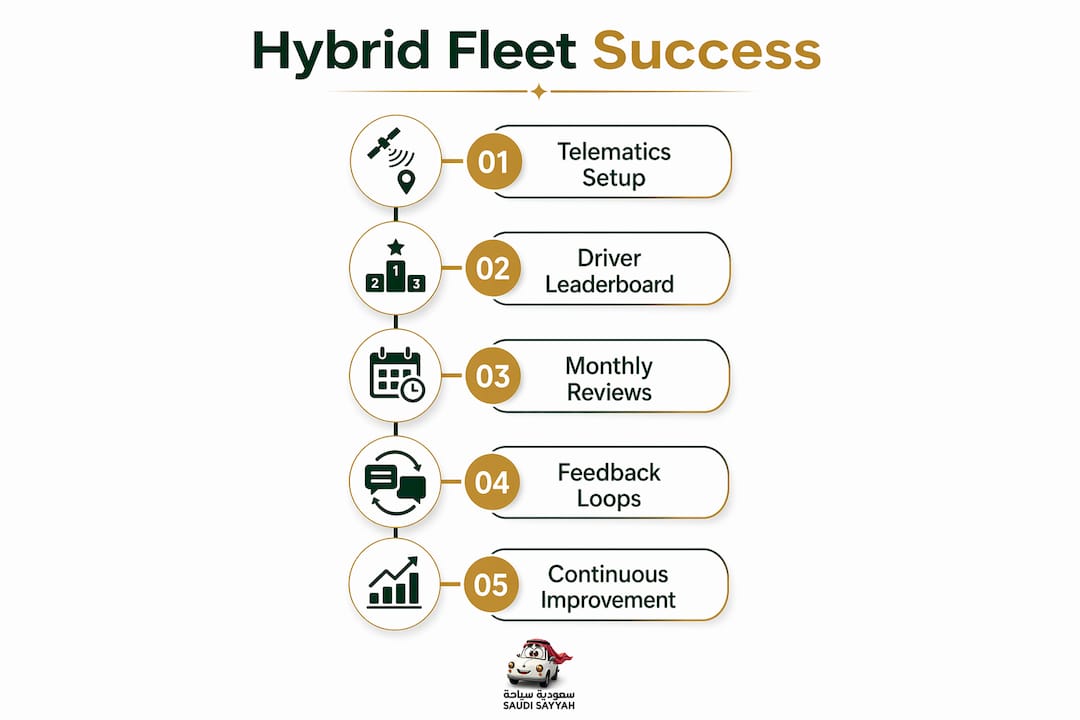
Deploy telematics at procurement. Implementing telematics during procurement enables precise measurement of hybrid usage patterns and accelerates driver training. Early telemetry data shows which drivers are maximizing regenerative braking and which need coaching.
-
Train drivers on hybrid-specific techniques. Regenerative braking, smooth acceleration, and anticipatory driving all increase electric assist contribution. A half-day training session on these techniques closes the gap between average and optimized hybrid performance.
-
Phase procurement rather than converting the entire fleet at once. A phased approach reduces financial risk, allows operational learning, and gives fleet managers time to refine vehicle selection criteria based on real performance data.
Pro Tip: Use telematics to create a driver efficiency leaderboard. Friendly competition around fuel economy scores consistently produces better driving behavior than policy mandates alone.
Continuous feedback loops matter as much as the initial setup. Monthly reviews of fuel consumption, brake replacement intervals, and per-vehicle emissions output let fleet managers catch underperforming vehicles early and adjust driver assignments or routes accordingly. For transportation managers interested in fleet compliance practices, integrating hybrid performance data into existing compliance reporting adds accountability without creating a separate tracking system.
What financial and environmental factors matter most?
The financial case for hybrid fleets rests on three pillars: fuel savings, maintenance savings, and regulatory cost avoidance. Fuel savings of 15–25% are the most visible. Maintenance savings of 10–20% accumulate more slowly but compound over a vehicle's full service life. Regulatory cost avoidance, particularly Clean Air Zone fees in cities like London, Birmingham, and Bath, can add thousands of dollars per vehicle per year to the savings total for city-based fleets.
Environmental considerations are more nuanced. Hybrids reduce emissions meaningfully but do not eliminate them. Organizations with aggressive ESG targets requiring net-zero operations will eventually need to move beyond hybrids. The practical value of hybrids in that context is as a transition vehicle: they reduce emissions now while the organization builds the infrastructure and budget for full electrification.
Key environmental and financial factors to weigh:
- Emission reduction scope. Hybrids cut CO2 output but still burn fossil fuel. They satisfy many current regulatory thresholds but may not meet future zero-emission mandates.
- Incentive availability. Government incentives for hybrid vehicles vary by country and region. Fleet managers should verify current incentive status before finalizing procurement budgets.
- Residual value. Hybrid vehicles have maintained strong residual values relative to equivalent gasoline models in most markets, which improves total cost of ownership calculations.
- Preparation for full electrification. Operating hybrids builds organizational competency in electrified powertrains, making the eventual transition to BEVs less disruptive.
Avoiding ideological decisions on powertrain choice and focusing on duty cycle fit leads to better fleet outcomes. A fleet that forces BEV adoption before its infrastructure is ready will spend more and deliver less than one that uses hybrids as a deliberate, time-bounded step. For fleet managers interested in how eco-friendly transport choices align with broader sustainability goals, hybrids represent a credible and immediate option.
The 2026 transportation trends point toward tightening emissions regulations across major markets. Fleet managers who have already integrated hybrids will be better positioned to meet those requirements than those still operating fully conventional fleets.
Key Takeaways
Hybrid fleets deliver measurable fuel savings, lower maintenance costs, and regulatory cost avoidance with less operational disruption than any other electrified powertrain option available today.
| Point | Details |
|---|---|
| Fuel and maintenance savings | Hybrids reduce fuel consumption by 15–25% and maintenance costs by 10–20% in real operations. |
| No infrastructure required | Conventional hybrids refuel at existing stations, eliminating charging hardware costs entirely. |
| PHEV behavior risk | Over 80% of PHEV drivers do not plug in consistently, making HEVs more reliable for fleet savings. |
| Telematics accelerates ROI | Deploying telematics at procurement enables precise usage tracking and faster driver performance gains. |
| Bridge to full electrification | Hybrids build organizational readiness for BEVs without stalling current decarbonization progress. |
The case for pragmatism over ideology in powertrain selection
Fleet managers face real pressure from two directions: finance teams demanding cost control and sustainability officers demanding decarbonization. The temptation is to treat those as competing priorities. They are not.
Hybrids resolve that tension better than any other powertrain option currently available at scale. The fuel and maintenance savings satisfy finance. The emissions reductions satisfy sustainability reporting. The absence of charging infrastructure requirements satisfies operations. That three-way alignment is rare in fleet management decisions, and it is the core reason hybrids continue to outsell both PHEVs and BEVs in fleet procurement.
What I find most underappreciated is the organizational learning value. Fleets that adopt hybrids now are building driver familiarity with electrified powertrains, collecting real-world duty cycle data, and developing internal expertise in telematics-based performance management. When those organizations eventually move to BEVs, they will do so with a trained workforce and a data-rich understanding of their own operations. Fleets that skip hybrids and wait for "the right moment" to go fully electric tend to arrive at that moment unprepared.
The practical recommendation is to pilot hybrids on your highest-frequency urban routes first, measure rigorously for 90 days, and let the data drive the next procurement decision. Powertrain selection should follow duty cycle analysis, not the other way around.
— Fa
Saudisayyah's fleet options for transportation managers
Transportation managers evaluating hybrid fleet strategies need vehicles that perform reliably across demanding duty cycles. Saudisayyah operates a fleet of late-model vehicles built for professional transportation, with real-time tracking, driver verification, and automated booking management built into every service.

Saudisayyah's vehicle hire services are designed for transportation managers who need operational reliability without the overhead of fleet ownership. For managers exploring how modern fleet composition supports both efficiency and passenger experience, the Saudisayyah fleet offers a practical reference point for late-model vehicle standards and professional driver management. Every vehicle comes with geolocation tracking and pre-trip driver details, giving transportation managers the visibility they need to manage operations confidently.
FAQ
What is a hybrid fleet?
A hybrid fleet is a group of vehicles that combine internal combustion engines with electric motors to reduce fuel consumption and emissions. These vehicles do not require external charging infrastructure and operate like conventional vehicles from the driver's perspective.
How much fuel can a hybrid fleet save?
Hybrid fleets typically reduce fuel consumption by 15–25% compared to equivalent conventional gasoline fleets in real-world operations. Savings are highest on urban and mixed-cycle routes where regenerative braking captures the most energy.
Are hybrid fleets better than fully electric fleets?
Hybrid fleets carry lower adoption risk and require no charging infrastructure, making them more practical for fleets with mixed routes or limited capital budgets. Fully electric vehicles deliver greater long-term emissions reductions but require significant infrastructure investment and suit predictable, depot-based duty cycles best.
Why do PHEVs underperform in fleet settings?
More than 80% of plug-in hybrid drivers do not plug in consistently, which eliminates most of the fuel and emissions savings PHEVs are designed to provide. Conventional hybrids deliver more predictable savings because their performance does not depend on driver charging behavior.
How do I start integrating hybrid vehicles into my fleet?
Start with a duty cycle audit to identify urban and mixed-route vehicles where hybrid efficiency gains are highest. Deploy telematics at procurement to measure performance from day one and use that data to guide phased expansion across the rest of the fleet.