

TL;DR:
- Travel management encompasses the entire process of planning, booking, controlling, and reporting on all travel activities within organizations or for individual trips. It involves policy enforcement, traveler safety, expense reconciliation, and analytics to reduce costs and ensure duty of care, especially for large-group travels. Modern systems leverage AI and centralized platforms to automate policies, real-time tracking, and dynamic itineraries, transforming travel management into a strategic function.
Travel management is far more than booking a flight and calling it done. What is travel management, really? It is the end-to-end process of planning, booking, controlling, and reporting on all travel activity within an organization or for an individual trip. It covers policy enforcement, traveler safety, expense reconciliation, and performance analytics. For organizations sending dozens or hundreds of people on the road each year, the difference between structured travel management and ad hoc booking can mean tens of thousands of dollars and serious duty-of-care gaps.
Table of Contents
- Key takeaways
- What travel management actually means
- Travel management systems and companies
- Group travel management challenges and best practices
- What is travel itinerary management
- Practical tips for managing travel effectively
- My take on where travel management is heading
- How Saudisayyah supports your travel management needs
- FAQ
Key takeaways
| Point | Details |
|---|---|
| Travel management is end-to-end | It covers planning, booking, compliance, safety, and reporting, not just reservations. |
| Technology is reshaping the role | AI-driven platforms shift travel managers from booking clerks to strategic spend controllers. |
| Group travel needs special handling | Groups of 10 or more require centralized workflows, room blocks, and dedicated coordination. |
| Itineraries are dynamic data records | Modern itineraries aggregate multi-supplier data and push real-time updates to travelers. |
| Good systems prevent costly mistakes | Missing one detail in group travel can disrupt an entire trip and organization. |
What travel management actually means
The definition of travel management is broader than most people expect. According to industry sources, key components include policy enforcement, booking infrastructure, expense reconciliation, duty of care, and analytics. Think of it as the operating system that sits behind every work trip, pilgrimage, or group excursion.
Here is what travel management typically covers:
- Policy enforcement. Setting rules about which airlines, hotels, and car services employees or travelers can use, and making sure those rules are followed at the point of booking.
- Budgeting and expense control. Tracking what is spent, catching out-of-policy expenses early, and reconciling receipts against approved budgets.
- Duty of care. Knowing where travelers are at all times, especially during disruptions or emergencies.
- Analytics and reporting. Measuring spend by department, supplier, or trip type to negotiate better rates and spot waste.
- Traveler support. Handling rebookings, cancellations, and real-time assistance when things go wrong.
The benefits of travel management are concrete. Organizations that manage travel through structured programs consistently reduce costs, improve policy compliance, and respond faster when travelers run into trouble. A company spending $1 million a year on travel can realistically save 10 to 20 percent through better supplier negotiations and policy adherence alone.
Pro Tip: Before choosing any system or provider, map your most frequent trip types first. A business with mostly domestic trips has very different needs from one sending groups overseas for conferences or religious observances.
Travel management systems and companies
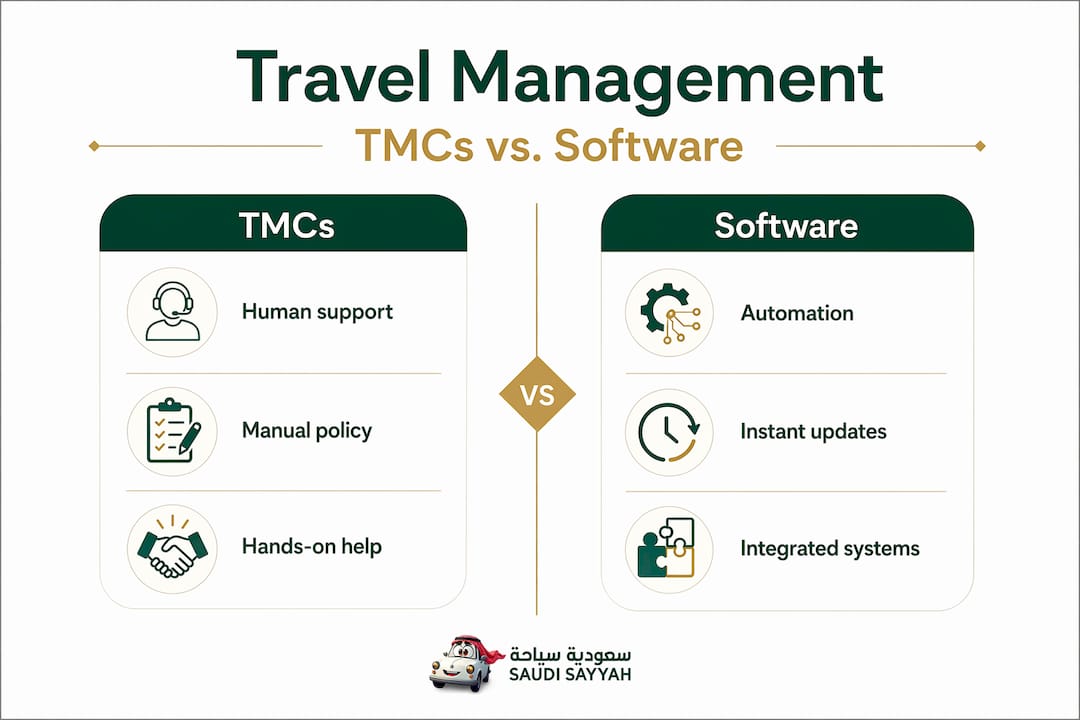
Two categories of providers handle travel management for organizations. Travel management companies (TMCs) are specialized agencies that go beyond standard booking. They negotiate corporate rates, provide 24/7 traveler support, and deliver reporting tools that a regular travel agency does not offer. They act as an extension of your operations team, not just a ticket vendor.
Travel management software operates alongside or in place of TMCs. AI-driven systems automate policy enforcement and real-time expense tracking, shifting the travel manager role from reactive booking to proactive spend control. The table below shows how manual and platform-based approaches compare:
| Function | Manual process | Integrated platform |
|---|---|---|
| Policy enforcement | Email reminders, manual review | Automated at point of booking |
| Expense tracking | Spreadsheets, receipts by email | Real-time dashboards |
| Traveler location | Unknown until check-in | Live tracking, duty of care alerts |
| Reporting | Monthly, often incomplete | Instant, exportable, filterable |
| Rebooking disruptions | Phone calls during travel | Automated alternatives pushed to traveler |
Modern travel management software also integrates with HR systems, corporate cards, and approval workflows. That means a travel request can go from submission to booked ticket to expensed receipt without anyone touching a spreadsheet.
Pro Tip: When evaluating travel management solutions, ask vendors specifically how policy violations are flagged. Some systems warn after booking. The best ones prevent out-of-policy selections from completing at all.
Group travel management challenges and best practices
What is group travel management? It refers to coordinating travel for 10 or more people traveling together for a shared purpose, whether that is a corporate offsite, a conference delegation, or a pilgrimage group. Group travel accounts for roughly 15 to 20 percent of total business travel spend, yet most organizations still manage it through email chains and spreadsheets.

The core problem is structural. Group booking can take 10 to 18 days due to negotiating group rates, managing room blocks, and updating passenger lists manually. Airlines handle group inventory through offline revenue management processes, meaning there is no instant API to confirm 25 seats the way individual booking works. That gap explains most of the frustration organizations feel when coordinating large groups.
Here is where most group travel coordination breaks down:
- No single source of truth. Traveler names, dietary needs, passport details, and flight preferences live in different emails and files.
- Payment milestones get missed. Group bookings require deposits at specific dates. Missing one can mean losing the block entirely.
- Approvals are informal. Without a workflow, approvals happen in chat messages that no one can audit later.
- Communication gaps. Changes to itineraries reach some travelers and not others, creating confusion on departure day.
Robust workflow controls that track every element of the lifecycle, from pre-departure tasks through payment milestones and approval routing, are what separates successful group travel programs from chaotic ones. A dedicated coordinator using a centralized platform makes all the difference. Centralized platforms keep all travelers visible for duty of care tracking and apply group rates and policies consistently without manual intervention.
Pro Tip: Assign one named coordinator per group trip with explicit authority to confirm decisions. Groups fail not from lack of tools but from unclear ownership.
What is travel itinerary management
Most travelers think an itinerary is just a printout of their flights and hotel. In professional travel management, it is far more than that. A modern itinerary is sometimes called a Super PNR or Trip Record. It is a dynamic data container aggregating booking data from multiple suppliers, including airlines, hotels, ground transport, and car hire, into one unified interface with real-time updates.
The difference between a ticket and an itinerary is meaningful. A ticket confirms a specific booking. An itinerary is the full trip record that holds all bookings together, tracks changes, and communicates updates to the traveler and travel manager simultaneously.
Here is what modern itinerary management platforms do:
- Pull booking data from multiple APIs automatically, so nothing needs to be entered manually.
- Push real-time notifications for delays, gate changes, and hotel updates directly to the traveler's phone.
- Flag disruptions and suggest alternatives before the traveler even knows something has changed.
- Provide travel managers with a live view of where every traveler in their program is at any given moment.
Travel itineraries are no longer static documents. They are interactive digital timelines that travelers and managers both depend on for operational control. For pilgrimages and religious travel specifically, where schedules are tight and group coordination is critical, a live itinerary is not a convenience. It is a necessity.
| Itinerary element | Static document | Dynamic platform |
|---|---|---|
| Flight updates | Manual re-issue | Auto-pushed to traveler |
| Hotel confirmation | PDF attachment | Live booking reference |
| Ground transport | Printed voucher | Real-time driver tracking |
| Emergency contact | Listed in document | Triggered alert system |
The role of automation in itinerary management has grown significantly. Organizations that use live itinerary platforms report fewer missed connections and faster response to disruptions compared to those relying on static booking confirmations.
Practical tips for managing travel effectively
Whether you are an individual planning a complex trip or an organization building a formal travel program, the following practices apply across the board.
- Start with a clear travel policy. Document which suppliers are approved, what spending limits apply, and how approvals work. A policy does not need to be long. It needs to be specific.
- Choose your tools based on your actual volume. A small organization with five trips a year does not need enterprise travel management software. A group running monthly delegations does.
- Centralize all traveler data. Passport numbers, visa status, emergency contacts, and dietary requirements should live in one accessible place, not scattered across email inboxes.
- Build communication checkpoints into every group trip. Send reminders at booking, 72 hours before departure, and on the morning of travel. Silence creates anxiety and last-minute calls.
- Track what you spend. Even basic reporting on trip costs by purpose, destination, or team reveals patterns that lead to better supplier negotiations within one or two booking cycles.
- Do not underestimate ground transport. Flights and hotels get the attention. But how travelers get from the airport to their destination, especially in unfamiliar cities or during pilgrimages, is where travel management either earns its value or loses it.
Pro Tip: For organizations managing Umrah or Hajj logistics, ground transport coordination is one of the highest-risk elements. Book transport providers who offer real-time tracking and confirmed driver details before every trip.
My take on where travel management is heading
I have watched organizations treat travel management as an afterthought for years, and the pattern is always the same. Everything works until it does not. One missed room block, one group stranded at an airport, one expense report that cannot be reconciled, and suddenly travel management becomes a boardroom topic.
What I have learned is that the real value of structured travel management is not in cutting costs, though that happens. It is in the elimination of uncertainty. When a travel manager knows where every traveler is, what every trip costs in real time, and has a workflow in place for exceptions, the organization can move faster and respond better.
The shift toward AI-powered spend control is real and accelerating. Travel managers who embrace that shift become strategic partners to finance and operations teams. Those who resist it spend their days chasing receipts.
For organizations managing religious travel or pilgrimage groups, the human element matters more than anywhere else. Technology should reduce friction and eliminate surprises. But the relationship between a traveler undertaking something sacred and the team supporting their journey requires genuine attention and care. The best travel management programs I have seen balance both. Precise systems, human accountability.
— Fa
How Saudisayyah supports your travel management needs
Effective travel management depends on reliable ground transport, especially when coordinating groups in unfamiliar destinations. Saudisayyah provides premium car hire services built specifically for individuals and groups traveling to Saudi Arabia for Umrah, Hajj, and corporate purposes. Every booking includes driver photos, vehicle details, and live GPS tracking before the trip begins, so there are no unknowns on arrival.
For group travel coordinators, Saudisayyah's vehicle fleet options cover everything from individual transfers to large group transport, with vehicles from the latest model years and drivers who understand the logistics of high-volume pilgrimage seasons. The platform's geolocation-enabled system integrates directly into your travel management workflow, giving coordinators real-time visibility and travelers genuine peace of mind. When ground transport is managed this way, it stops being a gap in your travel program and starts being a strength.
FAQ
What is the definition of travel management?
Travel management is the end-to-end process of planning, booking, controlling, and reporting on travel to maintain policy compliance, control costs, and protect traveler safety. It covers everything from booking infrastructure to real-time duty of care.
What does travel management involve day to day?
Day-to-day travel management includes enforcing travel policies, processing approvals, tracking expenses, managing itinerary changes, and supporting travelers during disruptions. In larger organizations, it also involves supplier negotiations and data reporting.
What is group travel management?
Group travel management is the coordination of travel for 10 or more people traveling together for a shared purpose. It requires centralized platforms, workflow controls, and dedicated coordinators to handle room blocks, group rates, approvals, and traveler communication.
How is travel itinerary management different from a booking?
A booking confirms a single reservation. Travel itinerary management aggregates all bookings for a trip into one dynamic record, with real-time updates from multiple suppliers and notifications pushed to the traveler for delays, gate changes, and other disruptions.
What are the main benefits of travel management for organizations?
The main benefits include cost control through better supplier rates, policy compliance, faster response to travel disruptions, and duty of care compliance. Organizations with structured travel programs also gain data that improves future travel decisions.