
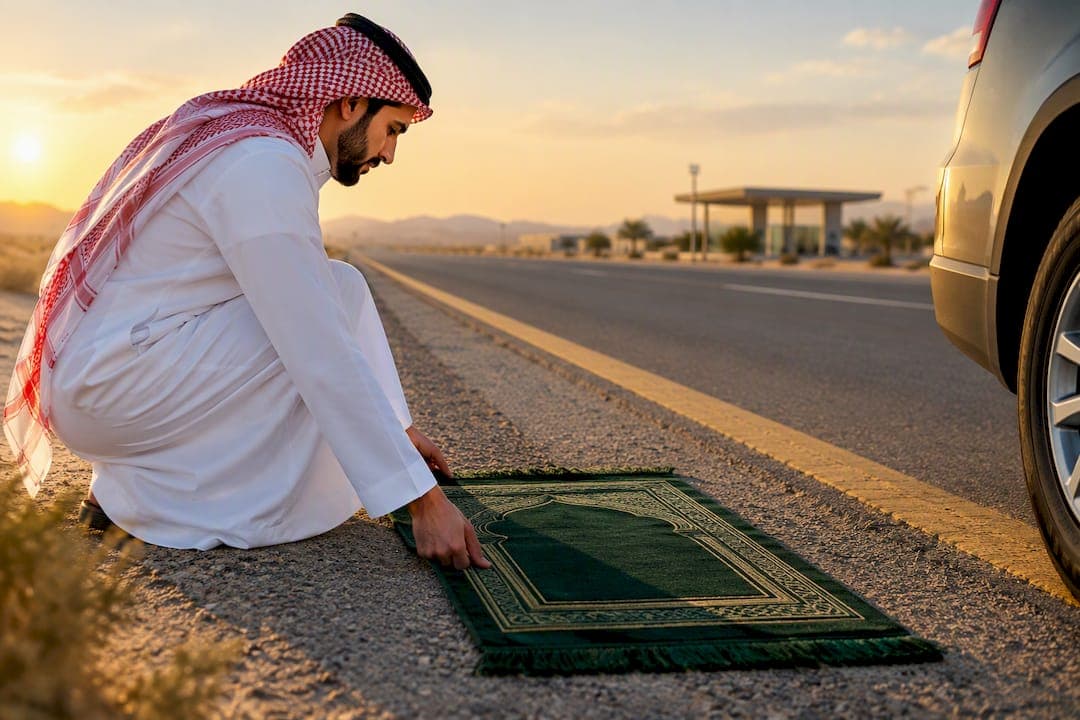
You may stop to pray while traveling in Saudi Arabia, but only off the carriageway, without blocking traffic, and never in a travel lane. Official traffic guidance and Islamic rulings agree on this point. A checklist below covers the immediate steps.
TL;DR:
- Stopping for prayer in Saudi Arabia requires pulling fully off the road and avoiding traffic lanes, roundabouts, or narrow shoulders to prevent violations.
- Prayer should be brief, face the qibla as closely as possible, and is permitted inside the vehicle if getting out is unsafe, using gestures for bowing and prostration.
- Always scout ahead for safe rest stops or service stations before prayer time to avoid hazardous roadside stops and unnecessary traffic violations.
- Rejoining traffic safely after prayer involves signaling early, checking mirrors twice, and merging gradually without rushing or creating hazards.
- Mobile prayer caravans and designated rest stops near highways are designed to reduce roadside stopping, and route planning can incorporate these facilities to avoid illegal stops.
Table of Contents
- Quick checklist: 6 practical actions to stop for prayer safely
- What Saudi traffic authorities say and legal risks to avoid
- Religious rulings and practical allowances for praying in a car or by the roadside
- Step-by-step: how to stop, pray, and rejoin traffic safely
- Alternatives and Saudi infrastructure: rest stops, mobile caravans, and mosque facilities on highways
- A driver's brief reflection on responsibility and planning
- A managed alternative that removes the roadside guesswork
- Sources
- FAQ
Quick checklist: 6 practical actions to stop for prayer safely
Safety first. Prayer second. Both matter.
- Choose a rest area or service station whenever one is available.
- Never stop inside a traffic lane or on a roundabout.
- Turn on hazard lights and pull fully off the road surface.
- Leave clear space for passing vehicles and avoid blocking any exit.
- Pray inside the vehicle if getting out is unsafe, using the allowances described below.
- Keep the prayer brief, then rejoin traffic without delay.
If no safe stop appears, continue to the next one.
Pro Tip: Scout for a rest stop sign or fuel station a few kilometers ahead before prayer time arrives, not after.
What Saudi traffic authorities say and legal risks to avoid
The General Directorate of Traffic urges drivers to select proper parking when stopping for prayer and treats random stopping that obstructs traffic as a violation. The Ministry of Interior's traffic system adds that stopping in a way that obstructs others can bring civil liability if harm results.
Unsafe or prohibited stopping includes:
- Stopping in an active travel lane, even briefly.
- Halting on or near a roundabout.
- Parking on a narrow shoulder with no clearance from passing traffic.
- Blocking an exit ramp or service road entrance.
Traffic officers commonly direct drivers to move on the spot. Comply immediately and look for the next marked pull-out or station. Repeated or hazardous stopping can draw a fine or a formal warning, and either outcome costs more time than driving a few extra minutes to a proper stop.
Religious rulings and practical allowances for praying in a car or by the roadside
IslamWeb's ruling on prayer in a vehicle permits praying in a car when stopping safely is not possible or the prayer time would otherwise be missed. Gestures replace the standing bow and prostration, and the worshipper faces the qibla as much as the situation allows.
Praying in the middle of the road is a separate matter. IslamWeb's ruling on prayer in the road treats it as disliked or forbidden in most cases, since it impedes others and distracts the person praying. Some scholars allow it only when no safe alternative exists and no obstruction occurs.
Practical steps for praying in a car:
- Pull off the carriageway first, then begin the prayer.
- Face the qibla direction as closely as the parking angle permits.
- Use head and hand gestures for ruku' and sujud while seated.
- Keep the prayer short and finish before restarting the drive.
One of the most consistent points in Islamic rulings on roadside prayer is that avoiding harm to others carries real weight in the ruling itself, not just as a courtesy. The obligation to worship never cancels the duty to keep other road users safe.
Step-by-step: how to stop, pray, and rejoin traffic safely
A safe stop follows a set order. Skipping a step raises the risk for everyone nearby.
- Scan ahead for a rest area, service station, or wide shoulder before you need to stop.
- Signal early and ease off the carriageway completely, not just onto the paint line.
- Set the handbrake and switch on hazard lights.
- Place a warning triangle behind the vehicle if you carry one and conditions allow it.
- Exit only on the side away from traffic, and stand clear of the road if you step out.
- If praying inside, orient toward the qibla as best you can and use seated gestures for the bowing and prostration positions.
- Finish the prayer, recheck mirrors and blind spots, then merge back gradually rather than pulling out sharply.
Pro Tip: Check your mirror twice before rejoining, once for a gap and once to confirm the gap is still there.
Rejoining traffic too quickly is one of the more common causes of a roadside stop turning into a real hazard. A few extra seconds of checking costs nothing.

Alternatives and Saudi infrastructure: rest stops, mobile caravans, and mosque facilities on highways
Saudi Arabia has built alternatives specifically to reduce roadside stopping. Mobile caravan initiatives on pilgrim routes such as Hijra Road bring prayer facilities, shade, and cooling directly to travelers along the way.
- Mobile caravans offer prayer space, shade, and cooling on major routes.
- Staffed rest stops cluster near known service stations during Hajj and Umrah seasons.
- Planning a route around these clusters removes most reasons to stop on the shoulder.
Reviewing a route before departure, the way our guide for first-time visitors to the holy cities recommends, turns prayer breaks into a planned stop rather than a rushed one.
A driver's brief reflection on responsibility and planning
Every driver on that road is someone's responsibility, including the ones who never see your hazard lights in time. The habit worth keeping is simple: know the next rest stop before you need it. Following both the traffic rules and the religious guidance together is not a compromise. It is the point.
— Fa
A managed alternative that removes the roadside guesswork
Booked transport removes the need for an unscheduled roadside stop in the first place. 
Saudi Sayyah builds prayer breaks into the route from the start, whether the trip is a Point to Point Transportation transfer, a Ziarah Packages tour, an Airport Transfer, an Intercity Transfer, or a vehicle booked through Hire by the Hour. Drivers know the road and the rest stops along it, so the stop happens at a proper station, not a narrow shoulder. Check our services to plan a trip where the prayer break is already part of the route.
Sources
This guide draws on Ministry of Interior traffic rules, IslamWeb fatwas on prayer in vehicles and on roads, and Saudi Press Agency and Saudiauto coverage of mobile caravan initiatives.
- Saudi Press Agency (SPA) — coverage of traffic guidance
- IslamWeb — Ruling on performing obligatory prayer in a vehicle
- Saudiauto — coverage of mobile caravan initiative for pilgrims
FAQ
Is it illegal to stop on the road to pray in Saudi Arabia?
Stopping itself is not illegal, but stopping in a way that blocks or endangers traffic is treated as a violation under General Directorate of Traffic guidance. Pull fully off the carriageway or use a rest stop instead.
Can I pray inside my car while driving in Saudi Arabia?
Yes, once the vehicle is safely stopped and getting out is not practical, Islamic rulings on prayer in a vehicle allow seated gestures for bowing and prostration. Face the qibla as closely as your position allows.
Is praying in the middle of the road allowed?
Generally no. IslamWeb's ruling on prayer in the road treats it as disliked or forbidden except when no safe alternative exists and no one is obstructed.
What should I do if a traffic officer asks me to move?
Comply right away and move to the nearest safe pull-out, rest area, or service station. Delaying compliance adds risk and can result in a citation.
Are there rest stops built for prayer along pilgrim routes?
Yes, mobile caravans and staffed rest stops along routes like Hijra Road provide prayer facilities, shade, and cooling during Hajj and Umrah seasons. Planning your route around them avoids the need for a roadside stop.