
TL;DR:
- Modern pilgrimage travel emphasizes personal transformation over sightseeing, attracting both religious and secular travelers seeking depth and reflection. It differs from tourism by prioritizing intention-driven journeys that promote inner change, with diverse spiritual and secular meanings filling traditional structures. Growth in pilgrimage tourism accelerates globally, with shorter trips, premium accommodations, and advanced technologies shaping the future of sacred travel.
Modern pilgrimage travel is a purposeful journey to a meaningful place, undertaken with the intention of personal transformation rather than sightseeing. The practice spans religious traditions and secular motivations alike, from Hajj in Mecca to walking the Camino de Santiago or trekking to Varanasi. What is modern pilgrimage travel, exactly? It is defined as intentional travel that prioritizes openness to transformation over pre-set destinations or experience collection. Pilgrimage is not a new concept, but its meaning has expanded dramatically, drawing millions of travelers who seek depth, reflection, and connection in a world saturated with passive tourism.
What is modern pilgrimage travel, and how does it differ from tourism?
Modern pilgrimage travel differs from tourism in one fundamental way: intention drives the journey, not the destination. A tourist moves through space to collect experiences. A pilgrim moves through space to be changed by it. That distinction, drawn clearly in a 2026 pilgrimage manifesto, separates the two practices even when they visit identical locations.
Traditional pilgrimage followed a recognizable structure: departure from ordinary life, a demanding road, arrival at a sacred site, and return transformed. Modern pilgrimage keeps that structure but fills it with diverse spiritual or secular meanings suited to each traveler's personal search. A devout Muslim completing Hajj and a secular hiker walking the Camino de Santiago share more structural DNA than either shares with a resort tourist.
The Camino de Santiago is the clearest example of this evolution. A 2026 analysis describes it as a "third form" distinct from both conventional tourism and traditional religious devotion. It attracts people processing grief, career transitions, and existential questions alongside devout Catholics completing a centuries-old vow.
| Characteristic | Pilgrimage | Tourism |
|---|---|---|
| Primary motivation | Transformation and meaning | Experience and leisure |
| Relationship to destination | Sacred or deeply significant | Attractive or novel |
| Mindset | Open, reflective, intentional | Exploratory, consumptive |
| Physical challenge | Often central to the experience | Usually minimized |
| Outcome sought | Inner change | External memories |
Pro Tip: Before booking anything, write one sentence describing what you want to be different about yourself when you return. That sentence is your pilgrimage intention, and it will guide every decision that follows.
How fast is pilgrimage tourism growing?
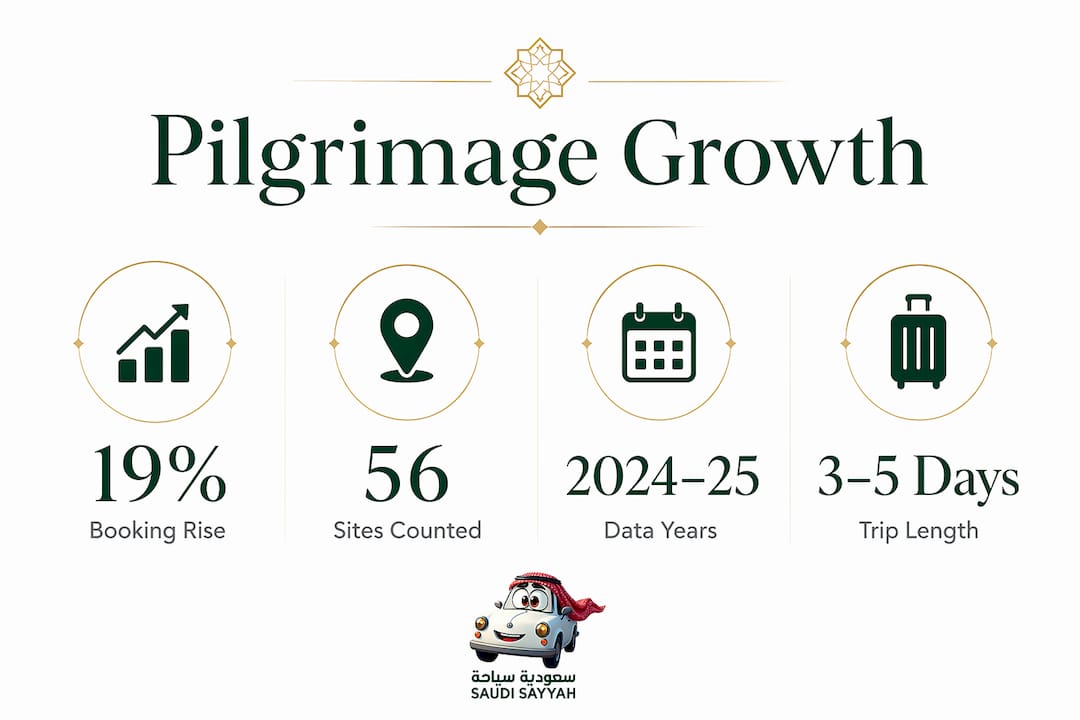
Pilgrimage tourism is growing faster than general leisure travel across multiple regions. Accommodation bookings across 56 pilgrimage destinations in India grew 19% in 2024–25, according to MakeMyTrip's annual pilgrimage travel report. That figure reflects a broad shift in traveler priorities, not just a regional spike.
Several trends are reshaping who goes on pilgrimage and how they do it.
- Shorter trips, higher spend. Travelers increasingly prefer 2–4 day pilgrimage trips with premium accommodations rather than extended budget journeys.
- Demographic expansion. Younger travelers in their 20s and 30s now make up a growing share of pilgrimage bookings, particularly on routes like the Camino de Santiago.
- Digital planning tools. Navigation apps, offline route downloads, and real-time transport tracking have made remote pilgrimage routes accessible to first-time travelers. Saudisayyah's guide on pilgrimage travel technologies covers the most useful tools for 2026.
- Premium comfort expectations. Modern pilgrims do not equate hardship with authenticity. Many book quality hotels near sacred sites and use professional transport services.
| Trend | Detail |
|---|---|
| Booking growth | 19% rise across 56 Indian pilgrimage destinations in 2024–25 |
| Trip duration | Short-duration trips (2–4 days) dominate new bookings |
| Accommodation preference | Premium rooms outpacing budget options at pilgrimage sites |
| Technology adoption | Offline maps, booking apps, and real-time tracking now standard |
| Sustainability pressure | Regenerative tourism frameworks emerging to protect sacred sites |
The growth also creates pressure. A 2026 MDPI paper introduced a Model of Regenerative Religious Sensitivity to address the tension between rising visitor numbers and the spiritual integrity of sacred spaces. More pilgrims means more infrastructure, and more infrastructure can erode the very atmosphere that draws people there.
How to plan a modern pilgrimage journey
Planning a modern pilgrimage starts with intention, not logistics. Setting a clear intention and preparing for enrichment beyond mere logistics separates a genuine pilgrimage from an expensive walk. Once your purpose is clear, the practical steps follow naturally.
Step-by-step planning framework:
- Define your intention. Write it down. Is this about grief, gratitude, faith, physical challenge, or cultural connection? Your answer shapes every other decision.
- Choose a destination aligned with that intention. Religious travelers may prioritize Mecca, Jerusalem, or Varanasi. Secular pilgrims might choose the Camino de Santiago, the Kumano Kodo in Japan, or a personally significant landscape.
- Decide on duration and pacing. Multi-week walking routes demand physical preparation months in advance. Shorter sacred site visits require less conditioning but benefit from scheduled reflection time.
- Plan your technology use deliberately. Carry a charged power bank and download offline route maps before departure. The British Pilgrimage Trust specifically advises against live GPS tracking during walking pilgrimages, since constant screen checking pulls attention away from the experience.
- Build in ritual and reflection. Schedule time each day for journaling, prayer, meditation, or simply sitting in silence. These moments are where transformation actually happens.
- Prepare for disruption. Delays, weather, physical fatigue, and unexpected detours are not problems on a pilgrimage. They are part of it. Build buffer days into your itinerary.
- Arrange reliable transport for key legs. Getting to and from sacred sites, airports, and hotels requires dependable logistics. For Hajj and Umrah travelers, Saudisayyah's Umrah logistics guide covers every transport consideration in detail.
Pro Tip: Limit phone notifications for the entire duration of your pilgrimage. One study of pilgrimage planning guidance from Psyche recommends treating notification silence as a ritual boundary, not just a preference.
Physical preparation matters more than most first-time pilgrims expect. Walking routes like the Camino Francés cover over 500 miles. Even shorter sacred site visits in cities like Mecca involve significant walking across large complexes. Start conditioning your body at least 8 weeks before departure.
What are the most significant modern pilgrimage destinations?
The world's most significant pilgrimage destinations span every major faith tradition and a growing number of secular contexts. Each illustrates a different dimension of what contemporary pilgrimage experiences can offer.
Major religious pilgrimage sites:
- Mecca, Saudi Arabia. The Hajj pilgrimage draws over 2 million Muslims annually, making it the largest human gathering on earth. Umrah, the lesser pilgrimage, is open year-round and attracts millions more. Both require careful logistics, particularly transport between Jeddah, Mecca, and Medina.
- Santiago de Compostela, Spain. The Cathedral of Saint James marks the end of the Camino de Santiago network, which includes multiple routes across France, Portugal, and Spain. Over 400,000 pilgrims received the official Compostela certificate in recent years.
- Varanasi, India. One of the world's oldest continuously inhabited cities, Varanasi draws Hindu pilgrims to the Ganges River for rituals of purification and remembrance. The city operates as a living pilgrimage site 365 days a year.
- Jerusalem, Israel. Sacred to Judaism, Christianity, and Islam simultaneously, Jerusalem hosts pilgrims from all three traditions at sites including the Western Wall, the Church of the Holy Sepulchre, and the Al-Aqsa Mosque.
Emerging secular and spiritual pilgrimage routes:
- Kumano Kodo, Japan. A UNESCO World Heritage trail network in the Kii Peninsula, the Kumano Kodo connects ancient shrines through mountain forest. It is one of only two pilgrimage routes in the world to hold dual UNESCO status alongside the Camino de Santiago.
- St. Cuthbert's Way, United Kingdom. A 62-mile walking route from Melrose, Scotland to Holy Island in England, this route draws walkers seeking both historical depth and natural solitude.
- Natural landscape pilgrimages. Locations like Mount Kailash in Tibet, Uluru in Australia, and the Scottish Highlands attract travelers who define their sacred space through nature rather than doctrine.
The middle portion of any pilgrimage, away from ordinary life and not yet at the destination, is where scholarship consistently identifies the deepest transformation. Physical movement, community with fellow travelers, and removal from routine combine to create conditions for genuine inner change. That insight applies equally to a Muslim completing Tawaf in Mecca and a secular hiker crossing the Pyrenees.
Key takeaways
Modern pilgrimage travel is defined by intention and openness to transformation, not by religious affiliation, distance traveled, or the prestige of the destination.
| Point | Details |
|---|---|
| Intention separates pilgrims from tourists | Define your purpose in writing before planning any logistics. |
| Growth is accelerating globally | Pilgrimage bookings in India rose 19% in 2024–25, with premium options leading demand. |
| Structure remains, meanings have expanded | Religious and secular pilgrims share the same journey arc but fill it with personal significance. |
| Technology supports but can distract | Download offline maps and carry a power bank; limit live tracking to stay present. |
| The middle of the journey matters most | Transformation happens in transit, not only at the destination. |
Why intention is the only thing that actually matters
Most pilgrimage advice focuses on gear lists, route distances, and accommodation ratings. That is useful, but it misses the point entirely.
Every pilgrimage route I have studied or traveled shares one pattern: the people who return changed are the ones who decided to be changed before they left. The Camino de Santiago is full of people walking 500 miles who come back with the same unresolved questions they started with. Not because the route failed them. Because they treated it like a very long hike.
Modern technology creates a specific trap here. Navigation apps, social media check-ins, and constant messaging give you the feeling of being present while actually keeping you anchored to your ordinary life. The British Pilgrimage Trust's advice to avoid live GPS tracking is not technophobia. It is a recognition that presence is the whole product.
The growth of premium pilgrimage accommodations is not a contradiction of pilgrimage values, either. Physical comfort and spiritual openness are not opposites. A pilgrim who sleeps well and travels safely has more capacity for reflection than one who is exhausted and anxious about logistics. The regenerative tourism frameworks emerging around sites like Varanasi and Mecca point toward a future where comfort and reverence coexist by design.
The most underrated pilgrimage principle is this: the journey does not end at the destination. What you do with the experience when you return home determines whether it was a pilgrimage or an expensive trip.
— Fa
Plan your pilgrimage journey with Saudisayyah
Pilgrims traveling to Saudi Arabia for Hajj or Umrah face one of the world's most logistically complex sacred journeys. Reliable transport between Jeddah, Mecca, and Medina is not a convenience. It is a requirement for a focused, safe experience.
Saudisayyah provides professional car hire and premium fleet services built specifically for pilgrimage travelers. Every booking includes real-time driver tracking, vehicle details sent in advance, and a fully automated system that removes uncertainty from every transfer. The premium vehicle fleet covers everything from individual transfers to group transport, with latest-model vehicles and experienced drivers who understand the specific needs of first-time pilgrims. Explore all transport services and plan your sacred journey with confidence.
FAQ
What is the definition of pilgrimage travel?
Pilgrimage travel is intentional travel to a meaningful place undertaken with openness to personal transformation. It differs from tourism in that the journey's purpose is inner change, not experience collection.
Does modern pilgrimage have to be religious?
No. Modern pilgrimage includes secular motivations such as personal growth, grief processing, and cultural connection. The Camino de Santiago, for example, attracts both devout Catholics and non-religious walkers seeking meaning.
How do i choose a pilgrimage destination?
Choose a destination aligned with your stated intention. Religious travelers typically select sites tied to their faith tradition, while secular pilgrims often choose historically significant trails or natural landscapes that hold personal meaning.
How long does a modern pilgrimage take?
Duration varies widely. MakeMyTrip's 2024–25 data shows most pilgrimage bookings in India are short trips of 2–4 days, while walking routes like the Camino Francés take 4–6 weeks to complete on foot.
What technology should i bring on a pilgrimage?
Carry a charged power bank and download offline route maps before departure. The British Pilgrimage Trust advises against live GPS tracking during walking pilgrimages to preserve presence and focus during the journey.