
TL;DR:
- Elderly pilgrims can access extensive mobility support at Masjid al-Haram and the Prophet's Mosque, including free manual wheelchairs and motorized carts. Using these aids does not diminish the validity of seated Tawaf and Sa'i, allowing pilgrims to worship safely and comfortably. Proper planning, early booking, and clear communication ensure a smoother Umrah experience for those with mobility limitations.
Mobility aid options for elderly pilgrims are the tools and services that make Umrah physically possible and spiritually complete. The Saudi authorities have built an extensive support system at Masjid al-Haram and the Prophet's Mosque, covering everything from free manual wheelchairs to motorized carts with dedicated ritual lanes. Seated Tawaf and seated Sa'i are both valid, meaning no pilgrim needs to choose between physical safety and ritual fulfillment. This guide covers every major option available in 2026, matched to different mobility levels and ritual stages.
1. What mobility aid options for elderly pilgrims are available at the holy sites?
The General Authority for the Care of the Two Holy Mosques runs the most organized pilgrim mobility program in the world. Over 6,000 manual wheelchairs and 25 specialized transport carts are deployed at strategic points across Masjid al-Haram. That scale means most pilgrims can access a wheelchair within minutes of arriving at the mosque gates.
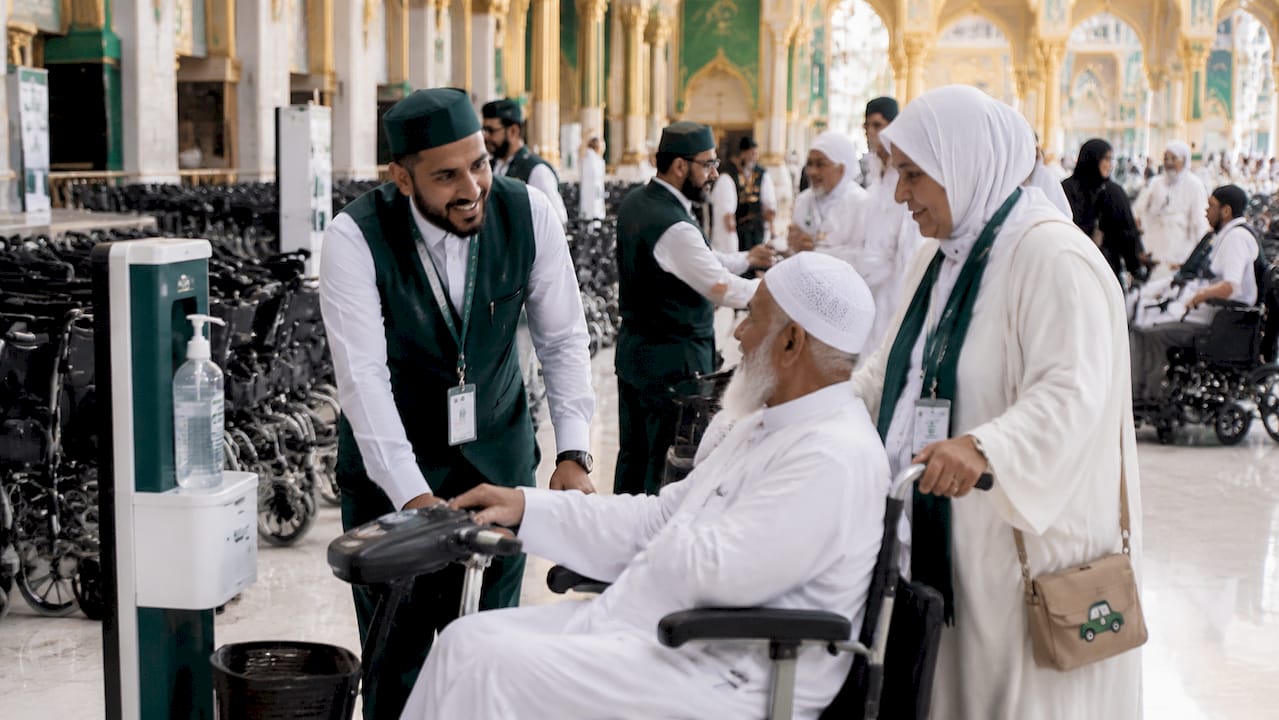
The Prophet's Mosque in Medina offers a parallel system. Electric and manual wheelchairs are available at entrances, along with transport carts and dedicated accessible routes. Staff guide elderly and disabled pilgrims during peak hours, and the facility includes elevators and accessible restrooms throughout.
Both mosques treat mobility support as a core service, not an afterthought. Pilgrims who need a wheelchair do not have to book in advance for manual chairs. They simply arrive at a distribution point near the gates and receive one.
2. How do manual wheelchairs and attendant services work?
Manual wheelchairs at Masjid al-Haram are free of charge and require no reservation. Distribution points sit near every major gate, and strategically positioned pick-up points provide flexibility even during the busiest hours. A family member or hired attendant can push the chair through Tawaf and Sa'i without any additional permit.
Attendant-assisted wheelchair services are the right choice for pilgrims who cannot self-propel but have a companion traveling with them. The companion handles navigation through the crowd while the pilgrim focuses entirely on worship. This setup works well for Tawaf on the ground floor, though upper levels are often less congested.
For pilgrims traveling without a companion, hired attendants are available at the mosque. Rates vary and are not publicly listed in a fixed schedule, so confirming costs on arrival is the practical approach.
Pro Tip: Request wheelchair and meet-and-assist services from your airline before departure. Coordinating airport assistance in advance prevents standing fatigue before rituals even begin.
- Free manual wheelchairs at all major Masjid al-Haram gates
- No advance booking required for manual chairs
- Attendant-assisted service available with or without a personal companion
- Airport wheelchair assistance available through most airlines on request
- Prophet's Mosque provides the same free wheelchair access with staff guidance
3. How do motorized carts and electric wheelchairs enhance Tawaf and Sa'i?
Motorized carts are the strongest option for pilgrims with severe mobility limitations. Booking a motorized cart for Tawaf, Sa'i, or both can be done through the Unified Mobility Platform or the Tanaqol app before arrival. Prices start from SAR 57.50 for single-use cart service and around SAR 115 for a combined Tawaf and Sa'i booking.
The carts operate on dedicated lanes that separate them from walking pilgrims. This matters most during peak hours, when ground-level congestion makes manual wheelchair navigation difficult. The Mas'a corridor for Sa'i is air-conditioned and has wheelchair and cart lanes on multiple levels, including upper and rooftop floors.
Upper-level Tawaf is quieter and cooler than the ground floor. Pilgrims using motorized carts on the upper levels complete the same valid ritual with significantly less physical stress. Rooftop tram services are also available for elderly pilgrims who need to cover longer distances within the mosque complex.
Pro Tip: Book your motorized cart through the Tanaqol app at least one week before arrival. Availability during peak Umrah seasons fills quickly, and pre-booking guarantees your slot.
| Service | Booking Method | Price (SAR) | Best For |
|---|---|---|---|
| Motorized cart, Tawaf only | Tanaqol app / Unified Mobility Platform | From 57.50 | Severe mobility limits |
| Motorized cart, Sa'i only | Tanaqol app / Unified Mobility Platform | From 57.50 | Severe mobility limits |
| Combined Tawaf and Sa'i | Tanaqol app / Unified Mobility Platform | Around 115 | Full ritual coverage |
| Manual wheelchair | No booking needed | Free | Light to moderate needs |
- Download the Tanaqol app or access the Unified Mobility Platform before travel
- Select the ritual type: Tawaf, Sa'i, or both
- Choose your preferred date and time slot
- Confirm the booking and save your reference number
- Present the reference at the designated cart pick-up point on arrival
4. What are the best walking aids for elderly pilgrims who can walk partially?
Walking aids cover a wide range, and the right choice depends on how far a pilgrim can walk and how stable they feel in a crowd. Canes, quad canes, walkers, and rollators each address a different level of balance and endurance. A standard cane suits pilgrims with mild balance issues. A quad cane, which has four small feet at the base, offers more stability on uneven surfaces.
Walkers provide full front support and work well for pilgrims who tire quickly. The limitation is speed. A walker slows movement considerably, which can create friction in dense crowds during peak Tawaf hours. Rollators, which are walkers with wheels and a built-in seat, solve the fatigue problem by letting pilgrims sit down briefly without finding a separate resting spot.
The crowd density at Masjid al-Haram is the main challenge for any walking aid user. Ground-level Tawaf during peak times is not ideal for walkers or rollators. Upper-level access, where crowds are thinner, is a better fit for pilgrims using these devices.
- Standard cane: Suits mild balance issues; lightweight and easy to carry
- Quad cane: Four-point base gives extra stability on marble floors
- Walker: Full front support; best for moderate fatigue but slows pace
- Rollator: Wheeled walker with a seat; ideal for pilgrims who need frequent short rests
- Combination approach: Use a walking aid for shorter distances and switch to a wheelchair or cart for Tawaf and Sa'i
5. How to choose the right mobility aid based on individual needs
Matching a mobility aid to the right pilgrim starts with an honest assessment of walking ability and endurance. A pilgrim who can walk 200 meters without stopping has different needs than one who cannot stand for more than a few minutes. The table below maps common mobility profiles to the most suitable aid.
| Mobility Level | Best Aid | Ritual Suitability | Cost |
|---|---|---|---|
| Walks well, mild balance issues | Standard or quad cane | Full walking rituals | Minimal |
| Walks short distances, tires quickly | Rollator or walker | Partial walking, rest breaks | Low |
| Cannot walk long distances | Manual wheelchair | Seated Tawaf and Sa'i (valid) | Free |
| Cannot walk at all | Motorized cart | Full seated ritual coverage | SAR 57.50–115 |
Seated Tawaf and seated Sa'i are valid ritual options. Pilgrims do not need to push through pain or risk a fall to fulfill the ritual correctly. A companion's role is also worth planning. A family member who understands the route, the pick-up points, and the crowd patterns adds more value than any single piece of equipment.
For pilgrims with fluctuating energy, a combined approach works best. Start Tawaf in a wheelchair, complete Sa'i by motorized cart, and use a cane for shorter walks between sites. Flexibility in the plan prevents exhaustion from derailing the entire pilgrimage.
6. What practical tips improve the Umrah experience using mobility aids?
Planning ahead is the single biggest factor in a smooth Umrah for elderly pilgrims. A practical mobility plan integrates walking, resting, wheelchair use, cart bookings, and companion support into a single schedule. Micro-rest strategies and planned hydration breaks improve endurance across the full ritual sequence.
Pro Tip: Schedule rituals for early morning or late evening when crowd density is lowest. Upper-level and rooftop areas stay cooler and less congested throughout the day, making them the best choice for elderly pilgrims using any mobility device.
- Book motorized carts and airport wheelchair assistance before departure
- Use upper-level Tawaf floors to avoid ground-level congestion
- Plan hydration and medication timing around ritual schedules
- Assign one companion specifically to navigation and crowd management
- Build in 15-minute rest stops between major ritual stages
- Stay flexible. If energy drops, switch from walking to a wheelchair without hesitation
- Check the accessible transport options available for transfers between Makkah and Medina
Key Takeaways
The most effective mobility plan for elderly Umrah pilgrims combines free manual wheelchairs, pre-booked motorized carts, and the right walking aid matched to individual endurance and ritual requirements.
| Point | Details |
|---|---|
| Free wheelchairs at both mosques | Over 6,000 manual wheelchairs are available at Masjid al-Haram gates with no booking needed. |
| Pre-book motorized carts | Use the Tanaqol app before arrival; prices start at SAR 57.50 for single-use service. |
| Seated rituals are valid | Seated Tawaf and seated Sa'i are fully valid, so physical safety never conflicts with ritual fulfillment. |
| Match aid to mobility level | Canes suit mild issues; rollators suit moderate fatigue; wheelchairs and carts suit severe limitations. |
| Plan airport assistance early | Requesting airline wheelchair service before departure prevents exhaustion before rituals begin. |
What I've learned watching elderly pilgrims use mobility aids at the holy sites
Most elderly pilgrims arrive with the same concern: that using a wheelchair or cart will somehow reduce the meaning of their worship. That concern is understandable. It is also wrong. Using a wheelchair or motorized cart does not diminish the spiritual value of the rituals. It enables pilgrims to worship in the best way they are able.
What I have observed is that the pilgrims who plan their mobility support in detail arrive calmer, complete more rituals, and leave with fewer regrets than those who try to push through without help. The ones who struggle most are those who wait until they are already exhausted to ask for a wheelchair. By that point, the energy needed for the remaining rituals is already gone.
The practical advice I give every time is this: communicate your needs early and clearly. Tell your airline, your transport provider, your hotel, and your companion exactly what you need before you arrive. The system at Masjid al-Haram is genuinely well-organized. The staff are experienced. But they cannot help you if they do not know you need support.
Accept the aid. Complete the worship. That is the point of the entire journey.
— Fa
Saudisayyah transport for elderly pilgrims
Elderly pilgrims need reliable, accessible ground transport from the moment they land. Saudisayyah provides vehicle transport services across Saudi Arabia with a fleet of late-model vehicles suited to pilgrims with mobility needs. Real-time tracking, driver photos, and vehicle details are sent before every trip, so there are no surprises on arrival.
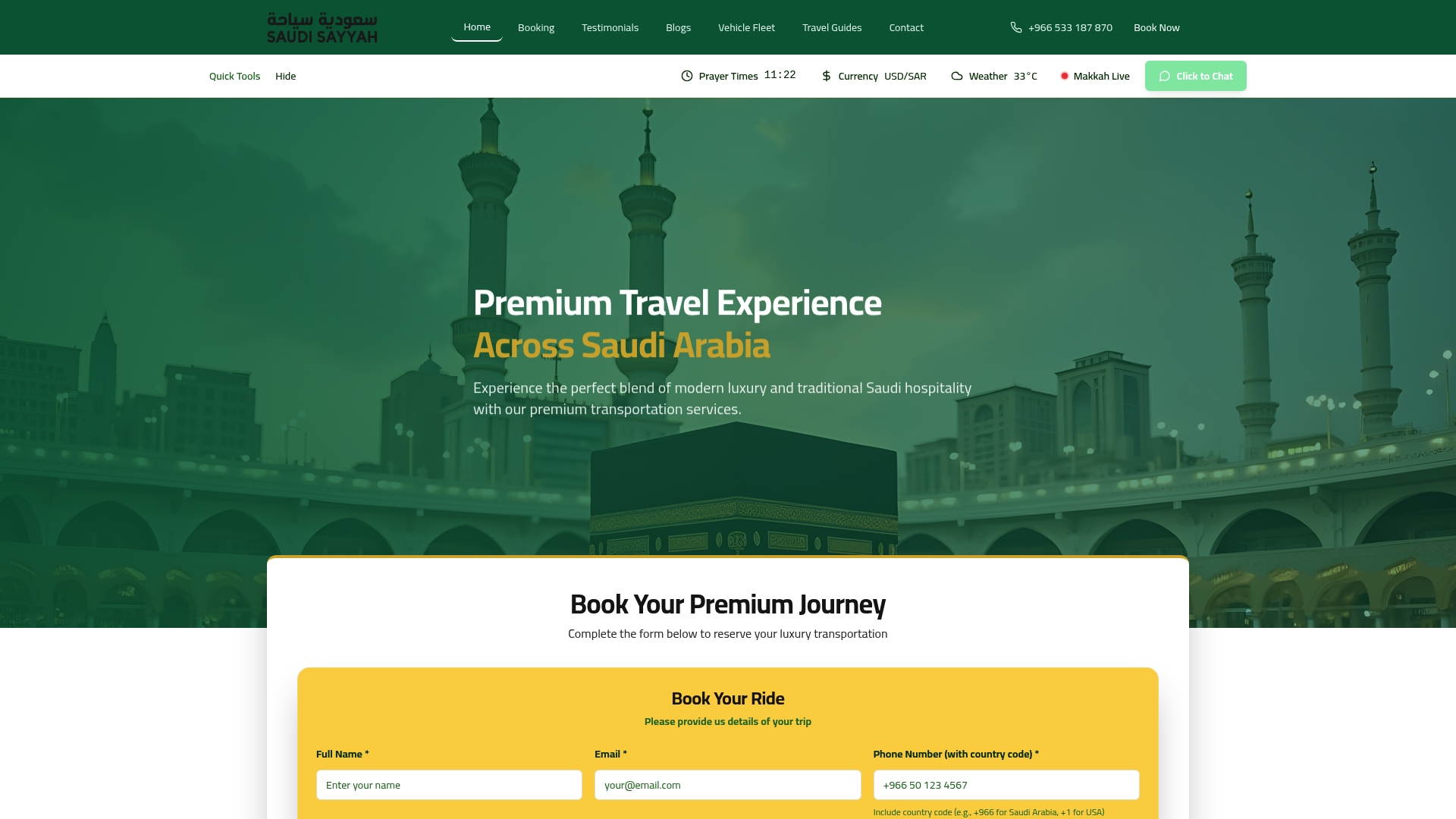
Saudisayyah's booking system is fully automated and internationally compliant, meaning you can arrange transport before you leave home. Drivers have extensive experience with elderly pilgrims and understand the pacing and access needs that come with mobility equipment. For a full look at available vehicles, the Saudisayyah fleet page lists every option. For first-time visitors planning the full trip, the holy cities planning guide covers transport, accommodation, and ritual logistics in one place.
FAQ
Are wheelchairs free at Masjid al-Haram?
Manual wheelchairs are free at Masjid al-Haram and require no advance booking. Distribution points are located near all major gates.
Is seated Tawaf valid for elderly pilgrims?
Seated Tawaf performed in a wheelchair or motorized cart is fully valid. Dedicated lanes on multiple levels accommodate wheelchair and cart users during both Tawaf and Sa'i.
How do I book a motorized cart for Umrah?
Motorized carts can be booked through the Tanaqol app or the Unified Mobility Platform before arrival. Prices start at SAR 57.50 for single-ritual use and around SAR 115 for combined Tawaf and Sa'i service.
What walking aid works best in crowded mosque areas?
A rollator works best for pilgrims who can walk short distances but need frequent rest stops. For very crowded ground-level areas, switching to a wheelchair or using upper-level access is the safer choice.
Should I request airport wheelchair assistance in advance?
Requesting wheelchair and meet-and-assist services from your airline before departure is the recommended approach. Advance coordination prevents standing fatigue and long queues before rituals begin.