
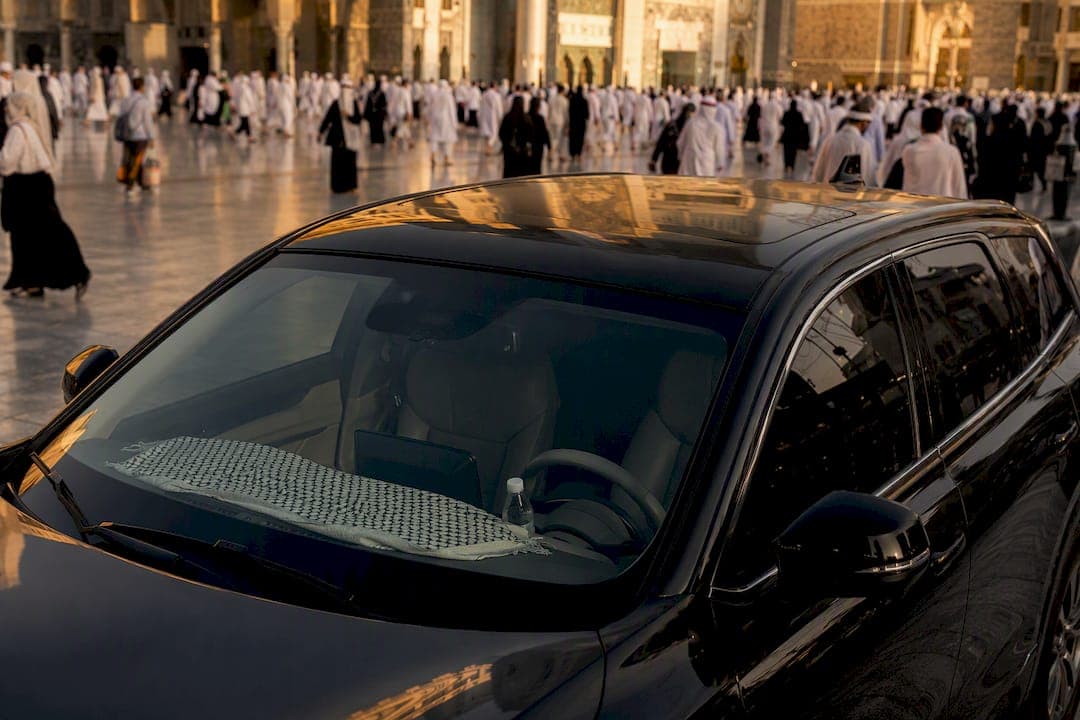
A private, chauffeured ziyarat tour is the most practical way to see Makkah's sacred and historical sites without wasting hours on transfers or missing prayer times, as offered by Kler Transport’s private chauffeur and charter services. A typical outing covers Masjid al-Haram, Jabal al-Noor, and Mount Arafat, run on a schedule you control rather than a bus timetable. In Makkah, Saudisayyah pairs this format with concrete trust signals:
- Pre-trip driver photo, name, and vehicle plate sent before pickup
- A modern fleet with current safety features
- Real-time GPS tracking for the whole route
Key Takeaways
A private, chauffeured ziyarat tour covering Masjid al-Haram, Jabal al-Noor, and Mount Arafat gives pilgrims the most flexible and spiritually focused way to see Makkah's sacred sites.
| Point | Details |
|---|---|
| Choose private over group | Private chauffeur tours cut transfer time and let you set the pace at each sacred site. |
| Plan around durations | Half-day tours run 2 to 4 hours; full-day tours run several hours, longer during Ramadan or Hajj. |
| Time the climbs early | Visit Jabal al-Noor and Jabal Thawr in the morning to avoid heat on the unshaded ascent. |
| Verify before booking | Check driver license, vehicle plate, insurance, and cancellation policy before confirming any tour. |
| Book with Saudisayyah | Saudisayyah pairs private chauffeured ziyarat tours with pre-trip driver details and real-time tracking. |
Table of Contents
- Planning a جولة مزارات مكة: Half-Day and Full-Day Itineraries
- What Do Makkah Ziyarat Tours Typically Cost?
- Private Car, Group Tour, or Self-Guided: Which Fits Your Trip?
- Best Times to Visit Each Sacred Site in Makkah
- What to Verify Before Booking a Private Ziyarat Tour
- Amenities and Facilities Near Makkah's Ziyarat Sites
- Cultural Etiquette Every Visitor Should Know
- Audio Guides and Apps for a Deeper Ziyarat Experience
- What to Eat and Drink During a Ziyarat Tour
- The Best Order to Visit Makkah's Sacred Sites
- Book a Private Ziyarat Tour with Saudisayyah
- Sources
Planning a جولة مزارات مكة: Half-Day and Full-Day Itineraries
A half-day جولة مزارات مكة usually runs two to four hours and fits comfortably between prayers. Most private drivers start with hotel pickup, move to Jabal al-Noor, then Jabal Thawr, and close with a short return visit to Masjid al-Haram.
- Hotel pickup — timed around 30 to 60 minutes before the first stop, adjusted for prayer schedule.
- Jabal al-Noor (Hira) — 45 to 60 minutes, including the walk toward the cave where the Prophet Muhammad received the first revelation. The climb is steep and unshaded, so this stop anchors the whole half-day plan.
- Jabal Thawr — 30 to 45 minutes at the base, since the cave itself sits high on a difficult ascent that most tours view rather than climb.
- Masjid al-Haram — a closing 45 to 90 minute visit, length depending on prayer timing and crowd density.
A full-day ziyarat tour, by contrast, runs several hours and adds historical depth to the spiritual stops. After the Masjid al-Haram overview, drivers typically route through the Makkah Museum, the Kiswa Factory, and the Exhibition of the Two Holy Mosques, which displays rare relics and architectural fragments from the mosque's history. From there, the route continues to Masjid al-Jinn, then out to Mina, Muzdalifah, and Mount Arafat before returning to the hotel.
Pro Tip: Book the full-day route with an early morning start. The Mina to Arafat leg covers real distance, and traffic builds fast once the midday sun pushes more visitors onto the same roads.
Local travel guides consistently list these same nine sites as the core ziyarah circuit in Makkah, which is why most operators build their packages around the same skeleton.
What Do Makkah Ziyarat Tours Typically Cost?
Standard durations split into two bands: a half-day run of two to four hours, and a full-day version of several hours. These durations may extend during Ramadan and Hajj season due to road congestion around the Haram.
Private-car pricing in SAR depends on three variables: vehicle class (sedan versus SUV or van), group size, and which services are bundled in. A small sedan for two passengers costs less than a van built for a family of six, and a package with a licensed guide runs higher than a driver-only booking.
Most private ziyarat bookings include:
- A driver and the vehicle itself, fuel and parking covered
- Bottled water for the group
- Optional add-ons: licensed guide commentary, museum or exhibition entrance fees
Lead time matters too. Booking a day ahead is usually enough outside peak season, but during Ramadan or Hajj, earlier reservations protect against fully booked fleets. Pickup is almost always arranged directly from the hotel lobby, coordinated by phone or app.
Pro Tip: If anyone in your group needs a wheelchair-accessible vehicle or extra mobility assistance, mention it at booking, not on pickup day. Accessible vehicles are a smaller share of most fleets, and pricing adjusts to reflect that.
Private Car, Group Tour, or Self-Guided: Which Fits Your Trip?
The right format depends on what you value most: privacy, cost, or independence.
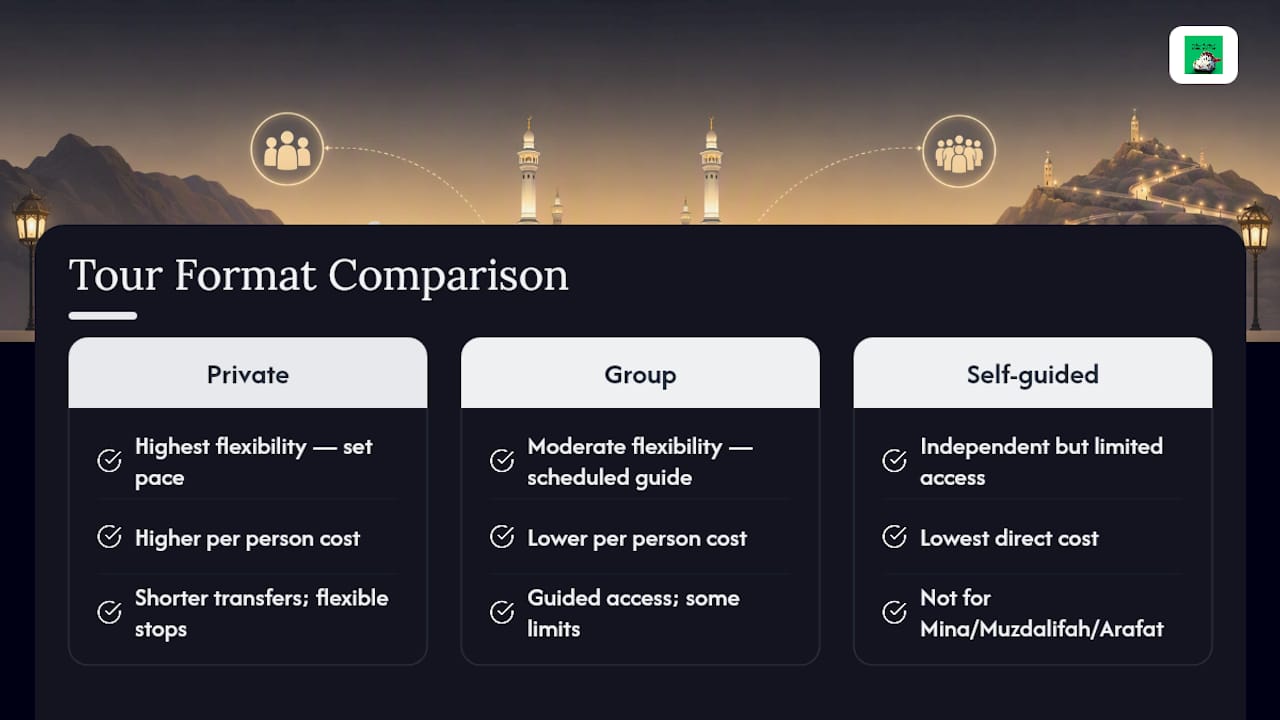
Private chauffeur tours give you flexibility other formats can't match. You set the pace, skip a stop that's too crowded, and add extra time at Jabal al-Noor if the group wants it. Transfers between sites also run shorter since the driver isn't waiting on other passengers.
Group tours trade some of that flexibility for a lower per-person cost and a scheduled guide walking you through the history at each stop.
Self-guided visits work only for sites with open public access and no permission requirements, and mainly for confident Arabic or English speakers comfortable navigating Makkah's traffic patterns alone. It rarely works for Mina, Muzdalifah, or Arafat, where access rules shift by season.
Ask yourself three questions before booking: Do you want control over timing? Is budget the primary constraint? Will language or mobility limit a self-guided approach? Your answers point straight to the right format.
Best Times to Visit Each Sacred Site in Makkah
Timing changes the entire experience at every stop on a جولة نصف يوم مكة.
Masjid al-Haram is calmest in the early morning hours before Fajr crowds build, or late at night after Isha. Security screening is standard at every entrance, and a short 45-minute visit works fine for a photo and prayer, while a full circuit of tawaf needs closer to 90 minutes. Zamzam water stations sit throughout the mosque, so hydration is rarely an issue once inside.
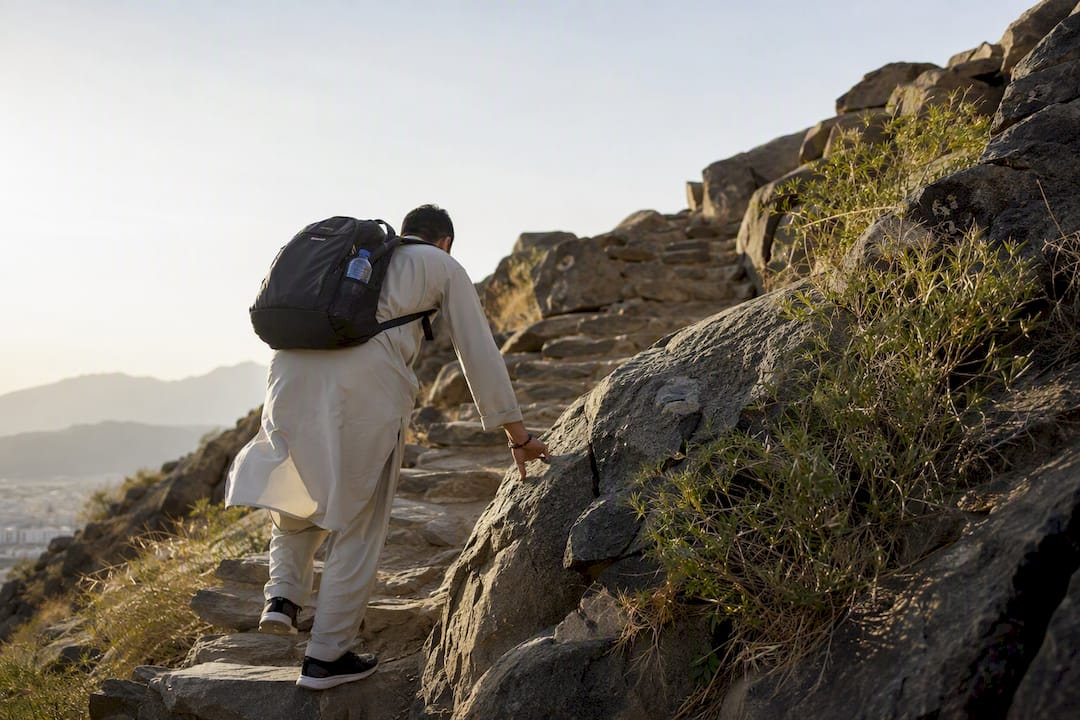
Jabal al-Noor and Jabal Thawr demand real physical effort. The Hira climb involves uneven rock steps with no shade, so closed shoes and a morning or late-afternoon visit beat midday heat. Jabal Thawr's cave sits even higher and tougher to reach, which is why most tours stop at the base.
Mount Arafat, Mina, and Muzdalifah operate differently outside Hajj season versus during it. Outside Hajj, sightseeing access is open and relaxed. During Hajj itself, authorities restrict movement around these zones tightly for crowd safety, so close approach is often impossible unless coordinated through a licensed operator.
The Kiswa Factory and Makkah Museum keep set opening hours, and booking ahead avoids a wasted trip if a group tour has reserved the slot first. Carry water regardless of season. Makkah's heat turns a skipped bottle into a real problem fast.
What to Verify Before Booking a Private Ziyarat Tour
A few checks before booking protect your schedule and your safety.
- Confirm the driver holds a valid license and ask for a pre-trip photo along with the vehicle's plate number.
- Check the vehicle's model year and onboard safety features, and ask about insurance coverage and the cancellation policy in plain terms.
- Choose operators offering real-time tracking, a direct driver contact number, and support available around the clock.
- If you need a wheelchair-accessible vehicle or assistance for an elderly traveler, note it at booking rather than assuming any car will work.
Saudisayyah builds its booking flow around exactly these checkpoints: driver photo and plate sent before pickup, a modern fleet, and live tracking through the trip. Readers planning transport for older relatives can find more detail in this guide to transport for elderly pilgrims.
Pro Tip: Save the driver's contact number the moment you receive it. If plans shift mid-tour, a two-minute call beats waiting on an app to refresh.
Amenities and Facilities Near Makkah's Ziyarat Sites
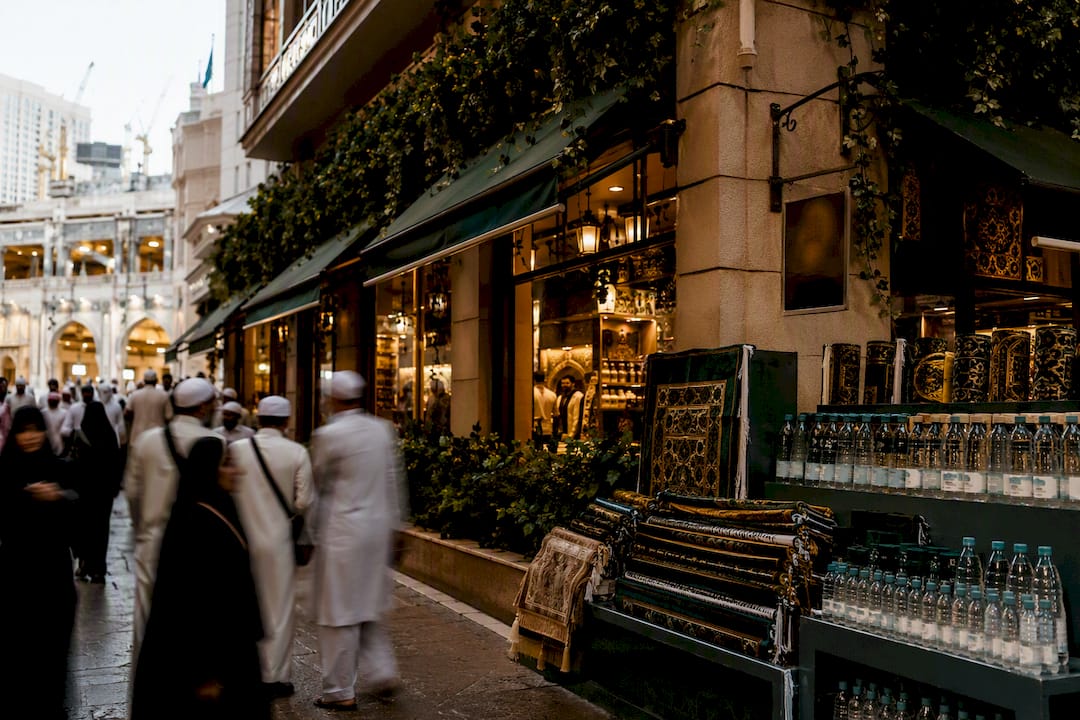
Masjid al-Haram sits inside a dense commercial zone. Hotels, pharmacies, and restaurants line the surrounding streets, and prayer mats, Zamzam stations, and restrooms are built into the mosque complex itself.
Jabal al-Noor and Jabal Thawr sit further from developed amenities. Small kiosks near the base sell water and snacks, but neither mountain has facilities near the summit, so pack what you need before the climb starts.
Mina and Muzdalifah operate as vast open camps rather than a fixed commercial district. Outside Hajj season, facilities are minimal, mostly restrooms and prayer areas maintained for pilgrims passing through. During Hajj, temporary tents, food stalls, and medical points appear across the zone, then disappear once the season ends.
The Kiswa Factory, Makkah Museum, and the Exhibition of the Two Holy Mosques all sit in more developed pockets of the city, with parking, restrooms, and nearby cafés typical of a modern exhibition space. These stops work well as a midday break during a full-day tour, since air conditioning and seating give the group a rest before the outdoor legs resume.
Ma'la cemetery has a more understated setup: a quiet perimeter with limited facilities, reflecting its purpose as a burial site rather than a tourist stop.
Cultural Etiquette Every Visitor Should Know
Each ziyarat site carries its own expectations, and getting them right matters more than moving fast through the itinerary.
Inside Masjid al-Haram, modest dress is required for everyone, and visitors should stay quiet and respectful near those praying or performing tawaf. Photography of worshippers up close is generally discouraged.
At Jabal al-Noor and Jabal Thawr, the mood shifts toward quiet reflection rather than tourist photography. These are sites tied directly to the Prophet Muhammad's history, and loud conversation or casual selfies feel out of place to most visitors.
Ma'la cemetery calls for particular restraint. It's an active burial ground, and behavior expected in a cemetery anywhere applies here too: low voices, no photography of graves, and no walking directly across burial plots.
Mina, Muzdalifah, and Arafat are treated with the same reverence as any other holy site, especially given their role in Hajj rites. Visitors outside Hajj season should still avoid loud group behavior.
Museum and exhibition stops allow a more relaxed tone, closer to any cultural museum visit, though modest dress remains the standard throughout Makkah regardless of the site.
Audio Guides and Apps for a Deeper Ziyarat Experience
Multimedia tools add real context that a quick site visit alone can't provide. The Exhibition of the Two Holy Mosques uses structured displays and curated exhibits to walk visitors through centuries of the mosque's architectural history, effectively functioning as a built-in audio and visual guide without needing a separate app.
Several general Hajj and Umrah apps offer audio explanations of each ziyarat site's history, useful for travelers who want context beyond what a driver or guide provides verbally. Official platforms like Visit Saudi also list packaged cultural experiences with descriptions that double as a reference point for what a private tour should include.
For most visitors, pairing a knowledgeable driver with one museum stop that includes curated displays covers the multimedia gap well enough. A phone with offline maps downloaded also helps when cellular service gets patchy near Jabal al-Noor's more remote base.
What to Eat and Drink During a Ziyarat Tour
Heat and physical exertion make hydration the priority on any Makkah ziyarat tour. Most private bookings include bottled water as standard, but a full-day route benefits from carrying extra, especially before the Jabal al-Noor climb.
Food options cluster near Masjid al-Haram and the museum district, with restaurants covering everything from quick shawarma stands to sit-down halal restaurants. Mina and Muzdalifah offer far fewer options outside Hajj season, so eating before departure or packing snacks makes sense for the longer full-day route.
Dates and water remain the simplest, most culturally fitting refreshment between stops, especially during Ramadan when timing around iftar shapes the whole schedule. A driver familiar with the route usually knows which stops have reliable food access and which don't, one more reason a private chauffeur beats guessing your way through a self-guided day.
The Best Order to Visit Makkah's Sacred Sites
Sequencing your جولة مزارات مكة affects both comfort and meaning. Starting with Jabal al-Noor and Jabal Thawr in the cooler morning hours avoids the worst heat, since both require walking with no shade.
Move to Masjid al-Haram midday or in the early afternoon, timed around a prayer if possible, then continue toward Mina, Muzdalifah, and Arafat as the day progresses. These three sites work well as a single continuous leg since they sit close together geographically.
Save museum stops, the Kiswa Factory, and the Exhibition of the Two Holy Mosques for late afternoon. Indoor, air-conditioned space gives the group a natural rest point after a day of walking and gives you an easier close to the tour before the return to the hotel.
What Travelers Value Most on a Ziyarat Tour
Ask pilgrims what they remember most, and it's rarely the itinerary itself. It's the quiet moments: a respectful driver who doesn't rush the visit, reliable timing that doesn't clash with prayer, and space to reflect rather than just check a site off a list. A private tour removes the friction of transfers so the day stays focused on devotion, not logistics.
Book a Private Ziyarat Tour with Saudisayyah
Saudisayyah runs private ziyarat tours built around exactly what this guide recommends: a chauffeured, flexible route through Makkah's sacred sites without the transfer delays a group tour carries.
Every booking comes with a modern fleet vehicle, a pre-trip driver photo, name, and plate number sent to your phone, and live GPS tracking for the full route. Both half-day and full-day packages are available, along with accessible vehicle options for elderly travelers or anyone needing extra mobility support, detailed further in this guide to booking accessible transport. Compare vehicle classes on the fleet page, then reserve your ziyarat tour directly through Saudisayyah's services page to lock in pickup timing before your travel dates fill up.
Sources
Visit Saudi Makkah tours · GACA airport info · SPA exhibition coverage · AlhadaFirst site guide · Saudisayyah booking