
TL;DR:
- Effective fleet management during Hajj utilizes GPS tracking, AI crowd monitoring, and sector-based deployment to ensure pilgrim safety and smooth movement. Coordinated use of buses, taxis, and the Al-Mashaaer Metro reduces congestion, with infrastructure improvements enhancing operational efficiency. Proper planning and adherence to sector assignments significantly improve pilgrimage travel experiences.
A pilgrimage fleet is defined as the coordinated network of buses, taxis, metro trains, and support vehicles deployed to move millions of pilgrims safely between sacred sites during major religious events like Hajj. The role of fleet in pilgrimage is not simply about providing vehicles. It is about capacity balancing, route predictability, and real-time coordination across millions of simultaneous movements. For Hajj 2026, Saudi authorities planned over 33,000 buses and 5,000 taxis to serve pilgrims across Makkah and surrounding holy sites. Add the Al-Mashaaer Metro, GPS tracking platforms, and AI-powered crowd monitoring, and what emerges is one of the most complex transportation operations on earth, directly tied to Saudi Vision 2030 infrastructure goals.
How does fleet management enhance pilgrim movement and safety during Hajj?
Fleet management during Hajj is not a passive scheduling exercise. It is an active, technology-driven operation that responds to crowd density, weather, and ritual timing in real time.
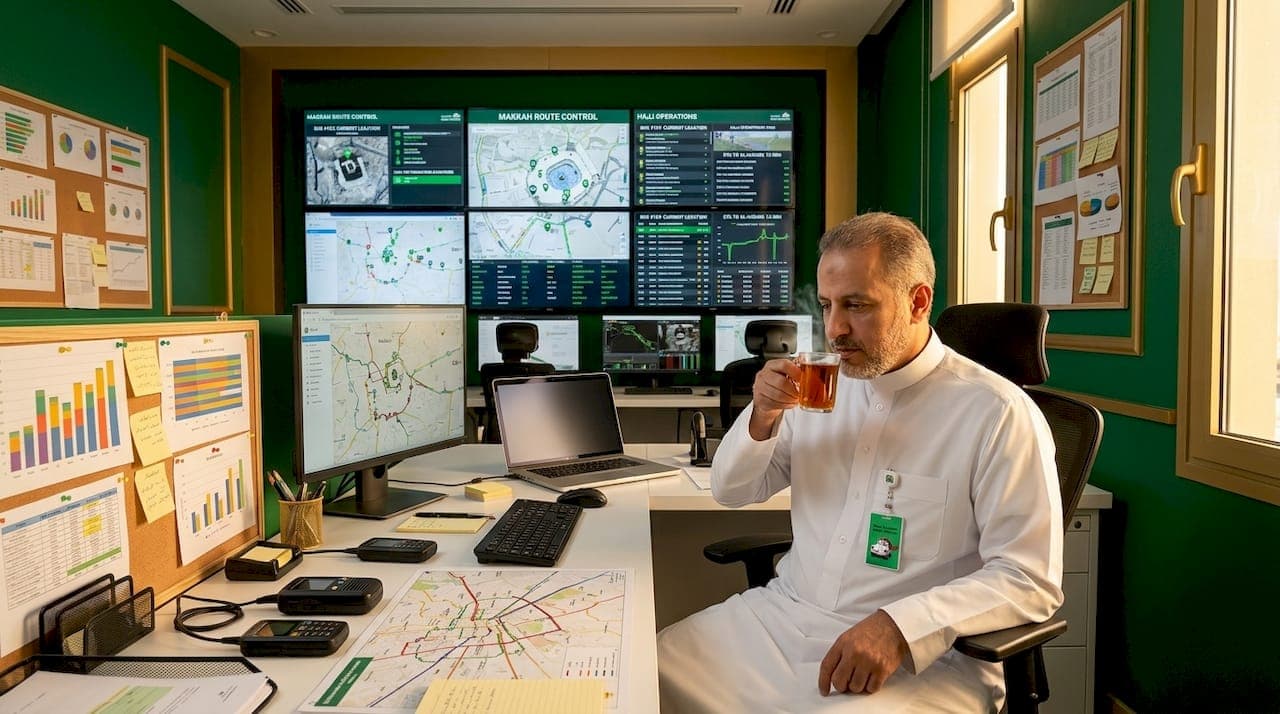
The foundation of safe pilgrim movement is GPS tracking and smart apps that allow transport authorities to monitor every vehicle's location, speed, and route adherence simultaneously. When a bus deviates or a sector becomes congested, dispatchers can reroute fleets within minutes. This dynamic response capability is what separates modern pilgrimage logistics from the chaotic crowd surges that caused tragedies in earlier decades.
Driver training is equally central to the system. Drivers receive instruction not just on routes but on crowd management behavior, including how to hold at designated stops, communicate with ground staff, and avoid creating secondary congestion at drop-off points. Driver training in crowd management directly reduces the risk of bottlenecks forming at high-density ritual sites like Mina and Arafat.
The safety layer extends beyond the vehicles themselves. AI-powered crowd monitoring and drone surveillance generate real-time crowd density alerts that trigger fleet adjustments before dangerous surges develop. Drones identify pressure points across the ritual sites and feed data directly to transport command centers.
Key operational elements of Hajj fleet management include:
- Sector-based bus deployment matched to local pilgrim population density
- Vehicle compliance inspections before and during the pilgrimage period
- Coordination between transport fleets, security forces, and public health teams
- Real-time rerouting via centralized GPS dispatch platforms
- Decentralized drop-off terminals to distribute arrival pressure across multiple points
Pro Tip: If you are traveling during peak ritual days like the Day of Arafat, follow your group leader's instructions on boarding times. Fleets operate on tight sector schedules, and missing your assigned bus window can add hours to your travel time.
What types of vehicles and transportation fleets support pilgrimage journeys?
The pilgrimage transportation ecosystem in Saudi Arabia combines three distinct fleet types, each serving a specific function in the overall logistics chain.
Large-scale bus fleets
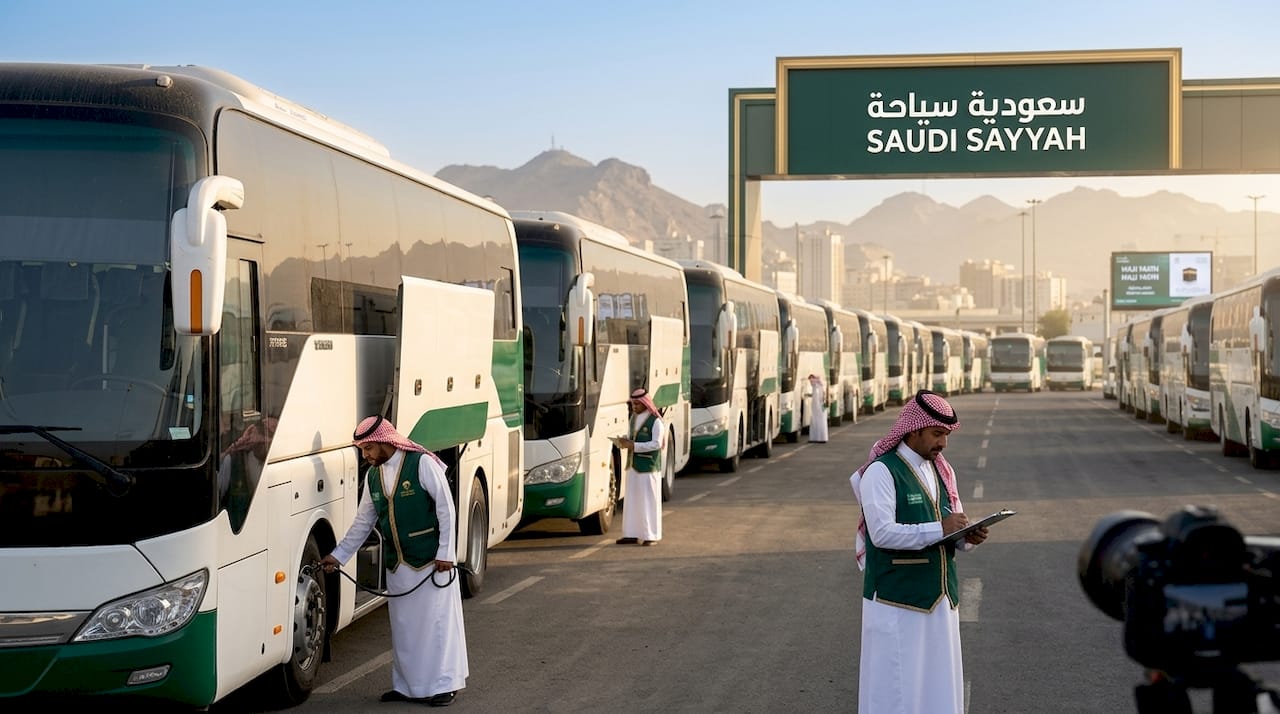
Buses form the backbone of surface transport during Hajj. The 33,000-bus fleet for Hajj 2026 operates across 12 designated sectors in Makkah, with each sector receiving buses proportional to its registered pilgrim population. A single coordinated operation, such as the Pakistani pilgrim service, saw 490 buses complete over 10,000 daily round trips across those sectors. That figure illustrates the sheer operational scale that organized fleet services for pilgrimage must sustain, day after day, across the most spiritually significant days of the Islamic calendar.
Taxi fleets and supplementary vehicles
The 5,000-taxi complement fills the gaps that fixed bus routes cannot cover. Taxis serve pilgrims with mobility limitations, those requiring point-to-point transfers between hotels and terminals, and groups with non-standard schedules. For elderly pilgrims especially, taxi availability is a practical necessity. Saudisayyah's transport for elderly pilgrims resource covers how to plan these transfers in advance.
Al-Mashaaer Metro rail system
The Al-Mashaaer Metro is the highest-capacity single component in the entire pilgrimage fleet. Operating 17 trains with up to 3,000 passengers per trip, the system runs over 2,000 trips to transport more than two million pilgrims across the Hajj period. At approximately 72,000 passengers per hour per direction, the metro acts as a load-shedding mechanism that absorbs bulk pilgrim movement and reduces pressure on road fleets during the most critical ritual transitions, particularly the movement from Arafat to Mina.
| Transport type | Capacity | Primary function | Environmental impact |
|---|---|---|---|
| Bus fleet | 33,000 vehicles across 12 sectors | Sector-based mass movement | Moderate fuel consumption |
| Taxi fleet | 5,000 vehicles | Point-to-point and accessibility transfers | Higher per-passenger emissions |
| Al-Mashaaer Metro | 72,000 passengers/hour/direction | High-volume ritual route transit | Low emissions, electric rail |
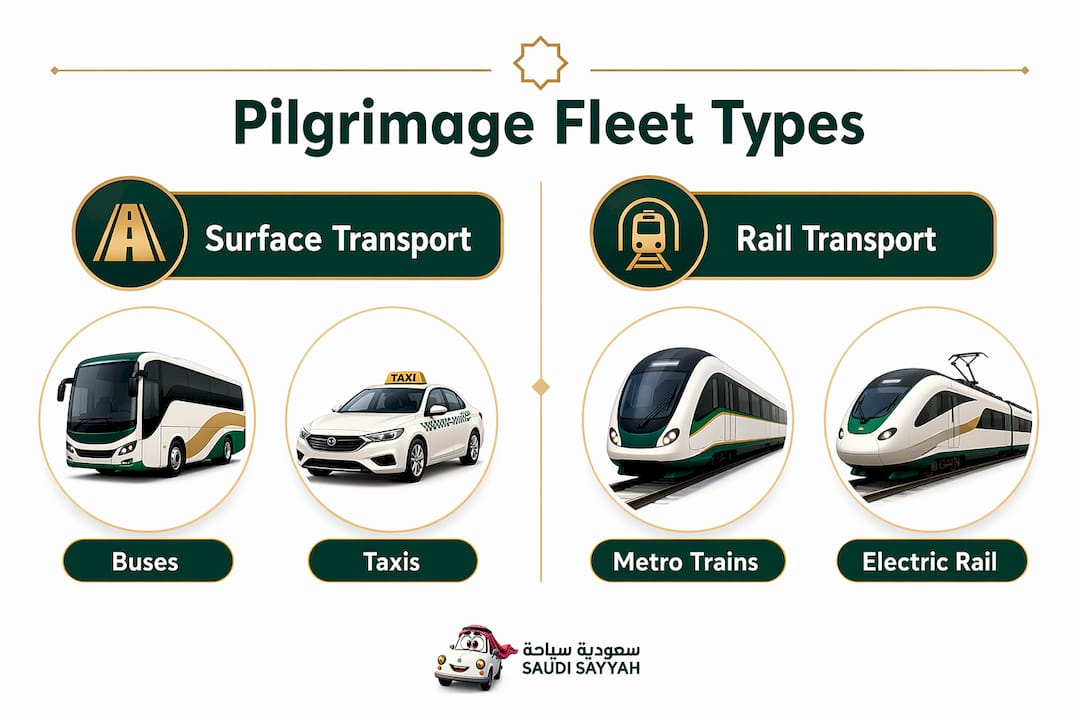
The metro's electric rail system also reduces road fleet dependence during peak hours, cutting travel time variability and giving pilgrims more time at each sacred site rather than in transit.
How do technology and infrastructure improvements support fleet operations?
Technology is not an add-on to pilgrimage fleet management. It is the operating system that makes the entire network function at scale.
-
Road condition monitoring. Saudi Arabia deployed the world's largest road survey fleet with sensors capable of detecting road defects to 0.05 mm precision. Roads that degrade under heavy bus traffic create vehicle damage, delays, and safety risks. Identifying defects before they affect fleet performance is a direct investment in pilgrim safety.
-
GPS and smart application platforms. Every vehicle in the authorized fleet operates under continuous GPS tracking. Smart applications give dispatchers a live map of the entire fleet, enabling dynamic rerouting as conditions change. Pilgrims using official transport apps can also see estimated arrival times for their sector's buses, reducing uncertainty at pickup points.
-
AI crowd density monitoring. Algorithms analyze live camera feeds and drone footage to calculate crowd density across ritual sites. When density thresholds are crossed, the system alerts fleet coordinators to redirect buses or hold departures until the receiving area clears. This prevents the compounding effect where arriving buses add to an already dangerous crowd concentration.
-
Terminal and highway infrastructure upgrades. New drop-off hubs distribute pilgrim arrivals across more entry points, preventing the single-point congestion that historically caused delays. Highway improvements aligned with Saudi Vision 2030 increase road capacity on the primary corridors between Makkah, Mina, Muzdalifah, and Arafat.
-
Electrified rail expansion. The Al-Mashaaer Metro's electric infrastructure reduces the number of diesel buses required on the most heavily trafficked routes, improving air quality in enclosed ritual areas and cutting overall fleet operating costs.
Pro Tip: Download the official Nusuk app before your pilgrimage. It integrates transport schedules, sector assignments, and real-time fleet updates, giving you accurate information without relying on word-of-mouth at crowded terminals.
How do sector-specific fleet deployment strategies optimize pilgrim transport?
The most counterintuitive insight in pilgrimage travel logistics is this: more buses do not automatically mean better service. The critical variable is where those buses are deployed, and in what proportion to local pilgrim density.
Makkah's transport authority divides the city into 12 operational sectors for bus deployment. Each sector receives a bus allocation calculated from the registered pilgrim population in that zone. A sector housing a large Pakistani or Indonesian delegation, for example, receives proportionally more buses than a smaller sector. Fleet deployment calibrated to pilgrim density prevents localized overloads and keeps traffic flow balanced across the city.
Travel times within this system are not fixed. Depending on traffic conditions and the specific ritual day, journey times between sectors range from 10 to 30 minutes. On the Day of Arafat, when millions of pilgrims move simultaneously, surface travel times can extend significantly. Real-time tracking apps improve scheduling transparency by showing pilgrims and group leaders when the next bus is arriving, reducing the instinct to crowd terminal entrances.
Practical considerations for pilgrims navigating sector-based transport:
- Know your sector number before departure day. It determines which bus stops and terminals apply to your group.
- Follow staff guidance at drop-off terminals. Decentralized hubs are designed to distribute load, but they only work when pilgrims use their assigned entry points.
- Plan for variability. A 15-minute journey on a quiet day may take 40 minutes during peak ritual movement. Build buffer time into your schedule.
- Use efficient travel resources for Umrah pilgrims to understand how coordinated bus and train deployment reduces delays across the full pilgrimage route.
The sector model also benefits from GPS-enabled fleet tracking at the vehicle level, which gives dispatchers the data to shift bus allocations between sectors mid-operation when actual pilgrim flows diverge from projections.
Key takeaways
Organized fleet management is the single most important logistical factor determining whether millions of pilgrims complete their rituals safely and on time during Hajj.
| Point | Details |
|---|---|
| Fleet scale for Hajj 2026 | Over 33,000 buses, 5,000 taxis, and 17 metro trains serve pilgrims across Makkah. |
| Sector-based deployment | Bus allocations match local pilgrim density across 12 sectors, preventing localized overloads. |
| Technology integration | GPS tracking, AI crowd monitoring, and smart apps enable real-time fleet adjustments. |
| Metro as load-shedder | Al-Mashaaer Metro carries 72,000 passengers per hour, reducing road fleet pressure at peak times. |
| Infrastructure readiness | Road survey fleets detect defects to 0.05 mm, keeping highways safe for heavy bus traffic. |
What the fleet data tells us that most pilgrims miss
Most pilgrims think about transportation as a comfort issue. After observing how Hajj fleet operations actually function, the more accurate frame is a safety issue.
The 2026 figures are striking: 33,000 buses, 5,000 taxis, 17 metro trains, AI surveillance, drone monitoring, and a road survey fleet detecting sub-millimeter defects. That level of investment exists because crowd dynamics at Hajj scale are genuinely dangerous when transport fails. The 2015 Mina stampede, which killed over 2,000 people, was partly a crowd flow failure. Modern fleet management, with its sector logic, real-time rerouting, and load-shedding metro, is a direct response to that history.
What I find underappreciated is the cooperation requirement. Technology can optimize a fleet, but it cannot force pilgrims to board at designated points, follow sector assignments, or wait for the next bus instead of rushing the current one. The system works when pilgrims treat fleet guidance as part of the ritual discipline, not an inconvenience. Groups that brief their members on transport protocols before arrival consistently report smoother experiences than those who leave it to chance at the terminal.
The other overlooked factor is the Umrah pilgrim. Hajj gets the headlines, but Umrah pilgrims traveling outside peak season face a different challenge: less fleet infrastructure, more reliance on private hire vehicles, and fewer real-time information resources. Understanding why reliable transport matters for Umrah pilgrims is just as important as understanding the Hajj fleet model.
— Fa
Plan your pilgrimage transport with Saudisayyah
Saudisayyah operates a premium vehicle fleet built specifically for Hajj and Umrah pilgrims traveling in Saudi Arabia. Every vehicle is a latest model year, every driver carries years of experience on the holy city routes, and every booking includes real-time GPS tracking with driver details sent directly to your phone before departure. The platform is fully automated and internationally compliant, so there are no surprises at pickup. Browse Saudisayyah's pilgrimage fleet to see available vehicle options for your travel dates, or explore the full range of pilgrimage transport services for group and individual bookings across Makkah and Madinah.
FAQ
What is a pilgrimage fleet?
A pilgrimage fleet is the coordinated network of buses, taxis, metro trains, and support vehicles organized to transport pilgrims between sacred sites during events like Hajj or Umrah. For Hajj 2026, this includes over 33,000 buses, 5,000 taxis, and the Al-Mashaaer Metro system.
How many buses operate during Hajj 2026?
Saudi authorities planned over 33,000 buses and 5,000 taxis for Hajj 2026, deployed across 12 operational sectors in Makkah based on registered pilgrim density per zone.
How does the Al-Mashaaer Metro support Hajj transport?
The Al-Mashaaer Metro operates 17 trains carrying up to 3,000 passengers per trip, handling approximately 72,000 passengers per hour per direction. It absorbs bulk pilgrim movement during peak ritual transitions, reducing road fleet congestion.
What technology is used to manage pilgrimage fleets?
Fleet management uses GPS tracking, smart dispatch applications, AI-powered crowd density monitoring, and drone surveillance. These tools enable real-time rerouting and prevent dangerous crowd surges at ritual sites.
How should pilgrims prepare for sector-based transport?
Know your assigned sector number before arrival, follow staff instructions at designated terminals, and use official apps like Nusuk for real-time bus schedules. Build extra time into your plans on peak ritual days, when travel times can extend from 15 minutes to over 40 minutes.