
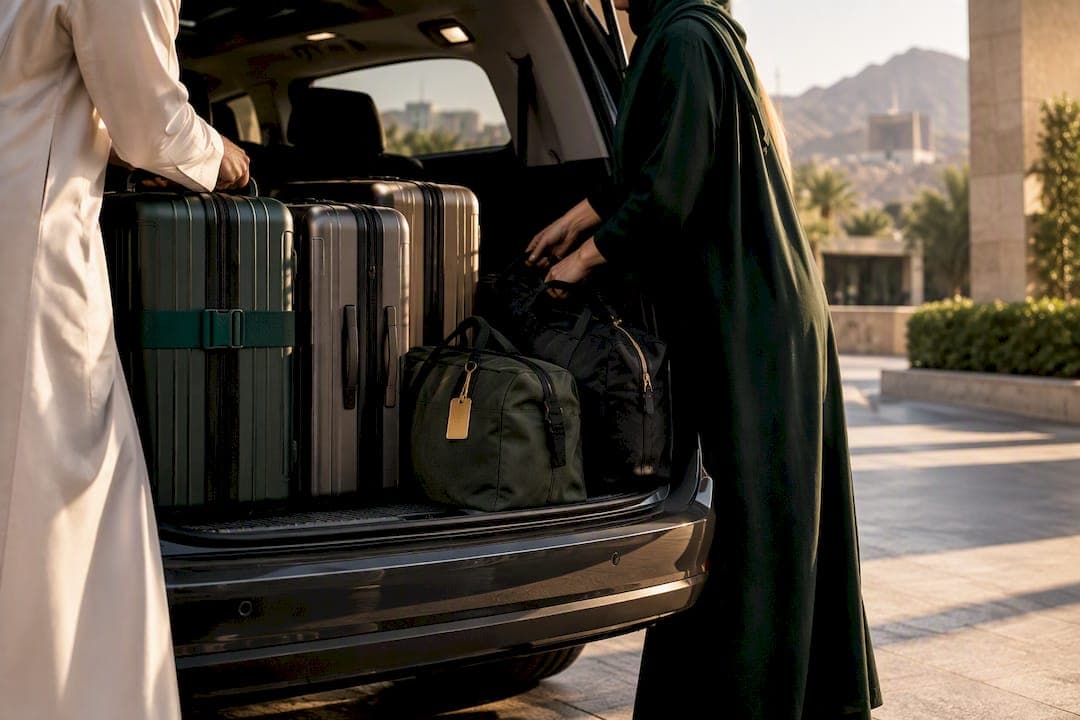
For transfers in and around Mecca, pick a compact or sedan for 1 to 3 passengers with hand luggage, a mid-size SUV or MPV for 4 to 6 passengers with 3 to 5 large suitcases, and a 12 to 15 seat van for 7 or more travelers with multiple bags. Confirm the air conditioning works before you get in. Overloading a trunk or a roof rack past the vehicle's rated limit is a safety issue, not just a comfort one.
TL;DR:
- Vehicles with fold-flat rear seats, like mid-size SUVs, can often increase trunk capacity enough to fit an extra large bag or stroller, which is crucial for tight groups.
- Booking the correct vehicle class depends heavily on accurately stating passenger counts, luggage types, and bulky items upfront, preventing common trunk space issues.
- Manufacturer trunk specs are estimates, but actual usable space varies significantly with seat folding and model, so always confirm the specific vehicle's capacity before booking.
- The cost of transfers increases with vehicle size and luggage volume, especially for larger groups or peak travel seasons, making precise upfront details essential for accurate pricing.
- Verified vehicle details, real-time photos, and live tracking help travelers ensure their luggage will fit, especially in extreme heat or when connecting to airport pickups.
Table of Contents
- How Much Luggage Space Do You Need for مساحة أمتعة في السيارة مكة Trips?
- How to Choose the Right Vehicle When Booking
- What Do Real Trunk Numbers Actually Mean for Your Bags?
- Packing Tricks That Actually Free Up Trunk Space
- What to Say When You Book a Transfer
- What Does It Cost to Book a Vehicle With Enough Luggage Room?
- Why Verified Vehicle Details Matter More Than Guesswork
- Book a Vehicle That Actually Fits Your Bags
- Sources
- FAQ
How Much Luggage Space Do You Need for مساحة أمتعة في السيارة مكة Trips?
Vehicle class determines luggage space more than any other single factor. So match your group size and bag count to the right category before you worry about price or model year.
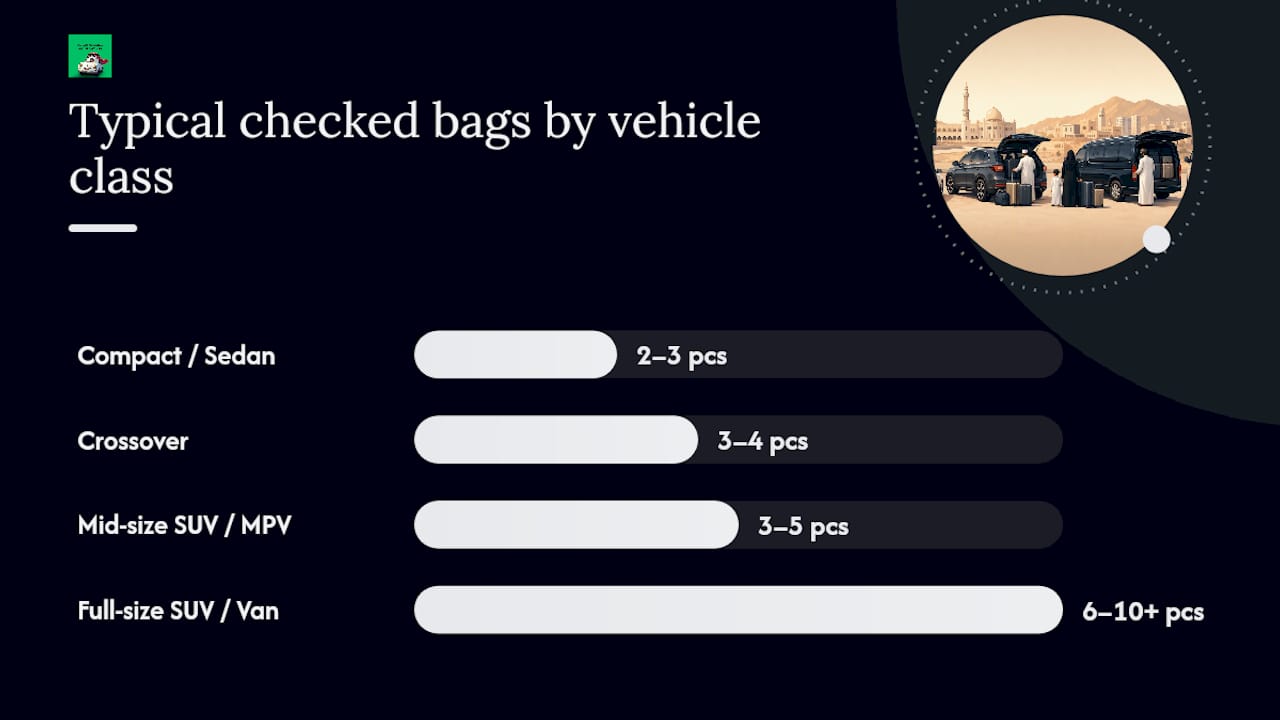
A compact car or sedan seats 1 to 3 people comfortably and typically swallows 2 to 3 medium suitcases plus a couple of backpacks. Trunk volume in this class usually runs around 400 to 500 liters. That is fine for a solo traveler or a couple flying into Jeddah for a short Umrah trip, but it gets tight fast if someone packs a large hard-shell case.
A crossover splits the difference, seating 4 to 5 people with a trunk in the 430 to 600 liter range. Think of it as the sedan's slightly roomier cousin, better for families who pack one large bag each but do not need a full-size SUV.
The mid-size SUV or MPV class is the workhorse for family transfers. These vehicles carry 4 to 6 passengers and generally hold 3 to 5 large suitcases, with trunk volumes ranging from roughly 500 to 800 liters depending on the model. Rental and transfer guidance for pilgrim trips in Saudi Arabia consistently points to this category for groups of 4 to 6 travelers who are carrying a normal load of checked baggage.
For 7 or more passengers, a full-size SUV or passenger van (the Toyota Hiace is a common example on Saudi routes) is the only realistic option once you factor in both bodies and bags. Vans built for pilgrim transfers can handle 8 to 10 suitcases without anyone sitting on top of a duffel bag for three hours.
- Compact/sedan: 1–3 passengers, 2–3 medium suitcases
- Crossover: 4–5 passengers, 3–4 medium to large suitcases
- Mid-size SUV/MPV: 4–6 passengers, 3–5 large suitcases
- Full-size SUV/van: 7+ passengers, 6–10+ suitcases
Seat-folding changes these numbers more than most travelers expect. A 60/40 split rear seat lets you fold one side flat while a passenger still sits on the other, which is useful when four people are traveling with five bags. Fold both sides flat in a mid-size SUV and you can often fit a stroller, two large suitcases, and three duffel bags where three suitcases used to be the limit.
Pro Tip: If your group has an odd mix of passengers and bags, book one class size up. It is far cheaper than paying for a second car because the trunk lid will not close.
How to Choose the Right Vehicle When Booking
Booking the wrong vehicle class is the single most common luggage mistake travelers make, and it is entirely avoidable if you give the provider the right details up front.
- State your exact passenger count. Not "a family," but the number of adults, children, and infants, since car seats and boosters take up cargo room too.
- Count your suitcases and estimate size. Say how many are large (28 to 32 inches), medium, and how many are carry-on or duffel bags.
- Flag bulky items separately. Wheelchairs, prayer rugs in hard cases, oxygen equipment, or musical instruments need a mention before the driver shows up, not after.
- Ask for fold-flat rear seats if your bag count is high relative to your passenger count. This single question solves most trunk-space disputes before they start.
- Confirm child seat availability if needed, since a bulky child seat can eat the space of a medium suitcase.
- Ask about accessibility needs, including step height and whether the driver can assist with mobility aids.
- Confirm the air conditioning is working and strong, especially for a Mecca transfer, given that summer temperatures can exceed 41 degrees Celsius.
- Ask about the vehicle's model and year, since a newer model generally means a more reliable AC system and better insulation on long routes between Jeddah, Mecca, and Medina.
- Ask whether a roof box is available if your group's luggage exceeds trunk capacity, and confirm any added cost.
- Check seating capacity and seatbelt count against your passenger number. A van rated for 10 people needs 10 working seatbelts, not 10 seats and 8 belts.
Saudi road safety rules require every seated passenger to have a functioning seatbelt, and vehicles should never carry more people or cargo than their rated capacity allows. That rule matters more on intercity routes where speed and highway conditions leave less margin for error. If you want a refresher on regional driving rules before a long transfer, Saudi Arabia's speed limits are worth a quick read.
What Do Real Trunk Numbers Actually Mean for Your Bags?
Manufacturer trunk specs sound precise, but they only make sense once you translate liters into suitcases.
Take the Renault Duster, sold in Saudi Arabia and commonly used for smaller group transfers. Its cargo volume runs from about 542 liters with the rear seats up to 1,696 liters with them folded 60/40. That jump illustrates the point better than any spec sheet alone: folding the seats roughly triples usable space, turning a car that holds 2 large suitcases into one that swallows 5 or 6 plus assorted bags.
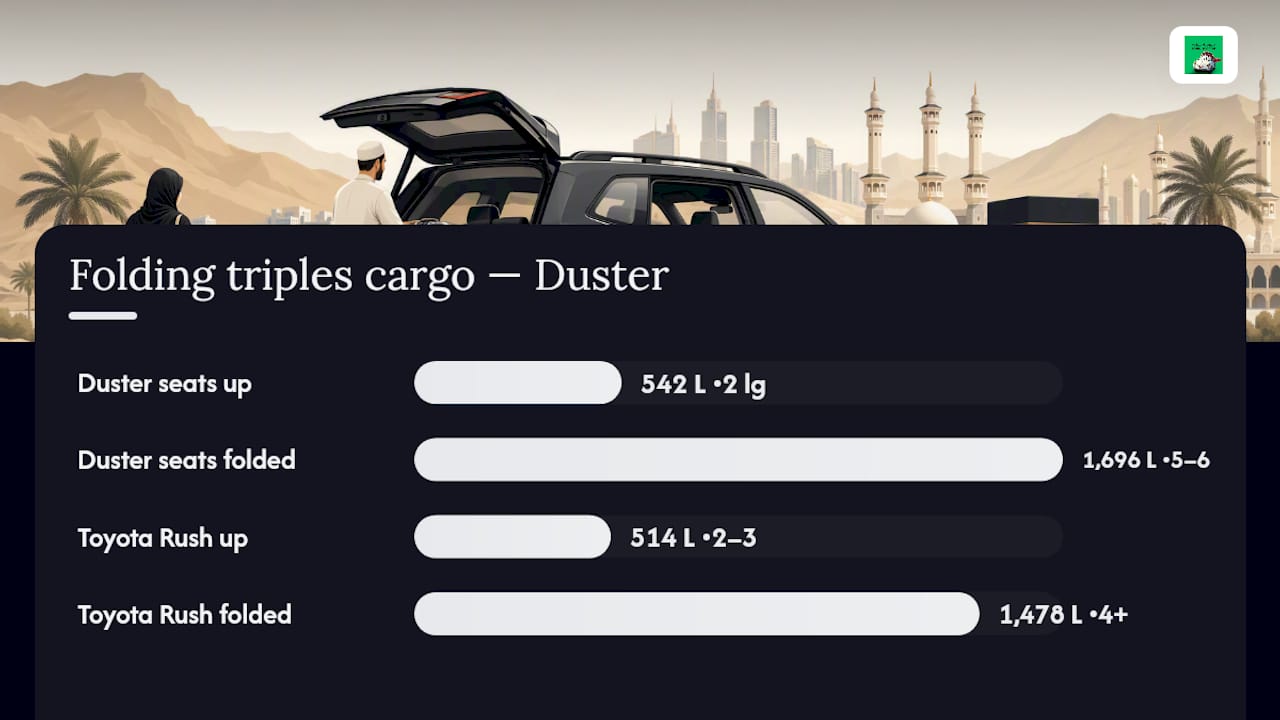
The Toyota Rush, a common crossover on Saudi roads, tells a similar story. Its trunk holds about 514 liters with all seats occupied and up to 1,478 liters with seats folded. In practical terms, that is the difference between fitting 2 to 3 medium suitcases and fitting 4 large ones plus a couple of backpacks.
Rough conversions that hold up across most sedans, crossovers, and SUVs:
- 400 to 500 liters: 2 to 3 medium suitcases
- 500 to 700 liters: 3 to 4 large suitcases
- 700 to 900 liters: 4 to 5 large suitcases plus small bags
- 1,400 liters and above (seats folded): 6 or more suitcases, strollers, or bulky items
Measurement standards vary between manufacturers, and cargo figures published on a brand's regional site do not always match the specific trim your driver shows up in. Always ask the provider for the exact vehicle model before you finalize a booking with a tight bag count.
Packing Tricks That Actually Free Up Trunk Space
Soft-sided duffel bags compress and stack far better than rigid suitcases, especially in vehicles with a low trunk opening or a shallow floor. If your group's cargo is borderline for the vehicle class, swapping even two hard-shell cases for duffels can be the difference between everything fitting and someone holding a bag on their lap.
- Pack heavy items low and toward the trunk floor to keep the load stable on highway curves.
- Keep valuables, medications, and documents in a cabin bag rather than buried in the trunk.
- Load the largest suitcases first, then fill gaps with soft bags and backpacks.
- Use a blanket or strap to keep bags from sliding into seatbacks on intercity routes.
- Store medications and food in insulated bags. Trunk temperatures climb fast in Mecca's heat, and a sealed trunk can turn into an oven within an hour.
- Avoid leaving laptops or phones in a hot trunk for extended stops.
Pro Tip: If you are unsure whether your bags will fit, photograph them next to a common object like a doorway before you book. It makes describing size to a provider far easier than guessing in centimeters.
What to Say When You Book a Transfer
Clear, specific booking language prevents almost every luggage surprise that happens at pickup.
- Declare your exact passenger count and ages, including any children needing seats.
- State the number and type of suitcases: large, medium, carry-on, or duffel.
- Ask directly for the vehicle model or trunk volume in liters, not just a vague "SUV" label.
- Request driver assistance with loading and unloading, particularly for airport pickups with a full trolley of bags.
- Confirm the airport meet-and-greet process and whether the driver waits at arrivals or a designated curb point.
- Ask about extra fees for oversized luggage or a roof box, since these are not always included in a quoted fare.
- Confirm the payment method, cancellation policy, and a direct contact for last-minute changes to your flight or bag count.
What Does It Cost to Book a Vehicle With Enough Luggage Room?
Pricing for pilgrim and tourist transfers in Saudi Arabia scales with both vehicle size and route distance, and luggage volume is part of that equation whether it is stated outright or not. A compact sedan for 1 to 3 passengers with light bags typically sits at the lower end of any transfer provider's rate card, since the vehicle burns less fuel and needs no extra loading time.
Mid-size SUVs and MPVs for 4 to 6 passengers with several large suitcases cost more, both because the vehicle class itself commands a higher rate and because loading five suitcases takes longer than loading two. Larger vans and full-size SUVs for groups of 7 or more sit at the top of the range, and licensed transfer guidance for pilgrim routes notes that vehicles like the Toyota Hiace or a GMC Yukon for 6 to 7 passengers with heavy luggage carry a price premium over smaller cars on the same route.
Rates also shift with season, since demand during Hajj and peak Umrah periods pushes prices higher across every vehicle class. Fuel costs and route length between cities like Jeddah, Mecca, and Medina add further variation. The most reliable way to know what you will actually pay is to confirm the rate for your specific date, passenger count, and bag load directly with your transfer provider rather than relying on a general estimate found online.
Why Verified Vehicle Details Matter More Than Guesswork
Guessing whether a car will fit your bags is a bad way to start a trip, especially after a long flight. Some transportation platforms send driver photos, vehicle details, and real-time tracking before pickup, so you can confirm trunk size and seating against your actual luggage count instead of hoping the car matches what was described. A modern fleet with verified, working air conditioning also matters more than most travelers realize once Mecca's summer heat hits.
— Fa
Book a Vehicle That Actually Fits Your Bags
Some premium transportation services provide driver photos, vehicle details, and live tracking sent to your phone before the car arrives, so you know what trunk space you are getting instead of finding out at the curb. Whether you need Point to Point Transportation, Hire by the Hour, or a Ziarah Package, you can state your suitcase count and passenger number when booking, and the platform matches you to a vehicle that actually fits both.
For airport arrivals with a full luggage trolley, Airport Transfers and Intercity Transfers come with driver assistance built in, so you are not loading five suitcases alone in the heat. If you want to see the vehicle classes and trunk options available before you commit, check the Saudisayyah fleet page and book the class that matches your group and your bags.
Sources
- Hajj 2026 driving guide — Makkah permit rules, fuel costs, best rental cars for pilgrims
- Renault Duster — dimensions and modularity (Saudi Arabia site)
- 2025 Toyota Rush trunk space and storage solutions
FAQ
How far is the drive from Mecca to Riyadh?
The drive between Mecca and Riyadh covers a long distance depending on the route, typically taking several hours by car. Most travelers covering this distance choose an intercity transfer with a larger vehicle class to keep luggage and passengers comfortable over the longer haul.
What is the best way to get from Mecca to Medina with luggage?
A mid-size SUV or a dedicated intercity transfer vehicle works best for the Mecca to Medina route, since it comfortably holds 3 to 5 large suitcases alongside 4 to 6 passengers. Saudisayyah's Intercity Transfers send driver and vehicle details ahead of pickup, so you can confirm trunk space fits your bag count before the trip starts.
How many cars can a resident register in Saudi Arabia?
Vehicle registration limits for residents are set by Saudi traffic authorities and can vary by residency category and vehicle type, so this is not a fixed universal number. Anyone with a specific registration question should confirm current rules directly with the Saudi traffic department rather than relying on general online guidance.
How much does a taxi from Mecca to Jeddah cost?
Taxi and transfer fares between Mecca and Jeddah vary by vehicle class, season, and demand, with larger vehicles for bigger groups and more luggage costing more than a compact car. Current rates for a specific date and passenger count are listed directly on the Saudisayyah services page rather than as a single fixed price.
Do I need to tell my driver how many suitcases I have?
Yes. Declaring your exact suitcase count, size, and any bulky items when booking is the single most effective way to avoid arriving at pickup with a vehicle that is too small. This also lets the provider offer a roof box or a larger vehicle class in advance instead of scrambling at the curb.