

TL;DR:
- Detail-oriented service focuses on small, sensory, operational, and timing elements to enhance customer trust and perception. Consistent, well-timed actions and personalized touches create loyalty, while operational systems enable reliable delivery of service quality. Regular audits, training, and proactive communication ensure that every detail supports an exceptional experience.
The role of detail in service is the deliberate focus on small, specific elements that collectively shape customer experience and separate exceptional service from average. Every clean glass, well-timed greeting, and clear instruction communicates one thing: this organization thought about you before you arrived. Research confirms that thoughtful details signal care, showing customers that an organization imagined the experience from their perspective. That signal builds trust faster than any marketing campaign.
How does the role of detail in service shape customer perception?
Detail-oriented service works because humans process environments before they process words. Guests form impressions within seconds, and small elements like visual presentation, glassware quality, and menu design set the tone for everything that follows. A single crack in a plate or a smudged glass tells the customer that standards are inconsistent. That doubt spreads to every other part of the experience.
The hospitality and transport industries have codified this understanding into formal frameworks. The "Exceptional Service Makes Sense" program, developed by Zest for Life, structures service quality around the five senses as standards: Smell, Taste, Touch, Hear, and See. Each sense becomes a checklist category. That structure forces teams to define what "good" looks like in concrete, measurable terms rather than vague aspirations.
Here is how sensory details translate into specific service behaviors:
- See: Spotless uniforms, clean vehicles, organized workspaces, and well-lit environments
- Hear: Calm, clear communication; appropriate background sound levels; no disruptive noise
- Touch: Quality materials in physical touchpoints, from seat fabric to printed materials
- Smell: Neutral, clean environments free from unpleasant odors
- Taste: Where applicable, food and beverage quality that matches the overall service promise
Consistency across these dimensions is what builds trust over time. A single excellent visit creates a positive memory. Repeated excellence across every sensory dimension creates loyalty. High-end service providers treat equipment like door handles and vehicle interiors as brand ambassadors, investing in quality physical details that reduce complaints and reinforce perception at every touchpoint.
Pro Tip: Conduct a monthly sensory audit of your service environment. Walk through the space as a first-time customer would, checking each of the five senses against a written standard.
Does timing matter as much as what you do?
Most service professionals focus on what they do. The more important question is when they do it. Most service failures stem from timing rather than omission. A warm greeting delivered three minutes after arrival lands differently than one delivered at the door. The action is identical. The impact is not.
This principle extends to every handover moment in a service interaction. The point when a customer receives a receipt, a key, a confirmation message, or a final farewell is a concentrated opportunity to leave a lasting impression. Miss the timing and the moment is gone. Nail it and the customer leaves with a feeling they cannot fully articulate but will absolutely remember.
"Service is not just about what you do. It is when you do it." — The Loyalty Zone
The Japanese concept of Kikubari captures this idea precisely. Kikubari describes sensing emotional undercurrents to deliver personalized, empathetic service before a customer has to ask for anything. It is the driver who notices a passenger looks tired and adjusts the conversation accordingly. It is the front desk agent who reads the room and skips the upsell pitch. Kikubari is not a script. It is a trained awareness.
Teams that develop this awareness perform better across every service metric because they respond to the actual customer in front of them, not a generic profile. Training for timing and emotional intelligence requires:
- Role-playing scenarios that focus on when to act, not just what to do
- Debriefing real interactions to identify missed timing opportunities
- Building checklists around key handover moments in the service journey
- Rewarding staff who demonstrate proactive, well-timed responses
Pro Tip: After each service interaction, ask your team one question: "Was there a moment we could have acted sooner or waited longer to create a better impression?" That single question builds timing awareness faster than any formal training module.
What operational details actually support flawless service?
Customer-facing details get the attention. Operational details do the actual work. Standardized file naming, approval processes, and well-maintained tools form the backbone that enables consistent front-facing service. When the back end is disorganized, the front end eventually shows it.
Consider the difference between a transport company that sends a driver photo, vehicle registration, and real-time tracking link before every pickup versus one that sends a generic confirmation number. The customer-facing detail is the photo and tracking link. The operational detail is the automated system that triggers that communication at the right moment, every time, without human error.
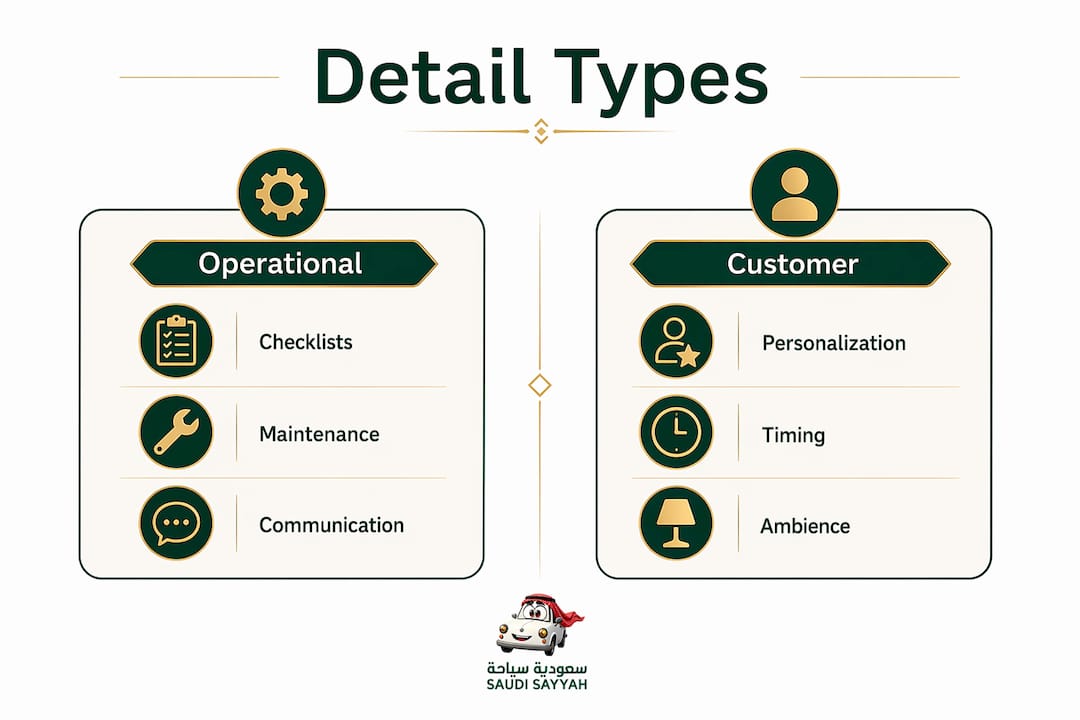
The table below shows how operational and customer-facing details differ and why both matter:
| Detail Type | Examples | Customer Impact |
|---|---|---|
| Operational | Standardized checklists, vehicle maintenance logs, booking system automation | Reduces errors, enables consistency under pressure |
| Customer-facing | Driver photo sent before pickup, clean vehicle interior, clear arrival instructions | Builds immediate trust and reduces customer anxiety |
| Communication | Proactive updates, jargon-free instructions, organized handoffs | Reduces customer effort and eliminates uncertainty |
| Physical environment | Equipment quality, uniform standards, signage clarity | Sets perception of brand quality before any interaction begins |
Proactive communication is one of the most underused operational details in service. Clear shipping updates, plain-language instructions, and organized handoffs reduce the number of questions customers need to ask. Fewer questions mean less friction. Less friction means higher satisfaction scores, without adding a single new service feature.
Pro Tip: Map every point in your service process where a customer might feel uncertain. At each point, add a proactive communication detail. A single well-timed message can prevent three reactive support contacts.
How do you apply detail-oriented service in practice?
Knowing that details matter is not the same as knowing which details to act on. The five senses framework gives teams a practical starting point. Define one specific standard for each sense in your service environment, write it down, and train to it. That process converts abstract quality goals into observable behaviors.

Personalization is the next layer. Using a guest's name, noting preferences, and solving problems with kindness creates deeper emotional connections than large-scale infrastructure investments. Trust built through repeated small, thoughtful moments is the most durable brand asset a service organization can hold. A customer who feels recognized returns. A customer who feels processed does not.
Complaint management is where detail-oriented service proves its real value. Proactive handling of mistakes with confidence transforms dissatisfied customers into loyal ones. The detail that matters here is not the apology. It is the speed, the ownership, and the specific resolution offered. Generic apologies are noise. Specific, fast, personalized recovery is signal.
Here are concrete steps to build detail awareness into daily service operations:
- Define standards in writing. Vague standards produce inconsistent results. Write down exactly what each detail should look like.
- Audit regularly. Walk through your service environment as a customer would, at least once a month.
- Train on timing. Include timing scenarios in every service training session, not just task completion.
- Personalize systematically. Use customer data to record preferences and brief your team before each interaction.
- Review complaints for detail failures. Most complaints trace back to a missed detail. Treat each one as a data point.
- Recognize detail-focused behavior. Staff who catch and correct small issues before customers notice deserve specific recognition.
For teams managing group transport for pilgrimages, detail management at scale requires documented systems, not individual effort. The goal is to make excellent detail delivery the default outcome of the process, not the result of one exceptional employee having a good day.
Key takeaways
Detail-oriented service works because small, consistent, well-timed actions build the trust and perception that large investments alone cannot create.
| Point | Details |
|---|---|
| First impressions are detail-driven | Visual, sensory, and physical details set service quality tone within seconds of customer arrival. |
| Timing is a detail | When an action happens matters as much as whether it happens; missed timing kills impact. |
| Operational details enable consistency | Back-end systems, checklists, and communication protocols make customer-facing excellence repeatable. |
| Personalization outperforms infrastructure | Using names, noting preferences, and resolving issues specifically builds stronger loyalty than facility upgrades. |
| Complaint recovery is a detail opportunity | Fast, specific, ownership-driven responses to mistakes convert dissatisfied customers into repeat ones. |
Why most services fail at the detail level
Service failures rarely happen because organizations do not care. They happen because detail management is treated as an individual responsibility rather than a system. I have seen transport operations with excellent drivers and poor booking confirmations. I have seen hotels with beautiful lobbies and inconsistent room standards. The gap is always the same: the front-facing detail was defined, but the operational detail that produces it consistently was not.
The Kikubari principle changed how I think about training. Most programs teach staff what to do. The better question is whether staff can read a situation and know when to do it. That skill does not come from a manual. It comes from deliberate practice, regular debriefs, and a culture that rewards noticing things before customers have to point them out.
The examples of customer service excellence that stand out in any industry share one trait: they made the customer feel anticipated. Not just served. Anticipated. That feeling is the product of hundreds of small decisions made correctly, consistently, over time. No single detail creates it. The absence of any single detail can destroy it.
The organizations that sustain service excellence treat detail review as a permanent operating function, not a one-time improvement project. They audit, they debrief, they update their standards, and they start again. That cycle is the actual work.
— Fa
How Saudisayyah puts detail into every trip
Saudisayyah applies every principle in this article to transport service for pilgrims traveling through Saudi Arabia. Before each trip, the platform sends driver photos, vehicle details, and real-time tracking. That single operational detail eliminates the anxiety of waiting for an unknown driver in an unfamiliar city.

The fleet comprises the latest model year vehicles maintained to consistent standards, and professional drivers are trained to recognize and respond to passenger needs throughout the journey. For first-time visitors to the holy lands, that level of detail is not a luxury. It is the difference between a stressful transfer and a peaceful one. Explore Saudisayyah's car hire services or review the full vehicle fleet to see how operational and customer-facing detail come together in practice.
FAQ
What is the role of detail in service?
The role of detail in service is the deliberate management of small, specific elements across sensory, operational, timing, and emotional dimensions to shape customer perception and build trust. Thoughtful details signal that an organization has considered the experience from the customer's point of view.
Why does timing matter in detail-oriented service?
Timing determines whether a service action creates a lasting impression or goes unnoticed. Most service failures trace back to timing rather than the omission of tasks entirely.
How do operational details affect customer experience?
Operational details like standardized checklists, automated communications, and maintained equipment create the consistency that customer-facing details depend on. Without reliable back-end systems, front-facing service quality becomes unpredictable.
What is kikubari and how does it apply to service?
Kikubari is a Japanese concept describing the practice of sensing a customer's emotional state and responding proactively before they ask. It applies to service by training staff to read situations and adjust timing, tone, and actions to match what the customer actually needs in that moment.
How can small details build customer loyalty?
Using a customer's name, noting preferences, and resolving issues specifically creates emotional connections that repeat over time into loyalty. Trust built through consistent small moments is more durable than any single large gesture.