
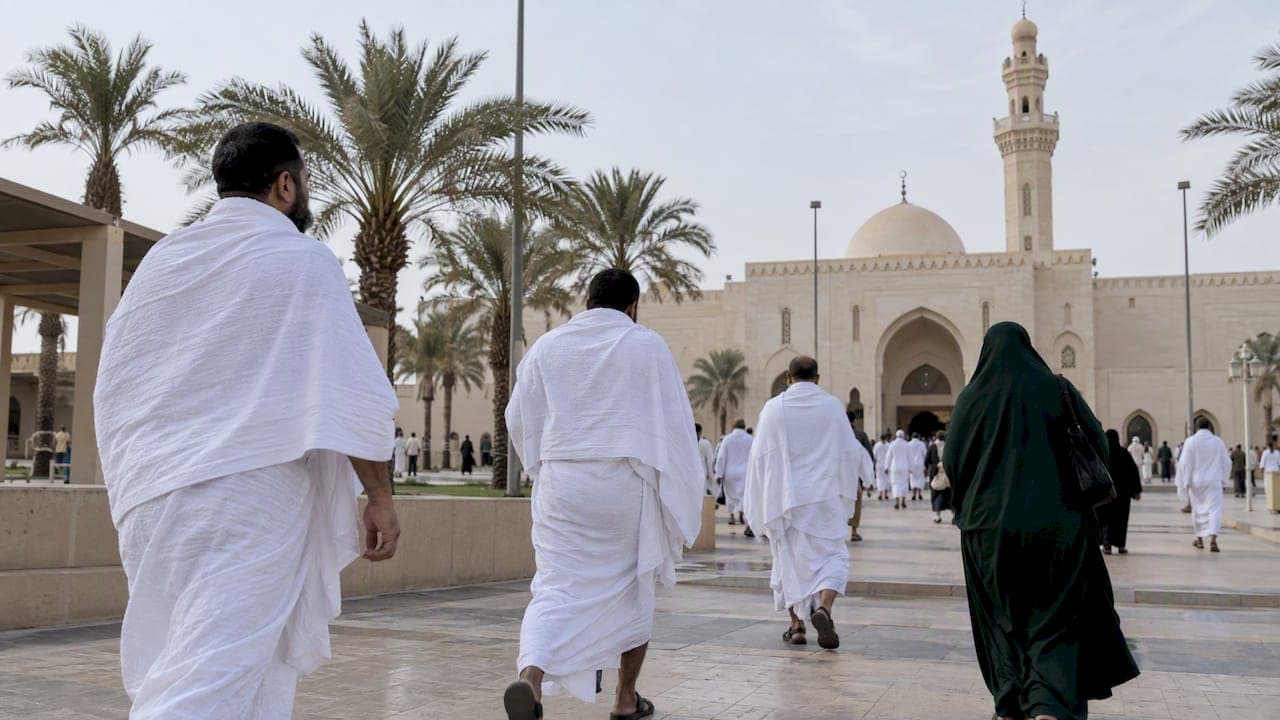
Your miqat depends on your route into Makkah, not your nationality or home country. There are five canonical miqats, and you enter ihram at or just before the one your journey crosses: Dhul-Hulaifah, Al-Juhfah, Qarn Al-Manazil, Yalamlam, and Dhat Irq. Flying in? Enter ihram when your plane is parallel to your miqat, not after the cabin announcement. Transfers help you time that moment correctly on the ground.
TL;DR:
- Travelers from Madinah use Dhul Hulaifah, about 450 kilometers away; Riyadh routes use Qarn Al Manazil, roughly 75 to 80 kilometers from Makkah.
- Airline announcements often come 30 to 45 minutes before crossing; change beforehand and treat them as a final reminder, not your cue to begin.
- Visitors passing through Jeddah must observe an earlier miqat they cross; residents and travelers who decide on Umrah only after arriving may enter ihram there.
- If you miss the miqat, return before beginning Umrah rites when possible; otherwise, fidyah may apply, so confirm the remedy with a knowledgeable guide.
- For an additional Umrah after reaching Makkah, enter ihram at Masjid Aisha in At Taneem, rather than returning to one of the five outer sites.
Table of Contents
- The Five Miqats: Quick Reference
- Which Miqat Applies to My Route: Examples and Decision Rules
- Timing and Logistics: Entering Ihram on Airplanes, Buses, and Cars
- Missed Miqat: What to Do
- Step-by-Step: How to Enter Ihram at the Miqat
- Operational Note: How Tracked Transfers Reduce the Risk of Missing the Miqat
- Simple Habits That Prevent Miqat Timing Stress
- Book a Transfer Timed to Your Miqat
- FAQ
- Sources
The Five Miqats: Quick Reference
Each miqat corresponds to a direction of approach into Makkah. Knowing the name and approximate distance helps you confirm you are at the right point before assuming ihram.
- Dhul-Hulaifah (Abyar Ali): used by pilgrims coming from or through Madinah, roughly 450 kilometers from Makkah, according to Ministry guidance.
- Al-Juhfah (Rabigh): serves travelers approaching from the northwest or along the Red Sea coast, about 183 kilometers out, with Rabigh commonly used today as the practical substitute for the historic site, per the Ministry of Hajj & Umrah.
- Qarn Al-Manazil (As-Sayl Al-Kabir): the point for those arriving from Najd and eastern routes, including drivers coming from Riyadh, roughly 75 to 80 kilometers from Makkah.
- Yalamlam (As-Sa'diyah): covers southern approaches, including the Jazan and Abha corridor, around 92 to 100 kilometers out.
- Dhat Irq: the miqat for northeastern approaches, about 90 to 94 kilometers from Makkah.
If you are already inside Makkah and need to enter ihram for an additional Umrah, Masjid Aisha in At-Taneem (also called Al-Ju'ranah) is the validated local point, confirmed in official Umrah guidance. Official maps published by the Ministry give GPS coordinates for each site, which is worth checking before you travel, since road signage can be easy to miss at highway speed.
Which Miqat Applies to My Route: Examples and Decision Rules
The rule is simple: the miqat is set by the path you take into Makkah, not by where you live or hold citizenship. Four common scenarios cover most pilgrims in Saudi Arabia.
- Arriving via Madinah: you use Dhul-Hulaifah (Abyar Ali), typically entering ihram at or near the mosque there before continuing south.
- Flying into Jeddah: your flight path determines the miqat, and you need to be ready to enter ihram while the aircraft is parallel to your designated point, often Al-Juhfah or Qarn Al-Manazil depending on origin.
- Driving from Riyadh: you use Qarn Al-Manazil (As-Sayl Al-Kabir), a well-marked stop on the route west.
- Living in or passing through Jeddah or Rabigh: residents of Jeddah may assume ihram from the city itself, but visitors who cross a canonical miqat on their way must still observe it unless they only form the intention to perform Umrah after arriving, a distinction Sheikh Ibn Baz addresses directly.
If you are unsure which category you fall into, the safer choice is to assume ihram slightly before the miqat rather than risk crossing it without intention.
Timing and Logistics: Entering Ihram on Airplanes, Buses, and Cars
Airlines flying into Jeddah or Madinah often announce the miqat crossing 30 to 45 minutes before the plane is parallel to it, per Ministry guidance. Treat that announcement as a final reminder, not your starting signal, since aircraft speed means the actual point arrives faster than expected.
- Change into ihram garments before boarding when your itinerary allows it, so you are not rushing in a cramped cabin.
- Make your niyyah and say the talbiyah once you are seated and settled, not mid-change.
- For land transfers, confirm with your driver that the route includes a stop near the miqat so you can change calmly rather than in a moving vehicle.
- Families and older pilgrims benefit from an earlier, unhurried stop rather than a last-minute change under pressure.
Pro Tip: Pack your ihram garments in your carry-on, not checked luggage, so you can change whenever the route requires it.
Missed Miqat: What to Do
If you pass your miqat without entering ihram, Ministry guidance and scholarly opinion treat this as a correctable situation, not a disqualifying one.
- Return to the miqat if you realize in time and have not yet begun Umrah rituals.
- If returning is not possible, scholars note that fidyah (a compensatory offering) may apply, so this is worth confirming with a knowledgeable guide before proceeding.
- If you are already inside Makkah and the trip was unplanned, Masjid Aisha (At-Taneem/Al-Ju'ranah) is a valid point to enter ihram, as official guidance confirms.
- Coordinate with your guide or transfer provider as soon as you notice the issue, since a quick return trip often resolves it without further steps.
Step-by-Step: How to Enter Ihram at the Miqat
A short, repeatable sequence keeps the process calm and correct.
- Put on the ihram garments, men in the two unstitched cloths, women in modest, loose clothing that covers normally without a face veil or gloves required.
- Form the internal niyyah for Umrah or Hajj, then say the talbiyah aloud or quietly depending on your setting.
- Observe the immediate restrictions, no perfume applied after niyyah, no trimming hair or nails, and stay mindful of these while still moving through the airport or on the road.
- Travelers needing assistance, including women, families with children, or those with mobility needs, should ask their driver or guide for a few extra minutes at the miqat rather than changing in transit.
Pro Tip: Rehearse the talbiyah before your trip so you are not reading it for the first time under travel pressure.
Operational Note: How Tracked Transfers Reduce the Risk of Missing the Miqat
A delayed pickup or an unfamiliar driver is a common reason pilgrims cross a miqat unprepared. Drivers know each miqat location and build a stop into the route rather than treating it as an afterthought.
- Real-time GPS tracking lets you see when your vehicle is approaching the miqat, so you can prepare in advance.
- Pre-trip driver and vehicle details help manage ihram timing without searching for an unfamiliar car.
- Fixed, pre-booked transfers aim to remove last-minute scrambling that can cause rushed, incomplete ihram changes.
For a deeper operational checklist, see Avoid Fidyah: Book Tracked Transfers to the Five Miqats.
Simple Habits That Prevent Miqat Timing Stress
Three habits remove most of the stress around miqat timing. Practice changing into ihram before you travel, so the garments feel familiar rather than foreign. Confirm your pickup time with your driver well ahead of departure, allowing for a stop at the miqat rather than a rushed roadside change. Keep a small ihram kit within reach and tell your driver or guide in advance if you need extra privacy or time.
— Fa
Book a Transfer Timed to Your Miqat

Timing your miqat crossing is easier with a driver who already knows the route. Our Point to Point Transportation and Airport Transfers build a stop into your journey so you can change into ihram without rushing, and real-time tracking means you always know how close you are to the crossing point.
- Fixed-route transfers from Jeddah and Madinah airports with a planned miqat stop.
- Driver and vehicle details sent before pickup, so there is no guessing at arrivals.
- Modern, comfortable vehicles suited to families and longer intercity routes.
If you are landing in Jeddah, our Jeddah to Makkah transfer service can be arranged with your miqat stop built in, or reach out through our main booking page to arrange pickup from either airport.
FAQ
Can you wear ihram in Jeddah?
Jeddah is not generally a miqat for visitors passing through on their way to Makkah; if your route crosses one of the five canonical miqats, you must enter ihram there. Residents of Jeddah, or travelers who only decide to perform Umrah after arriving in the city, may assume ihram from Jeddah itself, according to fatwas from Sheikh Ibn Baz.
Where is Hajj located in Saudi Arabia?
The rites of Hajj take place in and around Makkah, including the Grand Mosque, Mina, Mount Arafat, and Muzdalifah. Pilgrims first pass through one of the five miqats before entering this area in ihram.
What are the steps involved in performing Umrah?
Umrah begins with entering ihram at the correct miqat, followed by tawaf around the Kaaba, sa'i between Safa and Marwah, and finally cutting or shaving the hair to close the rites. Each step follows directly from the ihram state you enter at the miqat.
How many miqats are in Makkah?
There are five primary spatial miqats appointed for pilgrims approaching Makkah: Dhul-Hulaifah, Al-Juhfah, Qarn Al-Manazil, Yalamlam, and Dhat Irq, as listed by the Ministry of Hajj & Umrah. Pilgrims already inside Makkah who need to enter ihram again use a local point such as Masjid Aisha in At-Taneem instead of one of these five.
Sources
- Miqaats — Ministry of Hajj & Umrah
- Umrah Guide for Domestic Pilgrims — Ministry of Hajj & Umrah (PDF)
- The status when Jeddah is a miqat — Sheikh Ibn Baz (fatwa)