
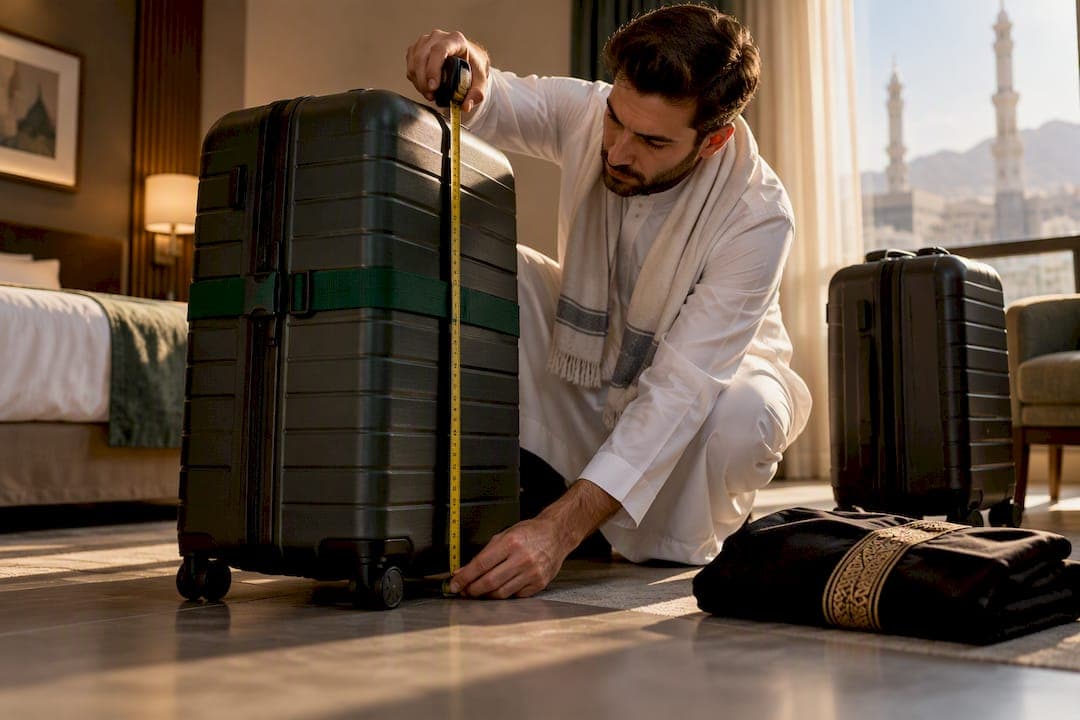
You may travel with luggage on Saudi transfer vehicles. Confirm vehicle class and the carrier's baggage terms before you book. Declare bag count and size at booking. Use airport wrapping services, official logistics programs, and provider tracking to reduce risk.
TL;DR:
- Declaring your total luggage accurately, including bag count and size, is crucial to ensure proper vehicle allocation and prevent disputes.
- Photographic documentation of your bags before loading helps verify condition and quantity, reducing liability issues during damage or loss claims.
- Baggage allowances vary by vehicle class, with sedans fitting two to three suitcases and larger vehicles accommodating more, but passenger count and luggage must be matched precisely.
- Using airport services like baggage wrapping or the government's Hajj Without Luggage program can reduce damage and handling risks for pilgrim groups.
- Confirming luggage details and vehicle class at booking, along with taking photos and keeping official confirmation, surpasses upgrading vehicle size as a safeguard.
Table of Contents
- 1. Vehicle classes and realistic luggage capacity
- 2. How to declare baggage and lock in written terms
- 3. Loading, securing, and documenting your bags safely
- 4. Airport baggage services and pilgrim logistics programs
- 5. How Saudi Sayyah handles luggage on real trips
- Why the standard advice on luggage gets it half right
- Booking a transfer that fits your luggage
- Sources
- FAQ
1. Vehicle classes and realistic luggage capacity
Sedans, MPVs, minibuses, and coaches each carry different loads. Match the vehicle to the group and the bags, not the other way around.
- Sedan or small car: Two to three passengers. Two to three medium suitcases in the trunk.
- MPV or 7-seater: Five to six passengers with luggage. Four to five medium suitcases plus carry-ons.
- 12 to 15-seat minibus: Full group capacity. Rear and underfloor storage for one bag per passenger, sometimes two.
- Coach bus: Large groups. Underfloor holds for multiple bags per person. Roof racks used only when underfloor space runs out.
Trunk and underfloor storage protect bags from weather and theft. Roof storage carries limits: weight caps, strapping requirements, and driver supervision. It works for hard cases and duffel bags, not for fragile items or electronics.
Measure your bags before booking. Standard checked suitcases run about 60 to 75 centimeters in height. Report the count and size honestly, especially for group Ziarah trips where extra bags add up fast. Request a larger vehicle class when the total exceeds two bags per seat.
Pro Tip: Photograph your bags next to a known object, like a car door, before the trip. It settles size disputes fast if a carrier questions oversize claims later.
The Road Transport Law classifies vehicles by passenger transport type and sets obligations tied to that classification, including how belongings are handled during the trip.

2. How to declare baggage and lock in written terms
Booking platforms ask for passenger count. Few ask clearly about bags. Ask anyway.
- State bag count and size in any notes field, or by message or email if no field exists.
- List special items: wheelchairs, medical equipment, oversized boxes, or zamzam water containers.
- Save the confirmation. Screenshot the booking, keep the email, and note the vehicle class assigned.
- Ask about limits before paying: weight caps, prohibited items, and what happens if your bags exceed the stated limit.
- Ask about liability: what the carrier covers if a bag is lost or damaged during the transfer.
Oversize charges, extra stops, and airport pickup fees vary by provider and route. Confirm these before the trip, not at the curb.
Under the Road Transport Law, passenger transport activities carry defined safety and vehicle obligations tied to vehicle class. A written confirmation of vehicle class at booking, matched to your declared luggage, prevents most pickup disputes.
3. Loading, securing, and documenting your bags safely
Safety rules exist for a reason. Aisles and emergency exits stay clear. Roof loads get strapped and checked before departure. On buses, a trained attendant supervises loading, not the driver alone.
At pickup:
- Watch the loading. Confirm your bags go in, not someone else's.
- Photograph your bags before they load, showing condition and count.
- Keep valuables with you. Passports, cash, and medication stay in the cabin, not the trunk or roof.
- Ask for a receipt or manifest entry if the provider offers one for group trips.
Pro Tip: A ten-second video of the loading process, timestamped on your phone, is worth more than a verbal complaint later.
If a bag goes missing or arrives damaged, act immediately. Photograph the damage, note your trip ID or booking reference, and contact the provider before leaving the vehicle or terminal. Road transport claims work differently from airline claims. Airlines follow set compensation rules: 148 SDR for the first day of delay and 60 SDR for each following day, with a cap of 1,288 SDR for loss or damage. Ground transport providers set their own terms, which is why the written confirmation from booking matters.

4. Airport baggage services and pilgrim logistics programs
King Abdulaziz International Airport supports pilgrim traffic with dedicated services. Its baggage wrapping service protects checked bags against damage and theft, available across terminals including the Hajj & Umrah Complex built for pilgrim flow.
For large groups, private transfers are not always the answer. The Saudi government runs Hajj Without Luggage, an integrated logistics system that ships group baggage separately, cutting down on handling at arrival and between rituals. Groups moving between Makkah and Madinah often benefit from this over multiple private vehicle transfers loaded with bags.
Coordinating transfers:
- Confirm your transfer pickup point matches your Haramain Railway arrival or departure terminal.
- Allow buffer time between train and vehicle transfer for baggage retrieval.
- Match luggage count to the vehicle booked for the connecting leg, not the earlier one.
KAIA's role as a primary pilgrim gateway, with its Hajj & Umrah facilities and rail link, shapes how these connections work in practice.
5. How Saudi Sayyah handles luggage on real trips
The booking system includes luggage fields at the point of booking. Passengers state bag count and size, and the system matches the request to an appropriate vehicle class from a fleet of vehicles.
Before the trip, passengers receive driver and vehicle details, confirmed through the platform. Loading is supervised at pickup. Real-time GPS tracking runs during the transfer, providing visibility into the route and timing. A feedback channel stays open after the trip for any luggage-related issue.
Why the standard advice on luggage gets it half right
Most guidance on this topic stops at packing tips: pack light, label your bags, done. That misses the real risk, which sits at the booking stage, not the packing stage. Declaring more bags than a vehicle reasonably holds creates problems before the trip starts.
The overrated fix is upgrading to a bigger bus "just in case." That solves capacity but not documentation. The bag still needs a count, a photo, and a written confirmation, regardless of vehicle size. Group programs like Hajj Without Luggage are underused by comparison. They solve the harder problem: moving bags between cities without tying them to a specific transfer vehicle at all.
Prioritize the paper trail first. Vehicle size second. A well-documented booking on a slightly cramped minibus beats an undocumented one on a spacious coach when something goes wrong.
— Fa
Booking a transfer that fits your luggage
Saudi Sayyah's services page covers Point to Point Transportation, Ziarah Packages, and Hire by the Hour, each with a luggage field at booking. State your bag count and size there, and the system matches you to a vehicle class before confirmation.
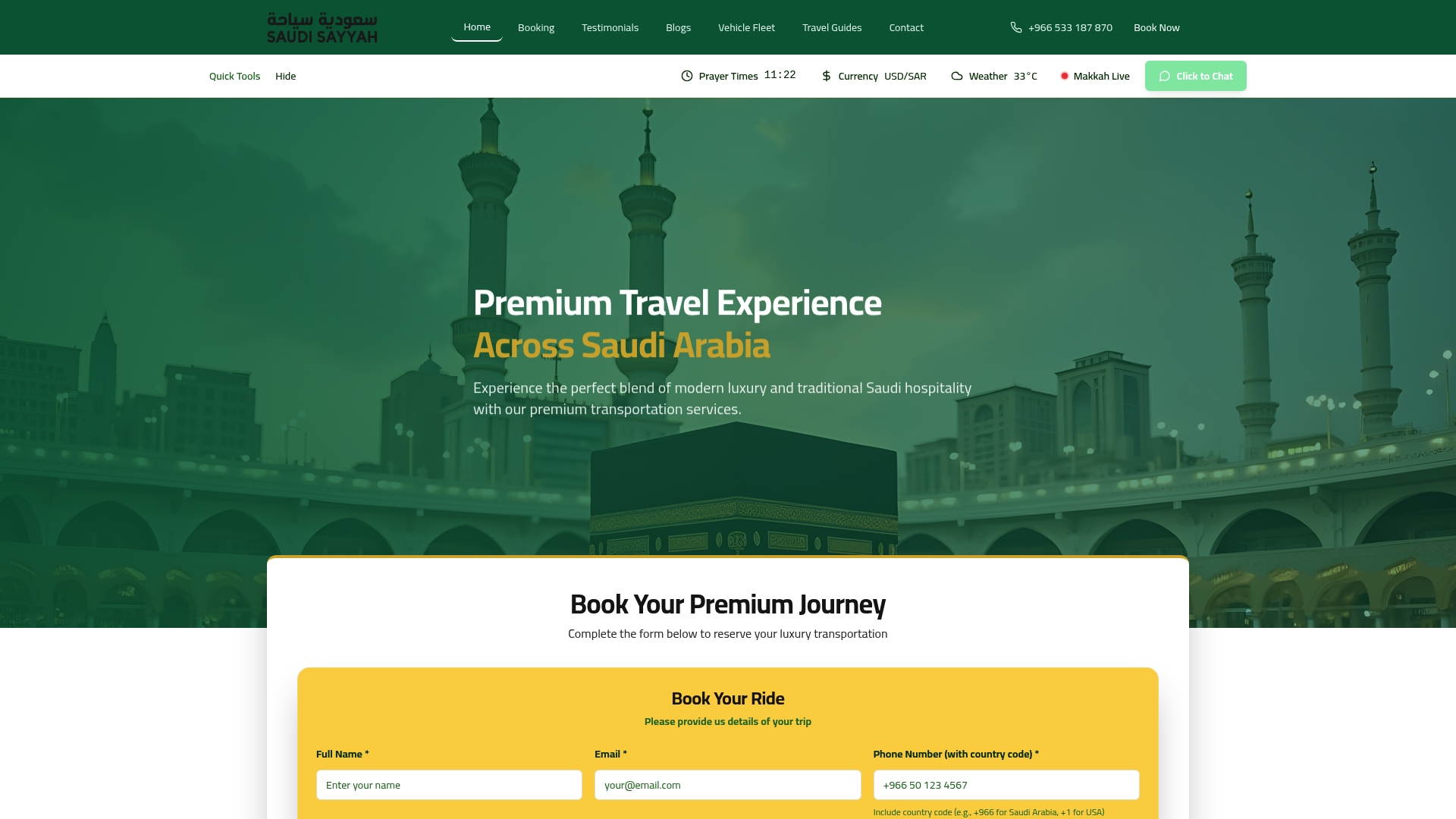
You receive a driver photo, vehicle details, and live tracking ahead of the trip, all tied to your booking record. Check the fleet page to see vehicle options by capacity, or start directly on the homepage for airport and intercity transfers.
- Airport pickups: state flight details and bag count at booking.
- Ziarah tours: confirm group size against vehicle capacity ahead of time.
- Hourly hire: useful for multi-stop trips with luggage staying in the vehicle.
Sources
- 'Hajj Without Luggage' Initiative Facilitates Pilgrims’ Journey Through Integrated Logistics System (SPA)
- Baggage wrapping service (KAIA)
- Road Transport Law (KSA) — full text (MISA)
FAQ
Can I bring multiple suitcases on a Saudi airport transfer?
Yes, within the vehicle's capacity. A sedan typically fits two to three medium suitcases, while an MPV or minibus fits more, so declare your bag count at booking to get matched to the right vehicle class.
What happens if my luggage is damaged during a transfer?
Photograph the damage immediately and contact your provider with your trip reference. Ground transport claims are handled by the provider directly and differ from airline rules, which specify 148 SDR for the first day of delay and 60 SDR for each following day, capped at 1,288 SDR for loss or damage.
What is the Hajj Without Luggage program?
It is a government-run integrated logistics system that ships pilgrim group baggage separately from passenger transfers, reducing handling at arrival and between Makkah and Madinah. It suits large groups more than individual point-to-point bookings.
Can I use airport baggage wrapping before my transfer?
Yes, King Abdulaziz International Airport offers baggage wrapping services across its terminals, including the Hajj & Umrah Complex, before you head to your ground transfer.
Does Saudi Sayyah let me specify luggage when booking?
Yes, the booking system on the services page includes fields for bag count and size, which the platform uses to match you with an appropriately sized vehicle from its fleet.