
TL;DR:
- Proper planning of visa requirements and transportation options at Jeddah airport ensures smooth connections, especially during Hajj and Umrah.
- Utilizing the airside 12-hour transit, the free 96-hour stopover visa, and booking trains or private transfers in advance simplifies airport navigation and reduces stress.
Knowing how to plan Jeddah airport transit before you arrive saves you from scrambling at transfer desks, missing connections, or discovering too late that your nationality requires a visa. King Abdulaziz International Airport handles tens of millions of passengers every year, and its position as a gateway to Makkah makes it unlike almost any other transit hub in the world. The rules around visas, the integration of the Haramain Railway, and the seasonal pressure of Hajj and Umrah create a set of planning variables that reward preparation. This guide covers all of them.
Table of Contents
- Key takeaways
- How to plan Jeddah airport transit: visa rules first
- Navigating Jeddah Airport terminals
- Comparing transport options to Makkah and beyond
- Step-by-step transit execution
- Common transit problems and how to avoid them
- My take on what travelers consistently get wrong
- Plan your transfer with Saudisayyah
- FAQ
Key takeaways
| Point | Details |
|---|---|
| Visa under 12 hours | No visa required if you stay in the airside transit area for layovers under 12 hours. |
| 96-hour stopover visa | Free for Saudia and flynas passengers, allows leaving the airport for Umrah or tourism. |
| Terminal 1 connections | Allow 60 to 90 minutes for connections within Terminal 1; inter-terminal transfers need 150 minutes. |
| Rail to Makkah | The Haramain High-Speed Railway departs from inside Terminal 1 and reaches Makkah in about 30 minutes. |
| Book transport early | During Hajj season, fares surge and train tickets sell out. Pre-booking private transfers avoids both problems. |
How to plan Jeddah airport transit: visa rules first
Getting your visa status right before you land is non-negotiable. The rules are actually straightforward once you understand the two main scenarios.
Airside transit (under 12 hours). No visa is required if your layover is under 12 hours and you stay inside the secured airside area. You do not clear Saudi immigration, you do not collect your checked bags, and you go directly to your connecting gate. This applies to the vast majority of short layovers.
The 96-hour stopover visa. This is where it gets interesting for passengers who want to leave the airport. The 96-hour stopover visa is free and available to passengers traveling on Saudia or flynas. It lets you exit the airport, visit Makkah for Umrah (for eligible Muslims), explore Jeddah, or simply rest at a hotel. There is one firm constraint: the visa is non-extendable and single-entry, so your hotel check-in, Umrah timing, and return to the airport all need to fit within the 96-hour window.
For passengers on other airlines or those needing longer stays, a standard transit visa applies. That requires an application ahead of travel, a valid passport with at least six months remaining, a confirmed onward ticket, and travel insurance.
Here is what you need to have ready regardless of which visa category applies:
- Passport valid for at least 6 months beyond travel dates
- Confirmed onward ticket printout or digital copy
- Travel or medical insurance documentation
- Visa approval letter (if applicable to your nationality or airline)
- Hotel booking confirmation (for 96-hour stopovers)
Pro Tip: Check your eligibility for the 96-hour stopover visa before booking your flights. If you are already flying Saudia or flynas, this benefit costs nothing and opens up a short Umrah opportunity that many travelers miss entirely.
Navigating Jeddah Airport terminals
King Abdulaziz International Airport's main international hub for transit passengers is Terminal 1. Most connecting flights and the Haramain Railway station are both located here, which makes Terminal 1 the center of the transit operation.
When you land as a connecting passenger, follow the "Transfer" signs immediately after deplaning. You will reach a transfer desk where staff verify your onward boarding pass and direct you to transfer security. This screening mirrors the security check at departure: liquids, electronics out of bags, shoes may be removed. It takes 10 to 20 minutes under normal conditions.
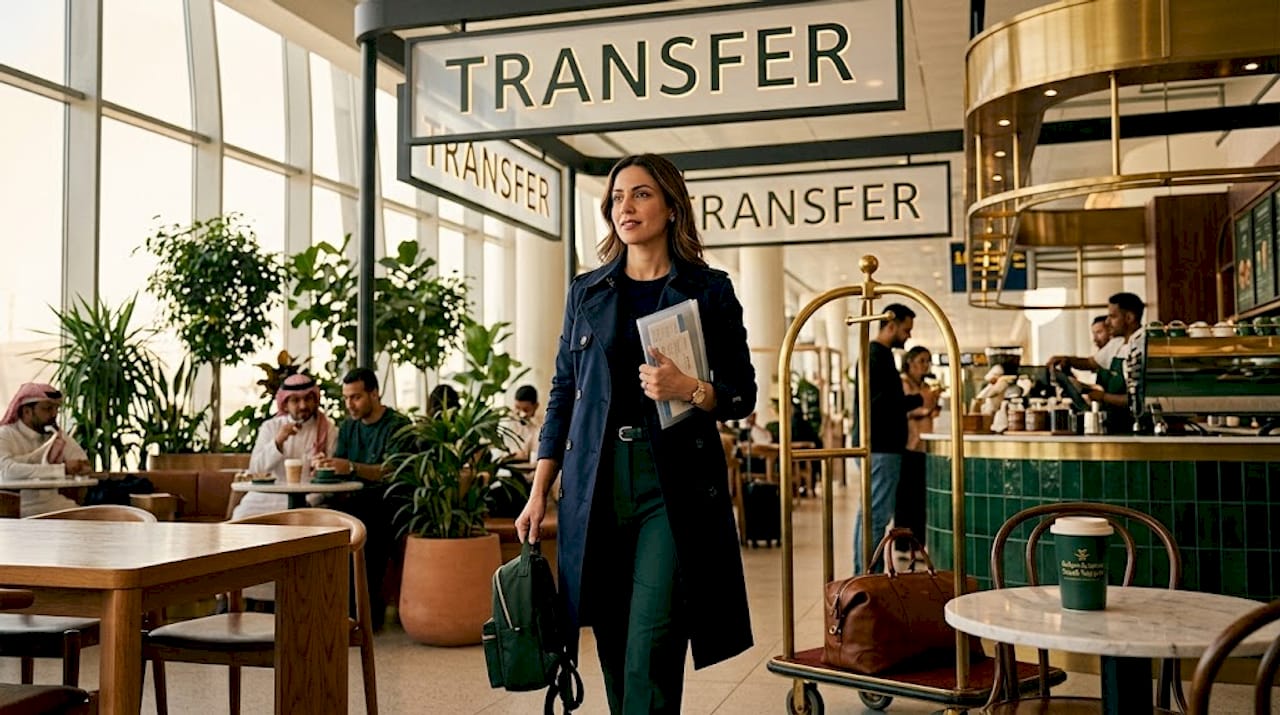
Timing is where most transit problems originate. Connections inside Terminal 1 require 60 to 90 minutes at a minimum. If your onward flight departs from the North Terminal, add time for the shuttle bus and a second security screening, bringing the total to at least 150 minutes. Shuttle buses run regularly, but frequency varies and wait times add up.
A few practical tips for staying on schedule:
- Follow overhead signage immediately. Do not pause or wait for fellow passengers.
- Avoid peak boarding and arrival windows, typically late evening and early morning during pilgrimage seasons.
- If traveling with elderly passengers or young children, request priority assistance at the transfer desk before proceeding.
- Confirm your departure gate on the airport screens as soon as you clear security, not after.
Pro Tip: Build at least 90 minutes into any connection within Terminal 1. If the booking system offers you a tighter window, consider whether a longer layover on the same itinerary is worth the peace of mind.
Comparing transport options to Makkah and beyond
For passengers using the 96-hour stopover visa or completing their onward journey by land, getting out of the airport efficiently matters. This is especially true for Umrah pilgrims who arrive with luggage, traveling in groups, or bringing elderly family members.
The fastest and most predictable option is the Haramain High-Speed Railway, which runs directly from a station built into Terminal 1 arrivals. The trip to Makkah takes roughly 30 minutes. The train avoids road traffic entirely, which is a significant advantage during Hajj when highway congestion can add hours to a road journey. Book tickets in advance through the official Haramain app or website, particularly during peak pilgrimage periods when transport times can double and surge pricing reaches SAR 350 or higher.
Here is how the main options compare:
| Mode | Approx. cost (SAR) | Travel time | Convenience |
|---|---|---|---|
| Haramain Railway | 30 to 80 | ~30 minutes | High. Fixed schedule, no traffic impact. |
| Private transfer | 300 to 500 | 45 to 90 minutes | High. Door-to-door, best for families. |
| Uber / Careem | 200 to 350+ | 45 to 120 minutes | Medium. Surge pricing during Hajj. |
| Official airport taxi | 250 to 350 | 45 to 120 minutes | Medium. Negotiated fare, variable quality. |
Uber vs taxi pricing is not a fixed comparison in Saudi Arabia. At non-peak times, ride-hailing apps can be competitive. During Hajj, surge pricing often makes app-based rides more expensive than negotiated taxis. Neither is as predictable as a pre-booked private transfer with a confirmed price.
Families, travelers with a lot of luggage, and elderly pilgrims benefit most from pre-booked private transfers. A confirmed vehicle, a named driver, and a fixed fare remove three variables from an already complex transit day.
Pro Tip: Book Haramain train tickets as soon as your flights are confirmed during Hajj season. Trains fill up weeks in advance and there is no standby option at the station.
Step-by-step transit execution
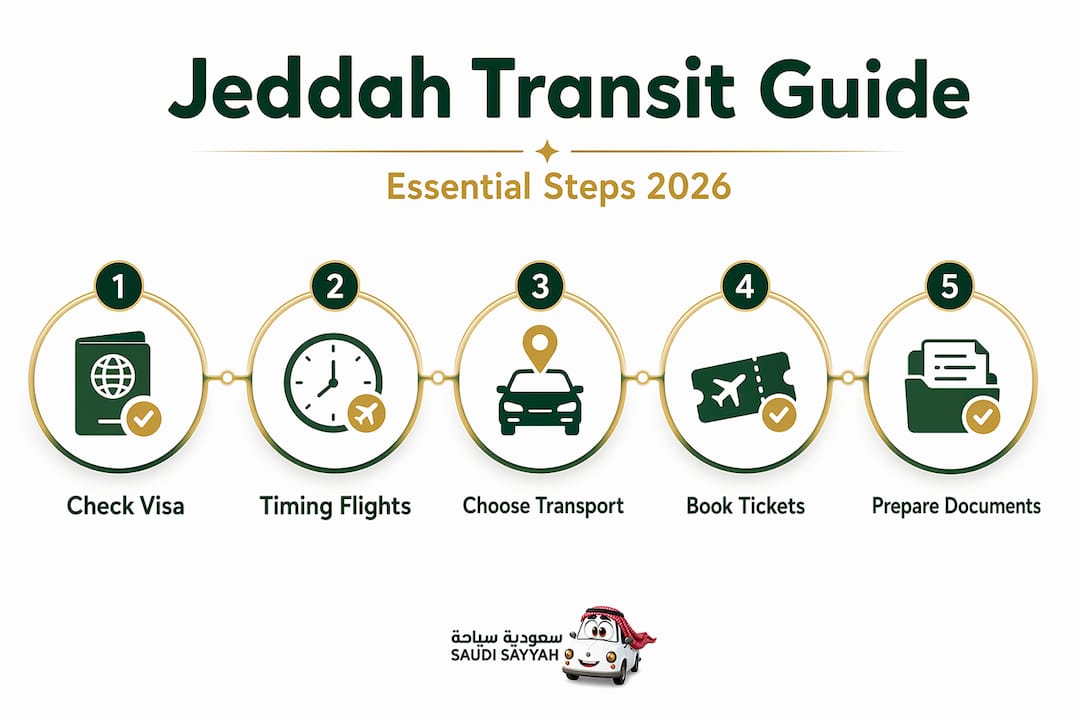
Good preparation becomes the plan. Here is how a well-organized Jeddah transit actually unfolds:
- Before departure: Confirm visa category based on your nationality, your airline, and your layover duration. Print your onward ticket and any visa approval letter. Download the airport map and the Haramain app if using the train.
- On arrival at JED: Follow "Transfer" signs immediately. Do not follow baggage claim signs unless you are exiting the airport on a stopover visa.
- Transfer desk: Present your boarding pass for the onward flight. Staff will confirm your route and gate area. Ask about current gate assignments and any terminal changes.
- Transfer security: Move through quickly. Have your boarding pass, passport, and any liquids organized before you reach the belt.
- If leaving the airport: Present your 96-hour stopover visa approval or verify eligibility at the transfer desk before exiting. Collect checked baggage from the arrivals belt, then proceed to the transport level.
- Connecting gate: Confirm your gate on the departures board. Reach the gate at least 40 minutes before departure. Boarding at JED can begin earlier than many travelers expect.
Pro Tip: Have your boarding pass and passport in your hand before you reach any desk or checkpoint. Small delays compound quickly in a large airport, and being ready at each step keeps you moving.
Common transit problems and how to avoid them
The issues that derail Jeddah transits tend to fall into predictable categories. Recognizing them in advance makes them avoidable.
Tight connections. The most common problem. A 60-minute domestic-style connection that works at smaller airports does not account for transfer security, signage following, and potential gate changes at JED. Inter-terminal transfers require around 150 minutes. Book itineraries with adequate buffers.
Visa confusion. Many travelers assume the 96-hour stopover visa is available regardless of airline. It applies only to Saudia and flynas passengers. Attempting to exit the airport on another carrier without the correct documentation leads to processing delays and potential denial.
Hajj season transport delays. During Hajj peaks, fares surge and wait times extend significantly. This affects every surface transport mode. Pre-booking a private transfer or securing Haramain train tickets in advance is the most reliable fix.
Additional issues to prepare for:
- Luggage delays: If your bag is late, it does not automatically follow you to a connecting flight on a separate booking. Confirm bag handling at check-in.
- Flight reschedules: If your inbound flight is delayed, contact your airline immediately about protected connections or alternative routing.
- Terminal reassignments: Gate and terminal changes happen. Check official screens and the airport app frequently.
Pro Tip: Download the King Abdulaziz International Airport app before travel. Real-time gate updates, terminal maps, and flight status notifications are available in one place.
Staying calm during unexpected changes is easier when documentation is organized and every step is pre-planned. The travelers who handle disruptions well are usually the ones who prepared for them before boarding.
My take on what travelers consistently get wrong
I've reviewed how travelers approach Jeddah transits, and the patterns are consistent. The mistake that causes the most avoidable stress is treating visa eligibility as something to figure out at the airport. The 96-hour stopover option is genuinely valuable for Umrah pilgrims, but it only works if you are on the right airline and have your documentation ready before you land. Discovering the eligibility requirement at the transfer desk does not create options.
The second issue I see regularly is underestimating how differently Jeddah operates during pilgrimage seasons. A transit that takes 2 hours on a quiet Tuesday in November can take twice as long in the weeks surrounding Hajj. That is not a failure of planning. It is the expected reality of one of the world's largest annual pilgrimages passing through a single airport. Build the time in.
What genuinely surprises first-time visitors is the 96-hour stopover as a cultural opportunity. Most people using Jeddah as a transit point are passing through on the way to somewhere else. But a 96-hour window with a free visa, access to Makkah for eligible Muslims, and a fast train from the terminal is not a layover inconvenience. For first-time visitors to the holy cities, it is a genuine entry point. Plan for it deliberately, not as an afterthought.
— Fa
Plan your transfer with Saudisayyah
Once you have your visa sorted and your connection timed, transport from the airport should not be left to chance. Saudisayyah provides pre-booked private transfers from King Abdulaziz International Airport to Makkah, Madinah, and across Saudi Arabia, with fixed fares and real-time driver tracking.
Every booking includes driver photos, vehicle details, and GPS tracking sent before pickup. No surge pricing. No negotiating at the curb with luggage in hand. Saudisayyah's fleet of late-model vehicles is suited for families, elderly pilgrims, and travelers with significant baggage, exactly the situations where standard taxis and ride-hailing apps fall short. For Umrah pilgrims managing a 96-hour stopover window, the airport transfer services remove one major variable from a tightly scheduled trip. View the full vehicle fleet and book before your travel dates, particularly if you are arriving during Hajj or peak Umrah season.
FAQ
Do I need a visa for a short layover at Jeddah Airport?
No. Layovers under 12 hours do not require a visa as long as you remain in the airside transit area and do not pass through immigration.
What is the 96-hour stopover visa and who qualifies?
The 96-hour stopover visa is a free permit for passengers flying Saudia or flynas that allows them to exit Jeddah Airport and spend up to four days in Saudi Arabia. It is non-extendable and single-entry.
How much time do I need for a connecting flight at JED?
Allow 60 to 90 minutes for connections within Terminal 1. Transfers to the North Terminal require a shuttle and additional security, so plan for at least 150 minutes total.
What is the fastest way to get from Jeddah Airport to Makkah?
The Haramain High-Speed Railway departs from inside Terminal 1 and reaches Makkah in approximately 30 minutes, making it the fastest and most reliable option regardless of road traffic.
Are taxis or Uber better for getting from JED to Makkah?
Neither is consistently better. Uber pricing varies with demand and surge conditions, particularly during Hajj. A pre-booked private transfer option with a fixed fare is the most predictable choice for most travelers.