
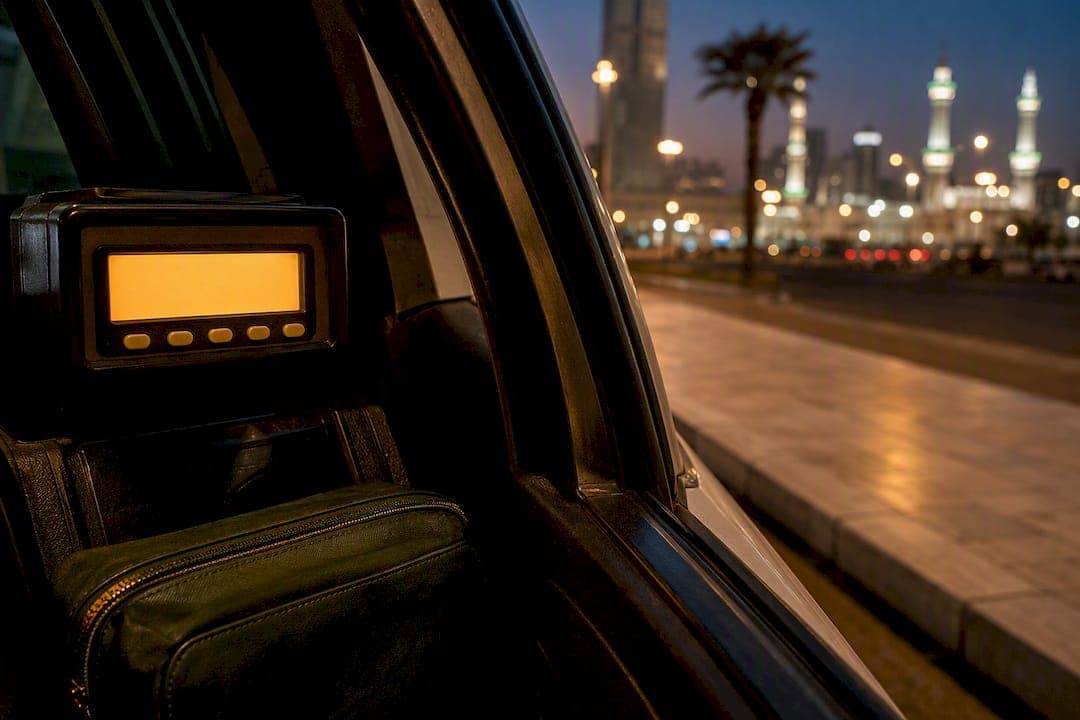
Mecca taxi meters now start at the officially raised rate around 6.4 SAR and add a per-kilometer charge varying with vehicle class, up from the previous base flagfall. Budget typical fares in the low to mid tens of SAR for short and medium rides inside Mecca, and a few hundred SAR for a Jeddah Airport transfer, with actual prices varying by distance and demand. Expect all of these to climb during Hajj and Umrah peaks, so prebook airport trips when you can.
TL;DR:
- Taxi flagfall in Mecca now starts at around 6 SAR, with per-kilometer rates varying based on vehicle capacity and demand, especially during peak seasons.
- Actual fares for short rides within Mecca typically range from 12 to 18 SAR, and long airport transfers can cost between 150 and 300 SAR depending on booking method and demand.
- Using app-based or prebooked fixed-rate services like Saudi Sayyah ensures a locked fare, avoiding fluctuations caused by traffic, surge pricing, or driver behavior.
- To prevent overcharging, always verify that the meter is running within the first minute, photograph the meter and license plate, and agree on fares before starting long trips.
- Night travel around Mecca is more unpredictable, with fewer taxis available, higher likelihood of flat fares, and increased importance of prebooked or app-locked fares during late hours.
Table of Contents
- What Are the Official Taxi Rates in Mecca?
- What Do Real Taxi Rides in Mecca Actually Cost?
- How Are Taxi Fares Calculated in Mecca?
- How Can You Avoid Being Overcharged?
- How Saudi Sayyah Removes the Fare Guesswork
- Do You Tip Taxi Drivers in Mecca?
- Are Taxis Harder to Find or More Expensive at Night?
- Are Mecca Taxis Regulated and Licensed?
- A Simple Rule for Budgeting Your Mecca Taxi Costs
- Book a Transfer Instead of Negotiating One
- Sources
What Are the Official Taxi Rates in Mecca?
The Transport General Authority raised the national taxi tariff, and the new numbers are now the legal reference point for every metered ride in Mecca. Opening flagfall moved from about 5.5 SAR to 6.4 SAR, per kilometer charges climbed to a range of roughly 2.1 to 2.4 SAR depending on the vehicle's seating capacity, and waiting time now runs about 0.9 to 1.1 SAR per minute, according to reporting on the tariff update.
- Flagfall charge set around 6 SAR
- Per-kilometer rates vary depending on vehicle capacity
- Waiting time charged by the minute
- Larger vehicles generally incur higher per-kilometer rates
The meter is the legal source of truth. Any driver quoting a flat rate for a metered trip inside city limits should be running the meter as backup, and a passenger has the right to ask for it.
This tariff applies nationally, not just in Mecca, but the holy city sees the highest real-world variance from these official numbers because of pilgrim demand near the Grand Mosque.
What Do Real Taxi Rides in Mecca Actually Cost?
Numbers on paper are one thing. What you'll actually pay depends heavily on distance, time of day, and how close you are to Masjid al-Haram. Here are three realistic scenarios:
- A 2 to 3 km hop inside central Mecca (hotel to a nearby mall or clinic): with the 6.4 SAR flagfall plus roughly 2.2 SAR per kilometer, expect a metered fare of about 12 to 18 SAR on a clear run, more with traffic waiting charges added.
- A 5 to 10 km ride (crossing from one district to another, avoiding the immediate Haram perimeter): fares typically land between 25 and 45 SAR, depending on congestion.
- Aziziyah to Masjid al-Haram, one of the most searched routes among pilgrims: passenger reports collected from local travel forums put this trip anywhere from 15 to 40 SAR depending on time of day and how firmly the driver holds to the meter, per fare discussions among pilgrims.
Multiple travelers describe the same pattern: fares from Aziziyah to the Haram run low during off-peak hours but jump noticeably during Umrah crowds, especially when drivers skip the meter entirely near the mosque gates.
For Jeddah Airport to Mecca, a roughly 80-kilometer trip, expect wider swings. Regulated airport taxis run about 200 to 300 SAR, ride-hailing apps often price the same trip between 150 and 280 SAR, and private hotel transfers land in the 300 to 600 SAR range depending on vehicle size, according to transfer comparisons for the route. During Hajj weeks, add a meaningful premium to every figure above.
How Are Taxi Fares Calculated in Mecca?
Every metered fare in Mecca combines the same three ingredients: a fixed opening charge, a running per-kilometer rate, and a per-minute charge for time spent stationary in traffic or at stops. That's the entire formula behind the official tariff described above.
App-based rides work differently. Uber's Mecca listings show upfront pricing before you accept a trip. One example on the platform prices a roughly 16 to 17-minute UberX ride at about 27 SAR, locked in before you get in the car. That upfront number can still rise with surge pricing during high-demand windows, even though you see the total before confirming.
Street taxis sometimes skip the meter and offer a flat fare instead, particularly for longer trips or airport runs. That's not automatically a bad deal.
- Accept a flat fare when it's close to or below your own meter-based estimate for the same distance
- Decline and insist on the meter when the flat quote is well above the per-kilometer math
- Treat any flat quote near the Haram during Umrah season with extra scrutiny
Pro Tip: Do the meter math in your head before you get in: multiply the estimated kilometers by 2.2 SAR and add the 6.4 SAR flagfall. If a driver's flat quote is more than 30 percent above that number, negotiate or walk.
How Can You Avoid Being Overcharged?
A few habits protect you far more than luck does. Photograph the driver's license plate and the meter reading at the start of the trip, and ask for a printed or digital receipt at the end. For street taxis heading to the airport or on any long trip, agree on the fare before the car moves, not after.
- Prefer app booking when possible since the price is locked before you ride
- Carry small SAR notes; many taxis have point-of-sale machines, but not all
- Screenshot your app fare estimate as a reference if a street driver quotes something different
- Report disputes through app support or the relevant transport authority, keeping your photo and receipt as proof
Travel advice for the area around the Grand Mosque specifically warns that meters get ignored more often there, so locking a price through an app before you travel is one of the simplest ways to sidestep an inflated quote.
Pro Tip: If a driver's meter isn't visibly running within the first minute of a metered trip, ask them to start it. If they refuse, get out. You already have a receipt trail if you booked through an app instead.
How Saudi Sayyah Removes the Fare Guesswork
Fixed-rate bookings solve the exact problem this guide describes: not knowing what a fair price looks like until you're already in the car. Saudi Sayyah confirms your fare before pickup, so there's no meter to watch and no flat-rate negotiation at the curb.
- Bookings with fixed rates agreed before the trip starts, with no surprise additions
- Driver photo and vehicle details sent ahead
- Real-time tracking to help you know where your ride is
- Airport transfers, pickups near religious sites, and hourly hire options
Do You Tip Taxi Drivers in Mecca?
Tipping isn't built into Saudi taxi culture the way it is in some other countries, and drivers don't expect it as a matter of course. A metered fare is a complete transaction on its own.
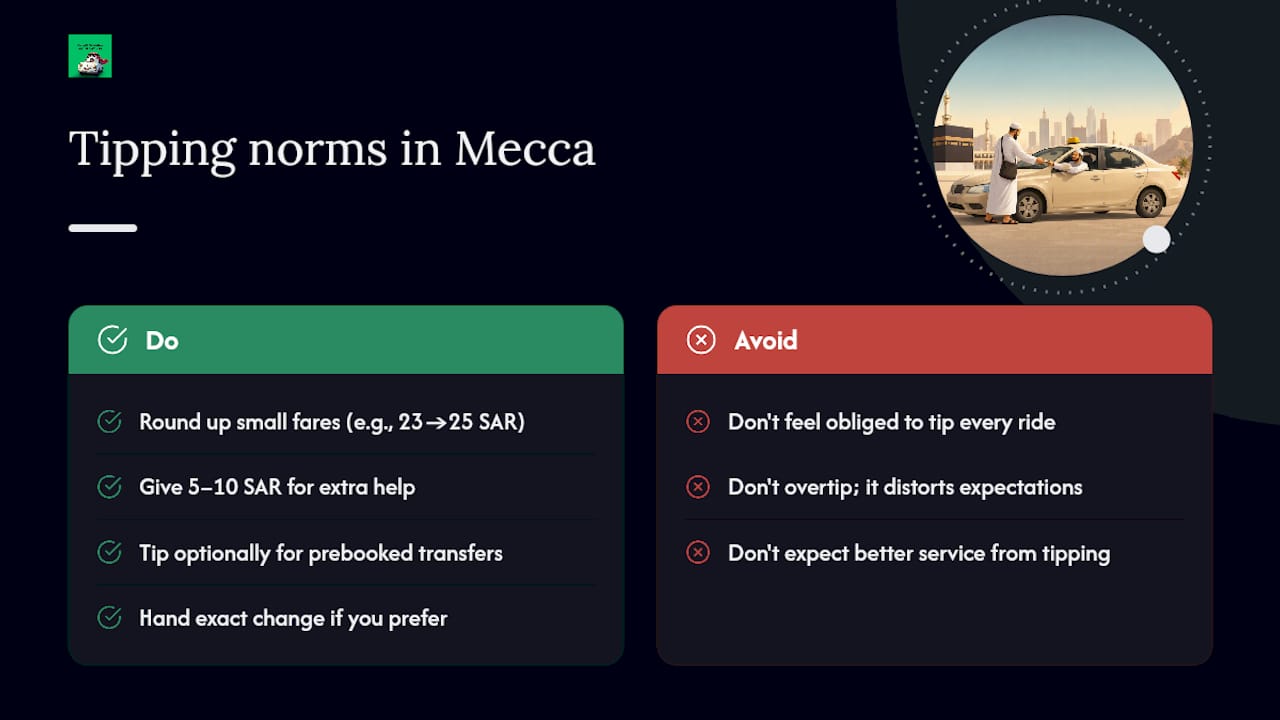
That said, rounding up is common and appreciated. If a metered ride comes to 23 SAR, handing over 25 SAR and letting the driver keep the change is a normal, low-friction gesture. It's not obligatory, and no driver should push back or act put out if you hand over exact change instead.
Where a small tip does make more sense is with drivers who go beyond the basic trip. If a driver helps carry heavy luggage at the airport, waits patiently through a long stop at a pharmacy, or handles a complicated multi-stop Ziarah route with extra care, an extra 5 to 10 SAR is a reasonable way to acknowledge that. For prebooked transfer services, tipping works the same way: it's optional and tied to service quality, not a built-in expectation baked into the fare.
Avoid the instinct to tip heavily just because you're a first-time visitor unsure of local norms. Overtipping doesn't buy better service here, and it can actually distort a driver's expectations for the next pilgrim who rides with them.
Are Taxis Harder to Find or More Expensive at Night?
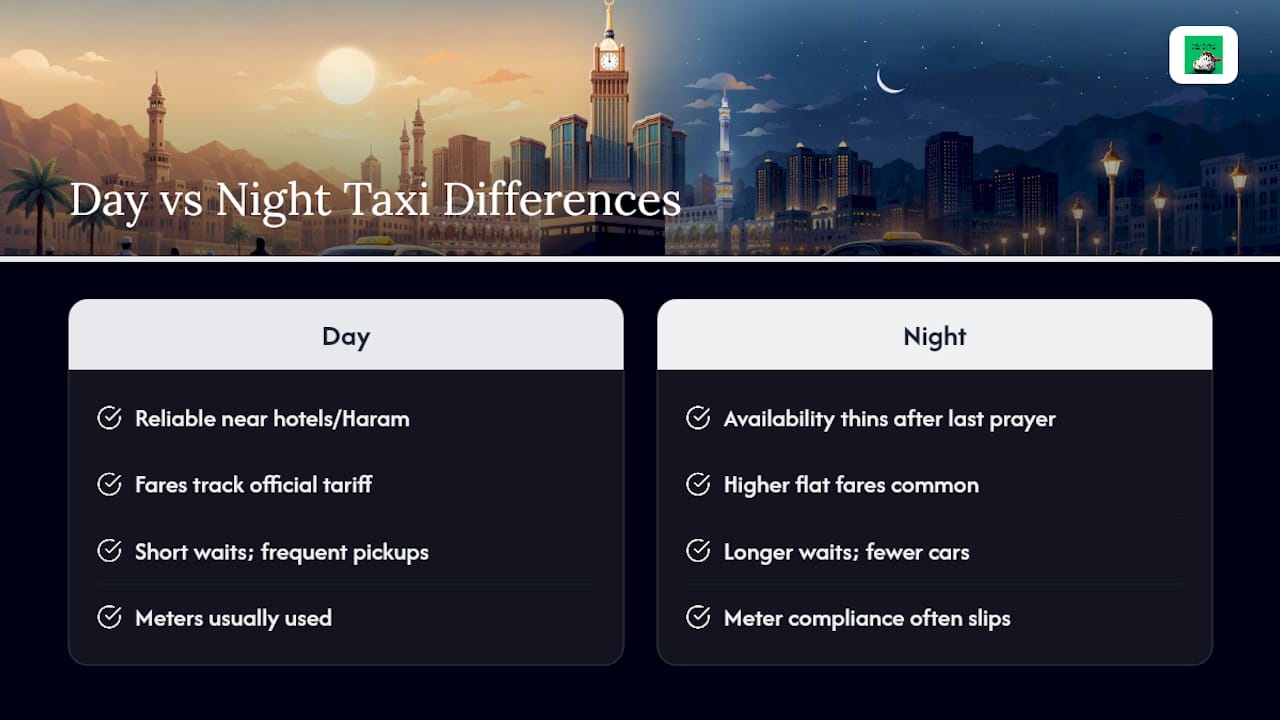
Daytime taxi availability around Mecca's main pilgrim zones is generally reliable, especially near hotels and the Haram perimeter, where drivers cycle through constantly picking up and dropping off. Fares during daylight hours track closest to the official tariff since competition among drivers keeps quotes reasonable.
Night rides tell a different story. Late-night availability thins out, particularly after the last prayer crowds disperse and outside the peak Umrah season. Fewer cars circulating means longer wait times and, in practice, a higher rate of drivers pushing flat fares instead of running the meter, since they know pilgrims have fewer alternatives at 2 a.m.
The hours immediately after Isha prayer and again before Fajr tend to see the heaviest demand spikes, since large crowds leave the mosque at roughly the same time. That's when meter compliance tends to slip the most and when app-based booking or a prebooked transfer pays off most clearly, because the price is already locked regardless of how thin the street supply gets.
If you're arriving at Jeddah Airport on a late-night flight, planning your Umrah-related travel carefully matters even more. Airport taxi queues at night can mean longer waits and less room to negotiate, which is exactly the scenario where a fixed-rate transfer booked in advance removes the guesswork entirely. Planning your pilgrimage taxi bookings ahead of a late arrival avoids the worst of this.
Are Mecca Taxis Regulated and Licensed?
Every legally operating taxi in Mecca falls under the Transport General Authority's licensing framework, which sets the tariff structure covered earlier and governs who can legally pick up paying passengers. Licensed vehicles carry visible plates and are required to run a functioning, calibrated meter for standard trips.
Ride-hailing apps operating in Saudi Arabia, including Uber and Careem, work within this same regulatory structure but layer their own upfront pricing on top of it. That's why an app fare and a street meter fare for the same trip can look different even though both are operating legally.
Unlicensed private drivers do operate informally around Mecca, especially near transit hubs and during Hajj crowding, offering rides without a meter or any regulatory oversight. These carry real risk: no fare protection, no accountability if a dispute arises, and no vehicle standards enforced. Sticking to licensed taxis, registered app rides, or a prebooked transfer service avoids this risk entirely, since each of those channels ties the driver and vehicle to a traceable, licensed record.
A Simple Rule for Budgeting Your Mecca Taxi Costs
The numbers above boil down to one habit: know the flagfall and per-kilometer math before you get in the car, and prebook anything involving the airport. Carry roughly 30 to 50 SAR in small notes for short trips, and lock in a fixed price ahead of time for longer journeys. Stick to licensed taxis or verified apps, and the fare surprises largely disappear.
— Fa
Book a Transfer Instead of Negotiating One
Skip the meter math and the curbside haggling entirely. Saudi Sayyah works as a prebooked alternative to street taxis and app estimates alike: you get a fixed rate confirmed before pickup, not a number that shifts with traffic, surge pricing, or a driver's mood near the Haram.
The service covers exactly the routes pilgrims ask about most: Jeddah Airport transfers, direct Haram pickups, hourly hire for multi-stop errands, and guided Ziarah tours to historical sites around Mecca and Medina. Every booking comes with the driver's photo, vehicle details, and real-time tracking sent to your phone before the trip starts, so you know who's picking you up and what car to look for. Payment runs through the platform's automated booking system, with support available if anything about your trip needs adjusting.
If you're planning arrival logistics from Jeddah, compare your airport transfer options first, then head to Saudi Sayyah's services page to check vehicle classes and lock in a fixed rate for your trip. For a longer stay, a look at available vehicle classes helps match group size and luggage to the right car before you book.
Sources
- السعودية تستحدث تسعيرة جديدة لأجرة “التاكسي”.. هذه تفاصيلها
- Taxi or Train from Jeddah Airport to Mecca? 2026 Comparison | UmrahOnTheGo